
Data-Driven Insights: Track Telecom Competitor Pricing Moves
Introduction: Why Tracking Telecom Pricing Moves Is a Competitive Imperative
In telecom, price wars rarely start with a press release. Competitors signal their pricing strategy months before it reaches your customers' inboxes — through product launches, quietly retired plans, tweaked data allowances, and buried lines in earnings calls. The operator that reads these signals first gets a head start; the one that waits for the official announcement is already reacting.
Consider the patterns: when a rival soft-launches a new unlimited plan in one region, it's often testing price elasticity before a national rollout. When it sunset a legacy package, it's nudging customers toward a higher-margin tier. When CFO commentary mentions "ARPU expansion initiatives," a price hike is usually already in motion.
To turn these observations into actionable intelligence, build a simple weekly signal-capture routine:
- Set up alerts for competitor product pages, press releases, and regulatory filings — tariff filings often precede public pricing.
- Track the full lifecycle — launch, promotion, price change, retirement — not just the headline price.
- Log context: timing, market, bundling, and channel, because price is only meaningful in context.
- Map each move to a strategic hypothesis, e.g., "testing willingness to pay" or "defending share in the SMB segment."
- Review monthly with your pricing and product teams to decide: match, counter-position, or hold.
This guide outlines a data-driven framework to do exactly that — systematically turning observable competitor actions into pricing intelligence you can act on with confidence, before the market shifts under you.
Reading Product Portfolio Expansions as Pricing Signals
Content libraries are the quietest pricing signals in telecom. When a rival drops a new mystery series, licensed blockbuster, or premium sports package, they're not just chasing subscribers—they're building the justification for a premium price point. Each exclusive becomes ammunition for holding or raising tier prices, because "you can't get this anywhere else" is the oldest pricing defense in the book.
But look closer at what they added. Catalog choices reveal segmentation strategy. A surge of family animation signals a household play—expect refreshed bundles and add-on pricing aimed at parents. Heavy licensed seasons? They're defending their flagship tier against churn. Mapping additions to audience segments lets you anticipate where bundling and add-on prices get refreshed before the press release.
Here's a real example captured by RivalSense:
Tet added the mystery series "The Watchful Eye," horror film "Hokum," and Season 11 of "Peppa Pig" to its Tet+ streaming platform.

This type of insight — a portfolio expansion that mixes thrillers and family content — reveals a dual pricing play: justifying premium tier pricing with exclusive mysteries while simultaneously preparing bundled offers for family households. RivalSense surfaces these content moves automatically, so your team can read the signal within hours instead of discovering it weeks later.
Build a systematic content watchlist so you react in hours, not weeks:
- Track launch calendars and press releases for every major competitor.
- Log additions in a spreadsheet or tool with fields: content type, license origin, genre, target segment, tier placement.
- Flag patterns—three family titles in a quarter is a strategy, not a coincidence.
- Run a pricing-impact analysis each time: Which of your tiers look weaker? Which bundles need refreshing?
- Set alerts so portfolio changes trigger an internal briefing within 48 hours.
The goal is to move from reactive catch-up to proactive positioning—reading their library as the pricing roadmap it really is.
Decoding Service Discontinuations: The Hidden Pricing Playbook
When a rival announces it's retiring a legacy service, the framing is always diplomatic—"licensing constraints," "no longer economically viable." Don't skim past it. That sentence is a public confession of margin pressure and a roadmap of resource reallocation. Discontinuations cluster in products that bleed cash, and the freed-up budget signals where your competitor intends to fight next. Track these announcements with the same rigor as price sheets.
The stated cutoff date is your competitive weapon. A "service ends December 31" timeline exposes contract cycles and migration windows. Use it to sequence your outreach: contact displaced customers 60–90 days before the cutoff, when they're actively comparing options and their incumbent has the least leverage to retain them.
Consider this RivalSense alert that landed in a subscriber's weekly report:
Tet announced it will discontinue its paid terrestrial TV service as of January 1, 2027, due to the expiration of its license and lack of participation in a new tender, with CEO Uldis Tatarčuks stating the service is no longer economically viable.

Service discontinuation insights like this are strategic gold. They tell you exactly when a rival will push a large customer segment to migrate — giving you a precise window to craft a switch-in campaign. RivalSense automatically flags end-of-life announcements, so you never miss a migration opportunity.
Treat every sunset as a customer-acquisition event. Displaced subscribers are pre-qualified buyers—they've already decided to move, they just haven't chosen you. Build a switch-in playbook:
- Set alerts for "end of life," "sunset," and "discontinued" announcements from key rivals
- Log every cutoff date and affected segment in a tracking sheet
- Price migration incentives (setup-fee waivers, first-year discounts, free data migration) against the customer's remaining contract value, not just acquisition cost
- Time follow-ups around their renewal cycle, not yours
Done right, your competitor's cost-cutting becomes your customer growth.
Connecting Financial Performance to Competitors' Pricing Power
A competitor's discount is never random — it's funded by something. Before reacting to a price cut, pull the latest earnings report and ask: where is this money coming from?
Read the profit centers. If a rival's core mobile business or a sister unit (e.g., enterprise, fiber, or content) is posting fat margins, they have headroom to subsidize aggressive consumer pricing or absorb losses for a quarter or two. Strong EBITDA from another division is effectively a war chest you can't see on a price list.
Map the cross-subsidization pattern. When profitable telecom arms quietly fund other ventures, they're telling you which segments are strategic priorities. A competitor bleeding cash in consumer broadband but pouring profits into 5G enterprise? That tells you where they'll fight hardest — and where they might retreat if you push.
A RivalSense insight recently exposed such a cross-subsidization dynamic:
Tet and Latvijas Mobilais Telefons SIA generated about €148 million in profit together, while airBaltic consumes their earnings.
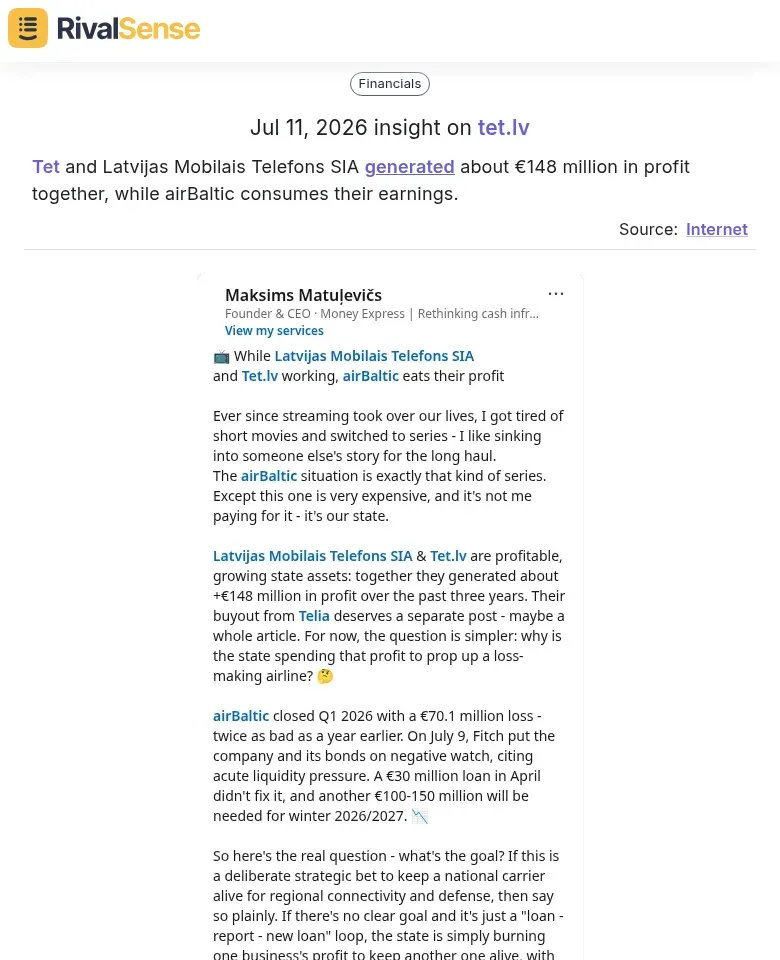
Financial interconnectivity insights like this help you gauge a competitor's true pricing headroom. If profitable telecom arms are propping up other group ventures, margins may be thinner than headline numbers suggest — limiting their ability to sustain a price war. RivalSense uncovers these links so you can recalibrate your pricing stance with data, not guesses.
Build a financial intelligence cadence:
- Add quarterly earnings calls and 10-Q/K filings to your tracking calendar — mark the dates for all key rivals.
- Track three metrics per competitor: EBITDA margin, free cash flow, and segment-level revenue/profit splits.
- Note management commentary on pricing, churn, and ARPU — the tone is often a leading indicator.
- Recalculate "discounting capacity" after every earnings release, not just annually.
The tell: a rival whose core margins are compressing while they still discount aggressively is burning cash. That's a price war that ends — and often ends with them, not you, capitulating. Financial data turns pricing moves from surprises into forecastable events.
Building Your Pricing Radar: A Practical Monitoring Framework
Passive awareness won't cut it in telecom, where price changes ripple through portfolios within days. You need a structured radar. Here's how to build one.
1. Automate your signal capture. Set up alerts across three source types so nothing slips through:
- Press releases: catch public price announcements, promotional launches, and enterprise plan revisions the moment they drop
- Product update pages: monitor feature changes, data caps, and add-on pricing shifts
- Financial filings: track earnings calls and 10-Ks for pricing commentary and margin-pressure signals
2. Build a signal-to-pricing matrix. Map each news type to its most likely pricing implication:
- New premium-tier launch → hold on your premium plans; watch for feature-based value erosion
- Discounted bundling campaign → churn risk in your mid-tier base; prepare retention offers
- CFO cites "ARPU pressure" → expect aggressive discounting; pre-empt with value messaging
- Legacy plan retirement → migration window opens; competitors will poach displaced customers
3. Run a three-tier cadence:
- Weekly: portfolio reviews — scan alerts, update pricing watchlists, flag urgent moves
- Monthly: service-lifecycle scans — audit plan changes, feature shifts, bundle reconfigurations
- Quarterly: financial deep-dives — analyze earnings, margins, and strategic commentary
Pro tip: assign an owner to each tier and keep a running pricing-move log. Six months of clean, dated data becomes your competitive pricing playbook — letting you predict moves instead of reacting to them.
Conclusion: Turning Competitor Intelligence Into Pricing Decisions
Stop reacting. Start positioning. Every telecom competitor signal—a portfolio launch, a quietly retired plan, a CFO hinting at margin pressure—is a data point, not a mandate to match prices. Your job is to translate each one into a concrete, testable pricing hypothesis for your own portfolio. Ask: "If this move is real, what does it mean for our highest-value segments?" Then design a small experiment—a pilot discount, a bundled tier, a revised contract term—and measure before you commit.
The most effective pricing teams treat competitor tracking as an ongoing data pipeline, not a one-off research project. Build a cadence: weekly signal capture, monthly hypothesis reviews, quarterly competitive narrative updates. Assign owners, keep a living signal log, and tie every finding to a decision it could actually change.
Finally, synthesize your three signal categories—portfolio, discontinuations, and financials—into a single competitive narrative. Portfolio moves show where rivals are investing; discontinuations reveal what they're quietly abandoning; financials expose the pressure behind the strategy. Read together, they tell leadership where the market is heading and where your pricing can lead.
Checklist before your next price change:
- One testable hypothesis per competitor signal
- An owner and review date for each
- A narrative connecting signals to strategy
- A defined rollback trigger if results disappoint
That's how intelligence becomes pricing decisions—and how you move from price-taker to price-setter.
Turn Telecom Competitor Signals Into Action — Automatically
Manually stitching together product launches, discontinuation dates, and financial filings is a full-time job. RivalSense does it for you. It monitors competitor websites, social media, registries, and press releases — then delivers all the relevant pricing signals in a weekly email report. So you can catch the content push, the legacy sunset, or the profit squeeze the moment it surfaces.
👉 Try RivalSense for free and get your first competitor report today.
📚 Read more
👉 Competitor Financials Cheat Sheet: Decoding M&A Signals to Stay Ahead
👉 Key Account Management vs Customer Success: 2026 Trend Shifts
👉 Biograph's Women's Health Shift Revealed a Blueprint for Member Growth
👉 Workflow Breakdown: Turning Internet Competitor Insights Into Pricing Power