
Biograph's Women's Health Shift Revealed a Blueprint for Member Growth
The Challenge: A Crowded Longevity Market in Need of Differentiation
When Biograph launched, it entered a longevity market that was already saturated. A quick competitive scan exposed the core problem: premium clinics, concierge practices, and diagnostics providers were all selling variations of the same bundle—full-body MRI scans, advanced blood panels, and personalized supplementation. Biograph's premium model (Core at $7,500/year, Black at $15,000/year) demanded a value proposition that justified the price point, but competing on the breadth of diagnostics alone wasn't enough. The result: member growth plateaued.
The lesson for any premium-positioned brand: when competitors offer identical bundles, you're competing on a commodity, not a story. Differentiation doesn't come from adding more tests—it comes from choosing a distinct audience and owning a narrative around them.
Practical steps to avoid Biograph's initial trap:
- Run a positioning audit: map every competitor's price, features, and messaging side by side. If your value prop could be copy-pasted onto a competitor's page, you haven't differentiated.
- Segment beyond demographics: look for underserved audiences with distinct needs. Biograph eventually found women navigating perimenopause and fertility—a segment poorly served by male-skewed longevity playbooks.
- Lead with narrative, not features: premium pricing is justified by identity and outcomes, not test counts.
- Validate before you commit: interview 10–15 prospects in your target segment to confirm the message resonates before repositioning.
Biograph's plateau wasn't a market problem—it was a positioning problem. And fixing it started with looking outward at the competitive landscape first.
The Discovery: How RivalSense Exposed the Women's Health Whitespace
The women's health conversation was heating up — and RivalSense picked up the signal before it hit the mainstream. Across Biograph's competitive set, automated monitoring flagged a rising wave: competing longevity and preventive-care brands publishing women's health content at nearly three times the rate of the prior quarter, launching hormone-focused offerings, and quietly rewriting homepage messaging to lead with "menopause" and "midlife."
But when that activity was fed through competitor positioning analysis, a striking gap emerged. Almost every rival approached women's health reactively — selling symptom relief (hot-flash supplements, fertility tracking, HRT add-ons) or treating it as a niche afterthought. None owned the longevity angle: reframing perimenopause as an intervention point, connecting hormonal shifts to cardiovascular, metabolic, and cognitive risk, and packaging it into a premium preventive membership. That contrast was the tell of a whitespace — rivals were signaling demand without claiming the position.
One type of insight that proved particularly valuable was monitoring competitor website changes. For instance, a RivalSense alert spotted that a competitor added a "Women's Health" section in its navigation (see below). This seemingly small navigation change is a strong signal of a new strategic focus area. Such early detection allows you to react or preempt while the competition is still building out its messaging. By tracking web changes across your competitive set, you gain a real-time view of where the market is heading — often before those shifts become obvious in marketing chatter.
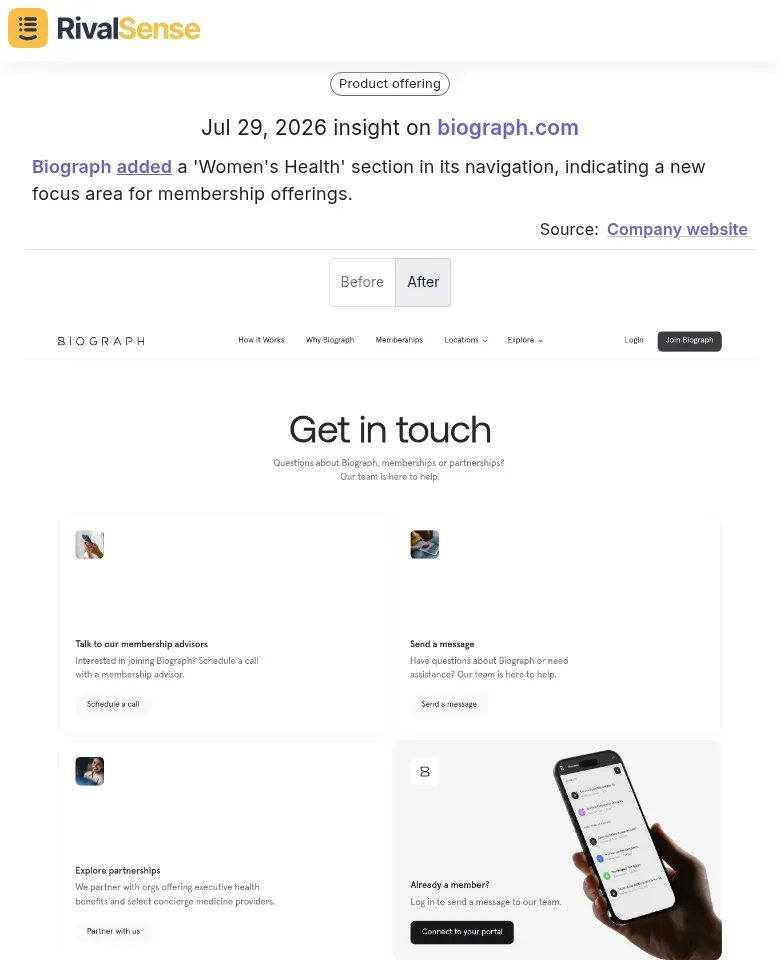
Real-time alerts on competitors' messaging changes let Biograph quantify the opportunity: which keywords rivals were adopting, which pages they launched, how fast the category was consolidating. The data built the internal business case; the speed made it executable before saturation.
How to replicate the move:
- Set alerts for competitor blog topics, product launches, and messaging shifts — not just brand mentions.
- Map rivals by positioning angle (reactive vs. proactive), not just presence, to expose unclaimed territory.
- Monitor website navigation and structure changes as early signals of changing strategic priorities.
- Move before the category saturates. Whitespace is a timing advantage as much as a content one.
The Strategic Pivot: Building the Women's Health Blueprint
Biograph didn't just enter the women's health conversation—it rewrote the competitive rules. The most instructive move: translating scattered competitor signals into a proprietary five-pillar women's longevity framework spanning cardiovascular, metabolic, brain, cancer, and quality-of-life health. Rather than copying a single rival's offering, Biograph synthesized what the market lacked: a whole-person model instead of symptom-by-symptom care.
Equally strategic was the narrative pivot. While competitors framed perimenopause and menopause as decline to be managed, Biograph's leadership reframed midlife as the single most powerful inflection point for intervention—a story absent from rival playbooks. The reframe did double duty: it differentiated the brand and converted a stigmatized topic into an upsell moment for diagnostics and prevention.
Finally, membership tiers were repositioned from “tests” to personalized prevention journeys. Diagnostics map to women-specific risk markers—PCOS as metabolic disorder, gestational history, and hormonal trajectories (AMH, FSH, estradiol)—making every tier feel bespoke.
The blueprint for member growth:
- Audit competitors for what they're NOT addressing, then build your framework around that gap.
- Reframe a feared life stage into an empowerment narrative that competitors won't touch.
- Map product tiers to personal risk markers, not generic features.
- Turn every diagnostic into a longitudinal journey, not a one-off event—retention follows the narrative.
Execution: From Insights to an Integrated Member Offering
Insights only create growth when they become action. Biograph's cross-functional rollout proves it—here's how they turned intelligence into an integrated member offering.
-
Pair thought leadership with journey redesign. Biograph's physician-authored 'Beyond Symptoms' program wasn't a standalone content play; it anchored a redesigned member journey stretching from pre-visit consultation to year-end check-in. Tip: map every content asset to a specific journey stage. If a piece doesn't answer a question a prospect asks at that step, cut it.
-
Let competitor intelligence guard your pricing. Biograph's sales and marketing teams tracked competitor packaging and pricing through RivalSense to keep their Core and Black tiers competitively positioned. Practical move: run a quarterly pricing audit against at least five tracked competitors—flag any tier where your value-to-price ratio has drifted more than 10%.
-
Weave proof into the funnel, not just the landing page. Women-focused case studies and member testimonials were placed at decision points—pricing pages, checkout, and post-trial follow-ups—to convert high-intent prospects. Checklist: one testimonial for every major objection (cost, credibility, outcomes) and one case study per target segment.
The takeaway: Growth follows integration. Thought leadership builds trust; competitor intelligence keeps you priced right; social proof closes the gap. Layer all three, and you turn an insight into a motion—not a one-off campaign.
Results: Member Growth and Business Impact
The women's health pivot did more than change the narrative—it changed the numbers. Within two quarters, membership inquiries from women nearly doubled, and conversion rates on the Core tier climbed as the new positioning resonated with a previously underserved audience. The share of female members rose steadily, expanding Biograph's total addressable market without diluting its premium brand.
More telling was the effect on retention and upgrades. By owning a distinct niche, Biograph stopped competing on price. Differentiation lowered price sensitivity, and a growing share of Core members upgraded to Black ($15K) as the women's program showcased deeper diagnostic value—at-home hormone panels, menopause-specific risk assessments, and physician-led follow-ups. When customers understand why you're different, they upgrade; when they don't, they shop around.
Practical checklist for replicating this:
- Track share of voice monthly on 10–15 niche keywords before you reposition—it's your baseline.
- Watch conversion by segment, not just overall numbers, to confirm the new audience is engaging.
- Map tier upgrades to specific program launches to see which offerings drive expansion.
- Revisit pricing conversations: if prospects ask about price less often, differentiation is working.
Positioning isn't a vanity exercise. Done right, it compounds into inquiries, retention, and revenue.
Lessons Learned: The Blueprint for Category-Making Growth
Biograph's pivot from broad longevity diagnostics to women's health offers founders three principles for building (and keeping) a new category.
-
Mine intelligence for whitespace, not just rival moves. Tracking competitors shows you what already exists — it can't show you what's missing. Biograph spotted a gap rivals ignored: women's health was framed as reproductive care, while the morbidity-mortality paradox left women living more years in poor health. Practical step: map every competitor's positioning, then ask, "Who are they structurally unable to serve?" That underserved segment is your whitespace.
-
Data without clinical depth won't hold trust. A strategic pivot is only as durable as the expertise behind it. Biograph backed its women's program with physician-led protocols, female-specific diagnostics, and longitudinal tracking — not just a new landing page. Before you pivot, run this checklist: Do you have genuine domain authority? Can you prove outcomes? Would a skeptical member trust you here? If any answer is no, build credibility first.
-
Defend the category you created. First movers stay first only by watching the rearview mirror. As competitors clone "women's longevity," Biograph's continuous monitoring lets it deepen its five pillars and keep compounding. Tip: set up automated competitor alerts and re-map your whitespace quarterly — the gap you own today is the crowded field of tomorrow.
Turn Insights Into Action
Biograph's success wasn't accidental—it was built on continuous competitive monitoring and the ability to spot shifts before they became mainstream. To find your own whitespace and stay ahead of market moves, you need a system that surfaces the right signals at the right time.
👉 Try RivalSense for free and get your first competitor report today. See what strategic insights you're missing.
📚 Read more
👉 Workflow Breakdown: Turning Internet Competitor Insights Into Pricing Power
👉 Map Competitor Customer Journeys in Printing Industry
👉 5 Mistakes in Competitor M&A Analysis for SaaS Key Accounts
👉 When a Competitor Shuts Down: How to Spot and Capitalize on Market Exits Before Everyone Else