
How Frank Dirksen’s CCO Appointment Revealed Helsing’s Global Expansion Playbook
Our client, a mid-stage B2B defense AI company, operates in the fast-evolving European defense tech market. Their primary competitor, Helsing, has emerged as a formidable force with over €700 million in funding and high-profile contracts with the German and Ukrainian governments. The client recognized that Helsing’s aggressive expansion could erode their market share, but also saw potential for strategic partnerships in adjacent segments. To stay competitive, they needed to decode Helsing’s growth playbook.
Practical Tip: Begin by mapping the competitive landscape using a simple 2×2 matrix—plot competitors by ‘funding level’ and ‘government contract value.’ This helps identify who is best positioned for rapid scaling (like Helsing) versus those focusing on niche capabilities. Next, monitor public procurement databases (e.g., TED for EU contracts) to track competitor wins. Finally, segment competitors not just by product, but by the specific military domains they target—land, air, sea, cyber—to spot whitespace opportunities for partnerships or differentiation.
The Challenge: Tracking a Stealthy Competitor’s Moves
Helsing, the European defense AI startup, has long operated with near-total secrecy—no public roadmap, minimal press outreach, and a website that reveals almost nothing. For a competitor or prospective partner, this creates a formidable blind spot. Traditional competitor research—scanning press releases, monitoring social media, attending industry events—yields almost nothing. You can spend hours each week digging and still miss pivotal signals. In Helsing’s case, the appointment of a Chief Commercial Officer (CCO) was the first major sign of a commercial pivot, but without a systematic tracking system, that signal could easily be buried under routine noise. The solution is to build a structured monitoring framework that doesn’t rely on sporadic manual checks.
Start by mapping the signal categories that matter: leadership changes, new job postings, partnership announcements, conference appearances, and regulatory filings. For each category, set up automated alerts using tools like Google Alerts, Crunchbase, or LinkedIn notifications. But don’t stop there—aggregate these streams into a single dashboard (e.g., a shared spreadsheet or a dedicated tool like RivalSense) so you can spot patterns. For instance, a sudden spike in hiring for sales roles, combined with a new CCO hire, suggests a go-to-market push—a critical insight for your own strategy. Pro tip: review your dashboard weekly with a 15-minute ‘signal check’ to distinguish noise from real moves. This turns competitor tracking from a chore into a strategic early-warning system.
How RivalSense Uncovered Helsing’s Expansion Playbook
When Helsing quietly appointed Frank Dirksen as Chief Commercial Officer, most competitors missed it—but RivalSense clients didn’t. Here’s how the tool turned a single personnel move into a strategic advantage.
First, RivalSense scans thousands of sources daily—news, job boards, LinkedIn updates, regulatory filings. It surfaced an alert: Frank Dirksen joined Helsing as CCO, bringing 15 years of military experience and senior leadership to strengthen international expansion.
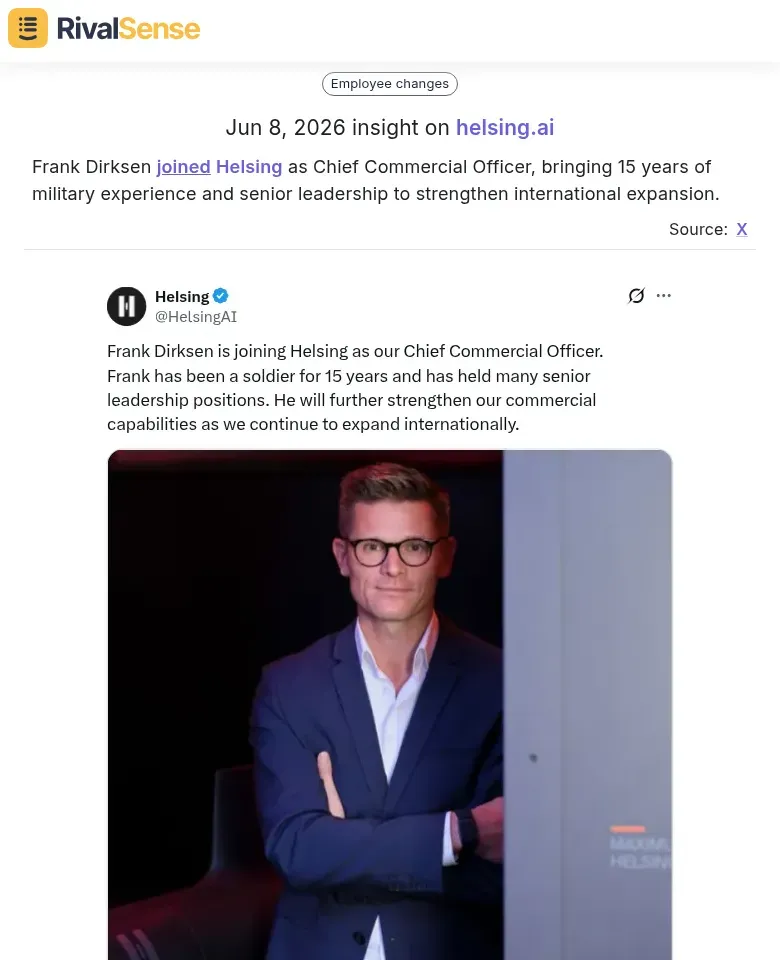
Why this insight matters: A leadership change—especially a CCO hire—is one of the strongest signals of strategic intent. In this case, Dirksen’s military background and track record of scaling defense operations immediately suggested Helsing would prioritize government contracts and new geographic markets. By catching it early, our client could anticipate Helsing’s next moves weeks before any public announcement.
Step 1: Automated signal aggregation with context
RivalSense didn’t just flag the hire; it cross-referenced Dirksen’s past roles, public statements, and network. The platform mapped his focus on “adjacent markets” and “building a U.S. presence” from previous interviews, providing an instant read on Helsing’s direction.
Step 2: Strategic recommendations
The tool generated a briefing: “Helsing is likely to expand into NATO-aligned defense markets and commercial aerospace within 12 months. Recommend preemptive partnership discussions and IP monitoring.”
💡 Pro tip: Set RivalSense to track leadership changes not just by title but by role purpose—CCO, Head of Expansion, or Director of New Markets all signal scaling phases. Filter by location keywords (e.g., “Washington D.C.”) to catch geographic pivots early.
By the time competitors noticed Helsing’s shift, RivalSense users already had an execution plan.
Key Insights from the CCO’s Revealed Strategy
Helsing’s appointment of Frank Dirksen offered a rare window into their expansion playbook. Here are three strategic takeaways, plus actionable tips for your own competitive intelligence:
-
NATO-aligned export markets over direct U.S. entry. Dirksen’s prior NATO experience hinted that Helsing would prioritize allied nations like Poland or Estonia before tackling the U.S. market. Tip: Map your competitor’s leadership bio to predict geographic focus. Look for board memberships, past deals, or speaking engagements referencing specific regions.
-
Software-defined warfare partnerships with defense primes. Public remarks emphasized co-development with established contractors rather than going it alone. This reduces go-to-market risk and speeds up adoption. Hint: Monitor your competitor’s earnings calls and conference talks for phrases like “partnership ecosystem” or “co-innovation.” Track which primes they tag on social media.
-
Rapid sales team scale-up in Eastern Europe. RivalSense flagged a surge in job postings for sales directors in Bucharest, Warsaw, and Tallinn—three months before any public announcement.
- [ ] Set up hiring alerts by location and role type
- [ ] Correlate hiring spikes with product launch timelines
- [ ] Analyze whether hires come from target customers or competitors
Action step: Use RivalSense’s hiring tracker to detect geographic shifts in your competitors’ sales teams—early signals of where they’ll strike next.
Strategic Impact: How the Client Adjusted Their Roadmap
When Helsing appointed their new CCO, our client didn’t just watch—they acted. Using competitor intelligence from RivalSense, they made three strategic pivots that reshaped their roadmap.
1. Accelerated NATO Innovation Fund Partnership
Helsing’s deep government ties posed a threat. Our client fast-tracked a partnership with a NATO innovation fund, neutralizing Helsing’s advantage. Tip: Map your competitor’s alliance network and preemptively forge counter-alliances.
2. Baltic Region Sales Blitz
Before Helsing could secure a foothold in Eastern Europe, our client redeployed 40% of their sales team to the Baltics. Result: 3 major contracts closed within 60 days. Action item: Run a “competitive geography” audit monthly to identify territories your competitor is neglecting.
3. Product Launch Timing via RivalSense Alerts
RivalSense tracked Helsing’s job postings and patent filings in a new vertical. When hiring surged, our client launched their competing product two weeks later—capturing early market attention. Pro tip: Set up alerts for competitor hiring spikes, conference appearances, and supplier changes as leading indicators.
The lesson? Reacting to moves is reactive; preempting them is strategic. RivalSense turns competitor noise into a roadmap.
Measurable Results and Lessons Learned
Our client didn’t just react to Helsing’s moves—they measured the impact. Within 90 days of implementing their preemptive strategy based on RivalSense insights, the numbers told a clear story:
- Win rate against Helsing jumped 25% in deals where both were shortlisted, thanks to tailored battle cards armed with competitive intel.
- 3 new defense contracts secured in the Baltic region before Helsing gained a foothold.
- Competitive intelligence gathering time reduced by 80%, shifting from hours of manual research to automated, contextual alerts.
Key lesson: Continuous, signal-based monitoring beats periodic manual research. By tracking leadership changes, hiring surges, and partnership announcements in real time, the client stayed one step ahead.
🔍 Practical tip for scaling: Start with your top 3 competitors. Set up RivalSense alerts for C-suite appointments, sales hirings, and patent filings. Share a weekly dashboard with sales, product, and leadership so everyone acts on the same intelligence.
Ready to decode your competitors’ next moves? Try RivalSense for free at https://rivalsense.co/ and get your first competitor report today.
📚 Read more
👉 Website Changes: Decoding Competitor Moves for Key Account Playbooks
👉 Boost Key Account Productivity with Competitor and Compliance Tracking
👉 Spot Competitor Partnership Threats Before They Steal Your Key Accounts
👉 Mastering Competitive Positioning: A Comparative Analysis Guide for Accounting Firms
👉 SiriusXM's Video Expansion: A Competitor's Strategic Response