
From Reactive to Predictive: A KAM Playbook for Med Equipment CEOs
In the medical equipment sector, key account management (KAM) often suffers from a reactive approach: teams scramble to address expiring contracts, equipment downtime, or sudden competitive threats. This firefighting mode leaves revenue and retention on the table. The shift to predictive account management leverages historical data—purchase patterns, service records, and usage analytics—to anticipate customer needs before they arise. For example, predictive models can flag accounts at risk of churn by analyzing declining engagement or delayed renewals, enabling preemptive outreach.
Practical steps to get started:
- Centralize data from CRM, service logs, and IoT sensors into a single analytics platform.
- Identify leading indicators (e.g., drop in support ticket volume or training attendance) that precede churn or upsell opportunities.
- Segment accounts by predictive scores (e.g., high-growth, at-risk, stable) and tailor actions accordingly.
- Automate alerts for trigger events (e.g., equipment nearing end-of-life) to prompt proactive engagement.
By moving from reactive to predictive, med equipment firms unlock revenue growth through timely upgrades and cross-sells, while boosting retention by addressing issues before they escalate. Start small with one high-value account cohort, measure the impact, then scale.
Tip: Use a simple 0-100 churn risk score for each account and review weekly with your KAM team to prioritize interventions.
Data Sources and Integration for Predictive KAM
To power predictive KAM for medical equipment, start by unifying three internal data sources: CRM (usage patterns, contract renewals), IoT sensor data (machine uptime, failure alerts), and service logs (repair history, parts replaced). Tip: Use a data lake to store raw IoT telemetry and structured CRM records separately before joining. Next, layer in external market data—regulatory filings (FDA 510(k) clearances), competitor product launches, pricing shifts, and hospital budget cycles.
Checklist:
- ☐ Map all data schemas
- ☐ Establish ETL jobs for nightly ingestion
- ☐ Implement API connectors for real-time feeds
Why Competitor Intelligence Feeds Predictive Edge
External signals—especially competitive moves—dramatically sharpen your predictions. A sudden competitor price hike may signal a perfect moment to capture their dissatisfied customers. A new feature launch can indicate shifting market demands before you see them in your own data. Tools that automatically monitor competitors’ websites, social channels, and public registries turn this intelligence into a steady data stream.
For example, RivalSense detected that a printing service provider, UPrinting, increased its default tape length from 100 ft. to 300 ft. and the printing cost from $28.86 to $49.13. 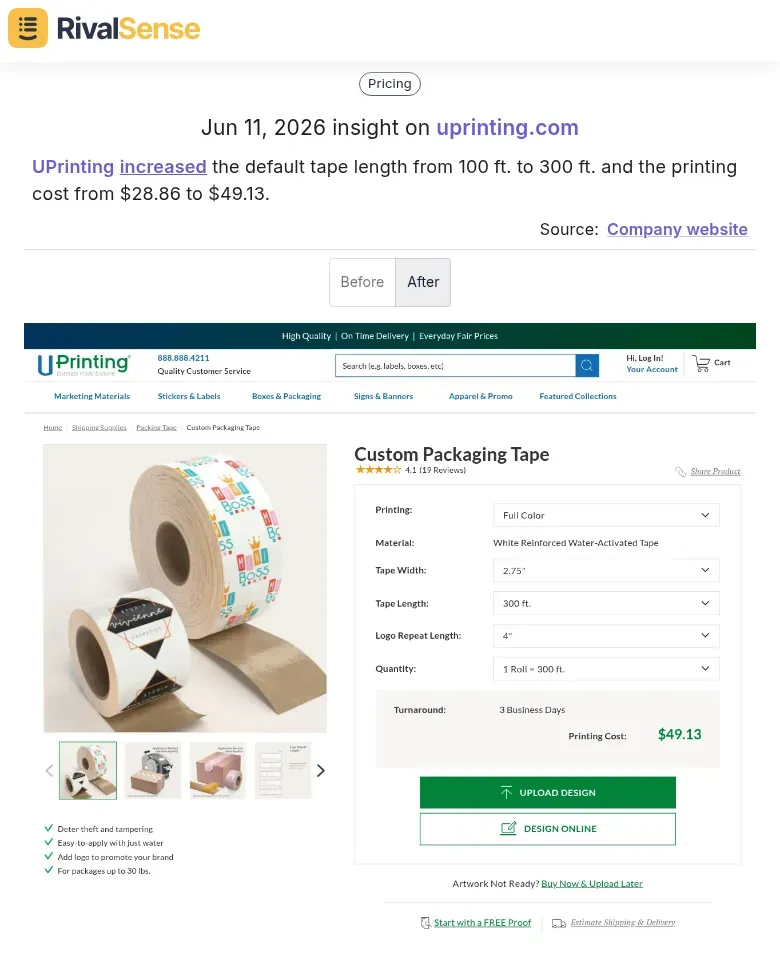
Why this matters: When a competitor alters its pricing structure, your KAM team can immediately assess which of your accounts might be affected and reach out with a lock-in offer, using the price delta as a compelling reason. This turns a reactive scramble into a proactive retention play.
Similarly, consider product innovation signals. Sierra’s Agent Studio recently launched Agent Traces for real-time debugging, Expert Answers for auto-drafting knowledge articles, and expanded integrations with 40+ pre-built options. 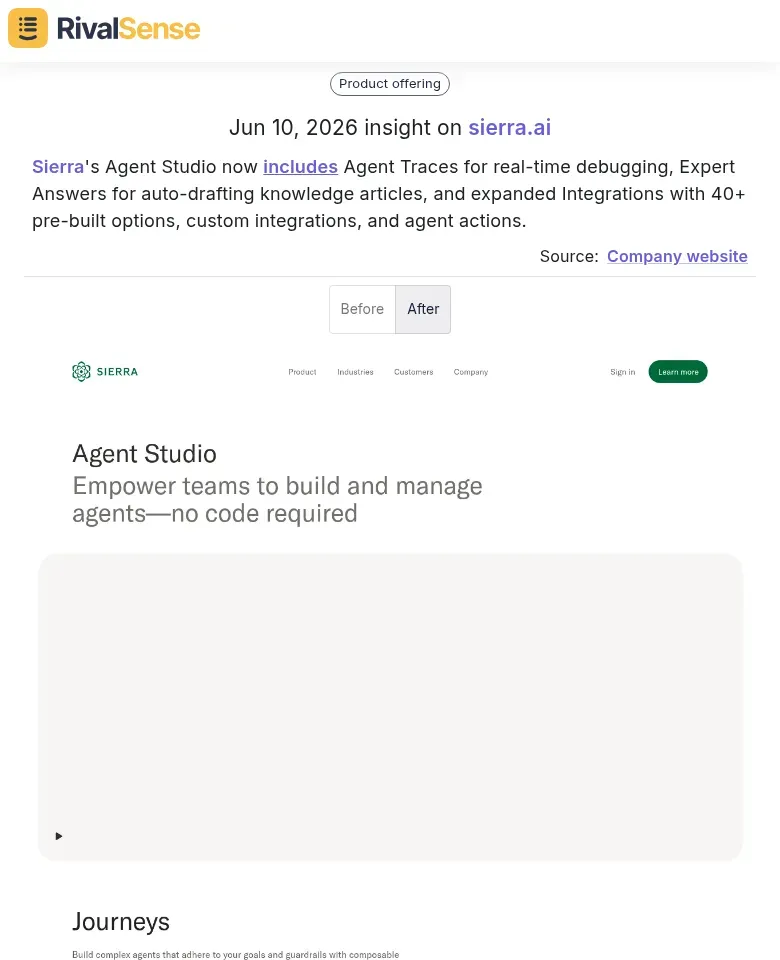
Why this matters: Such a feature expansion tells you the competitor is investing heavily in automation and self‑service. Your predictive models can incorporate this intelligence to flag accounts that are tech-forward or whose support tickets suggest they might be evaluating alternatives—your team can then proactively offer similar or superior capabilities before the competitor gains a foothold.
Lastly, shifts in thought leadership can be early indicators of a competitor’s strategic direction. Aura released new research on how autoplay, scrolling, and AI-driven content reshape childhood, and launched a quiz to match children’s app usage with offline summer activities. 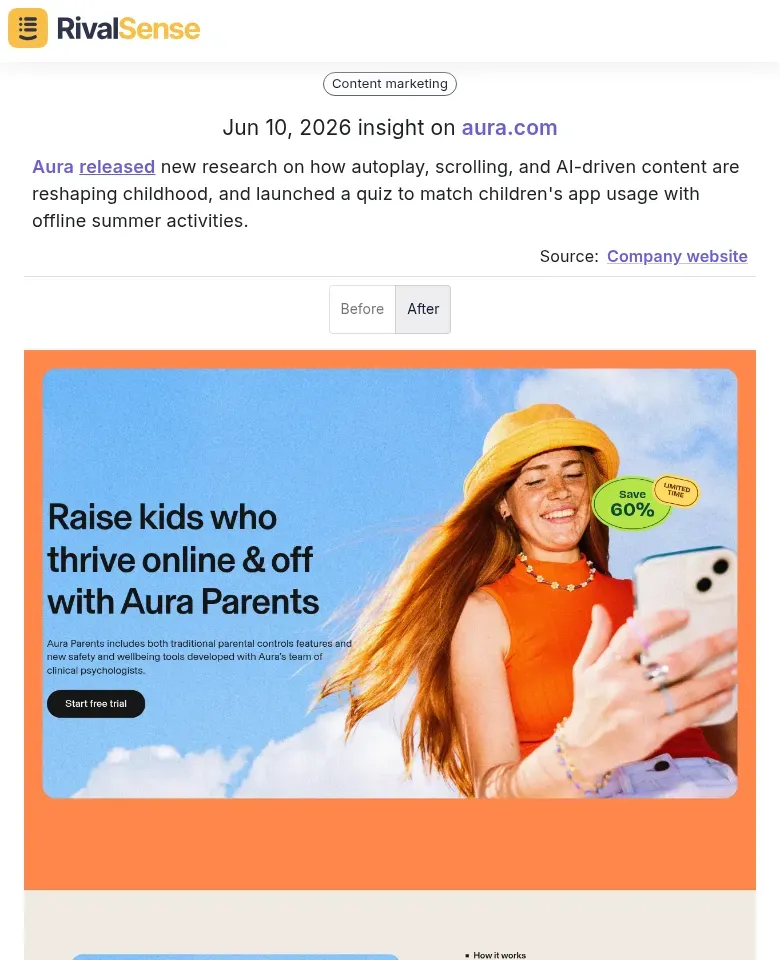
Why this matters: When a competitor publishes original research, it often telegraphs the narrative they will use in upcoming sales conversations. Integrating such signals into your account health models helps you prepare counter‑messaging and content, ensuring your KAM team is never caught off guard.
Build a unified pipeline using tools like Apache Kafka for streaming IoT data and dbt for transforming CRM+service logs into feature tables. Practical step: Start with a single high-value account to prove the model; integrate only the top 3 internal data sources plus one external feed—competitor pricing changes, for instance. For real-time predictions, deploy a lightweight ML model (e.g., gradient boosting) on the pipeline output, retraining weekly as new service logs, sensor data, and competitive intelligence arrive. Finally, set alerts—when IoT predicts a failure within 7 days and CRM shows the contract is up for renewal, trigger a proactive account visit.
Predictive Models to Forecast Account Health and Churn
To prevent churn and drive growth, build predictive models that score account health and flag risks. Start by identifying early warning signals—ranging from usage dips to competitor engagement—so your team can act before formal renewal discussions begin.
Early Warning Signals
- Usage dips: logins, feature adoption, session frequency
- Support ticket spikes: escalation rates, unresolved tickets
- Contract changes: downgrades, paused renewals
- Negative sentiment: NPS drops, CSAT scores
- Competitor activity: increase in competitor-related mentions in support tickets or sales notes
Machine Learning for Opportunities
Train models on historical data to flag accounts likely to accept upsells or cross-sells. Key features: product usage breadth, past purchase patterns, support engagement, and expansion velocity. A simple random forest classifier can yield 80%+ accuracy.
Account Health Scoring
Combine three pillars into a single score (0–100):
- Engagement (40%): login frequency, feature usage
- Satisfaction (30%): NPS, survey responses, ticket sentiment
- Financial (30%): contract value, payment history, renewal probability
Practical Steps
- Collect historical data on churned vs. retained accounts.
- Engineer features: rolling averages of usage, ticket volume, sentiment scores, plus frequency of competitor mentions.
- Train a classification model (e.g., XGBoost) to predict churn probability.
- Set thresholds: >70% probability = high risk; 40–70% = medium; <40% = low.
- Automate alerts to CSMs when score drops 15+ points in a month.
Pro Tip: Use a weighted average of engagement, satisfaction, and financial metrics. Update weekly and trigger automated playbooks for high-risk accounts.
Actionable Strategies from Predictive Insights
Predictive insights are only as valuable as the actions they drive. Here’s how med equipment leaders turn early warnings—both internal and competitive—into revenue protection and growth.
1. Proactive Outreach for At-Risk Accounts
- Step 1: Set up alerts for declining usage, support ticket spikes, or competitor mentions (e.g., a customer asking about a competitor’s new feature).
- Step 2: Within 48 hours, deploy a cross-functional care team (sales + support) with a pre-defined script: “We noticed X. Here’s a free training refresher / extended warranty.”
- Tip: Use a tiered response – high-risk accounts get a VP-level call; medium-risk get email + webinar invite.
2. Tailored Renewals & Pricing
- Checklist for each renewal:
☐ Predicted CLV (customer lifetime value)
☐ Likelihood to churn (high/med/low)
☐ Recent product feature adoption
☐ Competitive pricing intelligence (e.g., competitor just raised prices by 15%) - Strategy: For high-value, high-churn accounts → offer a 2-year fixed price lock. For low-risk expansion accounts → upsell with a usage-based premium tier.
- Example: One distributor increased renewal rates by 18% by bundling spare parts discounts into predicted high-value contracts after learning a competitor had cut its service coverage.
3. Align Internal Teams Around Alerts
- Playbook: Create Slack channels for each predictive alert type (e.g., #churn-risk, #upsell-opportunity, #competitor-alert). Sales, support, and product have predefined actions:
- Sales: Schedule quarterly business review
- Support: Proactive check-in call
- Product: Feature demo tailored to past usage
- Marketing: Push content that counters a competitor’s latest research
- Hint: Run a weekly 15-minute stand‑up to review top-5 alerts and assign owners.
By embedding predictive signals—fueled by both internal data and external competitor tracking—into daily workflows, med equipment firms shift from reactive firefighting to strategic account stewardship.
Case Studies: Predictive KAM in Med Equipment Companies
Case 1: Reducing Churn by 30% with IoT Usage Patterns
A ventilator manufacturer integrated IoT sensors to track daily usage hours, maintenance logs, and error codes. By feeding this data into a predictive model, they identified hospitals likely to switch vendors—those with declining usage or rising service tickets. Proactive outreach (e.g., offering free recalibration) cut churn by 30%.
Tip: Start with one high-value product line to validate your model before scaling.
Case 2: Increasing Upsell Revenue by 20% with Predictive Lead Scoring
A diagnostic imaging company scored its 500+ accounts using firmographics, purchase history, and support ticket sentiment. When a key competitor launched a new AI module, the company immediately enriched its scoring with that signal. Accounts flagged as “expansion-ready” received tailored upsell offers for service contracts and upgrades. Result: 20% revenue uplift in six months.
Checklist for Scoring:
- ✅ Historical purchase patterns
- ✅ Support ticket volume & sentiment
- ✅ Contract renewal dates
- ✅ Equipment age & usage trends
- ✅ Competitive moves (pricing, product launches)
Lessons Learned in Regulated Environments
- Data privacy comes first: Ensure IoT data complies with HIPAA/GDPR; anonymize patient-related metrics.
- Validation is non-negotiable: Test predictions against historical outcomes to avoid compliance risks.
- Involve compliance early: Partner with legal to design models that pass audits.
Step-by-Step Implementation:
- Step 1: Audit data sources for regulatory compliance.
- Step 2: Build a small pilot with 10–20 accounts.
- Step 3: Train sales teams on interpreting model outputs—including competitive intelligence flags.
- Step 4: Iterate based on feedback and accuracy metrics.
Conclusion: Building a Predictive KAM Roadmap
To build a predictive KAM roadmap, start with a pilot: integrate your CRM, support tickets, and public data sources (e.g., news, earnings calls, competitor updates) into a unified dataset. Train initial models on historical account outcomes—churn, expansion, satisfaction—to predict future behavior. Iterate: refine features based on model accuracy and user feedback. Use a low-code ML platform (e.g., DataRobot, H2O) to speed this up.
Measure ROI with three metrics: (1) account retention rate—did predicted at-risk accounts receive intervention? (2) revenue growth—are expansion opportunities flagged by models turning into upsells? (3) efficiency—time saved per account manager through automated alerts and prioritization. Aim for a 10% lift in retention and 15% more cross-sell conversions within 6 months.
Future trends: AI-driven account planning will auto-generate engagement strategies (e.g., send content on competitor weakness). Autonomous KAM actions—like auto-emailing a POC after product failure—will handle routine tasks. Start small, but design your roadmap for these capabilities. The winners will be those who treat prediction as a continuous loop: predict → act → measure → retrain.
Turn Competitor Signals into Your Next Move
The insights above show that external signals—from pricing tweaks to research campaigns—can be as powerful as internal usage data when building predictive KAM systems. Manually monitoring competitors is a time sink, but missing a critical shift can cost you accounts. RivalSense automatically tracks competitor product launches, pricing updates, event participation, partnerships, regulatory changes, management moves, and media mentions across websites, social media, and registries. All of it lands in a weekly email report, ready to feed your predictive models and playbooks.
👉 Try RivalSense for free and get your first competitor report today at https://rivalsense.co/.
📚 Read more
👉 How Frank Dirksen’s CCO Appointment Revealed Helsing’s Global Expansion Playbook
👉 Website Changes: Decoding Competitor Moves for Key Account Playbooks
👉 Boost Key Account Productivity with Competitor and Compliance Tracking
👉 Spot Competitor Partnership Threats Before They Steal Your Key Accounts
👉 Mastering Competitive Positioning: A Comparative Analysis Guide for Accounting Firms