
How to Turn a Competitor’s Feature Tease into Your Next Win
Even a small product update in your market can reshape buyer expectations — if you spot it early. For developer tool companies, a new debugger or build integration can be the difference between churn and loyalty.
Here’s a real-world competitor signal we caught this week:
Zed’s Haskell extension is getting a debugger, HLS settings, and run/build/test runnables, according to Jens Krause.
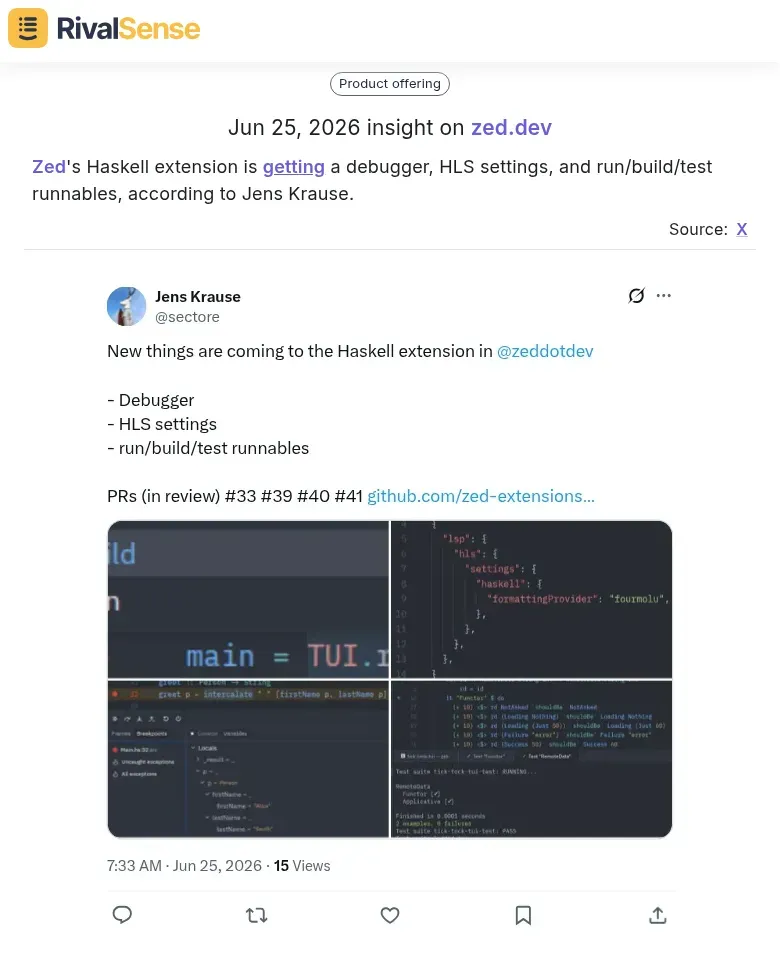
This isn’t just tech news — it’s a competitive move that touches three key battlefields:
- Developer experience – Debugger & runnables lower the barrier to adopt Zed for Haskell projects.
- Ecosystem alignment – HLS (Haskell Language Server) settings mean they’re syncing with the broader toolchain many enterprises already use.
- Enterprise readiness – Build/test runnables indicate Zed is targeting teams that need repeatable workflows, not just solo coders.
🔍 How to break down a similar signal
When you spot an update like this, don’t just note it — map it to your own accounts and roadmap:
✅ Check your deal pipeline: Are any prospects evaluating your tool primarily for Haskell support? Reach out with a tailored comparison before Zed’s update goes live.
✅ Audit key account health: Which of your current accounts run Haskell workloads? A competitor adding their missing piece is a retention risk — schedule a proactive health check.
✅ Inform your product team: Share the signal with a 1‑page brief: what changed, why it matters, and whether it’s worth accelerating your own comparable capability or building a partnership instead.
✅ Look for partnership opportunities: If Zed’s extension relies on open‑source HLS, is there a way for your tool to integrate even deeper and build a co‑marketing angle?
📋 Quick‑action checklist
- [ ] Tag the competitor update in your CRM / CI tool
- [ ] Identify 3 accounts that could be affected
- [ ] Draft a “Why [Your Product] + Haskell” one‑pager for account managers
- [ ] Organize a 15‑min stand‑up with product & sales to decide on a response
Competitor intelligence doesn’t have to be heavy. The trick is turning a single tweet or commit message into a concrete action before your next QBR.
Need a steady feed of signals like this without scouring forums and GitHub every day? Try RivalSense for free — it tracks product updates, pricing changes, partnerships, and more from company websites, social media, and registries, then delivers them in a regular email. Get your first report today and spot the moves that matter.
📚 Read more
👉 Key Account Tracking Cost: How to Measure, Monitor, and Protect Margins
👉 Trend Analysis: Competitor Matrix Benefits in Pharma Logistics
👉 Struggling to Win Key Accounts? Twitter Reveals Competitor Intel