
From 'Learn to Code' to 'Game Engines': How GitHub's Collection Shuffle Reveals Strategic Prioritization
Keeping a pulse on how competitors adjust their product ecosystem is one of the most underleveraged intelligence practices. Even subtle changes—like which showcase collections a platform chooses to promote or retire—can expose evolving audience bets, partnership priorities, and internal resource reallocation.
Let's break down a real-world example. Recently, GitHub made a simultaneous content curation move: it introduced a 'Game Engines' collection and a 'GitHub Copilot SDK Reddit Contest Winners' collection, while quietly removing its 'Made in Brazil' and 'Learn to Code' collections. At first glance, this looks like a routine editorial cleanup. But for a competitor analyst, it's a signal-rich event.
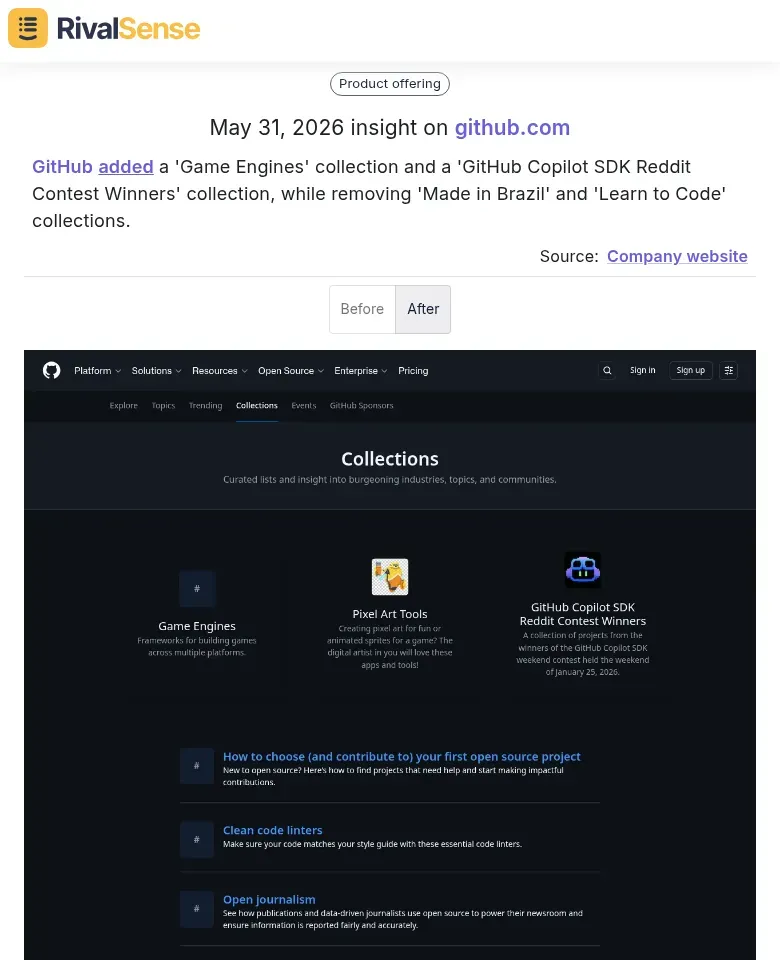
Why These Additions and Removals Matter Strategically
GitHub doesn't promote collections randomly—they reflect what the platform wants to amplify to millions of developers. By examining these moves together, we can piece together a clearer picture of where GitHub is placing future bets.
📈 Signal #1: Doubling Down on the Creator Economy & Game Development
The 'Game Engines' collection suggests increased strategic focus on indie developers and creator-centric tooling. Game development is a high-growth, high-engagement vertical, and showcasing engines on GitHub can:
- Attract a new generation of developers who build games as a hobby or side project.
- Compete indirectly with platforms like Unity Asset Store or itch.io by becoming the go-to code repository for game projects.
- Increase platform stickiness by encouraging long-term project hosting and collaboration.
🤖 Signal #2: Cementing Copilot as a Community-Driven Ecosystem
By highlighting 'GitHub Copilot SDK Reddit Contest Winners', GitHub is not just celebrating a contest—it's normalizing the idea of an SDK built around Copilot. This points toward:
- Encouraging third-party extensions and integrations around AI-powered coding.
- Fostering a developer community that contributes to Copilot's capabilities.
- Positioning Copilot less as a single tool and more as a platform with an extensible product surface.
🗑️ Signal #3: Phasing Out Initiatives That Don't Align with Senior/Professional Developer Personas
Removing 'Learn to Code' may initially seem counterintuitive, but consider the context of the other moves. GitHub likely no longer needs a standalone “learn to code” collection because:
- The platform is shifting focus toward advanced workflows, AI-assisted development, and professional toolchains.
- Educational resources might be migrating into more integrated experiences (like GitHub Codespaces tutorials or Copilot inline learning).
- The target audience is evolving from absolute beginners to intermediate/senior developers building production-grade systems.
Similarly, 'Made in Brazil' disappearing could indicate deprecation of geo-specific, non-technical thematic collections in favor of globally relevant, skill-based curation. It's a possible signal that GitHub is streamlining its community visibility toward product-centric rather than identity-centric showcases.
Actionable Takeaways for Your Own Competitor Intelligence Practice
You can replicate this type of analysis without an army of analysts. The key is systematic observation and pattern recognition. Start by building your own monitoring checklist.
✅ Competitor Product Update Monitoring Checklist
- [ ] Track changes to curated collections, showcases, or galleries on competitor sites (additions, removals, reordering).
- [ ] Monitor new or depreciated product categories in documentation, pricing pages, or developer portals.
- [ ] Watch for contest themes or hackathon announcements—these often preview upcoming API/SDK priorities.
- [ ] Note the language used in new landing pages or rebranded features (who are they targeting now?).
- [ ] Correlate collection/content changes with recent executive hires, acquisitions, or funding rounds.
📊 How to Interpret Signals at a Glance
| Observed Change | Possible Strategic Intent | Urgency Level |
|---|---|---|
| New topical collection (e.g., Game Engines) | Entering or expanding in a specific market vertical | 🔴 High |
| Platform SDK contest | Building an ecosystem moat; moving toward platform play | 🟠 Medium-High |
| Removal of beginner/niche collections | Audience maturation; resource reallocation | 🟡 Medium |
| Deprecation of regional collections | Shift from identity-based to capability-based engagement | 🟢 Low-Medium |
From Manual Tracking to Automated Intelligence
Manually refreshing competitor pages and correlating changes can become a full-time job. That's where purpose-built tools fill the gap. For example, RivalSense ingests signals just like this—product launches, feature updates, pricing shifts, management moves, and curated collection changes—from company websites, social media, registries, and the open web, then structures them into regular email reports.
If you'd spotted GitHub's 'Game Engines' collection through a RivalSense monitor, you could have triggered a timely strategic discussion long before the collection gained wider traction.
Don't let competitor signals slip through the cracks. Try RivalSense for free today and get your first intelligence report without delay.
📚 Read more
👉 How to Track Key Account Team Members for Competitive Intelligence
👉 How to Track Key Account Team Members on Influencer Platforms [Checklist]
👉 How to Spot Competitor Sourcing Pivots (Hint: Bvlgari's Raffia Secret)