
5 Key Account Management Mistakes IoT Firms Must Avoid
Introduction: Why Account Management Is the Make-or-Break Factor for IoT Firms
In the fast-paced world of IoT, success isn’t just about landing new clients—it’s about keeping them and growing their value over time. Yet too many IoT firms focus heavily on acquisition while neglecting the strategic discipline of account management. The result? High churn, missed upsell opportunities, and weakened market position.
Why does account management matter so much for IoT companies? Because IoT contracts often involve long-term commitments, complex integrations, and recurring revenue streams. Losing a key account can mean losing months of revenue and tarnishing your reputation in a tight-knit industry. In fact, studies show that increasing customer retention by just 5% can boost profits by 25% to 95%.
Common pitfalls include failing to monitor customer health metrics, treating all accounts equally rather than segmenting them, and reacting to issues only when the client threatens to leave. To avoid these, implement a proactive account review cadence: check in with your top 20% of accounts bi-weekly, use NPS surveys quarterly, and track usage trends weekly.
One overlooked lever is competitive intelligence. By monitoring your rivals’ moves—new features, pricing changes, or case studies—you can anticipate potential threats to your accounts and strengthen relationships before competitors poach your clients. With over 200+ data sources, RivalSense helps you stay ahead of competitor activity, so you can protect and expand your most valuable relationships.
Mistake #1: Ignoring the Value of Cross-Industry Leadership Talent
Many IoT firms fall into the trap of hiring exclusively from within the tech sector, missing the innovation that cross-industry leaders bring. Leaders from adjacent industries—like automotive, healthcare, or logistics—offer fresh perspectives on customer success and can identify pain points that incumbents overlook.
Practical Steps to Avoid This Mistake:
- Cast a wider net: When hiring for account management leadership, actively seek candidates from industries where IoT creates value (e.g., manufacturing, energy).
- Look for transferable skills: Prioritize experience in managing complex B2B relationships, subscription models, or consultative sales over pure IoT background.
- Use cross-industry interviews: Ask candidates how they’ve adapted strategies from one industry to solve problems in another.
Checklist for Leadership Hiring:
- [ ] Does the candidate have experience outside IoT/tech?
- [ ] Can they articulate how cross-domain trends apply to IoT?
- [ ] Do they bring a network of potential partners or clients?
Diversifying leadership backgrounds accelerates innovation in account management—don’t limit your talent pool to the same old sources.
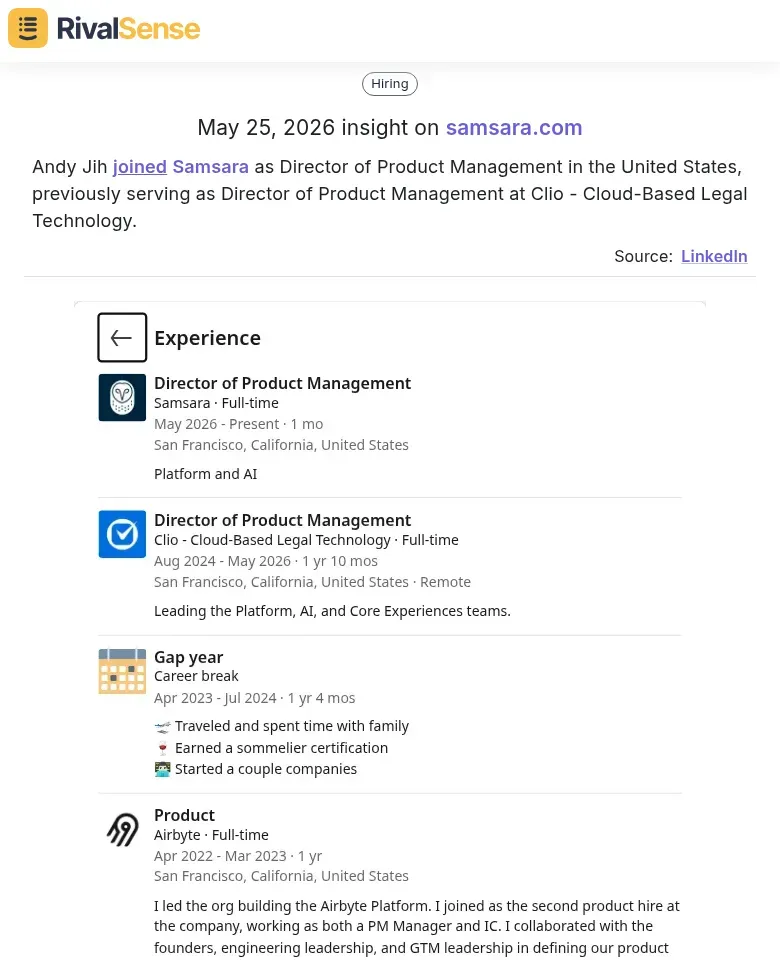
Competitive talent insight: Andy Jih joined Samsara as Director of Product Management, moving from Clio—a legal tech firm. Tracking such cross‑industry hires reveals where competitors are strengthening their teams and which capabilities they’re prioritizing. This intelligence helps you adjust your own hiring strategy and anticipate the skills your rivals will soon deploy against your accounts.
Mistake #2: Overlooking Operational ROI in Product Roadmaps
Key accounts in IoT don’t buy features—they buy outcomes. Fuel efficiency, maintenance automation, and downtime reduction are what keep them loyal. Yet many firms pack roadmaps with flashy tech that ignores these operational pain points, weakening account stickiness.
How to fix it:
- Map features to KPIs. Before building, ask: “Does this feature directly reduce fuel spend or automate a manual check?” If not, deprioritize it.
- Create continuous feedback loops. Schedule quarterly business reviews with top accounts. Use a simple scorecard (1–5) for each feature’s perceived operational impact. Track how scores shift over releases.
- Run ROI pilots. For major upgrades, test with 2–3 key accounts. Measure before/after metrics—e.g., hours saved per week, % reduction in unplanned maintenance. Share results publicly to build trust.
Practical checklist for your next roadmap review:
- ✅ Every major feature ties to at least one operational KPI (e.g., fuel efficiency, uptime).
- ✅ At least 30% of roadmap items originate from key account feedback.
- ✅ You have a documented process to calculate and communicate ROI per feature.
Aligning product evolution with real-world ROI transforms vendors into strategic partners—and that’s what makes accounts stick.

Competitive product insight: Samsara launched features to optimize fuel efficiency and automate maintenance. Monitoring such operational‑ROI moves alerts you to threats and gaps in your own offering. Use this intelligence to prioritize features that directly impact your key accounts’ bottom line, not just the tech spec sheet.
Mistake #3: Underinvesting in Community and Network-Building for Key Clients
Too many IoT firms treat key accounts as isolated revenue streams, neglecting the power of community. The fix? Shift from transactional to relational by investing in network-building.
Practical Steps:
- Host Industry-Specific Networking Events: Organize quarterly meetups or roundtables where your key clients can connect with peers. Focus on shared challenges (e.g., data security in IoT, scaling device fleets) rather than pitching your product. This positions your firm as a hub for industry collaboration.
- Create Peer-to-Peer Learning Opportunities: Launch a private LinkedIn group or Slack channel exclusively for your top accounts. Encourage members to share wins, ask questions, and offer advice. For example, facilitate a “case study swap” where two clients present how they solved a similar problem—your role is to moderate, not sell.
- Schedule Regular Non-Sales Touchpoints: Plan monthly happy hours or quarterly workshops on topics like “Negotiating IoT Contracts with Enterprise Buyers.” Keep these informal and interactive. The goal: humanize your team and deepen trust.
Checklist for Success:
- [ ] Assign a community manager for key accounts.
- [ ] Survey clients on preferred event formats.
- [ ] Track engagement (attendance, NPS) not just revenue.
By fostering a genuine community, you transform clients into advocates who stay longer and buy more.
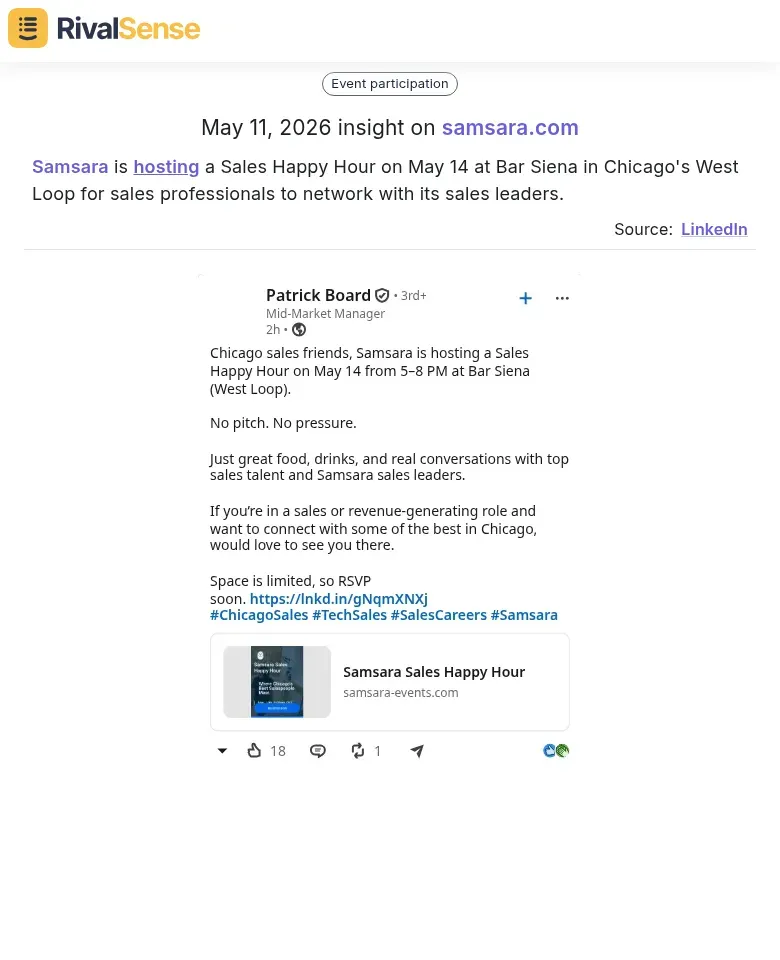
Competitive event insight: Samsara hosted a Sales Happy Hour in Chicago for networking. When competitors invest in relationship‑building events, they’re creating stickiness that can erode your own accounts. Proactively monitoring such gatherings lets you design counter‑programming before your clients feel that personal pull elsewhere.
Mistake #4: Treating All Accounts the Same Instead of Segmenting by Strategic Value
When every customer gets the same playbook, your highest-value accounts feel neglected while low-revenue clients drain resources. Smart segmentation prevents this. Start by categorizing accounts using three dimensions: revenue (current MRR/contract value), growth potential (expansion opportunities, wallet share), and advocacy risk (likelihood to churn or become a reference).
Quick segmentation framework:
- Tier 1 (Strategic): Top 10% by revenue + high growth potential → assign dedicated customer success managers, quarterly joint business reviews, and co-innovation workshops.
- Tier 2 (Growth): Solid revenue with clear upsell paths → monthly check-ins, personalized success plans, and early access to beta features.
- Tier 3 (Transactional): Low revenue, low growth → efficient self-serve resources, automated touchpoints, and reactive support.
Practical steps to implement today:
- Run a Pareto analysis—identify the 20% of accounts generating 80% of revenue.
- Score each account on growth potential (1–5) and advocacy risk (1–5).
- Create tier-specific engagement calendars with different contact frequency and depth.
- For Tier 1, schedule a joint business review within 30 days—focus on their KPIs, not yours.
- Remove low-value accounts from automatic proactive outreach; redirect that time to strategic accounts.
The result: Higher retention among key accounts, more referrals, and efficient use of your success team’s capacity.
Conclusion: Turning Competitor Insights into a Proactive Account Management Framework
In the fast-paced IoT landscape, reactive account management leaves you vulnerable to churn and missed opportunities. To build a proactive framework, start by systematically monitoring three competitor signals: talent moves, product updates, and client events. Use tools like RivalSense to automate alerts for executive hires, feature launches, and client win/loss announcements. Feed this intelligence into your existing workflows:
- Account Planning: Before quarterly reviews, scan competitors’ recent moves. If a rival launched a new vertical solution, prepare counter-narratives and case studies for your at-risk accounts.
- Product Prioritization: Tag competitive product gaps or client feature requests that match competitor updates. Use this to influence your roadmap—e.g., if a competitor’s edge computing module is gaining traction, accelerate your own rollout.
- Retention Tactics: When a client appears at a competitor event, trigger a personalized outreach with insights or a strategic check-in call. No hard pitch—just value.
Create a simple monthly ritual: a 30-minute cross-functional session where account managers share one competitive insight and how it changes their account approach. Over time, this builds a culture where competitor awareness reduces blind spots and turns threats into strategic advantages. The goal isn’t to copy—it’s to anticipate and act first.
Ready to turn competitor insights into account retention? Try RivalSense for free at https://rivalsense.co/ and get your first competitor report today.
📚 Read more
👉 How to Map Your Competitors’ Product Moves Before They Happen: Real-World Strategies
👉 How to Track Key Account Team Members for Competitive Intelligence
👉 How to Track Key Account Team Members on Influencer Platforms [Checklist]
👉 How to Spot Competitor Sourcing Pivots (Hint: Bvlgari's Raffia Secret)