
5 Quick Hacks to Track Industry Leaders (and Competitor Moves) for Consulting Success
Google Alerts is a free, low-effort tool to monitor competitor and industry movements. Here’s how to optimize it:
🔍 1. Choose Targeted Keywords
Select phrases your ideal clients use, your competitors’ USPs, or emerging industry terms. For example:
- “AI consulting for healthcare”
- “McKinsey digital transformation report”
- “new regulation [your niche]”
🔧 2. Set Up Alerts Efficiently
Go to google.com/alerts, enter your keyword, and choose:
- Sources: News, Blogs, Web (avoid redundant feeds like Books)
- Language & Region: Match your target market
- How often: “As-it-happens” for breaking news, “Once a day” for less urgent topics
- Result type: “Only the best results” to reduce noise
🧹 3. Filter and Prioritize
- Use quotes for exact phrases (e.g., “strategic cost reduction”) and minus signs to exclude irrelevant terms (e.g.,
-job -course). - Create separate alerts for each priority keyword—one general (industry terms) and one competitor-focused (company names + product features).
- Route alerts to a dedicated email folder or label using Gmail filters. Review daily at a fixed time, not constantly.
💡 Pro Tip: Start with 5–10 alerts. After a week, refine: pause underperforming alerts, add new ones from discovered terms. This prevents overwhelm while keeping you ahead of shifts in your consulting niche.
Leverage LinkedIn for Thought Leadership Insights
LinkedIn is a goldmine for understanding industry trends before they hit the mainstream. Here’s how to turn it into your competitive intelligence hub:
🧑💼 1. Follow the Right People
Curate a feed of top consultants, industry leaders, and competitor executives. Start with the top 20 voices in your niche—check who they follow for more. Pro tip: Use a dedicated LinkedIn list to group these contacts for easier monitoring.
💬 2. Engage to Uncover Trends
Don’t just scroll—comment and ask questions. When a thought leader posts about a challenge, reply with “How are you seeing this play out in [industry]?” Their responses reveal shifting priorities.
Checklist:
- [ ] Like or comment on 3 posts daily
- [ ] Note recurring topics
- [ ] Save posts with high engagement
🎯 3. Advanced Monitoring with Sales Navigator
LinkedIn Sales Navigator lets you set alerts for specific keywords, companies, or job titles. Create a “Competitor Moves” alert for product launches or leadership changes.
Step-by-step: Navigate to “Saved Alerts” → enter keywords (e.g., “AI strategy” + “consulting”) → filter by “Posts” → choose frequency. Review weekly to spot signals early.
⚡ Quick Win: Schedule 15 minutes every Monday to scan saved posts and update your competitor brief. This habit ensures you’re always ahead of the conversation.
Use RSS Feeds and News Aggregators (Beyond Just Blogs)
Stop checking 20+ tabs daily—let RSS feeds do the heavy lifting. Start by curating a list of authoritative sources: competitor blogs (e.g., McKinsey Insights, Gartner Blog Network), niche news sites, and industry publications like TechCrunch or Harvard Business Review. Use a tool like Feedly to combine all feeds into a single, scan-friendly dashboard.
📋 Quick setup checklist:
- Identify 10–15 top sources in your consulting niche.
- Add their RSS URLs to Feedly (most sites have a
/feedor/rssendpoint). - Create folders (e.g., “Competitors,” “Trends,” “Client Industries”).
- Set keyword filters within Feedly to surface only stories mentioning terms like “strategy,” “digital transformation,” or competitor names.
💡 Pro tip: Use Feedly’s “Priority” board to tag must-read articles, then share them with your team via Slack or email integrations.
But don’t stop at articles. The most dangerous competitor moves often come in the form of product changes, pricing adjustments, or feature additions—things that rarely make it into blog posts. Detecting these shifts gives you a massive strategic advantage. You can see exactly what rivals are betting on, what they’re sunsetting, and where new gaps are opening.
Here is what that type of real‑time, structured tracking looks like in practice (examples from RivalSense):
🔄 Product swerves reveal strategic intent
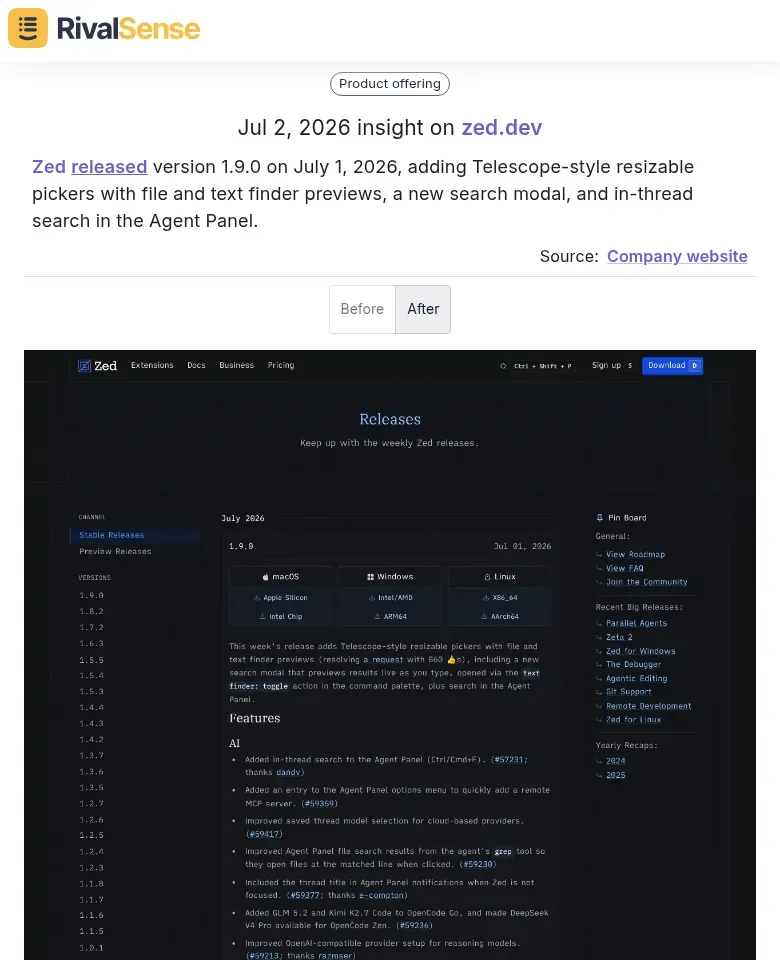
- Zed released version 1.9.0 on July 1, 2026, adding Telescope‑style resizable pickers, a new search modal, and in‑thread search in the Agent Panel – signals a deeper investment in developer productivity and agentic workflows.
🛒 Catalogue changes unmask sales priorities
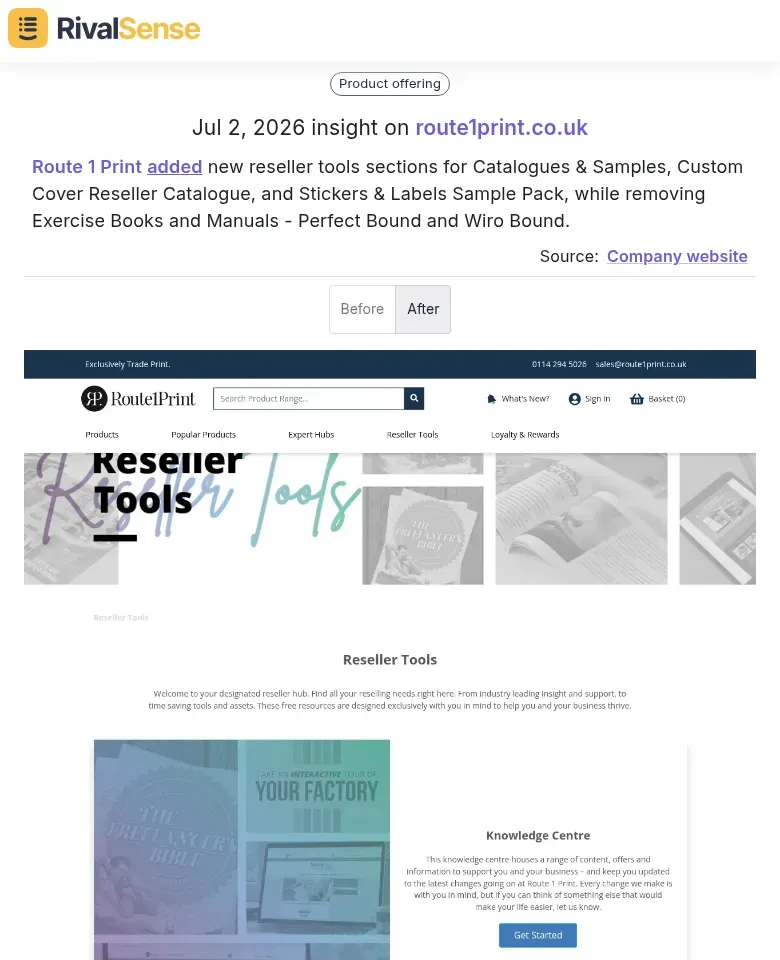
- Route 1 Print added reseller tools for Catalogues & Samples, Custom Cover Reseller Catalogue, and Stickers & Labels Sample Pack, while removing Exercise Books and Perfect‑Bound/Wiro Manuals – a clear pivot toward customisable print services.
🤖 Tooling swaps expose technology bets
- Genspark added ‘Nano Banana’ to its AI image generation tools, replacing ‘AI Image Upscaler’ – indicating a shift toward a new underlying model and away from a legacy feature.

Each of these micro‑shifts can inform your own positioning, sales arguments, or service offerings. The earlier you know, the sharper your edge.
By bundling feeds and filtering for relevance, you cut through noise and spot shifts in competitor strategy—without manual hunting. Spend 10 minutes each morning scanning your feeds, and you’ll never miss a critical move.
Monitor Social Media and Online Communities
Social platforms are early‑warning systems for industry shifts. Here’s how to mine them for consulting intelligence:
🐦 1. Track Twitter Strategically
- Create Lists: Build private lists of key industry leaders, competitors, and target clients. Tools like TweetDeck let you monitor these feeds without noise.
- Follow Hashtags: Track relevant hashtags (e.g., #FutureOfFinance) to spot emerging themes. Save searches to revisit top tweets weekly.
🧠 2. Mine Reddit for Pain Points
- Subreddits: Join niche subreddits (e.g., r/consulting, r/SaaS). Sort by “rising” to catch early‑stage discussions. Note recurring frustrations—these are your next service opportunities.
- Example: A sudden spike in “data silo” complaints in r/marketing signals a growing need for integration consulting.
🤝 3. Engage Authentically
Don’t lurk. Comment thoughtfully on posts, share insights without self‑promotion. Direct‑message active users to build rapport. Authentic engagement earns trust and access to off‑the‑record intelligence.
✅ Checklist:
- [ ] Set up 3 Twitter lists (leaders, competitors, clients).
- [ ] Identify 5 subreddits and enable daily notifications.
- [ ] Schedule 15 minutes daily for engagement.
This approach turns noise into actionable foresight.
Analyze Competitors’ Content Strategy (and Product Signals)
Track everything your rivals publish: blog posts, whitepapers, webinars, and case studies. Use a simple spreadsheet or a dedicated tool like RivalSense to log topics, formats, and engagement metrics (shares, comments).
📝 Step 1: Identify Content Gaps
Map out the topics they cover frequently—these are saturated. Look for gaps: questions unanswered in their comments, underserved subtopics, or emerging industry trends they ignore. For example, if all competitors write about ‘AI in consulting’ but none about ‘ethical AI frameworks’, that’s your gap.
🔄 Step 2: Adapt & Differentiate
Don’t copy—remix. If a webinar format works, turn it into a checklist or interactive tool. If a case study resonates, add your proprietary framework. The goal is to borrow the structure but inject your unique angle.
🗓️ Pro Tip: Set up monthly content audits. Ask: What formats got the most traction? What topics are we missing? Then create one piece of content per month that fills a gap and uses a proven format—but with your spin. This keeps you relevant without following the herd.
🕵️ Ready to see competitor moves like the ones above before anyone else?
RivalSense automatically tracks competitor product launches, pricing updates, leadership changes, media mentions, and more—delivering it to your inbox every week so you can stop hunting and start acting.
👉 Try RivalSense for free and get your first competitor report today.
📚 Read more
👉 How Barings Law's No-Fee PCP Model Sparked a Strategic Shift
👉 Predictive LinkedIn Analysis for Key Account Monitoring Wins
👉 Beginner’s Guide: How Transport Competitors Attract Customers
👉 Benchmarking Competitors' Client Partnerships: Trend Insights
👉 How CoreStream’s Free TPRM RFP Exposes a Powerful Competitive Move