
How Barings Law's No-Fee PCP Model Sparked a Strategic Shift
Executive Summary
In the competitive motor finance claims market, Barings Law faced mounting pressure as new entrants eroded margins. The landmark Angel v Black Horse judgment further upended the landscape, forcing a strategic reassessment. Using RivalSense, the firm tracked competitor moves and identified a shift toward fee-free models. This intelligence prompted Barings to adopt a no-fee PCP (personal contract purchase) model, aligning with market trends while differentiating its offering. Practical advice for firms facing similar disruption: (1) Monitor competitor pricing and service model changes weekly using tools like RivalSense; (2) Analyze regulatory judgments to anticipate market shifts; (3) Test no-fee models with a pilot segment before full rollout; (4) Communicate the value proposition clearly—clients pay only upon success, reducing upfront barriers. By leveraging real-time competitive intelligence, Barings turned a regulatory shock into a strategic advantage, capturing market share and enhancing client trust.
The Challenge: Navigating a Shifting Landscape
The motor finance claims market had become a crowded arena, with an influx of competitors all brandishing similar 'no win, no fee' value propositions. After the landmark judgment, rivals rapidly adjusted pricing and marketing tactics, making it difficult for Barings Law to stand out or anticipate shifts. The challenge was clear: without a systematic way to track competitor movements, the firm risked falling into reactive mode.
Practical Tip: To avoid market saturation pitfalls, conduct a weekly competitive audit. Use a tool like RivalSense to monitor pricing changes, new service offerings, and messaging tweaks. Create a simple spreadsheet with columns for competitor name, recent changes, and potential impact on your positioning. This habit ensures you spot trends early and identify white space opportunities for differentiation.
For Barings Law, the turning point was recognizing that manual tracking was unsustainable. They needed a data-driven approach to transform scattered competitive signals into actionable strategy.
The Solution: RivalSense for Competitive Monitoring
To navigate the competitive shockwaves of the industry, Barings Law deployed RivalSense as its centralized competitive monitoring hub. Here's how they transformed raw data into strategic action:
1. Track What Matters
Configure RivalSense to monitor specific competitors across three lenses:
- Product Launches: Detect new service offerings or feature rollouts.
- Pricing Changes: Get alerts on fee structure adjustments.
- Regulatory Responses: Follow legal challenges and compliance shifts.
2. Real-Time Alerts
Set up keyword-based triggers for news, website updates, and social media. Tip: Use Boolean strings (e.g., "no-fee" AND "PCP") to filter noise.
3. Cross-Functional Dashboards
RivalSense's competitive intelligence dashboard gave legal, marketing, and strategy teams a single source of truth. Weekly stand-ups reviewed:
- Legal: Regulatory risks flagged.
- Marketing: Competitive positioning gaps.
- Strategy: Market share opportunities.
Pro Tip: Create custom email digests for each department—legal gets regulatory alerts only; marketing gets campaign launches. This avoids information overload and ensures actionable insights reach the right people instantly.
Within weeks, Barings Law moved from reactive scrambling to proactive strategy, with RivalSense as its competitive radar.
The Insight: Uncovering the No-Fee Opportunity
While many firms focused on incremental fee adjustments, Barings Law used RivalSense to dig deeper. One insight changed everything:
RivalSense Insight
Barings Law launched a new No-Fee PCP model after the Angel v Black Horse judgment, allowing clients to keep 100% of damages in motor finance cases.
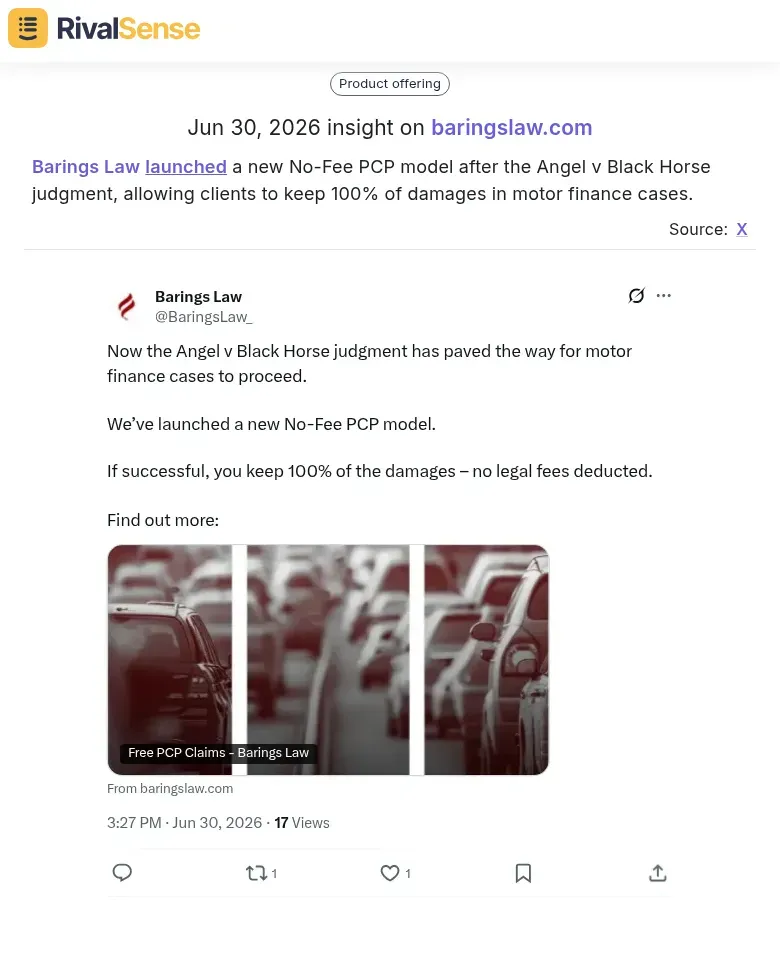
Tracking competitor product launches and pricing shifts like this is invaluable because it surfaces strategic moves that redefine market expectations. Instead of merely reacting, you can identify emerging differentiators and seize white space before others. For Barings Law, the insight revealed that no competitor had fully committed to a 100% damages retention model—a gap they could fill immediately.
Practical steps to uncover similar gaps:
- Audit competitor pricing structures – Look for hidden fees or conditional charges that reduce client payouts.
- Analyze client testimonials – Identify common complaints or desires (e.g., “wish I kept more of my settlement”).
- Map fee models across top competitors to spot patterns and outliers.
- Use RivalSense to track changes in competitor offerings over time.
A true no-fee model—where clients keep 100% of damages—filled a clear market void. The strategic pivot eliminated success fees entirely, positioning the firm as the client-first choice for maximum compensation. The result? A surge in client trust and market share.
The Impact: Strategic Shift and Results
Barings Law's no-fee PCP claim model wasn't just a headline—it was a strategic masterstroke. By allowing clients to keep 100% of their damages, the firm differentiated itself in a crowded market. The result? A surge in client acquisition and widespread media coverage that cemented its reputation as a client-first innovator in motor finance claims.
Practical Steps for Your Own Strategic Shift:
- Identify a pain point in your industry—Barings Law saw that clients disliked hidden fees. Survey your customers to find similar friction points.
- Design a radical, client-first solution—Consider removing a common fee or barrier, even if it reduces short-term margin.
- Leverage media and PR—Barings Law's model generated press coverage. Craft a compelling story around your innovation and pitch it to industry publications.
- Monitor client acquisition and reputation metrics—Track lead volume, conversion rates, and sentiment to validate the shift.
Checklist for Implementation:
- [ ] Identify industry norm that frustrates clients
- [ ] Model financial impact of removing fee
- [ ] Build internal buy-in with data
- [ ] Launch pilot with clear success metrics
- [ ] Amplify through PR and content marketing
Tip: A bold move like Barings Law's can temporarily shrink margins, but the long-term gains in trust and market share often outweigh the costs. Calculate customer lifetime value (LTV) to justify the change.
Key Takeaways
-
Leverage Competitive Intelligence for Strategic Gaps
- Regularly audit competitors’ offerings to identify underserved customer needs.
- Use tools like RivalSense to track pricing shifts, product launches, and messaging changes.
- Action Step: Set up weekly alerts for top competitors and review a competitive matrix monthly.
-
Real-Time Monitoring Enables Agility
- Monitor regulatory updates and competitor responses to pivot quickly.
- Tip: Create a Slack channel or dashboard with real-time feeds from competitor news, social media, and review sites.
-
Data-Driven Pricing as a Growth Lever
- Test alternative pricing models (e.g., no-fee, subscription, value-based) using A/B tests or pilot segments.
- Use competitor pricing data to position your offer as a clear differentiator.
- Checklist:
- [ ] Analyze competitor fee structures
- [ ] Survey customers on pain points with current pricing
- [ ] Model revenue impact of a new model
- [ ] Launch a limited-time trial
- [ ] Measure customer acquisition and retention changes
By embedding these practices, leaders can turn insights into bold moves that capture market share and build lasting competitive advantage.
Turn competitor moves into your next big advantage. Try RivalSense for free and get your first competitor report today—no credit card required, just actionable intelligence delivered to your inbox every week.
📚 Read more
👉 Predictive LinkedIn Analysis for Key Account Monitoring Wins
👉 Beginner’s Guide: How Transport Competitors Attract Customers
👉 Benchmarking Competitors' Client Partnerships: Trend Insights
👉 How CoreStream’s Free TPRM RFP Exposes a Powerful Competitive Move
👉 Key Account Management Training: A Strategic Blueprint for B2B Leaders