
Workflow Breakdown: Tracking Leaders to Boost Healthcare IT Consulting
1. Introduction: The Strategic Value of Tracking Leaders in Healthcare IT Consulting
In healthcare IT consulting, market leaders set the pace. Tracking them isn't just about staying current—it's about shaping your strategy. When you monitor leaders like Epic, Cerner (Oracle), and athenahealth, you uncover emerging trends (e.g., AI-driven diagnostics), shifting client demands (e.g., interoperability requirements), and partnership gaps before they become mainstream. This intelligence directly fuels your credibility: quoting leader moves in pitches signals deep industry awareness.
Practical tips:
- Set up alerts for quarterly earnings calls, product launches, and regulatory filings of top 5-7 leaders.
- Use a competitive intelligence tool (like RivalSense) to aggregate their news, job postings, and client wins automatically.
- Create a monthly 'Leader Radar' digest for your team, highlighting 3 key moves and their implications for your consulting pipeline.
- Track hiring patterns—when a leader hires for new roles (e.g., 'Value-Based Care Architect'), it signals a growing client need you can address.
2. Identifying the Right Leaders and Competitors to Track
To maximize competitive intelligence, apply three selection criteria: market share (revenue, deal volume), innovation rate (patent filings, product launches), and client portfolio (government contracts, Fortune 500 logos). Segment by consulting niche—EHR (Epic, Cerner), cybersecurity (Clearwater, CynergisTek), interoperability (InterSystems, Lyniate), and cloud migration (AWS, Google Health). Use Crunchbase and CB Insights to spot emerging disruptors; filter by "Healthcare IT" category and recent funding rounds above $10M. The KLAS Research reports offer vendor performance scores. Pro tip: Set up Google Alerts for keywords like "healthcare IT startup" + "EHR" to catch disruptors early. Maintain a radar with statuses: Monitor (early-stage), Track (high growth), Analyze (direct competitor). Update quarterly to avoid noise.
3. Building a Systematic Tracking Workflow
A haphazard approach to competitor tracking leads to missed signals. Here's how to build a workflow that catches every move.
Step 1: Set Up Automated Alerts & Dashboards
- Tools: Use RivalSense (or alternatives like Crayon, Klue) to monitor competitor websites, blogs, and news.
- Alerts: Configure real-time notifications for: product launches, leadership changes, funding news, pricing updates, and new customer wins.
- Dashboard: Create a shared dashboard (e.g., in Notion or Monday.com) that surfaces these alerts in one view. Tag each alert with the competitor name and signal type (e.g., "New Feature," "Partnership").
Step 2: Establish a Review Cadence
- Weekly Scan (30 min): Every Monday, scan the dashboard for the past week. Update a shared doc with key takeaways: "What changed? What's urgent?"
- Monthly Deep Dive (2 hours): Once a month, review all tracked competitors in detail. Compare their positioning, feature sets, and go-to-market tactics against yours. Look for patterns—e.g., "Three competitors launched AI chatbots this quarter."
Step 3: Leverage AI to Extract Structured Data
Unstructured sources (e.g., podcast transcripts, earnings calls, LinkedIn posts) are goldmines. Use AI tools to:
- Summarize: Pass competitor blog posts or earnings call transcripts through GPT-4 with a prompt like: "Extract strategic priorities, product roadmap hints, and customer pain points mentioned."
- Categorize: Automatically tag mentions by type (e.g., "Feature Launch," "Pricing Change," "Executive Hire") using NLP classifiers.
- Trend Spot: Set up a monthly AI analysis that scans all collected data for emerging themes (e.g., "Focus on interoperability" or "Expansion into mid-market").
Checklist for Your Workflow:
☐ Automated alerts for 5+ signal types per competitor
☐ Weekly scanning slot booked on calendar
☐ Monthly deep dive template ready (SWOT-like format)
☐ AI summarization pipeline tested on one source
This workflow ensures you see both the urgent (a competitor's new pricing page) and the important (a strategic pivot revealed in a CEO interview).
4. Analyzing Key Signals: From Product Launches to Thought Leadership
To outmaneuver competitors in healthcare IT consulting, you must decode their moves early. Here’s a practical framework:
Product & Regulatory Signals
Track product updates, regulatory filings (e.g., FDA 510(k) submissions), and patent activities via USPTO alerts or tools like Google Patents. Tip: Set up RSS feeds for competitor press rooms and regulatory databases. A sudden surge in patent filings may hint at an upcoming platform shift.
Positioning & Content Shifts
Monitor content marketing—white papers, blog tone—and executive speeches at HIMSS, ViVE, or HLTH. Checklist: Note changes in target audience (e.g., shifting from payers to providers), new buzzwords ("interoperability," "value-based care"), or critiques of current norms. A CEO’s keynote focusing on AI-driven clinical decision support likely signals a product pivot.
Growth & Hiring Patterns
Analyze job postings (LinkedIn, Glassdoor) for new roles in emerging areas (e.g., "AI Ethics Officer" or "Clinical Data Scientist"). Track client wins via press releases and case studies. Hack: Use Crunchbase or Owler to spot recent funding or partnerships. A competitor hiring ten cloud architects suggests a major infrastructure overhaul.
By systematically tracking these signals, you can anticipate moves before they hit the market, allowing you to adjust your own strategy proactively.
5. Converting Intelligence into Actionable Consulting Strategies
Raw competitive data is useless without a conversion plan. Here’s how to turn insight into action:
Differentiate via Gap Exploitation
Map competitors’ weaknesses (e.g., slow patient onboarding, poor interoperability) and build counter-offerings. Tip: Create a "Competitor Gap Matrix" listing each rival’s missing features – then design service packages that fill those voids.
Inform Client Advisory
Use benchmarked best practices (e.g., average EHR implementation timelines) to set realistic expectations. Alert clients early to threats like a competitor’s new AI diagnostics tool. Checklist: Monthly advisory briefs containing 3 early warnings, 2 benchmark stats, and 1 recommended pivot.
Steer Internal R&D & Partnerships
Monitor market direction signals (e.g., rising telehealth investment) to prioritize resource allocation. Step: Quarterly, score each R&D project against competitor moves – green (ahead), yellow (parity), red (falling behind). Redirect budget to red zones or forge partnerships to close gaps.
By systematically converting intelligence, you shift from reactive to prescriptive consulting, cementing your role as a market shaper.
6. Real-World Examples of Competitive Signals (And Why They Matter)
While the examples below come from outside healthcare IT, they illustrate exactly the kind of intelligence RivalSense delivers. Each signal type carries strategic weight—whether you're tracking a consulting rival, an EHR vendor, or an adjacent tech player.
| Signal Type | Real Example | Why It’s Valuable for Business Strategy |
|---|---|---|
| Product Launch | 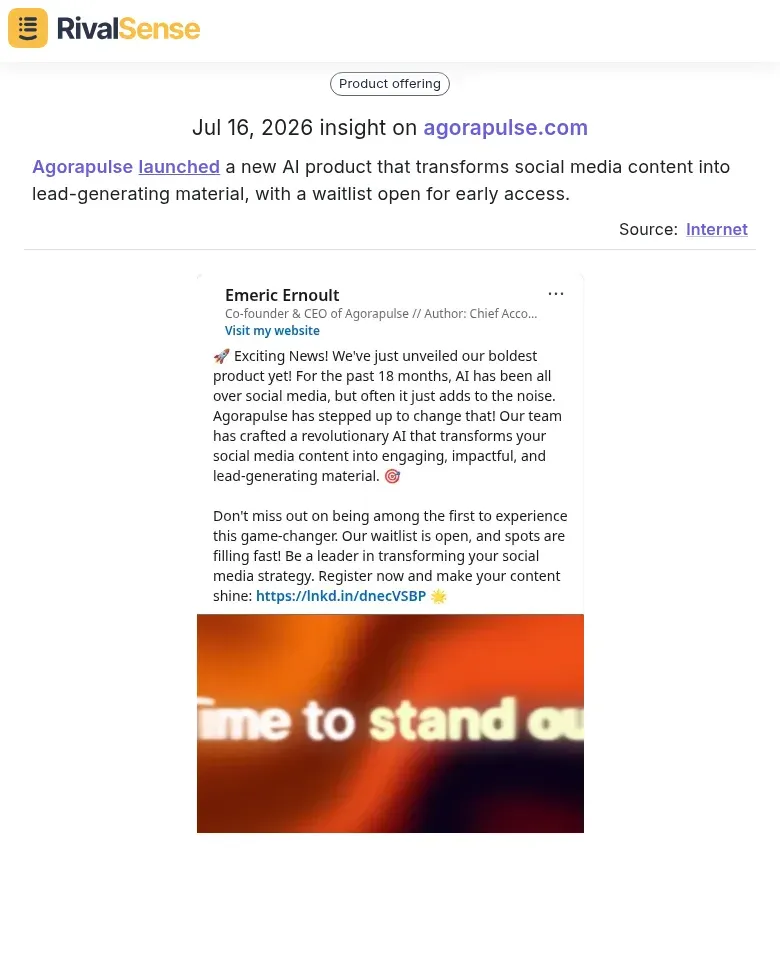 Agorapulse launched a new AI product that transforms social media content into lead-generating material, with a waitlist open for early access. Agorapulse launched a new AI product that transforms social media content into lead-generating material, with a waitlist open for early access. |
Product launches signal a company’s strategic direction, new revenue streams, and potential market disruption. In healthcare IT, tracking new EHR modules or AI diagnostic tools helps consultants anticipate client needs and adjust service offerings before a rival gains momentum. |
| Executive & Personnel Move | 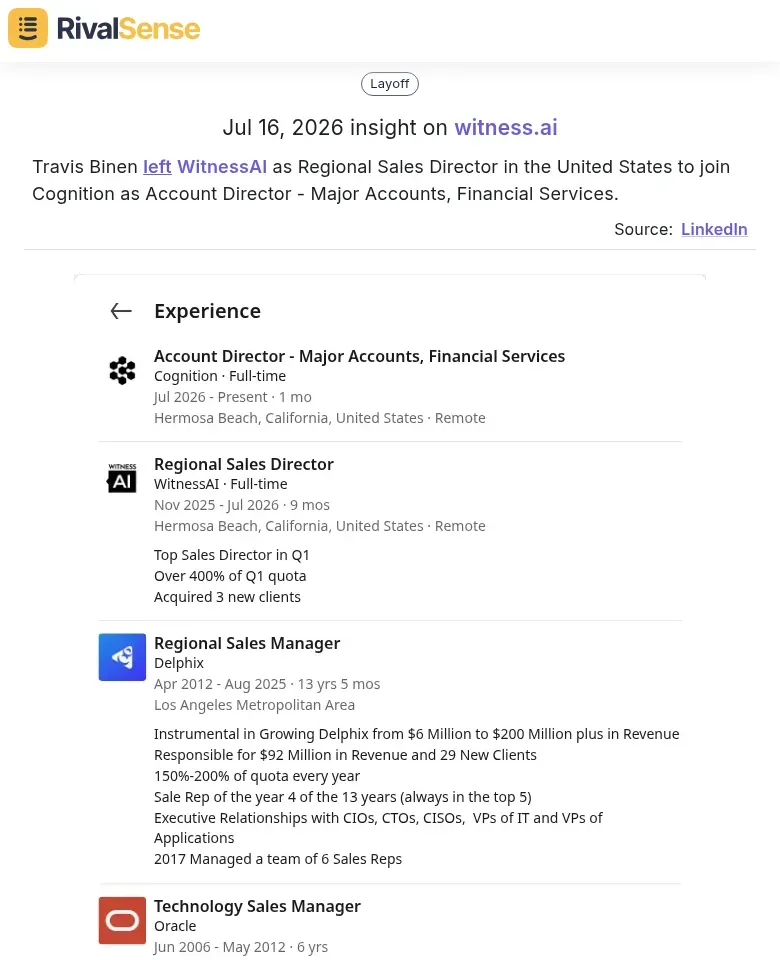 Travis Binen left WitnessAI as Regional Sales Director in the United States to join Cognition as Account Director - Major Accounts, Financial Services. Travis Binen left WitnessAI as Regional Sales Director in the United States to join Cognition as Account Director - Major Accounts, Financial Services. |
Key hires and departures reveal shifts in target markets, new verticals, or competitive poaching. A healthcare IT firm suddenly hiring a "Value-Based Care Architect" signals commitment to that model—prompting you to build advisory capabilities early. |
| Partnership / Integration |  First Tree integrated its agents with Cursor's runtime, allowing users to run First Tree agents on the Cursor Agent CLI. First Tree integrated its agents with Cursor's runtime, allowing users to run First Tree agents on the Cursor Agent CLI. |
Ecosystem integrations expose new bundling strategies and technical alliances. In healthcare IT, a telehealth platform integrating with an EHR may open a service gap you can fill, or indicate a competitor is locking in key interoperability positions. |
These three signal types—product launches, people moves, and partnerships—form the backbone of any competitive monitoring program. RivalSense aggregates such updates across company websites, social media, registries, and the internet, delivering them in a concise weekly report so you never miss a critical move.
7. Conclusion: Sustaining a Competitive Edge Through Continuous Tracking
To stay ahead in healthcare IT consulting, continuous competitor tracking isn't optional—it's strategic. The workflow we've outlined helps you systematically monitor market shifts, anticipate client needs, and differentiate your services. To embed this into your culture:
- Assign ownership – Designate a CI champion or team.
- Schedule regular reviews – Weekly 15-minute scan, monthly deep-dive.
- Share insights cross-functionally – Brief sales, delivery, and leadership.
- Act on intelligence – Turn competitor moves into service improvements or new offerings.
Ready to eliminate manual tracking? Try RivalSense for free and get your first competitor report today. Spend less time collecting data and more time acting on it.
Quick checklist to start now:
- List top 5 competitors + 3 adjacent innovators
- Define 3 key signals per competitor (e.g., new certifications, partnerships, content)
- Set up RivalSense alerts for each signal
- Schedule first monthly intelligence review
Consistency beats intensity. With the right workflow and tooling, you’ll transform raw competitor data into a sustained competitive advantage.
📚 Read more
👉 How Lumia's New Security Features Prompted a Rival's Response
👉 Predict Competitor SEO Moves via LinkedIn Insights
👉 Automate Key Account Monitoring in Trust Management
👉 Competitor Distribution Channel Monitoring: Your Compliance Superpower
👉 Comparative Pricing Analysis: Uncover Competitor Market Cap Insights