
Competitor Distribution Channel Monitoring: Your Compliance Superpower
Staying ahead of competitor distribution moves is no longer optional—it's a compliance imperative. When rivals shift their channel strategies, they often signal new regulatory headwinds or market realignments you can't afford to ignore. A systematic monitoring approach transforms scattered signals into actionable intelligence that protects your business and sharpens your competitive edge.
Why Competitor Distribution Channel Monitoring Matters for Compliance
Competitor shifts in distribution channels often fly under the radar until a compliance incident surfaces. When a rival adopts a new distributor in an unregulated market, it may signal an upcoming regulatory change you're not prepared for—or worse, create channel conflict that exposes your agreements to scrutiny. Proactive monitoring closes this gap.
🚨 The hidden risks of ignoring competitor channel moves
- Regulatory whiplash: A competitor's pivot to a new channel partner can precede a compliance shift (e.g., data privacy or trade sanctions). If you're unaware, you may miss critical adaptation windows.
- Channel conflict escalation: Competing through overlapping distributors without aligned compliance standards can lead to pricing disputes, contract breaches, or regulatory fines.
- Market alignment lag: Regulatory bodies often set industry benchmarks based on prevailing practices. If your competitors standardize compliance-friendly distribution terms (e.g., audit clauses), falling behind harms your negotiating position.
✅ Quick compliance monitoring cycle checklist
- [ ] Reviewed competitor press releases and earnings calls for distribution shifts.
- [ ] Updated distribution network maps and noted overlaps.
- [ ] Checked recent regulatory updates relevant to distribution in your markets.
- [ ] Escalated any high-risk competitor moves to your compliance team.
Tracking Hiring Signals: Executive Moves Reveal Channel Strategy
Executive hiring patterns offer a window into evolving channel strategies. When a competitor hires a GRC (Governance, Risk, and Compliance) leader, it signals product maturation and enterprise targeting—they’re building the infrastructure to sell into regulated industries. Similarly, recruiting enablement leaders from top SaaS companies like Salesforce or HubSpot indicates they are scaling customer success and partner programs, which directly impacts how they manage, train, and certify channel partners.
These signals are invaluable for your strategy: you can anticipate stricter partner requirements, new compliance-focused product tiers, or a push into verticals where you compete. The key is to spot them early and interpret what they mean for your own distribution agreements.
💼 Real-world intelligence: Vanta builds enterprise GRC muscle
RivalSense recently detected that Vanta is hiring a Director of Engineering, GRC Program Orchestration in the United States (Remote) to lead teams focused on maturing their Governance, Risk, and Compliance product for enterprise organizations.
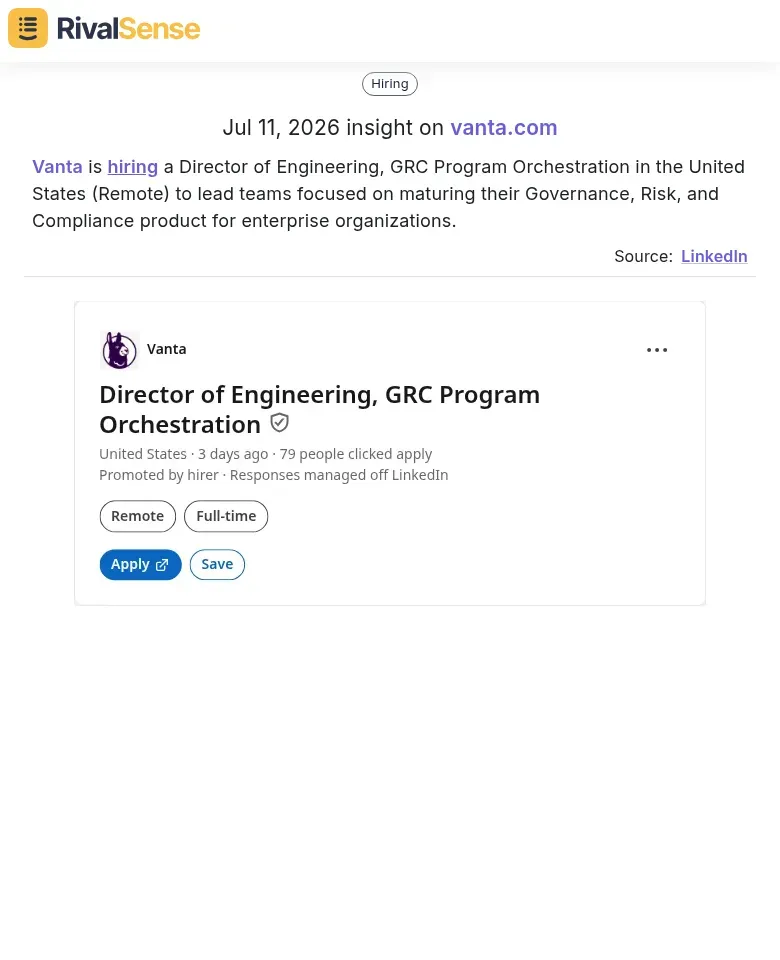
Why this insight matters: A dedicated GRC engineering leader indicates Vanta is moving beyond basic compliance automation into complex, enterprise-grade workflows. For competitors, this hiring signal suggests that Vanta will soon require channel partners to meet higher compliance and auditability standards. If you share partners or target similar regulated customers, now is the time to benchmark your own GRC readiness and revisit partner certification criteria.
👥 Scaling partner enablement: Vanta poaches top Salesforce talent
In another signal, Suzanna Jarrett joined Vanta as Director, Enablement GTM Programs, previously Senior Manager, Global Enablement – Customer Success at Salesforce.
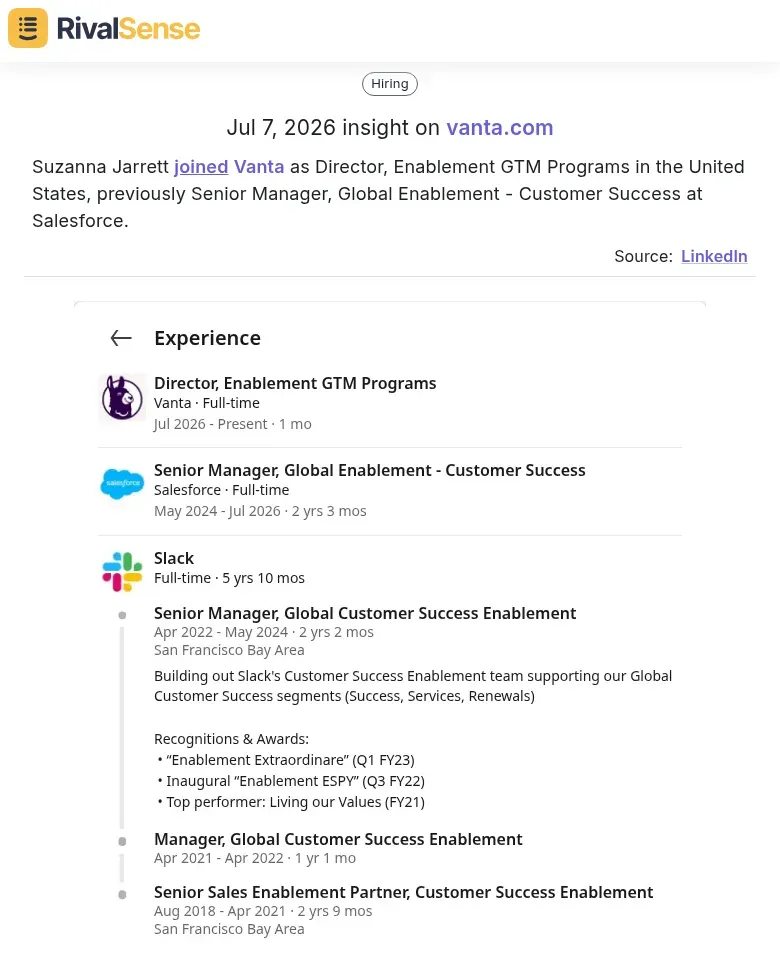
Why this insight matters: Poaching a seasoned enablement leader from a sales execution powerhouse like Salesforce tells you Vanta is firing up its go-to-market engine. This typically leads to rigorous partner onboarding, new training portals, and certification mandates that channel partners must meet. Monitoring such moves allows you to adjust your own partner incentives, training materials, and enablement resources before the market shifts underneath you.
🛠️ Action steps to decode hiring signals
- Monitor LinkedIn and job boards for title changes like "VP of Partner Programs" or "Director of Compliance".
- Analyze job descriptions for keywords: "AI integration", "partner program expansion", "regulatory readiness".
- Compare role seniority—a new CRO focused on channel vs. a Sr. Manager of Partner Ops reveals the scale of commitment.
- Track departures from competitors to your own team—timing may indicate strategic pivots.
Pro Tip: Set up automated alerts for competitor job postings using a tool like RivalSense. If a competitor posts multiple roles for "Partner Compliance Manager" within a quarter, expect a compliance-heavy partner onboarding process soon.
Product and Partnership Launches: Forecasting Distribution Evolution
Product and partnership launches often telegraph shifts in competitor distribution channels. When a competitor releases a new product module or service tier, expect corresponding changes in channel partner requirements—for example, a new enterprise-tier with advanced compliance features signals stricter partner certification criteria. Strategic partnerships, especially with AI vendors, hint at future distribution capabilities and the compliance frameworks partners will need to adopt.
🔍 Decode the signal: Vanta's MCP Server and Anthropic AI upgrade
RivalSense captured that Vanta launched an MCP Server over a year ago, now used by 16,000+ customers, and is partnering with Anthropic for an AI upgrade.
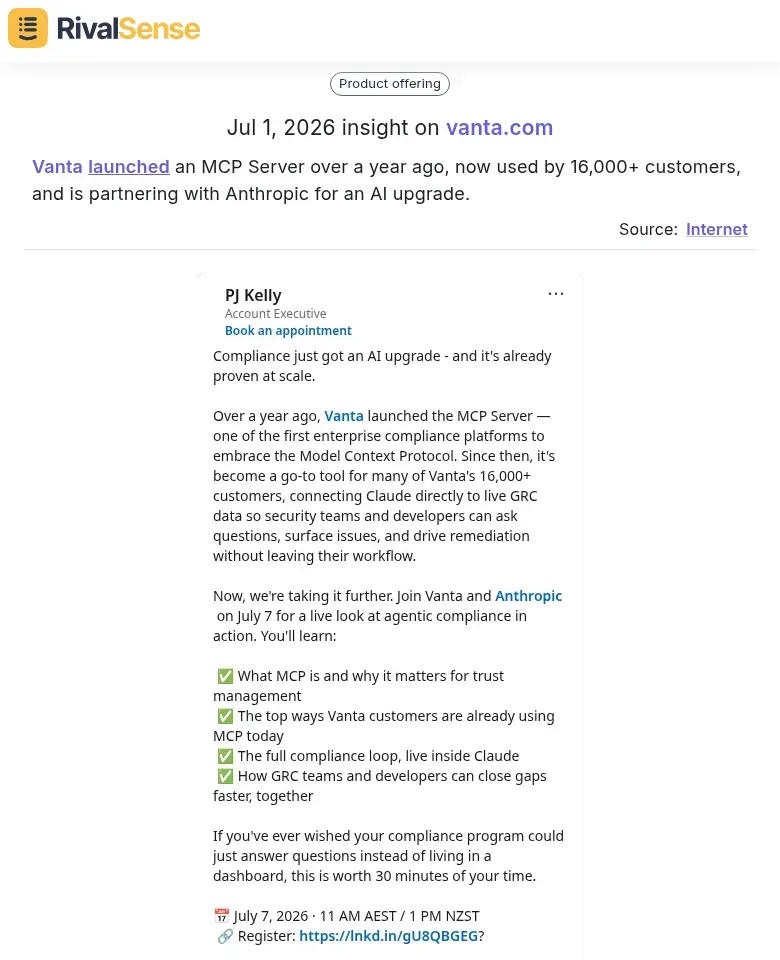
Why this insight matters: High adoption of an API-driven product combined with a deep AI partnership signals that Vanta is embedding compliance automation directly into customer workflows. For channel partners, this creates new integration and data-sharing obligations—you may soon face requirements to pass compliance data through their AI models. Monitoring such launches gives you lead time to evaluate your own API strategy, data governance, and partner agreements before these become de facto industry standards.
📋 Quick diagnostic checklist
- [ ] Monitor competitor product launch pages for new modules or API services.
- [ ] Log partnership announcements quarterly—map each to potential channel compliance changes.
- [ ] Review community forums and case studies for adoption signals that might set new compliance benchmarks.
- [ ] When a competitor announces a partnership in a regulated vertical, trigger a compliance review of your own partner contracts within 30 days.
Building Your Monitoring Framework: From Alerts to Action
Turning competitor distribution intelligence into compliance advantages requires a structured, repeatable process—not ad-hoc Googling. A lightweight framework ensures no signal is missed and every insight is routed to the right decision-maker before it’s too late.
1. Centralize intelligence gathering
Use a shared spreadsheet or project management tool to log each signal with date, source, and a relevance score (1–5). Assign a team member to scan weekly: competitor blogs, press releases, LinkedIn updates, SEC filings, and regulatory databases. Supplement manual scanning with a competitive intelligence tool like RivalSense, which automates monitoring across websites, social media, and registries and delivers a curated weekly email.
2. Automate and categorize alerts
Configure alerts for keywords such as "new partnership", "regulatory approval", "compliance update", or "distribution agreement". Categorize each alert by compliance risk level (High/Medium/Low) and distribution channel impact (Direct, Indirect, Partner-dependent). For example, a new distributor in a jurisdiction with upcoming data localization laws would be High risk and Partner-dependent.
3. Stand up a cross-functional review cadence
Create a biweekly review team that includes legal (to flag regulatory red flags), sales (to assess channel conflict), and product (to evaluate feature overlaps). Use a standardized template for each signal:
- Summarize the signal
- Rate compliance impact (1–5)
- Propose action (e.g., adjust channel terms, launch defensive campaign)
- Assign owner
Keep a decision log to track adjustments made and outcomes, enabling continuous improvement of your framework.
🔁 Turning intelligence into durable compliance advantages
Surveillance alone won't move the needle—you must operationalize what you learn. When you detect that a competitor is building a GRC program orchestration team, use that as a trigger to benchmark your own product's compliance architecture. When you see a rival scaling partner enablement with Salesforce veterans, review your onboarding and certification programs to avoid being outmatched. And when an API and AI partnership gains massive adoption, audit your data-sharing and AI governance playbooks.
📊 Pro tip: Use a shared dashboard that tags competitor moves by regulation (e.g., “CCPA update”). This turns raw data into an early-warning system for compliance shifts, keeping your entire organization aligned.
By systematically translating competitor actions into proactive compliance improvements, you transform monitoring from a cost center into a competitive weapon.
Ready to see what you're missing? Competitor distribution moves are happening right now—hidden in hiring posts, product updates, and partnership announcements. Try RivalSense for free and get your first competitor report today, so you can spot signals like these before they become compliance headaches.
👉 Start your free monitoring at RivalSense.co
📚 Read more
👉 Comparative Pricing Analysis: Uncover Competitor Market Cap Insights
👉 How to Turn a Competitor’s Milestone Into Your Next Strategic Move
👉 Stop Learning About Competitor Moves from Press Releases