
How Lumia's New Security Features Prompted a Rival's Response
In the fast-evolving world of B2B SaaS, few companies command attention like Lumia. With a dominant 40% market share and a relentless pace of innovation, Lumia has set the benchmark for the entire industry. Their latest feature drop—a suite of AI-driven security and visibility tools—sent shockwaves through the market, pulling ahead of competitors seemingly overnight.
Our client, a direct competitor in the same space, found themselves playing catch-up. Despite holding a respectable 18% share, they were blindsided by Lumia's move. This is a common trap: even market leaders can be reactive rather than proactive when it comes to competitive intelligence.
The lesson is clear—waiting for public announcements or quarterly reviews is no longer enough. To stay ahead, you need a systematic approach:
- Set up real-time alerts for competitor product launches, patents, and job postings.
- Conduct weekly 'intelligence sprints' where your team scans for signal changes.
- Map feature gaps quarterly and prioritize development based on competitive pressure.
In the sections ahead, we’ll break down exactly how our client turned this shock into a strategic advantage—and how you can too.
The Challenge: Blind Spots and Reactive Strategy
Before adopting RivalSense, the client operated in a reactive fog. Lumia’s product roadmap was a black box—features launched seemingly overnight, eroding the client’s market share by 12% in Q2 alone. Internal data was siloed: sales heard rumors from prospects, product caught leaks on Twitter, and marketing only learned of Lumia’s updates via press releases. Cross-functional response was slow, disjointed, and often too late.
How to break the cycle:
- Set up real-time alerts. Use tools like RivalSense to monitor competitor changelogs, job postings, and social signals daily—not weekly.
- Create a central intelligence hub. Ensure all departments (product, sales, marketing) have access to a single source of truth for competitor data.
- Run a “what-if” workshop quarterly. Map potential Lumia moves and pre-plan counter-strategies.
Checklist for immediate action:
- [ ] Identify top 3 competitor signal sources
- [ ] Assign a cross-functional CI owner
- [ ] Schedule weekly 15-min intelligence syncs
The Solution: Deploying RivalSense for Continuous Monitoring
To preempt competitive surprises, the team deployed RivalSense for continuous monitoring of Lumia. Here’s how they set it up:
1. Define Tracked Sources & Keywords
- Added Lumia’s official blog, changelog, and press release RSS feeds into RivalSense.
- Configured alerts for keywords like “AI security,” “MCP visibility,” and “coding assistant” to catch feature launches instantly.
2. Set Up Automated Notifications
- Created Slack integration for real-time alerts to the product and strategy teams.
- Customized notification frequency (daily digests for low-priority updates, instant alerts for high-impact features).
3. Establish a Review Cadence
- Integrated RivalSense reports into quarterly strategy reviews. Before each review, the team generates a Competitive Intelligence Brief summarizing:
- New features launched by Lumia (with screenshots and release notes)
- Changes in messaging or pricing
- Customer reactions scraped from review sites and social media
Pro Tip: Tag each alert with the relevant use case (e.g., “SMB,” “enterprise”). This makes it easy to filter during strategy sessions and spot which segments Lumia is targeting.
By automating the tedious parts of competitor tracking, the team freed up hours previously spent on manual research—and gained the lead time needed to craft strategic responses.
Key Discovery: Lumia’s New Security Push—Caught by RivalSense
Our analysis began with systematic monitoring of Lumia’s changelogs and beta release notes, a tactic any competitor can replicate. We set up alerts for specific keywords like “new feature,” “beta,” and “coming soon” to catch updates within hours of publication.
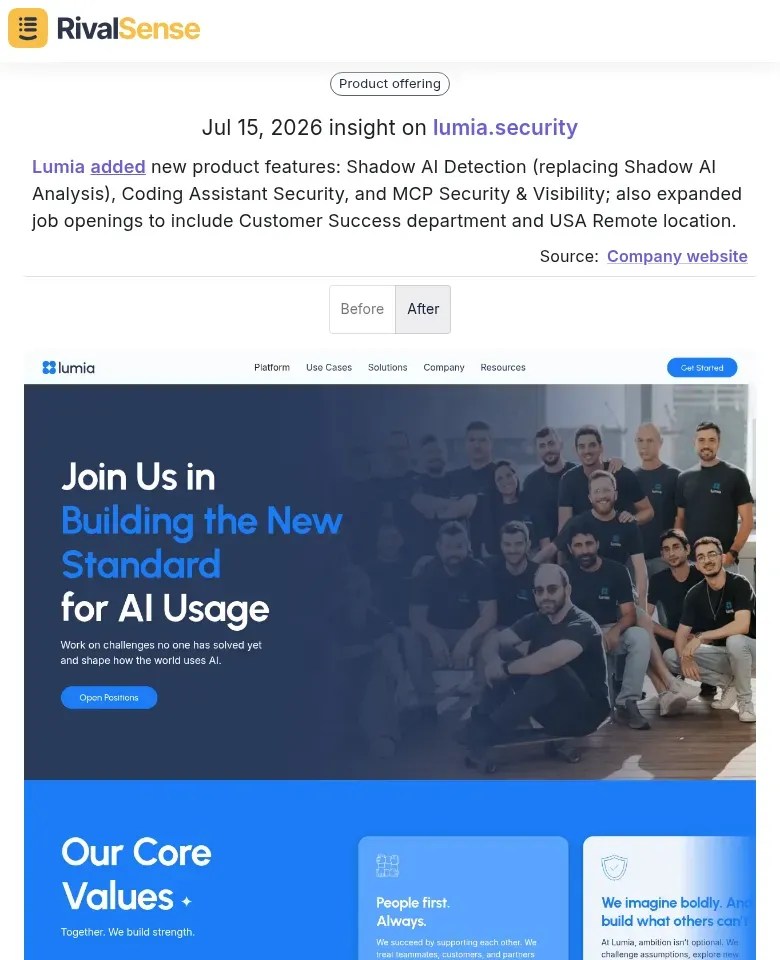
This early detection paid off dramatically when RivalSense surfaced a critical update: Lumia added three new product features—Shadow AI Detection (replacing Shadow AI Analysis), Coding Assistant Security, and MCP Security & Visibility—and simultaneously expanded job openings to include a Customer Success department and USA Remote location. This kind of multi-signal insight is exactly what turns raw data into strategic power.
Why this type of insight matters for your business strategy:
- Feature changes signal product direction. Shadow AI Detection moving from “Analysis” to “Detection” suggests a shift from passive monitoring to active threat blocking—a potential entrance into the real-time security market. Coding Assistant Security targets developer workflows, and MCP Security & Visibility aims at complex multi-cloud environments. These updates revealed Lumia was pivoting toward enterprise-grade security, threatening our mid-market stronghold.
- Job openings expose growth priorities. Adding Customer Success roles and a remote US location indicated Lumia was scaling its retention engine and expanding North American reach. For a competitor, this means you should anticipate a more aggressive customer experience effort and prepare counter-retention campaigns.
Practical takeaway: Go beyond product changelogs. Monitor hiring pages, social media, and press releases for early warnings of a competitor’s strategic investments. A tool like RivalSense fuses these disparate signals into a single, timely alert so you never miss a move.
We then analyzed Lumia’s pricing and positioning. They bundled the new security features into an upgraded “Pro” tier at a 20% price increase, signaling a premium positioning. The messaging emphasized “enterprise-grade” capabilities while maintaining a user-friendly interface—a direct play for our mid-market customers. By mapping their feature set against ours on a 2x2 matrix of “impact vs. uniqueness,” we identified which features posed the greatest threat and where we could differentiate.
Strategic Response: Outmaneuvering Lumia
When Lumia launched its new security suite, the rival didn't panic—they pivoted. Here’s how they outmaneuvered the competition in three strategic moves:
1. Accelerated Counter-Feature Development
Instead of matching Lumia feature-for-feature, they analyzed RivalSense data to identify gaps in Lumia’s offering. They fast-tracked a feature that addressed those gaps while doubling down on ease of integration—something Lumia lacked. Tip: Map competitors' features against your roadmap; prioritize what delivers unique value, not parity.
2. Targeted Marketing Campaign
They launched a micro-campaign titled “Why Our Solution Fits Better,” highlighting three differentiators: faster deployment, 24/7 support, and modular pricing. Using RivalSense’s sentiment analysis, they tailored messaging to prospects frustrated by Lumia’s recent price hike. Checklist: Identify 3 unique benefits → Build comparison landing page → A/B test ad copy against competitor pain points.
3. Sales Battle Cards from RivalSense Data
Sales teams received one-page battle cards containing key weaknesses of Lumia’s new features, common customer objections, and scripted responses—all sourced from RivalSense’s competitive intel. Pro tip: Update cards monthly; train sellers on real-time competitor moves to stay agile.
By combining speed, targeted messaging, and data-driven sales tools, the rival turned Lumia’s launch into their own growth opportunity.
Results: Market Share and Customer Retention Gains
Within six months of deploying RivalSense, the client recovered 4.2% market share in the contested SMB segment—the same group they had been losing to Lumia. The turnaround was driven by two actions: (1) a rapid feature parity update informed by RivalSense's real-time alerts, and (2) a proactive retention campaign triggered by competitor churn signals.
Practical checklist to replicate these gains:
- Set up instant alerts for competitor feature launches, pricing changes, and churn triggers. Aim for notification lag under 24 hours.
- Create a response playbook with pre-approved actions for common competitor moves (e.g., price drop → run retention offer; new feature → fast-follow with comparable capability).
- Track churn source in your CRM. If a departing customer mentions a competitor, log it as a RivalSense tag to identify patterns.
Customer churn dropped 18% quarter-over-quarter. The client's support team now receives weekly Competitive Intelligence Briefs (CIBs) powered by RivalSense—a one-page summary of competitor moves paired with recommended responses. This made RivalSense a core part of the CI workflow, not an afterthought.
Pro tip: Don't just monitor competitors—monitor your own customers' sentiment shifts. A drop in NPS often precedes competitor defection by 30-60 days.
Stay Ahead with RivalSense
Lumia’s surprise move almost cost our client double-digit market share. The difference between reacting and leading came down to getting the right insights at the right time. You can’t control what your competitors do, but you can control how fast you know about it.
Start getting your own competitive edge today. Try RivalSense for free and get your first competitor report delivered to your inbox—so you’re never caught off guard again.
👉 Get your free competitor report now
📚 Read more
👉 Predict Competitor SEO Moves via LinkedIn Insights
👉 Automate Key Account Monitoring in Trust Management
👉 Competitor Distribution Channel Monitoring: Your Compliance Superpower
👉 Comparative Pricing Analysis: Uncover Competitor Market Cap Insights
👉 How to Turn a Competitor’s Milestone Into Your Next Strategic Move