
Automate Key Account Monitoring in Trust Management
In trust management, key accounts are the lifeblood of your business—but they are also prime targets for competitors. A single competitor move (e.g., a new feature, pricing change, or strategic partnership) can erode trust and trigger churn. Manual monitoring—scrolling news, checking competitor websites, or relying on sales team anecdotes—is slow, inconsistent, and prone to blind spots. By the time you react, the damage may already be done.
Automated monitoring solves this. Using a tool like RivalSense, you can track competitor activity in real time and receive alerts on moves that directly impact your key accounts. Here’s how to operationalize it:
- Map key accounts to competitor threats. For each key account, list which competitors are most likely to poach or disrupt the relationship.
- Set up automated alerts for those competitors, focusing on product launches, pricing changes, leadership hires, and client wins.
- Create a weekly intelligence digest that filters alerts by account, so your account team sees only what matters.
- Tie insights to action. When a competitor launches a feature your key account requested, schedule a proactive check-in to discuss your roadmap.
By automating monitoring, you shift from reactive scrambling to proactive account defense—retaining trust and growing share of wallet.
Decoding Competitor Hiring Trends to Predict Product Direction
To predict competitor product direction, start by monitoring job postings for senior roles like Director of GRC (Governance, Risk, and Compliance). A surge in such hires signals an enterprise push and product maturation. Practical step: Set up automated alerts on LinkedIn, Indeed, and competitor career pages for leadership positions in product, engineering, compliance, and partnerships. Track role clusters—e.g., multiple data scientist hires suggest AI investment; a new VP of Sales for financial services hints at vertical expansion.
Here’s a real example captured by RivalSense:
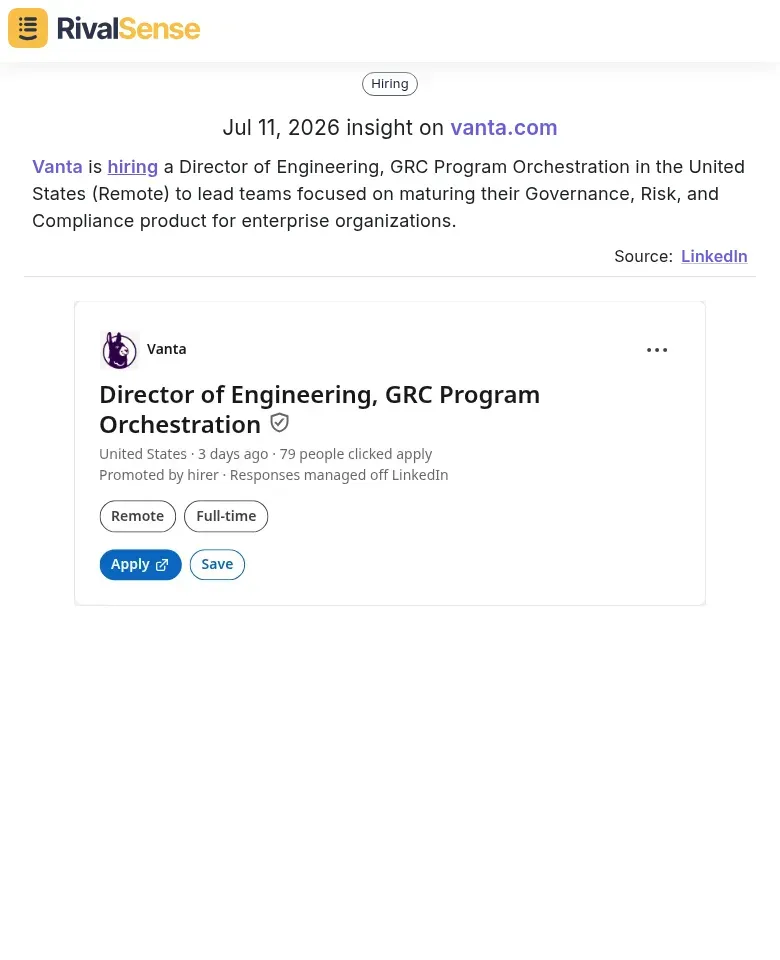
Vanta is hiring a Director of Engineering, GRC Program Orchestration in the United States (Remote) to lead teams focused on maturing their Governance, Risk, and Compliance product for enterprise organizations.
Monitoring senior hiring moves like this reveals where a competitor is doubling down on product investment. In this case, Vanta’s focus on GRC for enterprises signals an imminent push into larger, compliance-heavy accounts—exactly the type of insight that helps you pre-emptively strengthen your own positioning with key clients.
Pro tip: Use a spreadsheet to log role, department, and posting date. Look for hiring waves: a sudden spike in compliance-related roles indicates upcoming regulatory features. Actionable checklist:
- [ ] Identify 5–10 key competitors.
- [ ] Define target roles (e.g., CRO, Head of GRC, Director of Product).
- [ ] Monitor hiring trends weekly.
- [ ] Map hires to potential product timelines (e.g., 6–12 months from first hire to feature launch).
- [ ] Prepare counter-strategies for your key accounts—start capability gap analysis or preemptive feature messaging.
By decoding these signals, you can anticipate competitive moves and protect account relationships.
Tracking Event Engagements for Competitive Positioning
Competitors often descend on major industry events with flashy promotions and strategic networking, signaling which segments they’re targeting. By automating event tracking, you can decode their moves: which audiences they prioritize, what messaging resonates, and where they invest resources. This intelligence lets you align your own engagement plans with key account interests—before they’re locked in.
Take this RivalSense-captured event:
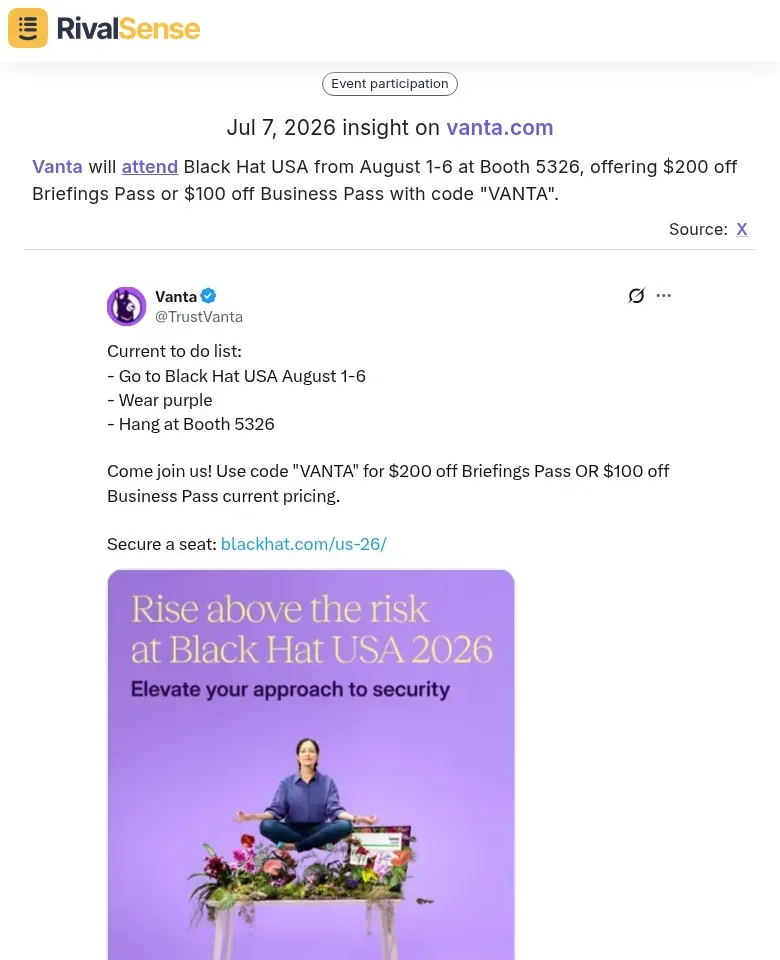
Vanta will attend Black Hat USA from August 1-6 at Booth 5326, offering $200 off Briefings Pass or $100 off Business Pass with code “VANTA”.
Tracking event participation provides a direct window into competitive tactics: booth size, discount codes, and the event’s audience profile all indicate who they’re trying to attract. If a key account attends Black Hat, you’ll know exactly what Vanta is offering—and can craft a counter-strategy.
How to implement event tracking:
- Set up alerts for competitor booth appearances, speaking slots, and sponsorship tiers via tools like RivalSense or Google Alerts.
- Monitor social channels for real-time posts, hashtags, and attendee interactions to capture messaging shifts.
- Analyze follow-up content—post-event emails, blogs, or case studies—to see which accounts they target next.
Pro tip: Create a simple checklist to track competitors’ event activity:
- [ ] Which events are they attending?
- [ ] What promotions or demos are they offering?
- [ ] Which accounts are they engaging with publicly?
- [ ] How does their post-event follow-up differ from yours?
Armed with this data, you can adjust your own event strategy—tailoring invites, content, or booth offers to win over high-value accounts before your competitors deepen their relationships.
Harnessing AI for Deep Competitor Intelligence
Harness AI to transform scattered competitor data into actionable intelligence. AI tools can automatically synthesize reports from multiple sources—earning calls, press releases, product updates—and generate concise summaries. For example, set up an AI agent to scan competitor activity weekly and produce a one-page brief for account teams. This keeps everyone informed without manual effort, improving responsiveness to market shifts.
Noticing how competitors adopt AI themselves can also reveal their future capabilities. RivalSense spotted this early partnership:
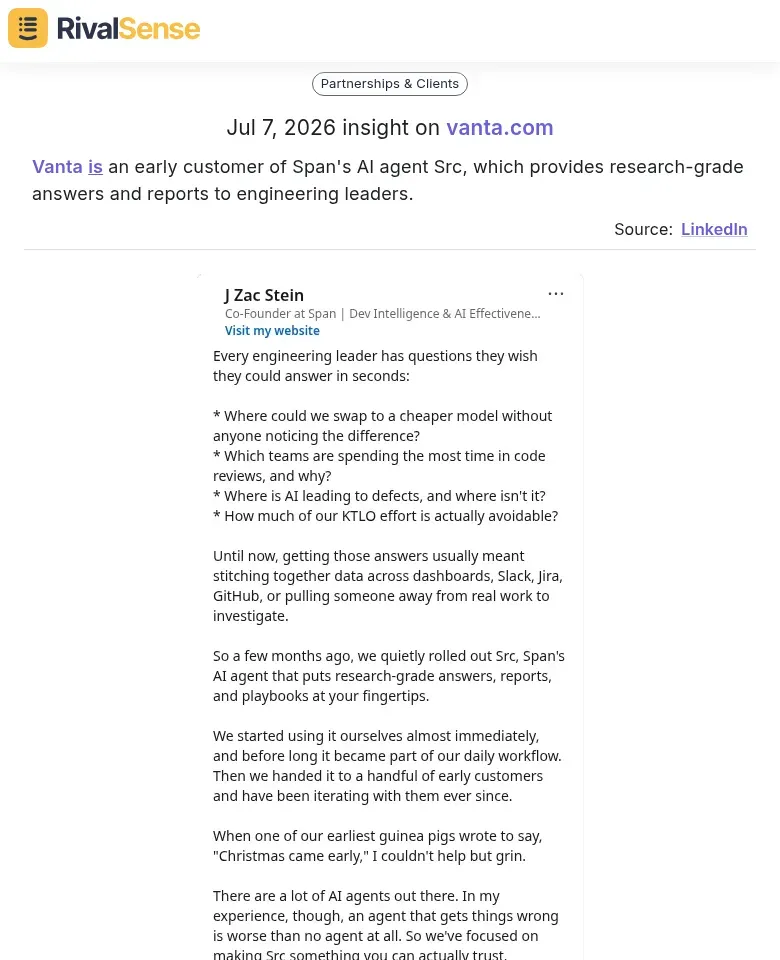
Vanta is an early customer of Span's AI agent Src, which provides research-grade answers and reports to engineering leaders.
When a competitor embraces cutting-edge AI tools like Src, it signals an acceleration in their internal intelligence gathering and product development. Understanding their tech stack helps you gauge how quickly they might act on market insights, forcing you to match or exceed their speed.
Practical steps:
- Define key monitoring signals (e.g., new features, pricing changes, leadership hires).
- Feed historical and real-time data into an AI analysis engine (use tools like RivalSense or custom GPTs).
- Generate automated briefs scheduled before weekly account meetings. Include a ‘so what’ section linking each signal to account risk or opportunity.
AI excels at pattern detection from large datasets—it can flag that a competitor’s price drop in one segment often precedes an expansion into your key accounts. Human analysts might miss such correlations. Use AI to cluster competitor moves (e.g., ‘aggressive pricing,’ ‘product bundling’) and alert your team when patterns shift.
Tip: Start with one key account and test the AI brief workflow. Iterate on signal relevance and summary length before scaling across all accounts.
Implementing an Automated Key Account Monitoring Workflow
To implement an automated key account monitoring workflow, start by setting up tracking across four critical channels: news, hiring, events, and product changes. Use tools like RivalSense to aggregate these signals into a single dashboard, then configure automated alerts for real-time notifications.
Step 1: Define Scope – Map your key accounts and assign priority levels (e.g., A/B/C). High-priority accounts require monitoring across all channels; lower-tier accounts can focus on major product or leadership changes.
Step 2: Integrate with CRM – Connect your monitoring tool to platforms like Salesforce or HubSpot. This pushes relevant competitor moves directly into account records, triggering alerts for account managers. For example, a competitor’s executive hire at a key account automatically creates a task for the assigned manager.
Step 3: Prioritize Signal Types – Not all signals are equal. Use a scoring system that weights events based on account importance (e.g., a funding round for a strategic account scores 10/10, while a random blog post scores 2/10). This prevents alert fatigue.
Pro Tip: Set up daily digest emails for low-priority accounts and real-time SMS alerts for tier-1 accounts. Test your workflow with a two-week pilot, adjusting thresholds based on manager feedback.
Future-Proofing Trust Management with Automation
To future-proof trust management, automation must evolve as a strategic asset, not a static tool. Gain a competitive edge by automating proactive account monitoring: set up alerts for competitor product launches, pricing shifts, or leadership changes that could impact your key accounts. Practical step: Use RivalSense or similar tools to create custom dashboards tracking competitor activity by account, then configure email/Slack notifications for high-priority signals. Continuously refine your system—schedule monthly reviews with account teams to assess alert relevance and add new data sources (e.g., social media, annual reports).
Checklist for refinement:
- [ ] Survey account managers quarterly on alert usefulness.
- [ ] A/B test notification frequency to avoid fatigue.
- [ ] Integrate CRM data to correlate competitor moves with account churn risks.
Staying ahead of competitor moves builds long-term trust: when you proactively share insights like “Competitor X is launching a new feature—here’s how we’ll address your concerns,” you demonstrate vigilance and partnership. Pro tip: Create a “Competitor Action Log” tied to each key account, automatically populated by your monitoring tool, so every team member can reference historical competitor moves during strategy discussions. This transforms monitoring from reactive defense to proactive trust-building.
Ready to safeguard your key accounts? Try RivalSense for free at https://rivalsense.co/ and get your first competitor report today—no setup, no heavy lifting, just immediate insight.
📚 Read more
👉 Competitor Distribution Channel Monitoring: Your Compliance Superpower
👉 Comparative Pricing Analysis: Uncover Competitor Market Cap Insights
👉 How to Turn a Competitor’s Milestone Into Your Next Strategic Move