
Predict Competitor SEO Moves via LinkedIn Insights
Most competitive SEO analysis relies on backward-looking tools that catch moves only after they’ve gone live. LinkedIn flips this dynamic, offering real-time, unsolicited signals about what your competitors are planning before they appear on owned channels. Unlike polished press releases or blog posts, LinkedIn announcements reveal softer signals—hints about location expansions, event plans, and partnerships that can be reverse-engineered into SEO predictions.
How to mine these signals for SEO predictions:
- New landing pages. A competitor’s post about “now hiring in Berlin” likely precedes a dedicated DE landing page. Watch for location tags in employee profile updates.
- Content themes. If a competitor’s CTO frequently comments on “AI-powered analytics,” expect new blog content or a pillar page on that topic soon. Track their engagement patterns.
- Backlink targets. Partnerships announced on LinkedIn (e.g., “We’re thrilled to integrate with X”) often lead to co-marketing pages and reciprocal backlinks. Jump on those partnership opportunities yourself.
Quick-start checklist:
- Use LinkedIn Sales Navigator to create a competitive list.
- Monitor employee posts, not just company pages—team members often leak plans first.
- Set up Google Alerts for key phrases your competitors use on LinkedIn.
- Reverse-engineer every “we’re excited to announce” post into a specific SEO asset prediction.
By treating LinkedIn as an early-warning radar for SEO moves, you shift from reactive analysis to proactive strategy—catching shifts before they impact your organic performance.
Decoding Location Expansion Announcements for Local and Product SEO
When your competitor announces a new facility or regional hub, it’s not just an operations win—it’s a clear signal of incoming localized content. Location expansions almost always trigger dedicated landing pages targeting city-specific keywords and often coincide with product-specific pages tied to that geography. These pages typically appear 3–6 months after the public announcement, giving you a critical window to prepare your own content and keyword strategies.
Consider this real insight captured by RivalSense: Helsing selected West Virginia for its US production home to manufacture the HX-2 loitering munition system.
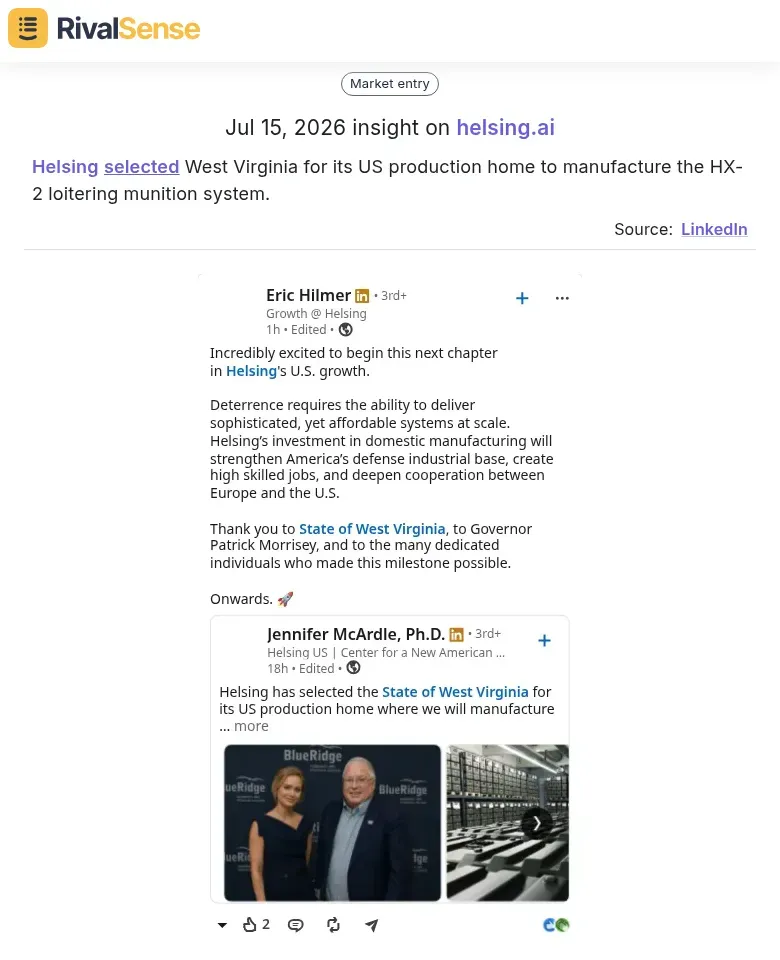
Why this matters for your strategy: A move like this signals upcoming location-focused landing pages (e.g., “defense manufacturing West Virginia”) and niche product pages optimized for industrial keywords like “HX-2 loitering munition.” By tracking such expansions early, you can predict their content map and either compete head-on or identify adjacent keyword gaps. Action step: Set up Google Alerts for competitor name + “new office” or “facility” terms, and watch for building permits or lease filings in local registries. Pro tip: Use Screaming Frog to crawl their existing site for page drafts or hidden “/test/” directories that may reveal new products. Finally, monitor hiring posts in that geography. A spike in roles like “SEO Specialist” or “Content Writer” in the region signals upcoming geo-targeted content and structured data implementations (e.g., LocalBusiness schema).
Checklist:
- Track job boards (LinkedIn, Indeed) for location-based hires.
- Over the next 8 weeks, check the competitor’s sitemap for new /location/ or /product/ URLs.
- Run a weekly
site:competitor.com inurl:west-virginiasearch to catch new pages early.
Event Participation as a Leading Indicator of Content & Backlink Moves
LinkedIn posts about event attendance are among the easiest competitive signals to spot and the most predictive of upcoming SEO activity. When a competitor announces they’ll be at a major conference, they’re effectively previewing the content they’ll create to support that event—blog posts, landing pages, speaker bios, and recap articles. Because events run on a fixed calendar, you can time your own moves precisely.
Take this RivalSense insight: Archer Integrated Risk Management will attend Black Hat USA from August 3-7, as announced by Rachel Bartlone.
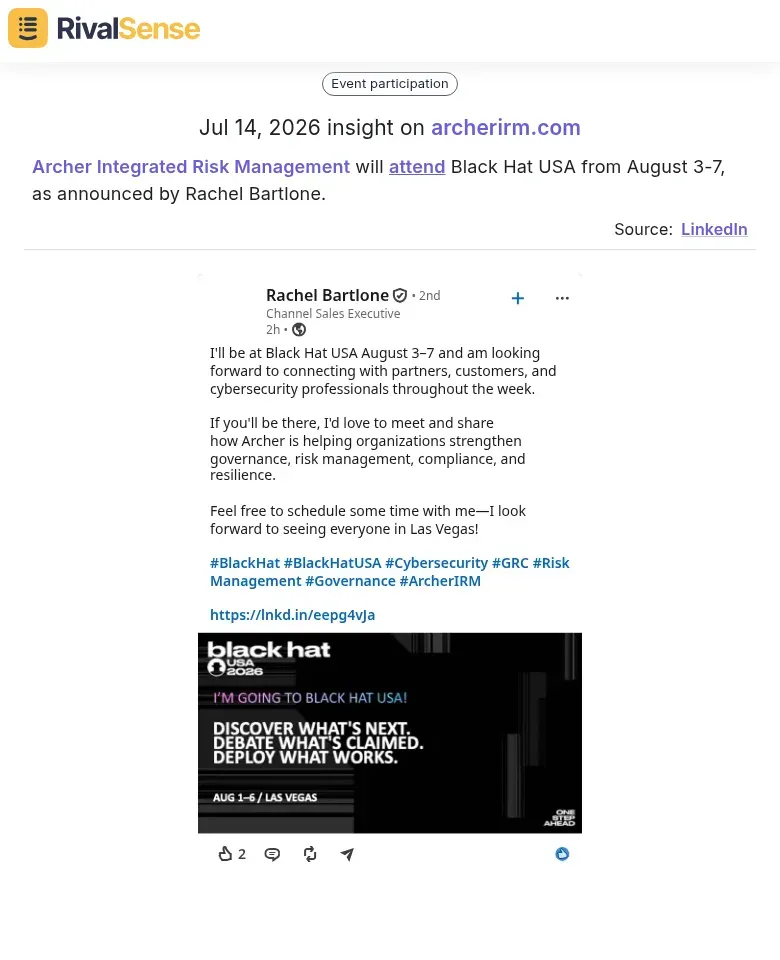
Why this matters for your strategy: This type of signal lets you forecast exactly what content Archer will publish—likely a “Black Hat 2026” landing page, session recap posts, and influencer roundups. It also tells you which backlinks they’ll pursue (conference press coverage, speaker bio pages) and what keywords they’ll optimize for (e.g., “Black Hat 2026 cybersecurity”). Use this early intel to publish your own event-related content ahead of theirs or to target the same high-authority backlink sources before they do.
How to predict and prepare:
- Spot the Signal: Scan LinkedIn for posts mentioning conference attendance, speaker slots, or booth numbers. Look for hashtags like #BlackHat2026.
- Predict Content Types: Expect landing pages targeting event keywords, speaker bios, session recaps, and “top takeaways” blog posts.
- Backlink Opportunities: Media coverage of conferences generates high-authority backlinks. Monitor which outlets the competitor engages with and pitch those journalists directly.
- Keyword Forecasting: Note the event-related keywords in their posts—these are terms they’ll optimize for. Use Google Keyword Planner to estimate search volume.
Pro tip: Create a LinkedIn list of key competitors and set alerts for event mentions. When you see a post, start drafting your own event content immediately to beat them to the SERP. Also, track the backlinks they earn from event coverage—these are prime targets for your outreach.
Partnerships and Funding Announcements: Authority-Building Signals
When a competitor announces a partnership or a funding round on LinkedIn, they’re not just celebrating a milestone—they’re about to launch a PR and content offensive that can significantly boost their search authority. Joint ventures lead to co-branded landing pages, cross-linking opportunities, and press releases that attract dozens of high-quality backlinks. Funding news, especially from notable investors, acts as a link magnet because major outlets automatically cover the round.
A perfect illustration comes from RivalSense: ICONIQ announced its partnership with Helsing and celebrated the company’s Series E, noting its AI-driven defense systems are battle-tested in Ukraine.

Why this matters for your strategy: An announcement of this calibre means Helsing is about to see a flood of backlinks from financial and tech media, as well as co-branded content with ICONIQ. For a competing founder, this is a cue to double down on your own authority-building efforts—perhaps by securing similar partnerships or by creating content that differentiates around AI-driven defense while the topic is hot. Spotting the partnership early lets you add those imminent backlink sources to your outreach list and forecast the keyword clusters they’ll target (e.g., “AI defense systems,” “battle-tested AI”).
How to leverage this:
- Track announcements daily – Use LinkedIn alerts or a tool like RivalSense to capture partnership/funding posts.
- Analyze link-building impact – Check the competitor’s backlink profile (Ahrefs, SEMrush) before and after the announcement for spikes in referring domains.
- Identify focus areas – If a competitor raises Series E for “AI defense systems,” expect new blog content around AI security, defense tech keywords, and related clusters. Plan your own content to compete or differentiate.
- Monitor new pages – Watch for new /partners/ or /press/ subdirectories; these often house co-branded content ripe for cross-linking.
Pro tip: Create a shared spreadsheet mapping each announcement to potential backlink sources and predicted keyword targets. Update weekly to stay ahead of their editorial calendar.
Actionable Framework: From LinkedIn Insight to SEO Prediction
Turning LinkedIn chatter into concrete SEO plans doesn’t require guesswork—just a repeatable process. A structured framework ensures you never miss a signal and can act on it within hours. That speed is what separates reactive monitoring from predictive advantage.
1. Set Up Monitoring
- Follow competitors’ company pages and key employees (CMOs, SEO leads, product managers).
- Use a tool like RivalSense to aggregate posts and track changes in job titles, location tags, event attendance, partnership announcements, and funding news.
2. Map Signals to SEO Tactics
- New office location → Expect localized landing pages targeting city+industry keywords. Start preparing your own geo-targeted content.
- Event sponsorship/speaking → They’ll publish event recap pages and link-building posts. Plan competing content around the same event hashtags.
- Funding round → They’ll ramp up PR, guest posts, and backlink outreach. Monitor their new backlinks weekly via Ahrefs or Semrush.
- Hiring surge → New roles often signal new content verticals. Track job descriptions for keyword hints.
3. Build a Prediction Scorecard
| Signal Type | Timing Window | Likely SEO Move | Example Keywords |
|---|---|---|---|
| New office | 3-6 months after announcement | Local landing pages, product pages | “Berlin [industry]”, “manufacturing [city]” |
| Event attendance | 2 weeks pre-event to 1 month post | Event hub, speaker bios, recap posts | “Black Hat 2026 trends”, “conference cybersecurity” |
| Partnership | 1-2 months | Co-branded page, joint press release | “[partner] integration”, “collaboration [industry]” |
| Funding round | 30 days post-announcement | PR blitz, guest posts, authority content | “Series E [company]”, “AI defense systems” |
Pro tip: Create a shared spreadsheet with columns for Signal, Likely SEO Move, Expected Date, and Priority. Review weekly and adjust your content calendar accordingly. This turns reactive monitoring into proactive strategy.
Stay Ahead by Watching What Competitors Share on LinkedIn
LinkedIn remains an underutilized goldmine for predictive competitive intelligence in SEO. By systematically analyzing hiring announcements, event appearances, and partnership posts, you can anticipate competitors’ next moves—whether it’s a content pivot, a technical SEO overhaul, or a new market entry—and adjust your strategy proactively.
Start small: pick three key competitors. Dedicate 30 minutes each week to review their LinkedIn activity. For each signal you spot, note one SEO prediction (e.g., new blog topics, link-building campaigns, or tool investments). Over time, patterns will emerge, giving you a strategic edge.
Quick checklist for weekly monitoring:
- Scan new hires in SEO, content, or engineering roles.
- Look for webinar or conference participation hints at upcoming topics.
- Watch for tool announcements or integration partnerships.
- Note any sudden spikes in engagement or content frequency.
To streamline this process and catch signals the moment they appear, consider using RivalSense. It automatically tracks competitor product launches, pricing updates, event participation, partnerships, regulatory moves, and more across company websites, social media, and registries—then delivers everything in a single weekly email report. Get your first competitor report today and turn LinkedIn insights into SEO action. Try RivalSense for free →
📚 Read more
👉 Automate Key Account Monitoring in Trust Management
👉 Competitor Distribution Channel Monitoring: Your Compliance Superpower
👉 Comparative Pricing Analysis: Uncover Competitor Market Cap Insights
👉 How to Turn a Competitor’s Milestone Into Your Next Strategic Move