
Comparative Pricing Analysis: Uncover Competitor Market Cap Insights
Comparative pricing analysis isn't just about matching numbers—it's about decoding your competitors' strategic intent. As a founder or CEO, you need to understand how every limited-time offer, bundle twist, and plan restructuring affects your market position.
Why it matters: Pricing directly impacts perceived value. A price too high can drive customers to cheaper alternatives, while a price too low may signal inferior quality. By benchmarking your pricing, you can identify sweet spots that maximize conversion and profitability.
Impact on acquisition & retention: Strategic pricing attracts the right customers and reduces churn. For instance, value-based pricing aligned with competitor offerings can reduce price objections, while loyalty programs or tiered pricing can incentivize repeat business. A simple tip: map your pricing tiers against competitors' to spot gaps—e.g., offering a mid-tier feature set that competitors lack at a similar price point.
What you'll learn in this post:
- How to collect and normalize competitor pricing data.
- Frameworks (e.g., price-value matrix) to analyze positioning.
- Using market cap insights to predict competitor pricing moves.
- A 3-step checklist to act on your findings.
⏳ Temporal Pricing Tactics: Limited-Time Offers and Event-Driven Strategies
Limited-time offers (LTOs) and event-driven promotions are powerful levers for driving urgency and repeat purchases. To analyze their impact on competitor market cap, you need a systematic monitoring approach. Consider this real RivalSense insight:
Flying Tiger Copenhagen is offering free drinks in store until July 8, 2026, as part of its Treasure Days sale.
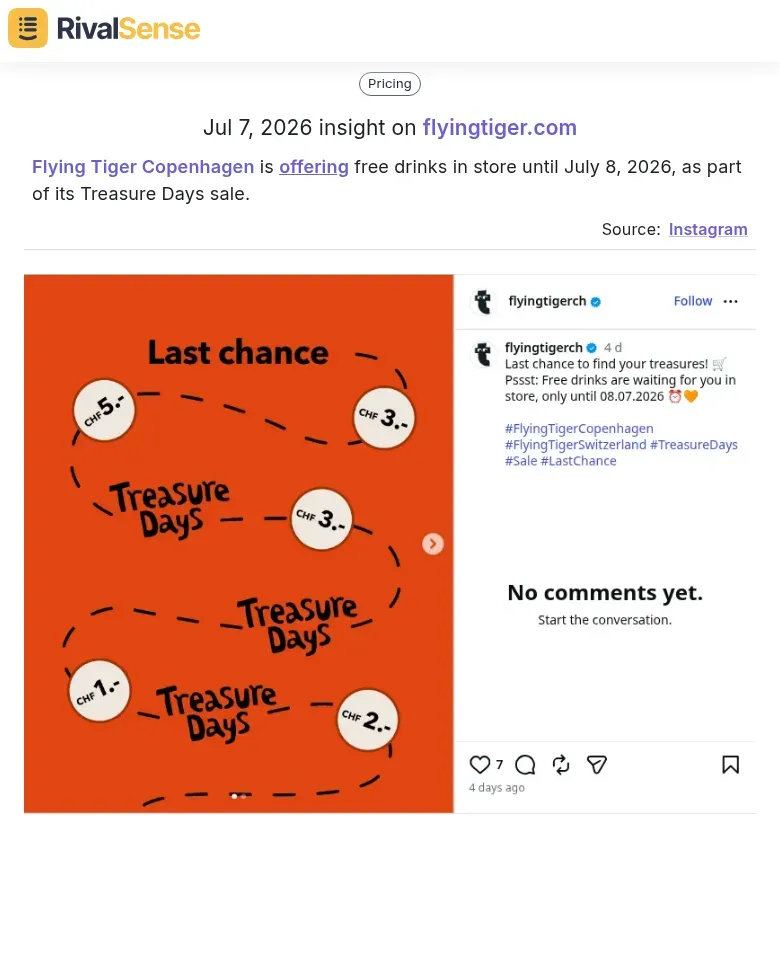
This type of insight is invaluable for business strategy because it reveals how a competitor uses in-store giveaways to boost foot traffic and cross-sell higher-margin items during a seasonal event. For a B2B company, similar patterns appear in webinar attendance rewards or conference booth freebies—spotting these lets you time your own counter-moves or anticipate a spike in their lead generation.
Follow these steps:
1. Track Time-Limited Codes/Coupons
- Monitor competitors' email campaigns, social media, and affiliate sites for coupon codes with expiry dates (e.g., “24HRFLASH”).
- Use tools like RivalSense to automatically capture and deliver these signals, noting the discount depth and frequency.
- Measure conversion rate spikes during these windows via web analytics; a 20-40% uplift is common.
2. Map Event-Driven Promotions
- Identify recurring events (Black Friday, Cyber Monday, Super Bowl, back-to-school) and plot competitors’ historical pricing against them.
- Look for patterns: Do they offer 15% off during March Madness but 30% off during Prime Day clones? This reveals market cap sensitivity.
3. Quantify Short-Term Market Cap Impact
- Calculate revenue lift per event by combining average order value (AOV) × order volume increase.
- Compare before/after stock price or private valuation (if data available) around the promo period.
Practical Checklist:
- [ ] Set up a spreadsheet to log offer start/end dates, discount %, and channel used.
- [ ] Subscribe to competitors’ newsletters; enable push notifications for app-based offers.
- [ ] For B2B, track webinar registration discounts or early-bird pricing tied to industry conferences.
Hint: Use automated alerts to catch stealth campaigns in real time. Correlate spikes in social chatter with pricing changes to estimate competitor revenue acceleration—and how that affects their perceived market cap.
🎁 Bundling and Perceived Value: Enhancing Core Offerings with Free Add-Ons
Bundling free add-ons with core offerings can shift perceived value without lowering list prices. A SaaS tool might include a complementary integration or premium template at no extra cost—a tactic that draws inbound interest and creates urgency when time-limited. Here's a competitor insight captured by RivalSense that exemplifies the power of a clever bundle:
Niantic announced that the offer code GOFEST2026 can be used in the Pokémon GO Web Store for purchases over US$4.99 to receive a Premium Battle Pass.
Why does this matter for your strategy? It demonstrates how a bonus item—perceived as high-value by customers—can be attached to a minimum spend threshold, effectively increasing average order size. For a B2B company, imagine offering a free premium consulting session with an annual plan; monitoring such moves from competitors helps you stay one step ahead in packaging your own services.
Practical Steps:
- Identify low-cost, high-perceived-value add-ons (e.g., eBooks, sample reports, beta features).
- Run A/B tests offering a free item for a limited period (7–14 days) and measure conversion uplift.
- Track CLV of customers acquired via bundles vs. standard pricing—bundles often yield higher retention.
Checklist for Deployment:
- [ ] Confirm the add-on’s marginal cost is ≤10% of core price.
- [ ] Set clear expiration dates to maintain exclusivity.
- [ ] Monitor competitor reactions to avoid price wars.
By strategically bundling, you differentiate your product while subtly gathering data on what features matter most to your audience.
📉 Subscription and Plan Restructuring: Adjusting Price Points for Market Penetration
To gain market share, consider lowering subscription prices below key competitors. However, avoid a race to the bottom by pairing price cuts with clear differentiators—for instance, emphasize superior server coverage, faster load times, or advanced security features that justify your value proposition even at a lower price point. A recent RivalSense insight shows how one company executed this:
Private Internet Access dropped its 2-year plan to $1.33 per month ahead of the World Cup 2026 quarterfinals, offering servers in 90 countries and all 50 US states.
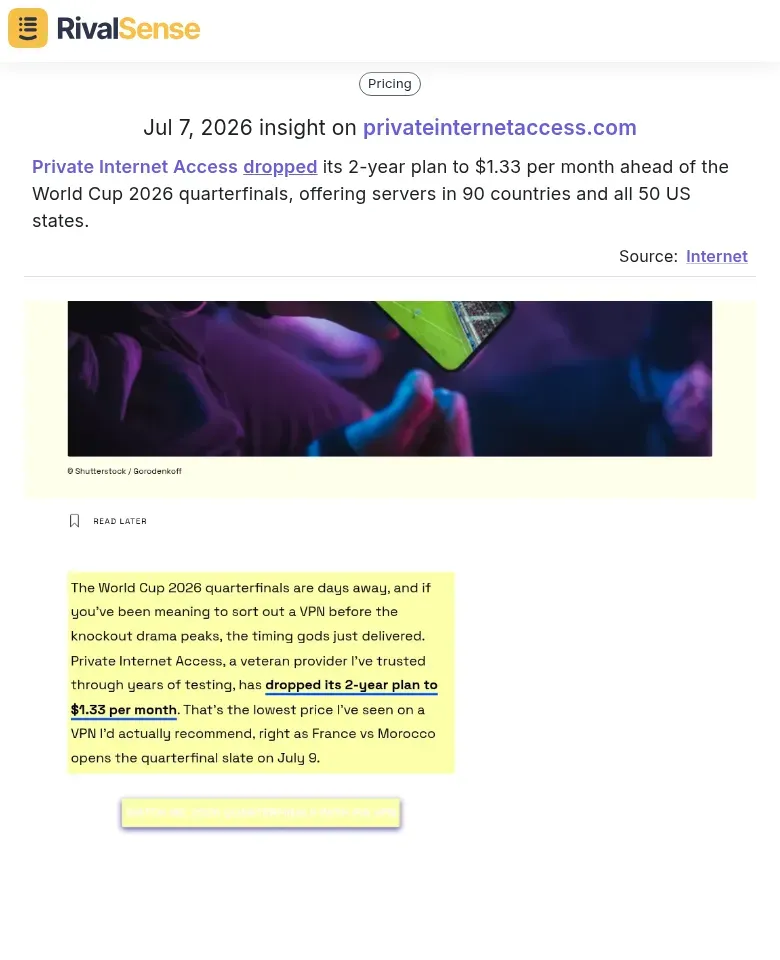
This insight is valuable because it demonstrates event-triggered pricing and aggressive market penetration—a B2B competitor might slash prices before a major industry expo to capture attention. Spotting this early through monitoring lets you decide whether to counter, ignore, or reposition your own messaging.
Steps to restructure plans:
- Map competitor pricing tiers – Identify their entry-level, mid, and premium plans.
- Identify price-sensitive segments – Look for customer reviews citing cost as a concern.
- Set competitive price points – Underprice by 10–20% on comparable features, but maintain a premium tier for full-feature users.
- Communicate the change – Highlight infrastructure advantages (e.g., "50+ global server locations") in your marketing.
Long-term revenue evaluation checklist:
- ✅ Project volume increases: Will lower prices attract enough new users to offset per-unit revenue loss?
- ✅ Analyze churn risk: Could existing customers downgrade to cheaper plans? Consider grandfathering or locking features.
- ✅ Monitor lifetime value (LTV): Lower prices may reduce LTV; ensure customer acquisition cost (CAC) adjusts accordingly.
- ✅ Test with A/B pricing trials before company-wide rollout.
A well-executed price restructuring can boost market penetration without sacrificing profitability—provided you track unit economics closely.
🔍 Data-Driven Insights: Reverse-Engineering Competitor Pricing Decisions
To reverse-engineer competitor pricing decisions, start by tracking the timing of their announcements. Use a tool to log dates, audience segments, and channels (press releases, social media, direct emails). Look for patterns: Are price hikes clustered before fiscal quarters? Do they follow a rival's move by two weeks? Map these to external triggers—raw material cost spikes, seasonal demand cycles, or new feature launches.
Practical steps:
- Create a pricing timeline matrix. For each competitor, record price change date, percentage, audience (enterprise vs. SMB), and channel.
- Overlay market events. Note industry reports, earnings calls, and economic indicators (e.g., inflation rates) on the same timeline.
- Estimate market cap impact. Multiply the price change percentage by their annual recurring revenue (ARR) to gauge potential revenue lift. If a competitor raised prices by 10% on their top-tier plan, estimate the ARR uplift and compare with their stock price movement post-announcement.
Tip: Use public APIs (e.g., Wayback Machine) to retrieve historical pricing pages. A sudden discount to a specific segment may signal loss of market share or a new entrant threat.
By correlating pricing shifts with external factors, you can predict future moves—and adjust your own strategy before the market reacts.
🧩 Conclusion: Building Your Own Pricing Intelligence Framework
To systematically track competitor pricing, follow these steps:
- Define your competitive set – Identify 5–10 key competitors whose pricing moves matter most.
- Set up automated monitoring – Use tools like RivalSense to capture changes without manual effort.
- Normalize data – Track price per unit, tier, and feature bundle to compare apples-to-apples.
- Store historically – Maintain a database of price points, discount offers, and bundling changes over time.
Key metrics to watch:
- Price change frequency – Sudden spikes may signal strategic pivots.
- Discount depth & prevalence – Heavy discounts often precede a price drop.
- Feature-to-price ratio – If features increase without price rises, expect future hikes.
Turning insights into action:
- React fast – When a rival slashes prices, model impact on your retention before matching.
- Differentiate – If competitors race to the bottom, double down on value-added services.
- Time your moves – Launch price increases when competitors are raising theirs (less customer backlash).
Pro tip: Combine pricing data with product release timelines. A price drop often follows a major feature launch as competitors try to gain share. Monitor both signals together for early-warning alerts.
By embedding this framework into your weekly CI routine, you move from reactive to proactive pricing strategy.
Ready to see competitor pricing moves before they impact your business?
Stop manually hunting for coupon codes, price drops, and bundle offers. RivalSense tracks competitor product launches, pricing updates, event participations, partnerships, and more—across company websites, social media, and registries—delivering a clear weekly email report. Try RivalSense for free and get your first competitor report today: https://rivalsense.co/.
📚 Read more
👉 How to Turn a Competitor’s Milestone Into Your Next Strategic Move
👉 Stop Learning About Competitor Moves from Press Releases
👉 Predictive Analysis: What Gives Your Competitors an Edge