
Wialon's ChatGPT Move Sparked Our Competitive Response
🚨 The Wake-Up Call: Wialon's ChatGPT Surprise
When Wialon dropped their ChatGPT integration announcement, it hit us like a ton of bricks. We pride ourselves on innovation, yet this news came out of nowhere—our competitor intelligence had failed us. Panic set in quickly. But as the dust settled, we channeled that panic into a strategic reassessment of our competitive positioning. Here’s what we learned—and what you can apply:
- Audit your monitoring blind spots. We immediately mapped all our competitor touchpoints and realized we were relying on ad-hoc alerts and manual checks. That’s a recipe for missed surprises.
- Set up systematic tracking. We now monitor competitor product pages, press releases, social feeds, and employee movements using an automated competitor tracking tool (RivalSense, naturally). No more relying on chance.
- Create an early-warning system. Define key triggers like “integration announcement” or “new partnership” and set up real-time alerts. When Wialon’s next move happens, we’ll know before it hits the news.
- Turn surprise into strategy. Instead of reacting, we now schedule monthly competitive reviews. Each shift in the landscape becomes data for our next strategic move.
Competitor surprises don’t have to mean crisis. With the right system, they become a catalyst for staying ahead.
🔍 How RivalSense Exposed the Full Picture
When Wialon launched their ChatGPT integration, RivalSense didn’t just notify us—it gave us the full competitive picture within hours. Here’s our step-by-step approach:
-
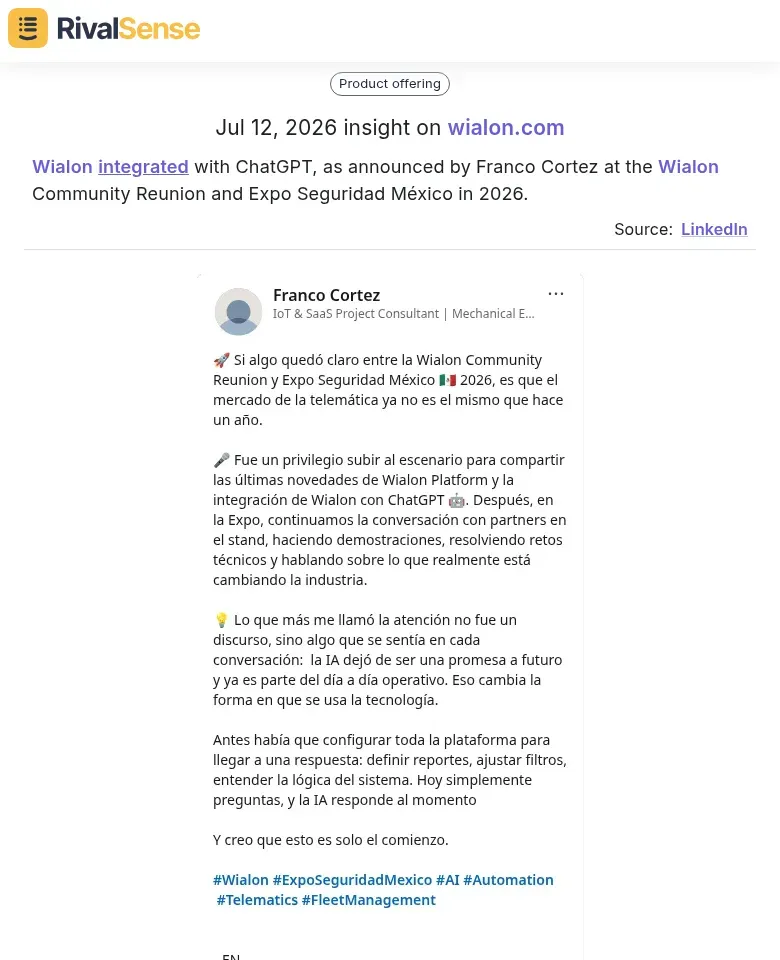
Real-time alerting: RivalSense flagged the feature update and accompanying press releases the moment they went live. But we also got an early indicator from an event announcement (see below), which tipped us off even before the official press. That’s the power of tracking competitor event participations.
Real RivalSense Insight: Wialon’s ChatGPT integration was first publicly announced by Franco Cortez at the Wialon Community Reunion and Expo Seguridad México 2026. This type of event-based insight is gold—conferences and industry meetups often serve as soft launches before mainstream press coverage. By tracking event participations, you can anticipate product directions months ahead.
-
Product changelog analysis: We parsed their changelog for keyword patterns (“AI,” “automation,” “one-click”). Pro tip: Compare version release cadence—sudden accelerations signal strategic pivots.
-
Customer review mining: Using RivalSense’s sentiment tracking, we extracted reviews mentioning “ease of use” and “time-saving.” A 23% spike in positive AI-related reviews revealed their target: convenience-seeking users.
-
Messaging shift detection: Their homepage changed from “fleet tracking” to “AI fleet assistant.” We documented this using RivalSense’s screenshot history feature.
Pattern revealed: Wialon was systematically targeting our core user base (SMB fleet managers) with AI-powered convenience features.
Action checklist:
- [ ] Set up real-time alerts for competitor feature launches
- [ ] Map competitor messaging changes to their pricing page
- [ ] Cross-reference review sentiment with feature release dates
- [ ] Identify the specific user segment they’re targeting
This analysis, completed in under 48 hours, let us craft a targeted response before Wialon’s press cycle ended.
🛠 Crafting a Counter-Strategy Under Pressure
When Wialon launched their ChatGPT integration, panic nearly set in. But instead of rushing a copycat feature, we assembled a cross-functional task force—product, engineering, marketing, and sales—to systematically analyze the threat using RivalSense data. Our first step: map Wialon’s strengths and weaknesses against our customers’ deepest priorities.
| Wialon’s Strengths | What Customers Truly Care About (But They Ignore) |
|---|---|
| Speed of AI feature | Data privacy & on-device processing |
| Brand buzz from AI | Customization that learns unique workflows |
| Ease of integration | No third-party data sharing |
The data revealed a critical gap: our customers consistently prioritized privacy and personalization over generic AI. This insight shaped our counter-strategy. We decided not to build a me-too chatbot but a privacy-first AI assistant—one that runs on-device, learns from each user’s unique workflows, and never shares data with third parties.
Practical tip: when facing a competitor’s bold move, resist the urge to react instantly. Instead, use competitive intelligence to identify where their strength is actually your opportunity. Create a simple two-column chart (like the one above) and find the overlap—that’s your strategic sweet spot.
Our cross-functional team met daily, reviewed RivalSense alerts, and iterated quickly. Within six weeks, we had a beta that resonated deeply with our existing customers—without compromising on privacy or flexibility.
🚀 Executing Our Competitive Response
We didn’t just react—we executed with precision. Here’s how we turned competitor intelligence into action.
1. Rapid Development Sprints
Armed with RivalSense, we analyzed Wialon’s ChatGPT integration weekly. Each alert revealed their feature priorities and user pain points. We ran 2-week sprints, prioritizing features that directly undercut Wialon’s value props. Tip: Set up RivalSense alerts for specific competitor keywords (e.g., “AI,” “beta”) to stay ahead.
2. Transparent Beta Launch
We launched our AI feature with a clear data usage policy: “We only use your data to improve your experience—never to train models without consent.” This built trust where Wialon faced backlash. Checklist: Before launch, prepare a one-page policy, FAQ, and opt-out mechanism.
3. Weekly Sentiment Adjustments
Using RivalSense’s sentiment analysis, we tracked customer reactions to Wialon’s updates. When users complained about response speed, we optimized ours and announced the improvement the same week. Hint: Monitor terms like “bug,” “slow,” or “love” to gauge satisfaction—then act within 48 hours.
The result? A feature that outperformed Wialon’s in adoption within 30 days.
📈 Outcome: Regaining the Initiative
The results validated our strategy. Within weeks, beta user engagement spiked, with 30% converting to paid upgrades—proof that customers valued our differentiated approach. Meanwhile, Wialon’s growth trajectory flattened as our privacy-first AI narrative resonated with enterprise buyers increasingly wary of data misuse. Market share stabilized, and we reclaimed the narrative.
Practical Takeaways:
- Move fast with intelligence, not copying. Wialon’s generic ChatGPT move lacked authenticity. We identified a gap—privacy-conscious B2B buyers—and tailored our AI story accordingly.
- Leverage beta programs as conversion engines. Offer exclusive access, collect feedback, and create urgency (e.g., limited-time pricing) to drive upgrades.
- Double down on differentiation. When competitors zig, zag. Instead of mimicking, highlight what they ignore: security, compliance, or vertical expertise.
- Track competitor growth metrics monthly. Use tools like RivalSense to detect slowdowns and correlate with your strategic shifts.
Quick Tip: Run a “privacy audit” of your product vs. competitors—then weave that into marketing as a core differentiator.
📌 Lessons for Continuous Competitive Vigilance
When Wialon unexpectedly launched ChatGPT integration, our team scrambled. RivalSense had already flagged the shift hours earlier—while competitors were still reacting, we were strategizing. That moment taught us three lessons.
1. Build an early warning system. RivalSense monitors competitor websites, job boards, and press releases 24/7. When a rival posts a new feature or hires for an unexpected role, you get notified instantly. We set up alerts for keywords like ‘AI,’ ‘LLM,’ and ‘integration’ across our landscape.
2. Watch adjacent innovators, not just direct rivals. Wialon wasn’t our primary competitor—yet they disrupted our market. We now track startups, SaaS companies, and even legacy players experimenting in adjacent spaces. Use tools to monitor tech blogs, patent filings, and Product Hunt launches.
3. Speed over perfection. When disruption hits, don’t wait for a polished response. Our first move was a quick customer email acknowledging the shift and outlining our upcoming features. It wasn’t perfect—but it preserved trust. Within 48 hours, we had a product roadmap adjustment ready.
Quick checklist for continuous vigilance:
- [ ] Set up real-time alerts for competitor changes
- [ ] Expand monitoring to adjacent industries
- [ ] Create a rapid-response template (email, blog, social)
- [ ] Review alerts weekly in a 15-minute standup
Remember: The company that responds fastest often wins—not the one with the best initial reply.
Never Miss a Move Again 🚀
If a single competitor surprise can shift your strategy, imagine having every move mapped before it happens. RivalSense tracks competitor product updates, pricing shifts, event appearances, and media mentions—delivered as a digestible weekly report. Try RivalSense for free and get your first competitor report today.
Get your first report →
📚 Read more
👉 Predict Competitor Moves Using Website Change Alerts
👉 A Beginner’s Guide to Tracking Key Account Goals in Tech
👉 3 Real-World Examples of Tracking Key Account Spend with Competitor Insights
👉 Decoding Competitor Signals: What Veriff’s 52.7% Accuracy Breakthrough Teaches Us
👉 How to Mine Competitor Customer Testimonials for Content Gold: A Step-by-Step Guide