
A Beginner’s Guide to Tracking Key Account Goals in Tech
In the fast-paced tech industry, account goals are anything but static. A product roadmap shift, a funding round, or a new competitor entrant can radically alter a client's priorities within weeks. Without continuous goal alignment, you risk serving yesterday's needs—and losing the account to a more agile rival.
The Three Pillars of Account Goal Tracking
1. Monitor Competitor Movements
When a competitor launches a feature or adjusts pricing, it often signals a shift in market priorities. For example, if a rival introduces AI-powered analytics, your account may soon expect the same. Use competitive intelligence tools to track these signals and proactively adjust your account goals.
2. Establish a Baseline
Define clear, measurable KPIs for each account—revenue targets, product adoption rates, NPS scores. Revisit these monthly, not quarterly. This baseline helps you spot growth opportunities before they become urgent.
3. Create a Continuous Feedback Loop
Schedule bi-weekly check-ins with key stakeholders. Ask: “Has anything changed in your business strategy?” and “What competitor moves have caught your attention?” This turns goal tracking into a shared process, not a passive report.
Quick Tip: Set up a simple dashboard that tracks your top 5 accounts’ stated goals, competitor actions, and your progress. Update it every Friday. In three months, you’ll have a clear pattern of what drives retention and expansion.
By tracking goals dynamically, you move from reactive account management to strategic partnership—building trust and uncovering upsell opportunities your competitors miss.
Decoding Competitor Signals to Inform Account Goals
To set informed account goals, decode competitor signals through three practical lenses. Each signal type reveals different strategic shifts. Here’s how to spot them and—more importantly—what to do with them.
1. Monitor Strategic Hiring for Talent & Budget Signals
A single executive hire can telegraph a company's new priorities. For example, when RivalSense flagged that Google was hiring a Director of Cloud Compensation, it wasn’t just a job posting—it signaled a major push to design competitive reward programs for Google Cloud talent. For your key accounts, this kind of insight suggests Google Cloud is aggressively investing in retention and acquisition. If your accounts rely on cloud services, they may soon face higher costs or bundled incentives—so you should adjust your own value proposition accordingly.
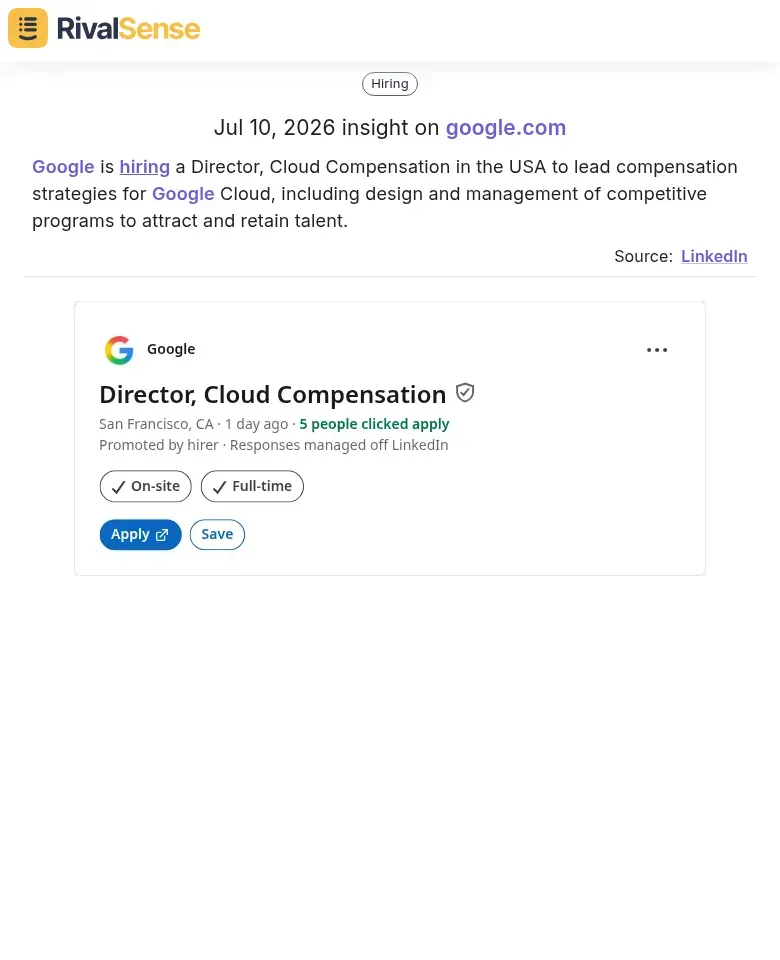
Why it matters: A hire focused on compensation strategy often precedes a pricing model change or a talent war. Track roles like “Compensation Director,” “Head of Sales Incentives,” or “VP Total Rewards” to anticipate shifts that will impact account economics.
2. Track Engineering Leadership Hires to Foresee Product Pivots
When a competitor appoints a senior engineering leader, product roadmap changes are rarely far behind. RivalSense recently detected that Google was looking for a Director of Engineering to lead its global ML scheduling infrastructure. This isn’t just a tech hire—it’s a declaration that Google is doubling down on the orchestration layer for massive machine learning workloads. For key accounts leveraging or competing with Google Cloud, this could mean new service offerings, performance improvements, or even a shift in partner ecosystems.

Why it matters: Such hires precede infrastructure investments (e.g., Kubernetes-native ML scheduling) that you can mirror or counter. Create a simple spreadsheet to track role, date, and inferred priority—then adjust your account goals to align with (or differentiate from) the coming changes.
3. Analyze Industry Adoption Reports to Validate Market Momentum
Reports from authoritative sources reveal technology adoption curves that directly shape client expectations. When Google U.K. released its ‘AI that Works for Britain’ report, finding workplace AI adoption doubled from 34% to 73% in the past year, it confirmed a seismic shift. For your accounts, this means demand for AI solutions is no longer a “future trend”—it’s a current baseline requirement. If your offering doesn’t address AI, expect procurement objections. If it does, now is the time to accelerate AI-related account goals.
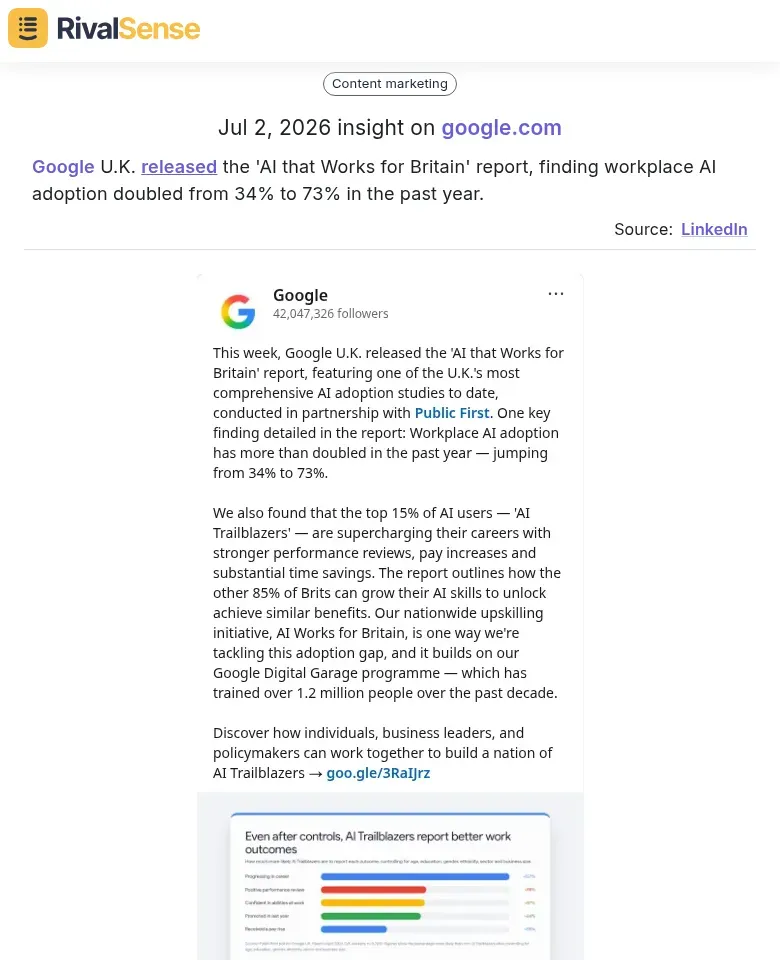
Why it matters: Adoption data helps you frame conversations. You can say, “According to this recent report, AI adoption in your sector has doubled—how is your team preparing?” and immediately position your solution as timely.
Checklist for decoding signals:
- [ ] Identify your competitor’s current tech stack via case studies and job postings.
- [ ] Cross-reference with report trends (e.g., AI-driven analytics) using tools like RivalSense.
- [ ] Assess if your account targets show similar adoption signals.
- [ ] For each insight, ask: “Does this expand my target account list? Does it reprioritize existing goals?”
Use these signals to proactively adjust quarterly targets, not just react.
Setting SMART Goals for Key Accounts
When setting goals for key accounts, start by applying the SMART framework—but layer in competitor insights for a strategic edge. Specific: Instead of ‘increase upsells,’ define ‘upsell our AI analytics module to 3 key accounts by Q3.’ Measurable: Use metrics like account penetration rate or NPS shifts. Achievable: Base your targets on observed competitor moves. If a rival just launched a similar feature, adjust your goal downward to account for increased competition. Relevant: Tie goals to market trends. For example, if AI adoption in your sector grew 40% and talent is shifting toward AI startups, set goals that leverage this momentum—like onboarding accounts onto your AI roadmap. Time-bound: Set quarterly milestones to review against competitive intelligence.
Practical steps:
- Monthly, scan competitor product launches and customer wins.
- Update account goals accordingly—if a competitor targets the same account, shift focus to retention or differentiation.
- Use a table to track:
| Account | Goal | Metric | Baseline | Competitor Signal | Adjustment |
|---|---|---|---|---|---|
| Acme Corp | Expand usage by 20% | MAU | 500 | Rival released AI feature | Focus on bundled AI offering instead |
| Beta Ltd | Renewal at 120% value | Contract value | $200K | Competitor hiring in sector | Accelerate executive engagement |
Pro tip: Assign a ‘competitive trigger’ for each account (e.g., if X competitor hires an AE from this account’s industry, flag it). This shifts you from reactive to proactive. Example: Account A’s goal to expand usage by 20% may need to drop to 10% if a rival undercuts pricing—but you could pivot to a bundled offer instead. Stay nimble.
Tools and Frameworks for Tracking Account Performance
Tracking account performance requires the right tools and frameworks. Start with dashboards that aggregate data from public sources (job boards, news, SEC filings) alongside your internal metrics (CRM, support tickets, product usage). Services like RivalSense, Crayon, or Kompyte can centralize competitor updates into a single view, saving hours of manual research.
Implement a structured framework to turn raw data into action. OKRs work well for growth-stage accounts: set an Objective (e.g., “Expand footprint at Acme Corp”) with Key Results tied to product adoption or contract value. For larger enterprises, a Balanced Scorecard ensures you track financial, customer, internal process, and learning metrics.
Checklist for setting up:
- Define 3–5 critical account metrics (e.g., MAU, NPS, expansion revenue).
- Choose a dashboard tool (Tableau, Geckoboard, or simple Google Data Studio).
- Connect public feeds (Google Alerts, RSS, LinkedIn company pages).
- Schedule weekly reviews of competitor hiring spikes and product launches.
Pro tip: Recalibrate account milestones quarterly based on competitor moves. If a rival just released a feature your target account needs, adjust your roadmap pitch. If they’re hiring for a new team, that signals a shift in priorities you can address.
By combining automated data aggregation with a clear framework, you’ll spot opportunities and risks before they become urgent—turning competitive intelligence into account growth.
Leveraging AI and Automation in Account Goal Tracking
Manual tracking is time-consuming and error-prone. Here’s how to automate it:
-
Automate Signal Collection. Use tools like RivalSense to scrape competitor job postings, product launch pages, and industry reports daily. For example, a sudden spike in sales hiring at a competitor signals a push for market share in your accounts.
-
Apply AI for Analysis. Feed collected data into an AI sentiment analyzer. Look for patterns: positive language in earnings calls may indicate investment in your account’s segment; negative reviews of their product could be your opening. Tools like MonkeyLearn or custom GPT models can classify risks (e.g., competitor poaching) and opportunities (e.g., unmet needs).
-
Set Automated Alerts. Configure alerts for key triggers:
- New executive hires (e.g., a new VP of Sales) → triggers account plan review.
- Funding announcements → assess if they’ll expand into your accounts.
- Product launches → update competitive positioning in your account playbooks.
Practical Tip: Start small—pick one competitor and one account. Automate job posting monitoring for that competitor, set a weekly AI summary, and review alerts with your account team. Scale gradually to 3–5 accounts. Use a simple checklist:
- [ ] Define 3–5 key signals to track.
- [ ] Connect data sources (feeds, APIs).
- [ ] Configure AI to flag risks/opportunities.
- [ ] Set alert thresholds.
- [ ] Review with team bi-weekly.
By automating the tedious parts, you free up time to act on insights and keep account goals aligned with real-time market shifts.
Building a Continuous Feedback Loop
A continuous feedback loop ensures your account goals stay relevant as the competitive landscape shifts. Here’s how to build one:
-
Set a regular cadence for intelligence reviews.
- Schedule weekly 15-minute syncs to discuss new competitor moves, product launches, or customer wins.
- Use a shared dashboard (e.g., RivalSense or a simple spreadsheet) to log updates and flag accounts that need goal adjustments.
- Tip: Align review cycles with your sales pipeline stages—e.g., monthly for prospecting accounts, weekly for those in active negotiation.
-
Foster cross-functional collaboration.
- Create a dedicated Slack channel (#competitive-intel) where sales, marketing, and product teams can post real-time insights.
- Run monthly cross-functional workshops to map intelligence to account goals. Example: Marketing shares a competitor’s new pricing page; product adjusts feature priorities; sales updates the account’s win-back strategy.
- Hint: Assign a rotating ‘intel champion’ from each team to keep the loop alive.
-
Measure impact to refine the loop.
- Track two metrics: account health score (e.g., engagement, sentiment) and revenue attribution (e.g., deals won/lost after goal changes).
- After each review cycle, ask: Did our goal tweak improve the outcome? If not, what intelligence was missing?
- Checklist: ✓ Compare pre- and post-adjustment win rates. ✓ Survey account owners on goal relevance quarterly. ✓ Automate alerts when key accounts show sudden changes in buying signals.
By closing the loop with data, you turn ad‑hoc competitor watching into a strategic advantage.
Ready to turn competitor signals into account growth?
Get your first RivalSense competitor report today—free, no strings attached. See how we track hiring moves, product launches, and industry reports (like the Google examples above) to keep your account goals razor-sharp.
📚 Read more
👉 3 Real-World Examples of Tracking Key Account Spend with Competitor Insights
👉 Decoding Competitor Signals: What Veriff’s 52.7% Accuracy Breakthrough Teaches Us
👉 How to Mine Competitor Customer Testimonials for Content Gold: A Step-by-Step Guide
👉 Data-Driven Insights: Competitor Trade Show Strategies in Semiconductor Support