
3 Real-World Examples of Tracking Key Account Spend with Competitor Insights
Tracking how much your key accounts spend on your product is table stakes. But knowing where they’re allocating budget with competitors—that’s the unlock. For B2B revenue and retention teams, monitoring account spend isn’t just about protecting renewal dollars; it’s about identifying expansion opportunities hiding in plain sight.
When a customer invests in a competitor’s integration, certification, or partnership program, it signals unmet needs, budget shifts, or strategic pivots. By systematically tracking three signal types—new partnerships, integrations, and certifications—you can proactively address gaps, cross-sell, or reposition your value before the relationship erodes.
💡 How to start: Create a simple signal tracker. List your top 20 accounts, then set up alerts for any public announcement of a new partnership, a technology integration, or a certification (e.g., “AWS Advanced Partner”). When you spot a signal, schedule a discovery call focused on the account’s evolving priorities, not your pitch. Pro tip: Use competitive intelligence tools to automate these alerts, so you never miss a signal. This approach turns competitor activity into a roadmap for retention and growth.
Identifying Upsell Opportunities Through Partnership Signals
Strategic partnerships often signal that a key account is scaling its solution stack. When a customer announces a new integration or technology partnership, it frequently precedes increased vendor investment. Here’s how to detect these signals and act.
How to Detect Partnership Announcements
Set up competitor news feeds to monitor for partnership language. Use Boolean search strings like: “[company name] announces integration with” OR “[company name] partners with” OR “[company name] joins forces with”. Filter for relevance using keywords such as strategic alliance, technology partnership, or ecosystem expansion.
Practical Steps
- Create a tracking dashboard in your competitor intelligence tool that monitors your top 20 key accounts for partnership announcements.
- Tag and categorize each announcement by type: technology integration, reseller agreement, or joint go-to-market.
- Alert your sales team within 24 hours of any partnership signal from a key account.
🔎 Real‑world insight from RivalSense:
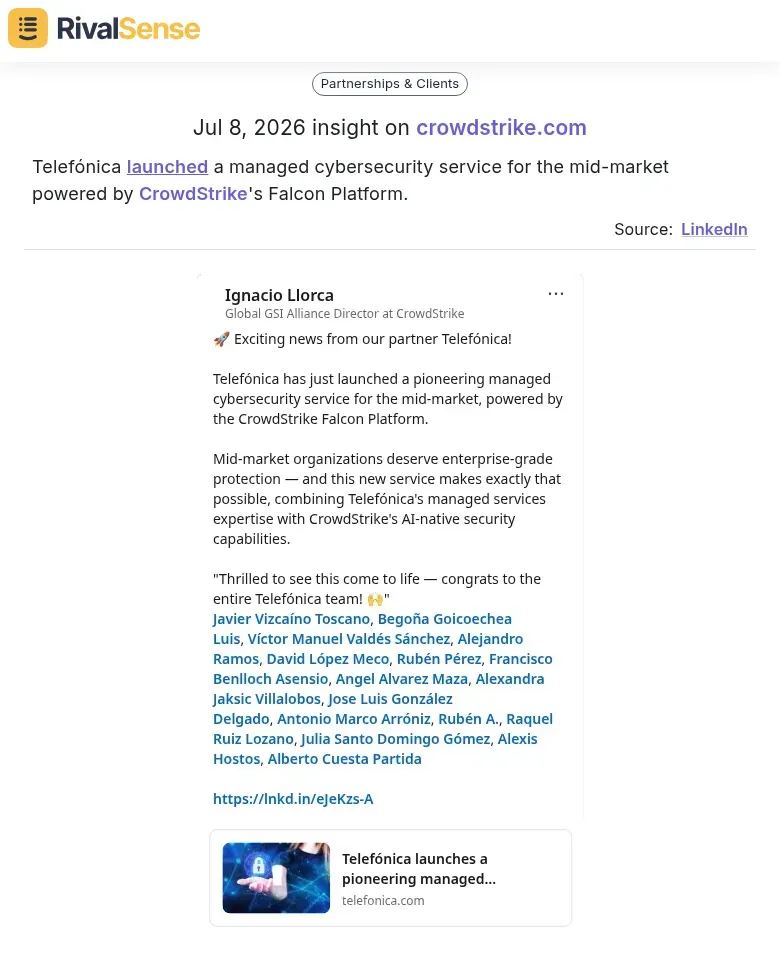
Telefónica launched a managed cybersecurity service for the mid-market powered by CrowdStrike's Falcon Platform.
Why this matters for your strategy: A service launch like this reveals that a key account (or a competitor) is expanding its offering by investing in a third‑party platform. Tracking such partnership signals lets you anticipate budget reallocation, spot new service gaps you could fill, or even identify co‑selling opportunities before your competitors do. For any B2B team, a product‑launch signal is an early warning—or an early invitation—to deepen the relationship.
Pro Tip: A partner launch is a leading indicator that the account is expanding its vendor ecosystem. Reach out to discuss how your solution complements their new stack before competitors do.
Key Learning: When a key account announces a partnership, it signals they are scaling their solution stack. This is your cue to position your product as the missing piece.
Spotting Expansion Signals via Integration Announcements
When a key account announces a new integration—whether with your product, a complementary tool, or a competitor—it’s a strong expansion signal. Integrations reflect deeper product adoption and increased customer stickiness, as the customer is weaving your solution into their core workflows.
How to Monitor Integration News:
- Set up Google Alerts for “[Customer Name] + integration” or “[Customer Name] + [Your Product]”.
- Track public release notes, blog posts, and press releases from your target accounts using a competitive intelligence tool like RivalSense.
- Follow your customers’ engineering or product blogs for technical integration announcements.
- Use social listening (e.g., LinkedIn, Twitter) for mentions of joint use cases.
Practical Checklist for Sales & CS Teams:
- [ ] Identify top 10 key accounts by revenue or strategic value.
- [ ] Create a shared dashboard (e.g., in Slack or Notion) to log integration announcements.
- [ ] Within 48 hours of an announcement, reach out to the customer’s account champion to understand their integration goals.
- [ ] Map the integration to potential upsell or cross‑sell opportunities (e.g., premium plan features, adjacent modules).
🔎 Real‑world insight from RivalSense:
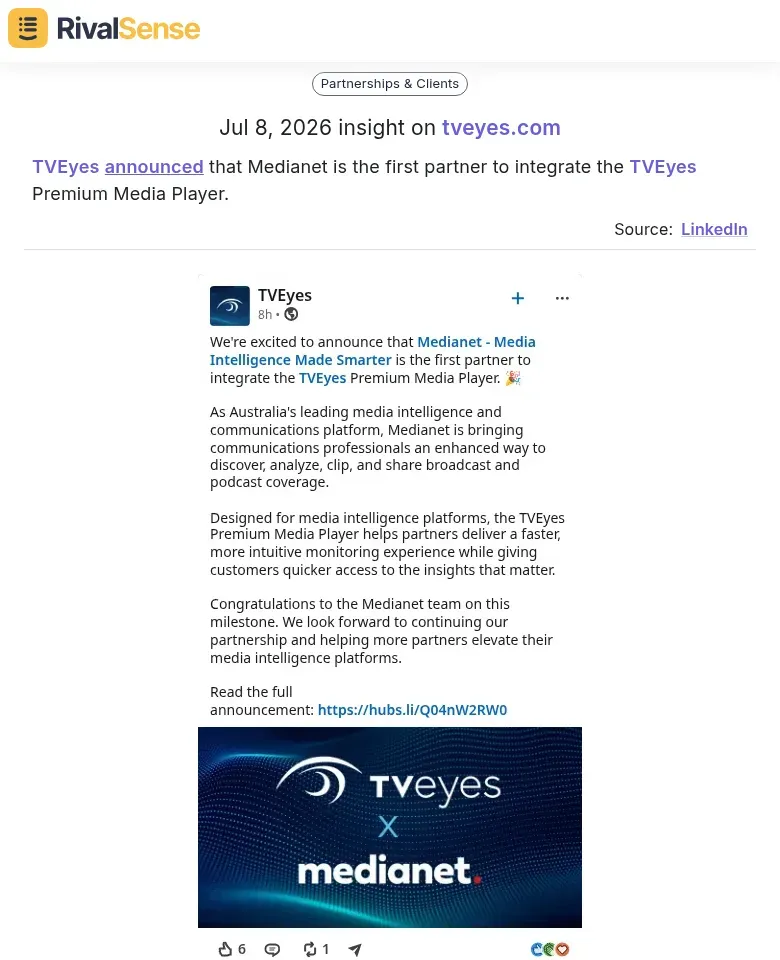
TVEyes announced that Medianet is the first partner to integrate the TVEyes Premium Media Player.
Why this matters for your strategy: Integration announcements show that a key account is embedding a product deeper into its operations, which dramatically increases switching costs and signals readiness to scale. For a competitor or a partner, spotting such moves lets you time your account expansion plays precisely—offer complementary features or a premium tier while the integration is fresh and top‑of‑mind. Ignore these signals and you risk being locked out of the ecosystem.
Key Learning: An integration announcement signals the customer is invested in an ecosystem and likely expanding usage. That’s your cue to propose a deeper relationship—offer a business review, suggest a premium tier, or introduce a complementary product. Timing matters: act while the integration is fresh and top‑of‑mind for their team.
By systematically monitoring integration news, you can spot expansion signals early and move from reactive support to proactive growth.
Uncovering Growth with Certification and Compliance Milestones
Certifications like SOC 2, ISO 27001, or HIPAA compliance are more than badges—they signal investment in security, trust, and scalability. When an account suddenly pursues certifications, it often precedes a growth spurt requiring enterprise‑grade infrastructure.
How to track certifications as growth signals:
- Monitor certification databases (e.g., SOC 2 reports, ISO listings) for newly certified accounts.
- Set alerts for public announcements of compliance achievements.
- Cross‑reference timing with hiring surges or funding rounds to confirm growth trajectory.
🔎 Real‑world insight from RivalSense:
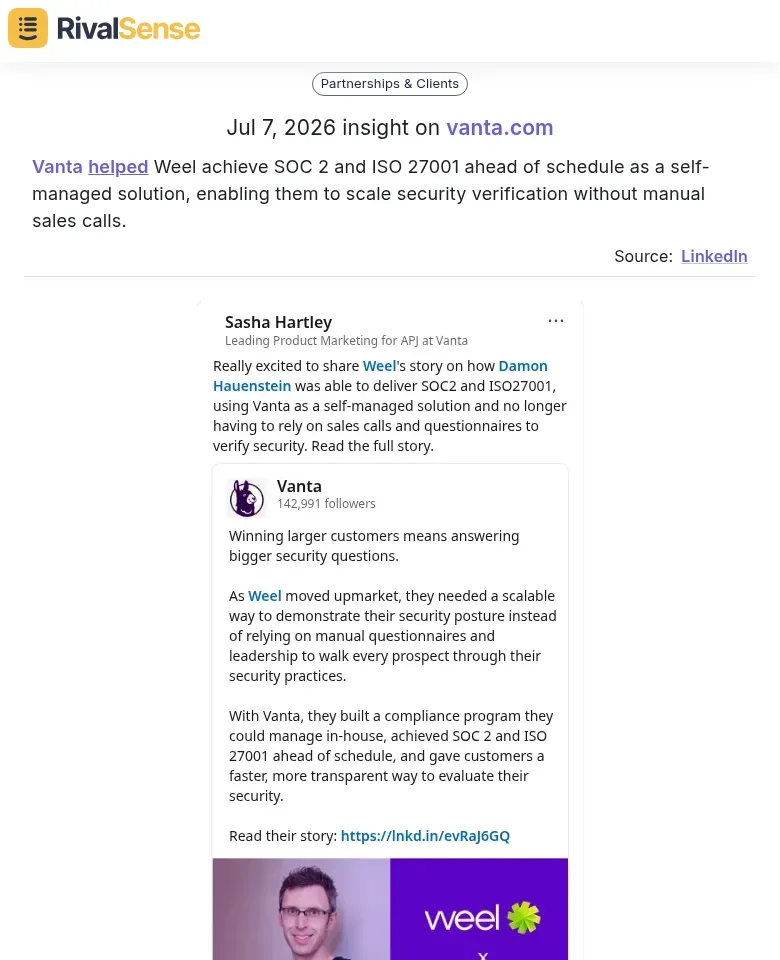
Vanta helped Weel achieve SOC 2 and ISO 27001 ahead of schedule as a self‑managed solution, enabling them to scale security verification without manual sales calls.
Why this matters for your strategy: Early attainment of key compliance milestones signals that a company is building for enterprise scale, often well before revenue numbers reflect that ambition. For a B2B vendor, flagging accounts that achieve SOC 2 or ISO 27001 well ahead of typical timelines reveals high‑potential targets that will soon need expanded service tiers, dedicated support, or adjacent solutions. Use these signals to prioritize your outbound efforts and beat the competition to the next growth phase.
Key Learning: Early certification attainment indicates accelerated development. When a prospect achieves compliance milestones well before peers, they’re likely building for scale. For competitive intelligence, flag accounts that achieve SOC 2, HIPAA, or FedRAMP certifications ahead of industry averages—these are your high‑potential targets.
Quick Tip: Create a checklist mapping common certifications by industry (e.g., PCI DSS for fintech, GDPR for EU‑focused firms). Track each account’s certification timeline and compare against typical cycles to identify outliers.
By weaving certification milestones into your account tracking, you’ll spot growth before revenue numbers reflect it. This proactive lens turns compliance from a checkbox into a strategic intelligence asset.
Building a Competitive Intelligence Dashboard for Key Accounts
To build an effective competitive intelligence dashboard for key accounts, start by aggregating three signal types: partnership announcements (e.g., joint press releases), integration launches (e.g., API or marketplace additions), and certification milestones (e.g., security compliance badges). Use a tool like RivalSense to automatically pull these from news, blogs, and social feeds. Set up automated alerts per account—trigger notifications when a new partnership or certification is detected.
Prioritize accounts using a simple scoring system: assign points per signal (partnership = 3, integration = 2, certification = 1) and multiply by recency (e.g., within 30 days = 2x). Focus your team on accounts with scores above a defined threshold. Pro tip: include a summary card for each competitor that shows their latest signal count and trend (increasing/decreasing) to quickly identify which key accounts need immediate attention.
Conclusion – From Insights to Revenue
By tracking competitor relationships through competitor spend shifts, partnership changes, and vendor diversification, you gain a direct line to revenue opportunities. Each insight type reveals where accounts are investing and where you can intercept. The key is consistency: embed competitor monitoring into your daily workflows by setting up automated alerts, scheduling weekly reviews of competitive moves, and linking insights directly to your CRM for real‑time action.
Next steps:
- Audit your current competitor tracking process—are you watching partner ecosystems and spend patterns?
- Set up alerts for new hires, funding rounds, and partnership announcements in your top accounts.
- Create a simple checklist: each week, log one competitive insight and identify one account action (outreach, upsell, or defense).
To automate these signals and never miss a move that could impact your key accounts, try RivalSense for free – get your first competitor report today.
📚 Read more
👉 Decoding Competitor Signals: What Veriff’s 52.7% Accuracy Breakthrough Teaches Us
👉 How to Mine Competitor Customer Testimonials for Content Gold: A Step-by-Step Guide
👉 Data-Driven Insights: Competitor Trade Show Strategies in Semiconductor Support