
How to Mine Competitor Customer Testimonials for Content Gold: A Step-by-Step Guide
Most marketers treat customer reviews as a numbers game: star ratings, review velocity, and volume thresholds. But the real competitive intelligence lies in the text—the words customers use when they praise or complain about your competitors.
Think of competitor reviews as a free, ongoing focus group. Every complaint is a content opportunity. Every praise is a positioning gap. Here’s how to systematically extract actionable insights from competitor testimonials using automation and NLP—without drowning in data.
Step 1: Cast a Wide Net (Don’t Stop at Google)
Google reviews are the obvious starting point, but they’re also the most curated. Negative reviews get removed; profiles get gamed. To get an honest picture, expand your sources:
- Social media: Reddit, TikTok, Instagram, Facebook groups
- Industry review platforms: G2, Capterra (for B2B), Yelp, Angi
- Competitor social profiles: Comments on their own posts
Pro tip: Use a web scraping tool like Apify to pull data from Reddit, Facebook, and Instagram at scale. Feed the raw text into a Google Colab notebook for cleaning.
Step 2: Let Algorithms Do the Categorization (Avoid Confirmation Bias)
Manually tagging reviews or using LLM prompts can introduce bias—you see what you expect to see. Instead, use a dedicated NLP API (like Google Cloud Natural Language API) to automatically surface thematic buckets.
The API outputs reliable sentiment scores and topic clusters without your preconceptions skewing the results. You can then review the buckets and create custom categories (e.g., “trust,” “pricing,” “communication”) by layering rules on top.
Why this matters: An algorithm might reveal that “cleanliness” is a major theme in plumber reviews—something you wouldn’t have thought to look for. Those hidden patterns are your content gold.
Step 3: Separate Noise from Signals (Volume vs. Severity)
Not every negative review is a trend. Use this framework:
| Signal Type | Action |
|---|---|
| High volume + high sentiment impact | Immediate action (e.g., “they never showed up on time” appears in 30% of reviews) |
| Low volume + high severity | Investigate (e.g., a single review describing a safety violation or hidden fee) |
| Low volume + low severity | Ignore |
Aggregate data from multiple competitors into a master sheet (with a column for brand name) so you can filter by competitor or view market-wide themes.
Step 4: Translate Insights into Tactical Content
Once you have your themes, ask:
- What fears do customers express? → Build FAQ blocks, pricing transparency pages, or “what to expect” guides.
- What features do competitors’ customers love? → Check if your own business offers something similar—and if so, why isn’t it in your marketing?
- What questions go unanswered? → Create dedicated content that answers them (blog posts, landing pages, video explainers).
Real-World Example: A Plumbing Company
Insight from competitor reviews: Customers’ #1 anxiety is surprise bills. #2 is punctuality.
Actions taken:
- Overhauled website copy to emphasize upfront pricing and guaranteed arrival windows.
- Added transparent FAQ blocks (“How much will it cost? Will you be on time?”).
- Removed generic taglines like “on time, on budget” (everyone says that).
Result: a measurable lift in conversion rates and engagement with the new content.
Real-World Example: A Home Builder
Insight from competitor reviews: Customers complained about lack of communication during construction. But one competitor’s reviews repeatedly praised a “mobile app” that sent real-time updates.
Action taken: The builder had that same app but never marketed it. They moved it from “operational tool” to “core brand differentiator” in their website copy.
Lesson: Your strongest selling point might be hiding in your own operations—competitor reviews can point you to it.
Step 5: Ensure Cross-Channel Consistency (For AI Search)
AI search engines (Google AI Overviews, ChatGPT, Gemini) now pull from multiple sources—reviews, websites, social profiles, directories. If your messaging isn’t consistent across all channels, AI will surface contradictory signals, eroding trust.
Checklist:
- [ ] Does your website copy match your Google Business Profile description?
- [ ] Do your social bios reflect the same promises as your FAQ blocks?
- [ ] Are your review responses aligned with your brand voice?
Inconsistency is a trust killer. AI-powered discovery engines reward brands that say the same thing everywhere.
🔍 Go Beyond Testimonials: Spot Strategy Shifts Before They Hit Reviews
Testimonials tell you what customers think today, but competitor moves—product launches, executive changes, rebranding—reveal where the market is heading tomorrow. Smart leaders monitor these early signals to adjust content and positioning before reviews start shifting.
RivalSense recently flagged three strategic moves that any attentive competitor would want to catch:
-
Product expansion that addresses hidden complaints
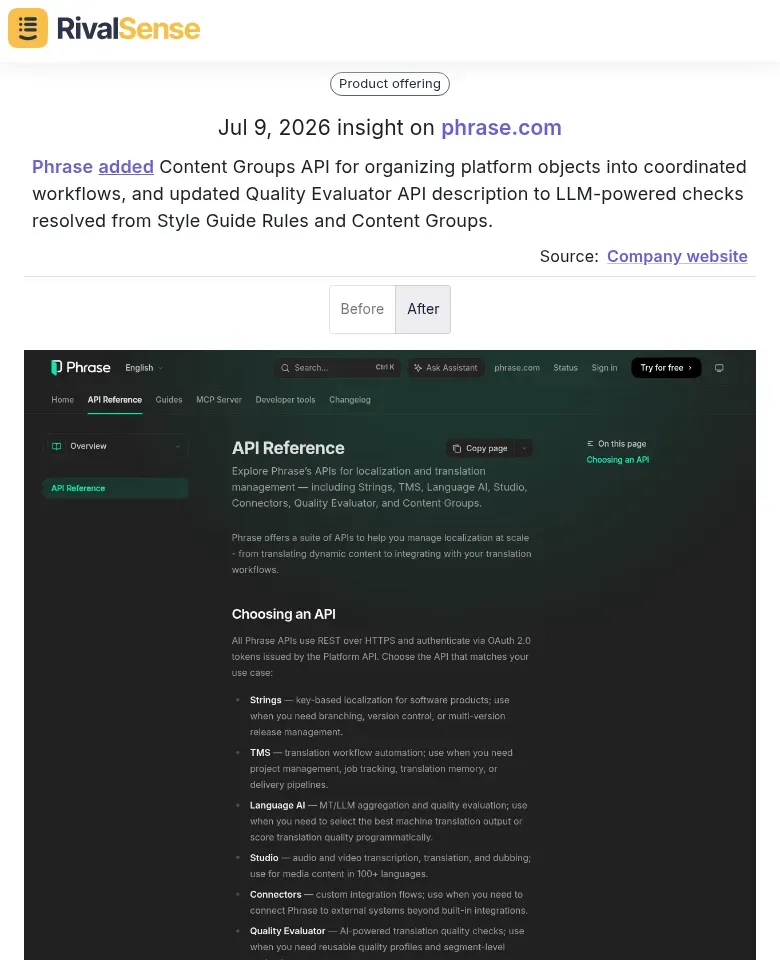
Phrase added a Content Groups API for organizing platform objects into coordinated workflows, and updated its Quality Evaluator API description to LLM-powered checks resolved from Style Guide Rules and Content Groups.
Why it matters: If customers have been grumbling about inconsistent localization quality, this update directly targets that pain point. Monitoring such API enhancements lets you preemptively update your own comparison pages or highlight your existing strengths. -
Leadership moves that signal a strategic pivot
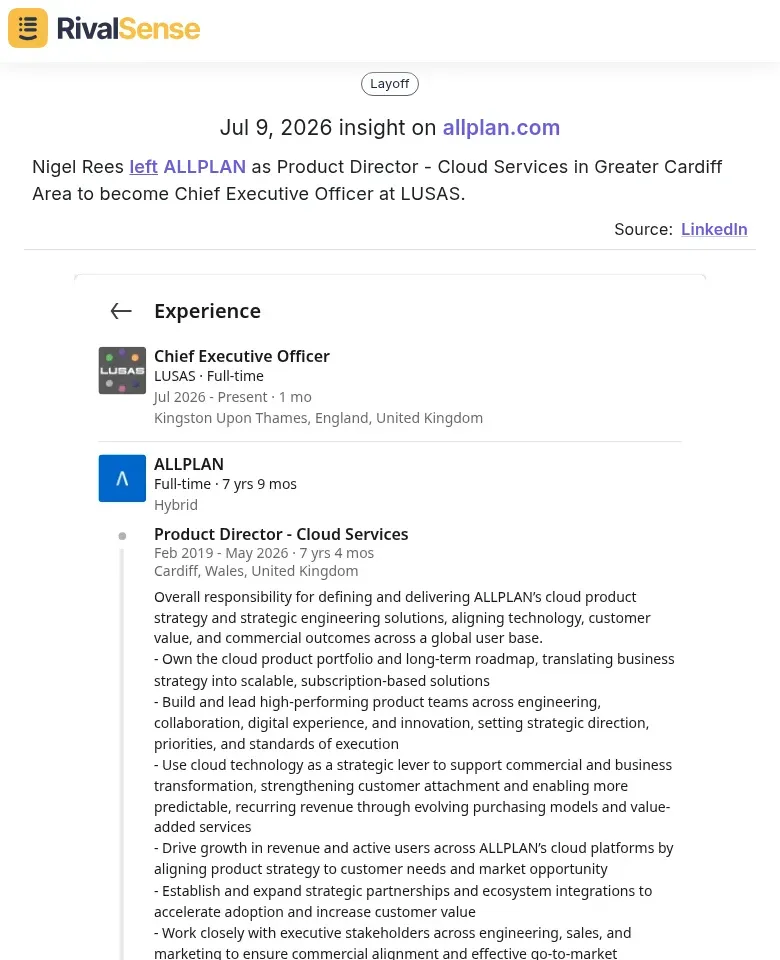
Nigel Rees left ALLPLAN as Product Director - Cloud Services in Greater Cardiff Area to become Chief Executive Officer at LUSAS.
Why it matters: A new CEO often brings a new customer philosophy. Tracking management changes lets you anticipate shifts in service quality, product roadmap, or messaging—well before they show up in user reviews. -
Rebrand + feature launch that rewrites customer expectations
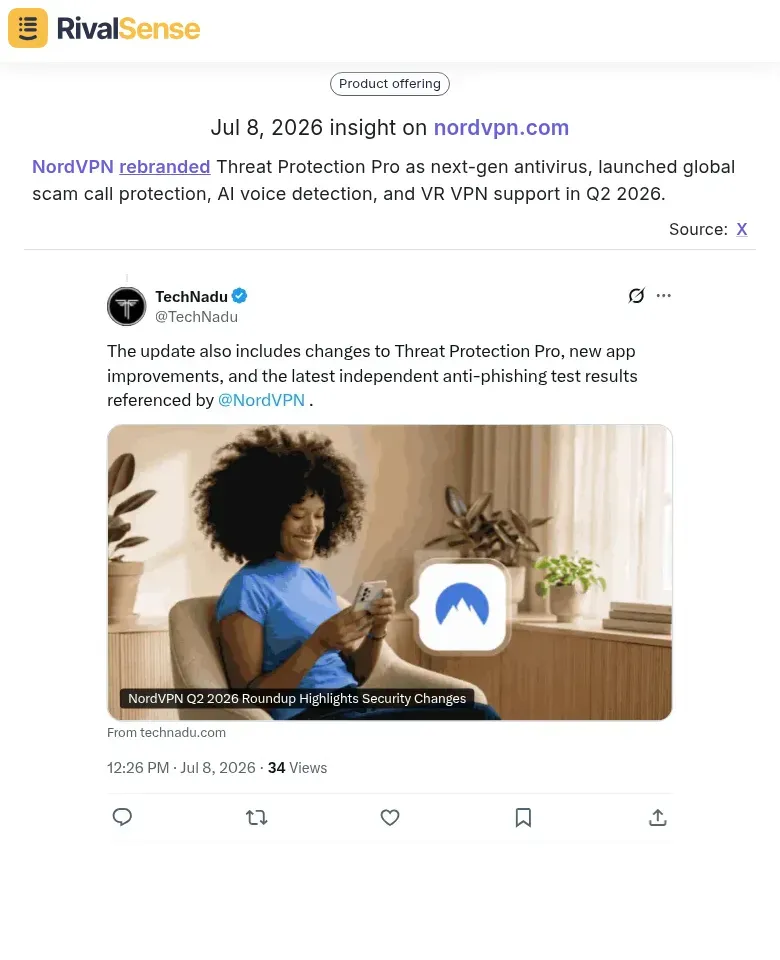
NordVPN rebranded Threat Protection Pro as next-gen antivirus, launched global scam call protection, AI voice detection, and VR VPN support in Q2 2026.
Why it matters: Competitor reviews may soon glow (or gripe) about these new features. Seeing the launch early gives you time to craft counter-narratives, adjust your unique selling points, or publish content that addresses the new landscape.
These insights—product updates, executive moves, rebrandings—are the early warnings testimonials can’t give you. Weaving them into your content strategy keeps you months ahead.
✅ Final Checklist: Your Competitor Review Audit Workflow
- Identify competitors (include the ones you lose bids to, not just top rankers)
- Scrape reviews from Google, Reddit, social media, and niche platforms
- Run NLP for unbiased thematic categorization (e.g., Google Cloud NLP)
- Flag high-volume trends and investigate severe outliers
- Map insights to content gaps (FAQs, landing pages, social posts)
- Update copy across all channels for consistency
- Monitor results (engagement, conversions, rank changes)
🚀 Stay Ahead Without Building a Scraping Stack
Competitor testimonials are a goldmine of customer language, pain points, and differentiators. Most businesses ignore them. The ones that mine them systematically—and layer on real-time monitoring of competitor moves—gain a content advantage that compounds over time.
Stop manually scraping reviews from dozens of platforms. RivalSense automatically tracks competitor product launches, pricing updates, leadership changes, media mentions, and more from over 80 sources, delivering the intelligence straight to your inbox. You’ll spot shifts in customer sentiment and market direction before they trend.
👉 Try RivalSense for free and get your first competitor report today.
📚 Read more
👉 Data-Driven Insights: Competitor Trade Show Strategies in Semiconductor Support
👉 How TikTok's Travel Move Sparked Our Counter-Strategy
👉 Quick Instagram Hacks to Track Competitor Key Goals
👉 Track Financial Leaders: Actionable Strategies for Growth
👉 3 Quick Hacks to Track Competitors & Key Accounts at Events