
Twitter Competitor Tracking: Ultimate Checklist for Key Account Models
In the high-stakes world of key account management, traditional competitor research moves at a glacial pace—often taking weeks to surface critical intelligence. Twitter changes this dynamic completely, delivering real-time competitor insights 10-15x faster than conventional methods. When you're managing million-dollar deals, this speed advantage becomes a strategic weapon.
Consider this: key account decisions are profoundly influenced by competitor announcements on product launches, pricing changes, and strategic partnerships. A competitor's tweet about a new enterprise feature could derail your sales cycle tomorrow. Their pricing announcement could force immediate contract renegotiations. Their partnership reveal could shift market perception overnight.
Proactive Twitter monitoring transforms reactive tracking into strategic advantage. Instead of learning about competitor moves after they've impacted your deals, you can anticipate shifts and prepare counter-strategies. Start by creating private Twitter lists for each key competitor's leadership, product, and sales accounts. Set up real-time alerts for their announcements using tools like RivalSense. Monitor not just what they say, but who engages with their content—this reveals their target accounts and partnership networks.
🛠️ Practical tip: Track competitor hashtags for product launches (#NewFeatureAlert) and event announcements. Watch for patterns in their posting times—this often signals upcoming announcements. Remember: in key account battles, the first mover advantage often goes to the best-informed team.
🚀 Three Core Twitter Insight Types for Key Account Models
Twitter competitor tracking provides actionable intelligence that can directly influence your key account strategies. By focusing on specific insight types, you can decode competitor intentions and adjust your approach in real-time. Here are the three core types to monitor:
-
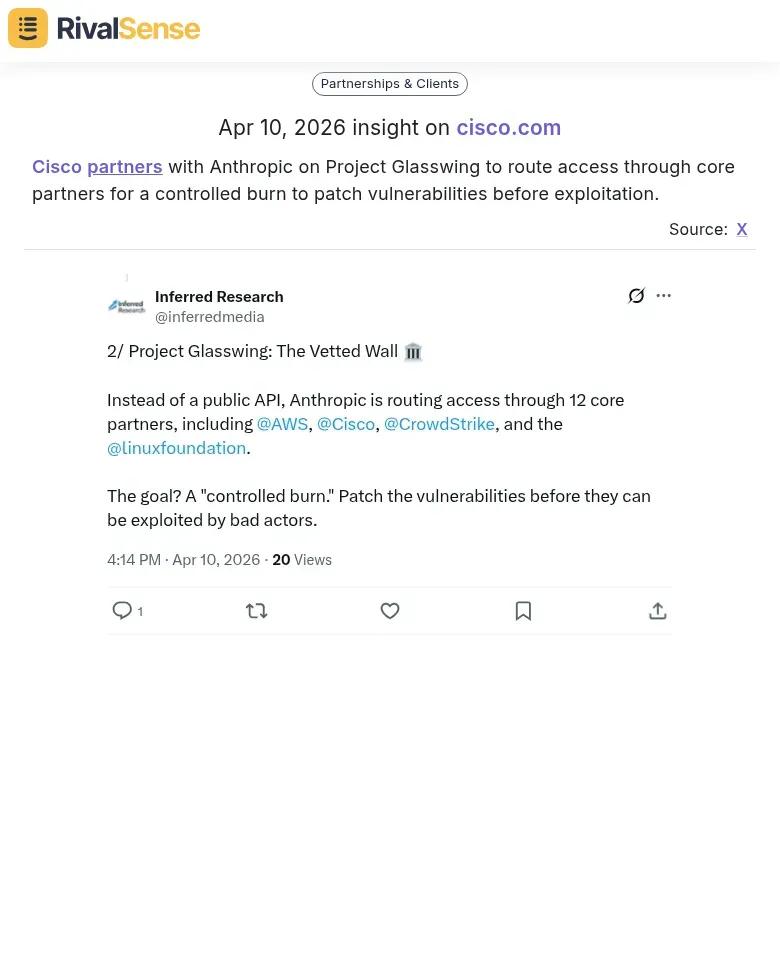
Event & Partnership Announcements: These reveal market expansion plans and strategic alliances. For example, RivalSense tracked that Cisco partners with Anthropic on Project Glasswing to route access through core partners for a controlled burn to patch vulnerabilities before exploitation. This type of insight is valuable for understanding how competitors are fortifying their market position through collaborations, allowing you to assess potential threats or partnership opportunities.
🛠️ Practical tip: Create alerts for partnership keywords (#partner, #collaboration) and note tagged accounts—these indicate priority targets.
-
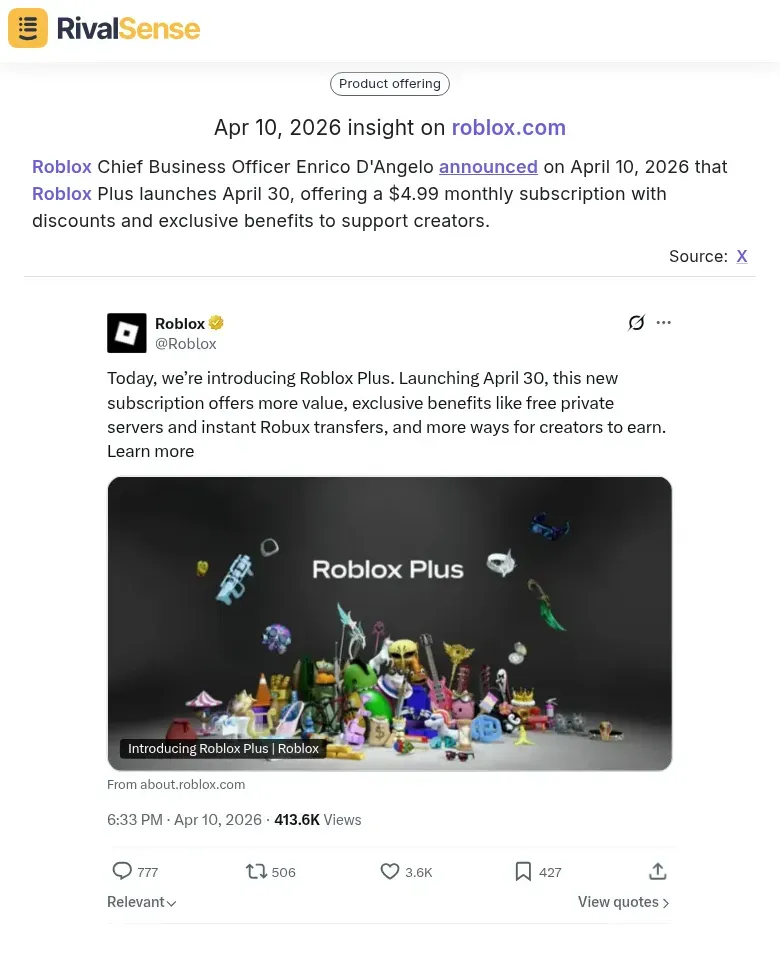
Executive Thought Leadership: Insights from competitor C-suite accounts provide early signals of strategic direction. For instance, RivalSense captured that Roblox Chief Business Officer Enrico D'Angelo announced on April 10, 2026 that Roblox Plus launches April 30, offering a $4.99 monthly subscription with discounts and exclusive benefits to support creators. This insight is valuable for gauging upcoming product launches and subscription models, helping you anticipate market shifts.
✅ Checklist item: Follow leadership accounts and analyze their engagement patterns with industry influencers to identify emerging relationships.
-
Creative Campaign Launches: These reveal engagement approaches and content innovation strategies targeting specific customer segments. Actionable step: Document campaign hashtags, content formats, and engagement metrics to identify what resonates with target accounts.
Use Twitter Lists to organize competitors by tier and track their interactions with shared target accounts—frequent engagements indicate priority relationships worth monitoring closely.
📈 Learning from Real-World Twitter Insights: Strategic Applications
Real-world Twitter insights transform competitive intelligence into actionable strategy. By analyzing concrete examples, you can derive patterns and apply them to your own business. Here’s how to apply these learnings:
-
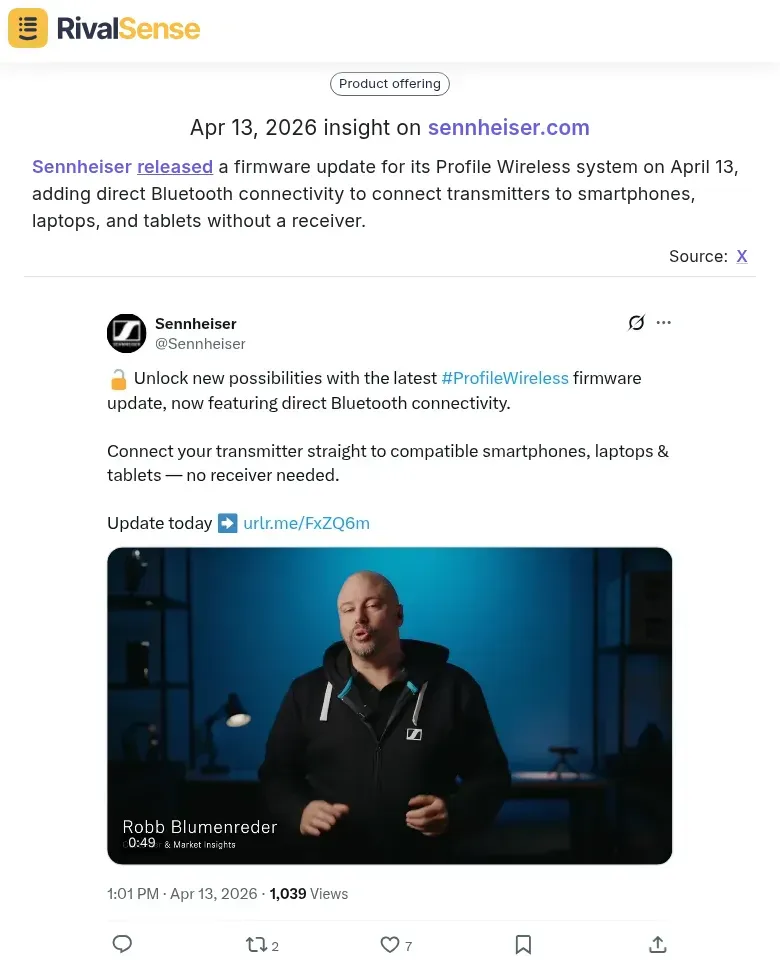
Product Innovation Analysis: When competitors announce updates like Sennheiser's firmware automation, map their efficiency gains to your workflows. RivalSense tracked that Sennheiser released a firmware update for its Profile Wireless system on April 13, adding direct Bluetooth connectivity to connect transmitters to smartphones, laptops, and tablets without a receiver. This type of insight is valuable for identifying product enhancements that improve user experience, allowing you to benchmark and innovate in your own offerings.
Create a checklist:
- ✅ Identify automation potential in your processes
- ✅ Calculate time/cost savings
- ✅ Prioritize implementation based on ROI
-
Technology Partnership Monitoring: Track partnership reveals to decode market expansion. Practical steps:
- ✅ Map partner ecosystems to identify gaps in your network
- ✅ Analyze integration patterns to anticipate new market segments
- ✅ Develop counter-partnership strategies before competitors solidify positions
-
Conversational AI & Interactive Features: Monitor feature launches to predict customer experience trends. Key actions:
- ✅ Test competitor's interactive tools to identify UX patterns
- ✅ Document engagement metrics from their launches
- ✅ Build a feature adoption timeline to anticipate market shifts
🔍 Pro tip: Create a Twitter insight dashboard with three columns: Innovation Signals, Partnership Patterns, and Feature Adoption Rates. Update weekly to spot strategic opportunities before they become industry standards.
🏗️ Building Your Twitter Monitoring Framework for Key Accounts
Building an effective Twitter monitoring framework for key accounts requires strategic organization and automation. A well-structured framework ensures you capture relevant insights without being overwhelmed by noise. Start by creating specialized Twitter Lists:
- 1) Competitor List: Track direct rivals' announcements, campaigns, and customer interactions.
- 2) Industry Influencer List: Monitor thought leaders for market trends and partnership opportunities.
- 3) Target Account List: Follow decision-makers at priority companies.
Organize these lists in a dedicated Twitter dashboard for quick access.
Next, set up automated alerts using Boolean operators for refined tracking. Use tools like TweetDeck or Hootsuite to create search queries like: "(competitor_name OR @competitor_handle) AND (launch OR pricing OR update)" - this captures relevant announcements while filtering noise. Add location-specific terms for geo-targeted monitoring.
Implement sentiment analysis to categorize reactions and identify market validation opportunities. Use tools like Brandwatch or native Twitter analytics to track sentiment around competitor product launches. Look for patterns: positive sentiment may reveal market gaps you can fill, while negative feedback highlights pain points to address in your own offerings.
✅ Practical checklist:
- ✓ Create 3 specialized Twitter lists
- ✓ Set up 5 Boolean search alerts
- ✓ Configure weekly sentiment reports
- ✓ Review alerts daily, analyze trends weekly
- ✓ Update lists monthly as accounts evolve
🎯 Turning Twitter Insights into Actionable Account Engagement Strategies
Transform Twitter competitor insights into strategic account engagement with this 3-step framework. By systematically analyzing and applying these insights, you can create targeted engagements that resonate with your key accounts.
-
Analyze Competitor Engagement Patterns: Track which accounts your competitors engage with most frequently and identify underserved segments. Create a checklist: monitor announcement frequency, engagement metrics (likes, replies, shares), and audience responses. When competitors celebrate enterprise wins but ignore SMB pain points, you've found a gap. 🛠️ Practical tip: Use Twitter Lists to organize competitors by tier and track their interactions with shared target accounts.
-
Develop Targeted Messaging: Position your company as the specialist for identified gaps. If competitors focus on large enterprises, craft messaging emphasizing SMB-friendly pricing and support. Test messaging in targeted Twitter polls and analyze response rates before full campaigns. Validate messaging resonance using Twitter analytics to ensure it addresses real pain points revealed in competitor engagement patterns.
-
Create Competitive Battle Cards: Build battle cards with validated intelligence from Twitter engagement patterns. Include: competitor feature gaps, pricing vulnerabilities, and engagement metrics showing audience dissatisfaction. Document campaign frequency and content gaps where you can offer unique value. ✅ Practical step: Implement a 30-day validation process to establish baseline patterns and refine positioning based on response patterns and sentiment analysis.
Integrate these insights across your organization by creating shared dashboards that visualize real-time data on competitor tweets, engagement metrics, and trending topics for coordinated strategic responses.
🤝 Integrating Twitter Intelligence Across Your Organization for Maximum Impact
To maximize Twitter competitor intelligence impact across your organization, implement these three strategic protocols. Effective integration ensures that insights lead to coordinated actions and measurable business outcomes.
-
Cross-Functional Dashboard Integration: Create shared competitive dashboards accessible to sales, marketing, and product teams. Set up automated alerts for competitor announcements, pricing changes, or key account wins. Example: When a competitor announces a new enterprise feature, sales receives immediate notification with talking points, while product gets insights for roadmap planning.
-
Quarterly Competitive Playbook Reviews: Schedule mandatory quarterly sessions where each department presents competitor insights. Update competitive positioning documents, battle cards, and objection handling guides based on emerging Twitter patterns. 🔄 Tip: Use a standardized template to track competitor messaging evolution over time.
-
ROI Measurement Framework: Correlate competitive intelligence with business outcomes by tracking:
- 📊 Account wins/losses against competitor activity
- ⏱️ Response time to competitor announcements
- 📈 Sales cycle changes post-intelligence implementation
✅ Practical checklist:
- ✓ Designate intelligence champions per department
- ✓ Establish weekly sync meetings
- ✓ Create competitor response playbooks
- ✓ Track win rates with/without intelligence
- ✓ Document competitive strategy shifts quarterly
🛠️ Leverage Advanced Tools for Comprehensive Competitor Tracking
While manual Twitter monitoring is valuable, scaling it across multiple competitors and platforms can be challenging. Tools like RivalSense automate the tracking of competitor product launches, pricing updates, event participations, partnerships, regulatory aspects, management changes, and media mentions across company websites, social media, and various registries. All this intelligence is delivered in a weekly email report, saving you time and ensuring you never miss a critical update.
Ready to transform your competitor intelligence? Try RivalSense for free today and get your first competitor report to start gaining a strategic edge in your key account battles. Sign up now at https://rivalsense.co/
📚 Read more
👉 Best Practices for Apparel Key Account Performance Dashboards in 2026
👉 Market Entry Competitor Insights: 7 Critical Mistakes Key Account Managers Must Avoid
👉 Real-World Competitor Loyalty Program Analysis: Leveraging Internet Insights
👉 2026 Print-on-Demand Benchmarking: Uncover Competitor Innovation Advantages