
2026 Print-on-Demand Benchmarking: Uncover Competitor Innovation Advantages
The print-on-demand landscape in 2026 is a dynamic ecosystem where agility and innovation separate market leaders from laggards. With personalization, sustainability, and multi-channel expansion driving rapid evolution, competitive benchmarking has become essential—not optional—for POD businesses seeking to thrive. Why? Because today's competitive advantages are often fleeting, and real-time competitor intelligence transforms strategic decision-making from reactive guesswork to proactive advantage.
Key trends reshaping the POD space include:
- 🚀 Hyper-personalization: AI-driven designs and customer-specific products.
- 🌱 Eco-conscious operations: Carbon-neutral shipping and sustainable materials.
- 🔗 Seamless multi-channel presence: Social commerce integration and physical pop-ups.
To navigate this complexity, start with a competitor tracking checklist:
- Monitor top 5 rivals' product launches weekly.
- Analyze their sustainability claims vs. actual practices.
- Track pricing changes across channels.
- Benchmark your innovation cycle against theirs.
Practical tip: Use tools like RivalSense to automate tracking of competitor website updates, social media campaigns, and customer reviews—this data reveals gaps in your strategy and uncovers hidden innovation advantages before they become industry standards.
Product Innovation Benchmarking: Analyzing Competitor Offerings
Staying ahead in the 2026 print-on-demand market requires a deep dive into how competitors innovate. By systematically analyzing their product launches, pricing strategies, and development cycles, you can identify emerging trends and adjust your offerings accordingly.
For instance, tracking product launches can reveal new market niches and competitive pricing. Consider this real-world insight from RivalSense:
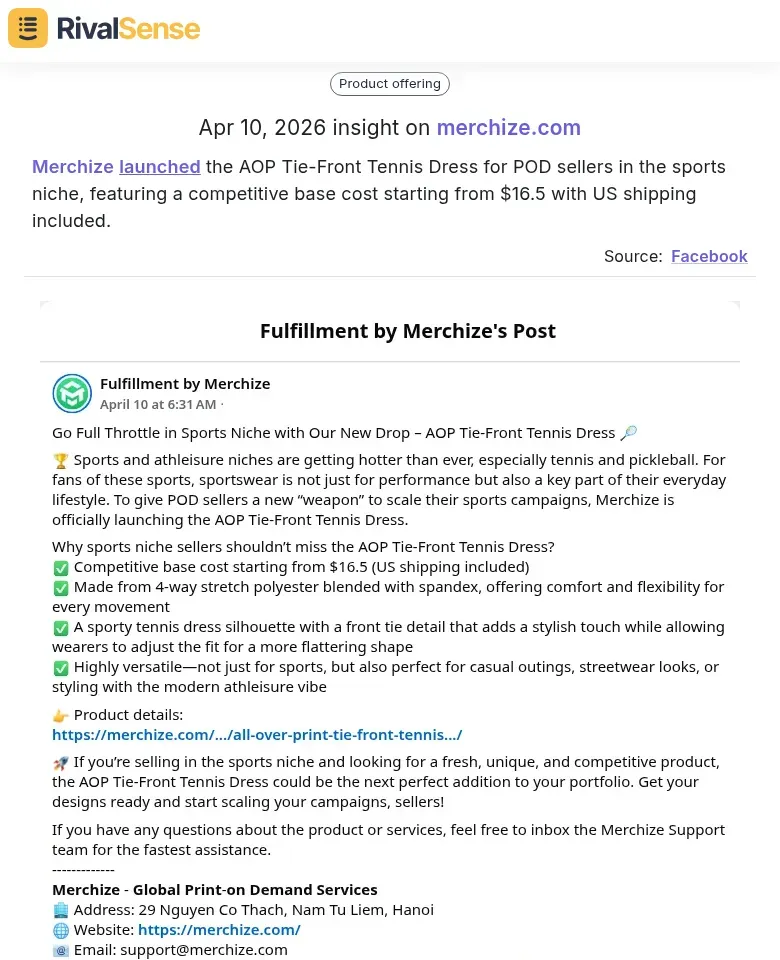
Merchize launched the AOP Tie-Front Tennis Dress for POD sellers in the sports niche, featuring a competitive base cost starting from $16.5 with US shipping included. This type of insight is valuable because it helps you understand competitor moves into specific niches, allowing you to assess demand and adjust your product development focus.
To outperform, start by tracking how competitors identify emerging niches like sports apparel: monitor their social media for micro-niche targeting (e.g., retro gaming or sustainable fitness gear) and use tools like Google Trends to validate demand.
For pricing strategies, create a competitor pricing matrix comparing base costs, premium tiers, and bundle discounts. Analyze how leaders use value-based pricing for eco-friendly products versus cost-plus models for basics.
Assess product development cycles by timing competitor launches from trend detection to market entry. Top performers leverage AI design tools to reduce cycles from weeks to days.
Practical Checklist for Product Innovation:
✅ Map 3-5 competitors' niche expansion patterns quarterly.
✅ Benchmark pricing against production costs using supplier data.
✅ Track innovation velocity via product catalog updates and social announcements.
✅ Use RivalSense to automate tracking of competitor feature releases and pricing changes, ensuring you match or exceed their agility.
Marketing & Channel Expansion Strategies
In 2026, leading print-on-demand competitors are mastering integrated marketing strategies to build sustainable brand advantages. Understanding their approach to physical events, social commerce, and multi-channel distribution can provide actionable insights for your own campaigns.
Tracking event participation, for example, shows how competitors engage with audiences offline. Here's an insight from RivalSense:
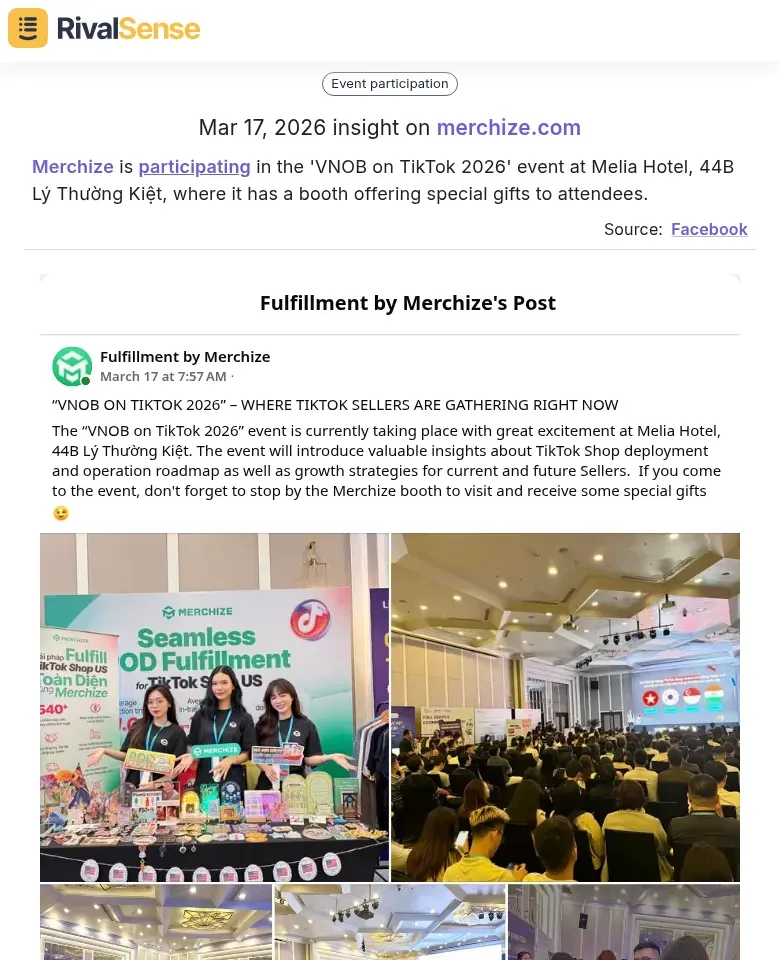
Merchize is participating in the 'VNOB on TikTok 2026' event at Melia Hotel, 44B Lý Thường Kiệt, where it has a booth offering special gifts to attendees. This insight is valuable because it highlights competitor investment in physical presence and event marketing, which can drive brand awareness and customer acquisition.
First, they're leveraging physical presence through strategic pop-up shops at high-traffic events and trade shows. These events serve as brand-building platforms where customers can experience product quality firsthand.
Second, social commerce integration has become non-negotiable. Top performers are achieving high conversion rates on platforms like TikTok Shop by combining creator-led content with LIVE shopping sessions.
Practical tip: Implement a 4-pillar TikTok strategy:
- Creator partnerships
- LIVE shopping events
- Affiliate programs
- Targeted ads
Third, multi-channel distribution is evolving beyond basic marketplace presence.
Checklist for 2026 Channel Expansion:
✅ Integrate Shopify with Amazon FBA for multi-channel fulfillment.
✅ Maintain synchronized inventory across Etsy, Amazon, and TikTok Shop.
✅ Use centralized order management systems.
✅ Implement platform-specific pricing strategies.
Key insight: Competitors winning in 2026 aren't just present across channels—they're creating integrated experiences where physical events drive social content, which converts through multiple sales channels simultaneously.
Technology & Platform Integration Advantages
Technology integration is a critical differentiator in the 2026 POD landscape. By examining how competitors leverage APIs, automation, and synchronization, you can identify gaps in your own tech stack and prioritize improvements.
Monitoring feature launches, for instance, reveals how competitors enhance seller efficiency. Take this RivalSense insight:
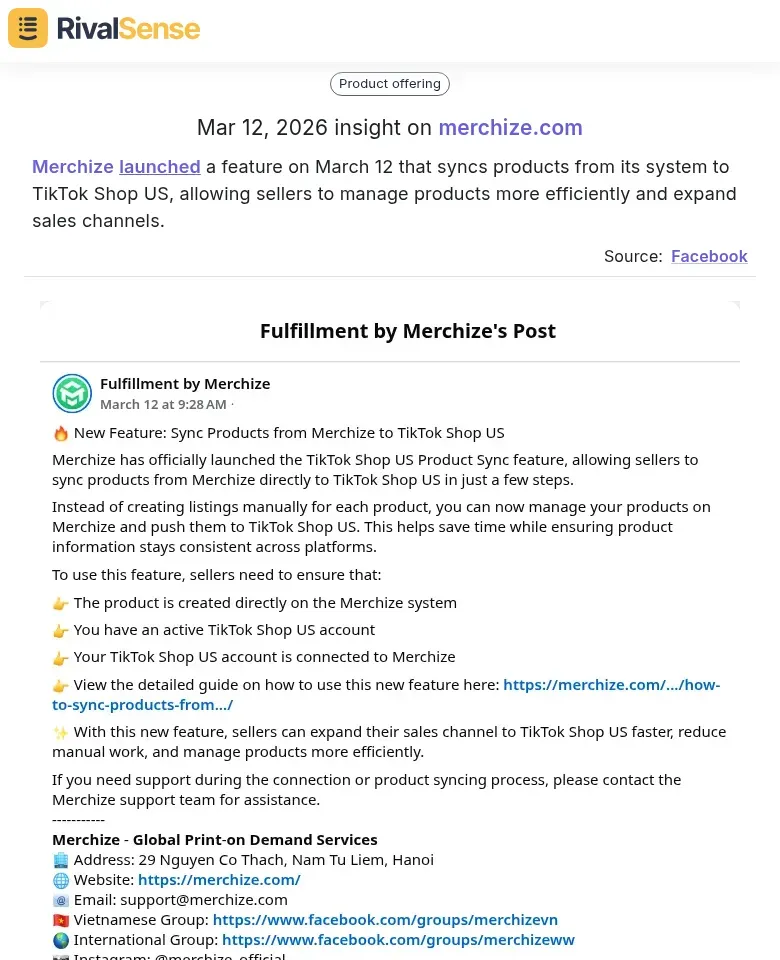
Merchize launched a feature on March 12 that syncs products from its system to TikTok Shop US, allowing sellers to manage products more efficiently and expand sales channels. This insight is valuable because it shows competitor moves to streamline operations and tap into new sales channels, prompting you to evaluate similar integrations for your business.
Top competitors leverage API-first architectures that automate repetitive tasks like order processing and shipping inquiries. They implement real-time synchronization across platforms, eliminating manual data entry bottlenecks.
Practical Checklist for Assessing Competitor Tech Advantages:
✅ Map their API ecosystem - count native integrations vs. third-party middleware.
✅ Measure synchronization latency (target: under 1 hour for order status updates).
✅ Identify automation triggers for design changes and production workflows.
✅ Evaluate scalability metrics - can their system handle 50,000+ monthly queries?
Leading platforms demonstrate how unified order views and AI-assisted routing reduce handling time. The real competitive edge comes from predictive analytics that flag potential delays before customers inquire.
Competitive Intelligence Framework for POD Businesses
A robust competitive intelligence framework is essential for POD businesses to systematically track competitor innovation. By establishing structured monitoring systems, you can transform random observations into actionable intelligence for strategic decision-making.
Start by creating a structured monitoring system:
- Product Launch Tracking: Set up automated alerts for competitor product pages. Create a spreadsheet template with columns for launch date, product type, unique features, and initial pricing.
- Pricing Intelligence: Monitor competitor pricing pages daily, noting seasonal patterns and promotional strategies.
- Marketing Activity Analysis: Use social listening tools to track competitor campaigns, influencer partnerships, and content strategies.
- Technology Adoption: Analyze competitor job postings for tech stack signals and integration announcements.
Practical tip: Conduct quarterly competitive landscape reviews using a standardized template that compares product innovation velocity, pricing elasticity, and channel diversification across your top 5 competitors.
Strategic Recommendations: Turning Insights into Action
Transform your benchmarking insights into competitive advantage with these actionable strategies:
Agile Product Development:
- Implement 2-week sprint cycles to rapidly test competitor-inspired features.
- Create a "fast-follow" checklist: identify top 3 competitor innovations each quarter, prioritize based on customer demand data, and allocate 20% of development resources to implementation.
- Use A/B testing to validate which competitor features resonate with your audience before full rollout.
Integrated Marketing Strategy:
- Develop a 70/30 digital-to-physical presence ratio, allocating 30% of marketing budget to physical touchpoints like pop-up shops and trade show booths.
- Create QR code campaigns that bridge physical products to digital experiences, tracking conversion rates.
- Implement a unified content calendar that coordinates social media campaigns with physical event promotions.
Technology Roadmap Priorities:
- Build API integrations with top 3 e-commerce platforms within 6 months.
- Prioritize automation features that reduce seller workload: automated order processing, inventory sync, and AI-powered design suggestions.
- Create a seller value scorecard to evaluate all technology investments based on time saved, revenue potential, and customer satisfaction impact.
Action Checklist:
✅ Quarterly competitor feature audit.
✅ Monthly integration performance review.
✅ Bi-weekly marketing channel ROI analysis.
✅ Weekly seller feedback collection.
✅ Daily competitive intelligence monitoring via tools like RivalSense.
Leverage Competitor Insights with RivalSense
To effectively implement the strategies outlined above, you need reliable and timely competitor intelligence. RivalSense tracks competitor product launches, pricing updates, event participations, partnerships, and more across websites, social media, and various registries, delivering all insights in a weekly email report.
By using RivalSense, you can automate the tracking of key competitor activities, freeing up time to focus on strategic decisions. For example, the insights shared in this post—from product launches to event participation and feature updates—are exactly the kind of data RivalSense provides.
Ready to uncover your competitors' innovation advantages? Try RivalSense for free at https://rivalsense.co/ and get your first competitor report today!
📚 Read more
👉 SaaS Product Offering Analysis Framework: Turn Competitor Insights into Strategy
👉 Decodo's Residential Proxy Pricing Update: Competitive Insights and Actionable Tips
👉 Track Key Account Team Members: The Complete Guide to Competitive Intelligence for B2B Leaders
👉 Data-Driven Insights: Track Key Account Communications in B2B Fintech
👉 How NVIDIA's Nuclear AI Deal Enabled Competitors to Secure Energy Partnerships