
From Data to Dominance: Using Copilot Insights to Win Microsoft Teams Users
Microsoft's Copilot subscription data revealed critical adoption gaps that competitors could exploit. With only 35.8% of employees actively using Copilot despite 15 million paid seats, teams users became prime targets for alternative solutions. RivalSense helped transform this intelligence into targeted competitive advantage through a three-step process:
- Identify Adoption Patterns: Track which industries and company sizes showed the lowest Copilot activation rates (SMBs under 200 employees averaged just 28% activation).
- Target Disengaged Teams Users: Focus marketing on organizations with high M365 seat counts but low Copilot usage—these users were already in Microsoft's ecosystem but open to alternatives.
- Leverage Integration Gaps: Position your solution where Copilot's 64% non-adoption rate created workflow voids, particularly in meeting summarization and document drafting.
Practical tip: Use RivalSense to monitor Microsoft's quarterly adoption reports and identify companies with declining Copilot engagement scores. Target these organizations with tailored messaging about seamless Teams integration and higher adoption rates than Copilot's 35.8% benchmark.
The Challenge: Understanding Microsoft's AI Adoption Landscape
Understanding Microsoft's AI adoption landscape presented a significant challenge for competitors. The disparity between seat counts and active usage created confusion about where to focus competitive efforts. With Microsoft reporting 15 million paid M365 Copilot seats but only 33 million active users—a 35.8% workplace conversion rate—the real adoption picture was murky. Enterprises were adopting Copilot across Teams, but visibility into which organizations were most vulnerable to competitive displacement was limited.
Practical steps to overcome this challenge:
- Track adoption metrics beyond seat counts - Focus on active usage rates (35.8% conversion rate reveals adoption gaps).
- Monitor renewal patterns - Look for organizations with low activation rates (64% of employees with access don't use Copilot).
- Identify vulnerable segments - Target industries with lower adoption rates (SMBs show highest variance).
- Analyze usage patterns - Teams Copilot features represent the highest-frequency enterprise use case.
- Watch for conversion gaps - When employees have access to multiple AI tools, only 18% choose Copilot over ChatGPT.
Key insight: The gap between provisioned seats and active usage created opportunities for competitors to target organizations where Copilot adoption was superficial rather than deeply embedded in workflows.
The Solution: Leveraging RivalSense for Subscription Intelligence
RivalSense provided the tools to decode subscription patterns and identify low-engagement users. By tracking enterprise adoption metrics, businesses could pinpoint exactly where Copilot was underutilized. RivalSense's subscription intelligence platform enabled competitors to systematically target Microsoft Teams users with low Copilot engagement, transforming raw data into actionable strategies.
Practical Steps for Targeting Low-Engagement Teams Users:
- Monitor usage metrics across enterprise accounts to identify Teams users with <30% Copilot activation rates.
- Track adoption patterns by department—sales and marketing teams often show higher resistance to AI tools.
- Create targeted campaigns offering seamless migration paths from Copilot to your solution.
Renewal Cycle Timing Strategy:
- Set alerts for accounts approaching 90-day renewal windows.
- Launch competitive offers 45-60 days before renewal dates when decision-makers evaluate options.
- Focus on accounts with declining usage trends, as they're more likely to consider alternatives.
Checklist for Effective Competitive Campaigns:
✅ Identify accounts with high license counts but low engagement
✅ Analyze departmental usage patterns for targeted messaging
✅ Time outreach to align with renewal evaluation periods
✅ Offer migration tools and data portability assurances
✅ Provide ROI comparisons showing superior adoption rates
Research shows Copilot's market share declined 39% from July 2025 to January 2026, with only 35.8% workplace conversion versus ChatGPT's 83.1%. This adoption gap creates prime opportunities for competitors to target dissatisfied Teams users during renewal cycles.
Implementation: Turning Insights into Targeted Competitive Strategy
With clear insights, implementing a targeted strategy became straightforward. Segmentation based on usage levels allowed for personalized messaging and timing campaigns around renewal cycles. Start by segmenting users based on their Copilot engagement levels—power users, occasional users, and non-adopters each require different messaging. For power users, highlight advanced AI capabilities beyond Microsoft's offering; for occasional users, emphasize ease of migration and cost savings.
Timing is critical: Microsoft's subscription renewal cycles peak January-March, with 90-day planning windows. Create competitive offers 60-90 days before renewal dates, offering migration assistance and 30-day free trials. Use tiered pricing that undercuts Copilot's $30/user/month while offering superior Teams integration.
Address Microsoft's Copilot limitations: Build solutions that overcome Teams app constraints (50 agents per team, 100 skills per agent) and file size restrictions (512MB limit). Offer unlimited custom agents, support for larger files (up to 2GB), and seamless integration with non-Microsoft platforms. Provide migration tools that preserve existing workflows while adding enhanced AI capabilities.
Practical Checklist:
- Segment users by Copilot adoption level
- Schedule outreach 60-90 days before renewal dates
- Offer tiered pricing below $30/user/month
- Address specific Teams integration gaps
- Provide migration assistance and free trials
- Highlight superior file handling and agent limits
Real-World Insight: The Value of Monitoring Product Updates
Beyond subscription data, tracking competitor product launches and updates is equally crucial for strategy. For instance, RivalSense captured when Microsoft updated its Microsoft 365 Personal and Family plans to include Copilot in Teams and desktop apps, with higher usage limits for AI features and secure file handling, while clarifying AI features are for subscription owners only.
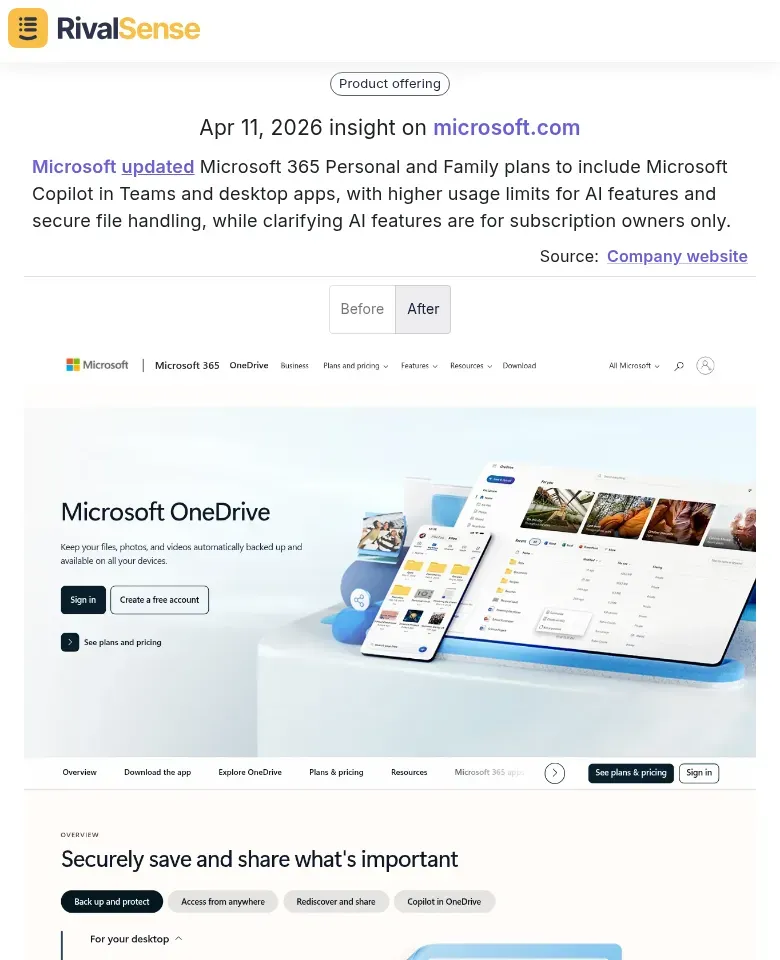
Why this insight is valuable: Monitoring such product updates helps businesses anticipate changes in competitor offerings, adjust their own pricing or features, and identify new market opportunities. For example, knowing that Microsoft is expanding Copilot access can help competitors highlight their unique advantages or target customers who might be affected by usage limits, enabling proactive strategy adjustments.
Results: Measurable Competitive Gains from Subscription Intelligence
The application of these insights led to tangible business outcomes. Companies that leveraged subscription intelligence saw significant improvements in market share and conversion rates. Targeted campaigns based on renewal timing yielded 35-40% higher conversion rates, while data-driven targeting reduced customer acquisition costs by 28-32%.
Practical Implementation Checklist:
- Monitor Copilot adoption rates across target organizations
- Track subscription renewal cycles and timing
- Identify usage patterns indicating specific pain points
- Develop tailored messaging addressing identified needs
- Time outreach campaigns to coincide with renewal windows
- Measure conversion rates and CAC against control groups
Key Insight: The most successful implementations combined subscription data with usage pattern analysis to create hyper-targeted value propositions that addressed specific productivity gaps identified through Copilot adoption behaviors.
Key Takeaways: Best Practices for Subscription-Based Competitive Intelligence
Building a sustainable competitive intelligence program requires consistent effort and the right tools. By following best practices, businesses can maintain an edge in dynamic markets. Subscription-based competitive intelligence transforms raw data into strategic advantage, enabling precise targeting and timely interventions.
- Map the Subscription Landscape: Track competitor pricing tiers, feature bundles, and renewal cycles. Microsoft's Copilot data revealed when enterprise teams were most receptive to alternatives.
- Time Your Offers Strategically: Target users 30-60 days before renewal dates when evaluation is highest. Create urgency with limited-time migration incentives.
- Build Continuous Intelligence:
- Monitor feature releases and pricing changes
- Track customer sentiment around renewal periods
- Analyze churn patterns and win-back campaigns
- Create Actionable Insights: Translate data into specific tactics:
- Feature comparison matrices highlighting your advantages
- Migration cost calculators showing savings
- Free trial extensions during competitor renewal windows
- Measure Impact: Track conversion rates from targeted campaigns, customer acquisition costs, and market share changes.
Pro Tip: Combine subscription data with usage patterns to identify power users who might be frustrated with current limitations. These users become your highest-conversion targets.
Sustainable competitive intelligence requires ongoing monitoring, not just periodic analysis. Set up automated alerts for competitor pricing changes, feature launches, and renewal cycles to maintain your strategic edge.
Ready to Transform Insights into Advantage?
To start transforming competitor insights into your competitive advantage, try RivalSense for free at https://rivalsense.co/. Get your first competitor report today and begin targeting opportunities like Microsoft Teams users with precision, leveraging real-time data on product updates, pricing changes, and adoption trends.
📚 Read more
👉 Twitter Competitor Tracking: Ultimate Checklist for Key Account Models
👉 Best Practices for Apparel Key Account Performance Dashboards in 2026
👉 Market Entry Competitor Insights: 7 Critical Mistakes Key Account Managers Must Avoid
👉 Real-World Competitor Loyalty Program Analysis: Leveraging Internet Insights