
Real-World Competitor Loyalty Program Analysis: Leveraging Internet Insights
In today's hyper-competitive landscape, analyzing competitor loyalty programs isn't just about points and rewards—it's a strategic window into market positioning and customer retention strategies. When you dissect a rival's loyalty structure, you uncover their target customer segments, value propositions, and retention priorities. Are they focusing on high-value customers with exclusive tiers, or casting a wide net with simple point systems? This reveals their market positioning and customer lifetime value strategy.
Internet insights provide real-time competitive intelligence that transforms business decision-making. By tracking social media discussions, review platforms, and industry forums, you gain immediate visibility into how customers respond to competitor programs. This enables you to identify gaps in the market, anticipate industry trends, and make data-driven decisions about your own loyalty strategy.
Practical Tip: Create a competitor loyalty program tracking checklist:
- Monitor program launches and major updates
- Track reward structures and tier systems
- Analyze customer feedback and complaints
- Benchmark redemption rates and engagement metrics
Key Action: Set up automated alerts for competitor loyalty program announcements and customer sentiment shifts to stay ahead of market changes and respond strategically.
Decoding Competitor Loyalty Program Structures and Models
Understanding the architectural models of competitor loyalty programs is crucial for designing your own effective strategy. By mapping their structures, you can identify psychological triggers and engagement patterns that drive customer retention. Start by analyzing points-based systems like Starbucks Rewards, which create psychological ownership through accumulated "stars," or tiered programs like Sephora Beauty Insider that use exclusivity to drive status-seeking.
Different models deploy various psychological triggers to enhance loyalty. Identify triggers such as: 1) Endowment effect (points feel like personal assets), 2) Loss aversion (expiring points create urgency), 3) Reciprocity (surprise rewards build obligation), 4) Social proof (member counts validate participation), and 5) Scarcity/exclusivity (limited-time offers drive FOMO).
Practical Checklist for Designing Better Retention Strategies:
- Audit 3-5 competitor programs across different architectures
- Map their psychological triggers and engagement patterns
- Identify gaps where your program can offer superior value
- Test hybrid models combining the best elements
- Implement progress visualization to enhance endowment effect
- Create tiered exclusivity without alienating entry-level members
- Build reciprocity loops through unexpected rewards
- Use social proof elements like "top earners" displays
- Balance scarcity with accessibility to maintain trust
- Monitor redemption rates and engagement metrics monthly
Key Insight: The most effective programs combine architectural flexibility with multiple psychological triggers, creating layered value propositions that competitors can't easily replicate.
Extracting Insights from Competitor Announcements and Updates
Competitor announcements reveal strategic priorities that directly impact loyalty program development. By analyzing product launches, AI innovations, and funding rounds, you can anticipate market shifts and adapt your strategy accordingly. These insights provide a forward-looking view into where competitors are investing and what customer segments they are targeting.
Product Launch Insights: Signaling Strategic Priorities
When competitors launch new products, it often signals a shift in their loyalty strategy or target audience. For example, consider this real-world insight from RivalSense:
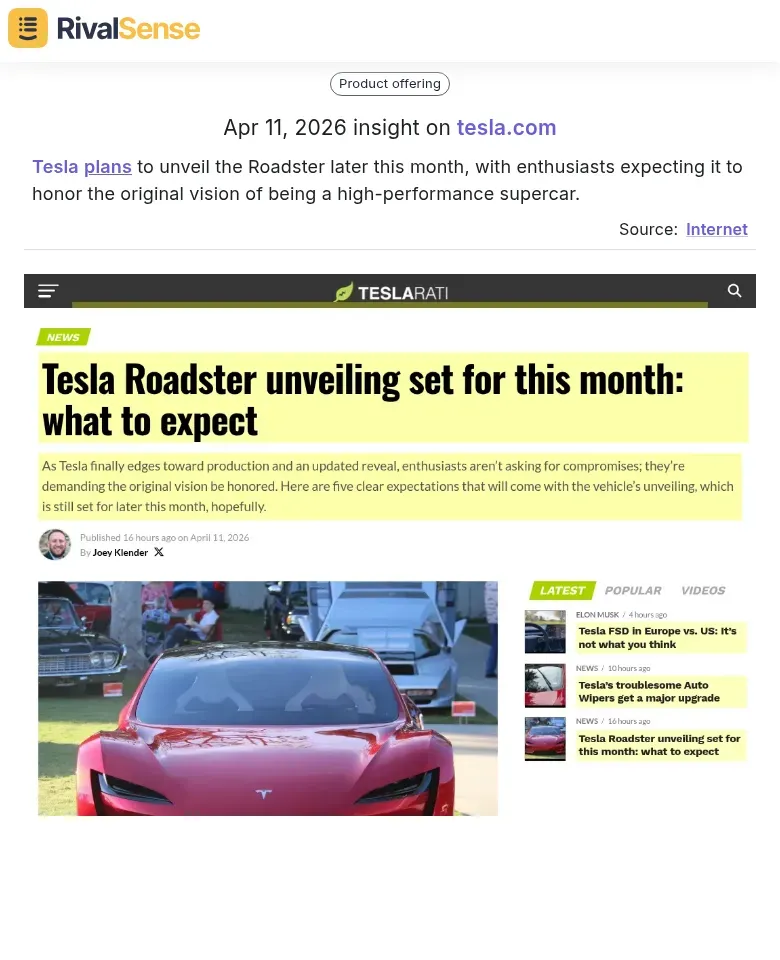
Tesla plans to unveil the Roadster later this month, with enthusiasts expecting it to honor the original vision of being a high-performance supercar.
This type of product launch insight is valuable because it reveals competitor focus on premium segments and technological advancements. By tracking such announcements, you can infer how competitors are enhancing brand loyalty through exclusivity and innovation, allowing you to adjust your own program to compete effectively.
Practical Checklist for Product Launch Analysis:
- Identify target customer segments and their loyalty drivers
- Map how the product creates exclusivity or status benefits
- Assess potential for tiered loyalty programs or early access privileges
- Evaluate technological innovations that could enhance personalization
AI Innovation Insights: Transforming Loyalty Programs
AI-powered innovations are reshaping how loyalty programs operate, offering personalized experiences and automation. For instance, RivalSense tracked this announcement:
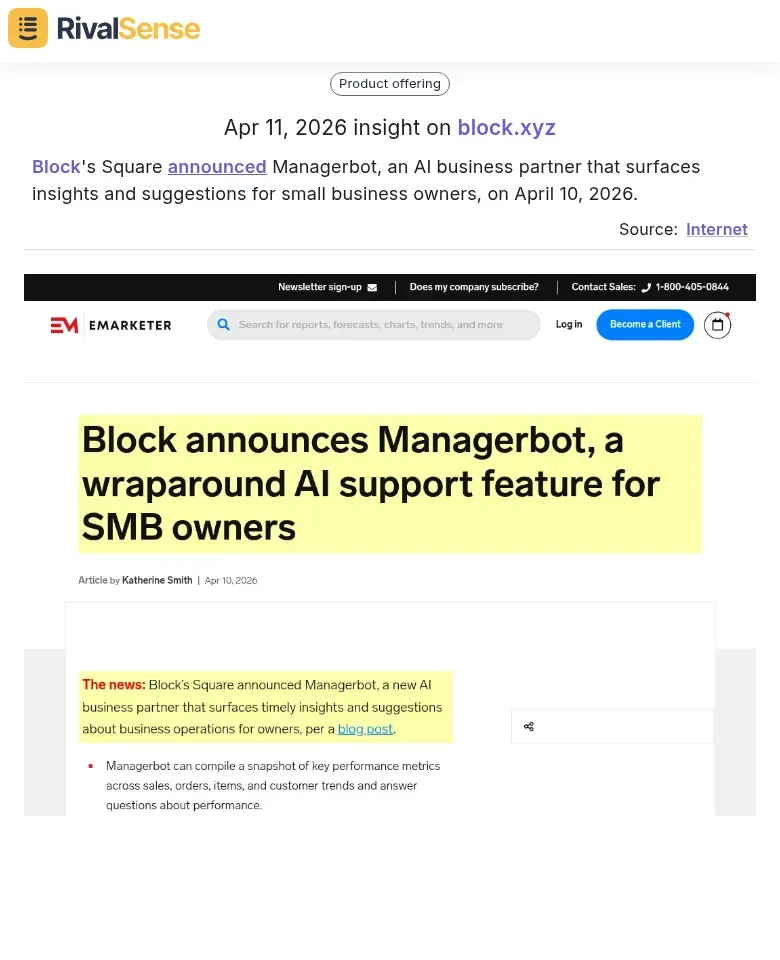
Block's Square announced Managerbot, an AI business partner that surfaces insights and suggestions for small business owners, on April 10, 2026.
This insight into AI innovations is valuable as it shows how competitors are leveraging technology to automate loyalty optimization and personalize customer interactions. Understanding these moves helps you identify opportunities to integrate AI into your own program for better customer segmentation and engagement.
AI Innovation Analysis Framework:
- Document the AI capabilities and their loyalty applications
- Assess implementation complexity and required data infrastructure
- Identify competitive advantages gained through automation
- Evaluate potential for personalization at scale
Funding Insights: Revealing Technology Investments
Funding announcements indicate where competitors are investing in technology infrastructure that can power advanced loyalty programs. Here's an example from RivalSense:
Luminai raised $38 million in Series B funding to expand its AI platform for automating healthcare administrative workflows.
Tracking such funding insights is valuable because it reveals emerging loyalty technologies and competitive hiring trends. By monitoring funding patterns, you can anticipate new capabilities in loyalty analytics and personalization, enabling you to stay ahead in technology adoption.
Funding Signal Analysis Steps:
- Monitor funding rounds and investor profiles
- Analyze stated use of funds for loyalty-relevant technology
- Track hiring patterns for technical roles
- Assess partnership announcements for loyalty ecosystem expansion
By systematically analyzing these three announcement types, you can anticipate competitor moves, identify emerging loyalty technologies, and develop counter-strategies before new loyalty programs launch in your market.
Advanced Analytics: Measuring Competitor Program Performance
To measure competitor loyalty program performance, implement systematic tracking across key areas. This involves monitoring engagement, value, and structural metrics to benchmark your own program effectively. By using tools like RivalSense, you can gather real-time data on redemption rates, customer sentiment, and more.
Engagement metrics include redemption rates and active member percentages, while value metrics cover points-to-dollar ratios and customer lifetime value uplift. Structural metrics involve tier progression requirements and personalization levels. Analyzing these helps you identify gaps and opportunities.
Benchmarking with a Competitive Scorecard:
Create a scorecard with weighted KPIs: engagement (30%), value delivery (40%), and innovation (30%). For example, if competitors average 25% redemption rates while yours is 15%, identify friction points in your redemption process.
Practical Steps:
- Create a competitor dashboard with weekly metric updates
- Conduct quarterly deep-dives on program changes and customer feedback
- Calculate ROI gaps: if competitors achieve 3:1 loyalty program ROI while yours is 2:1, analyze their cost structures
- Identify white spaces: when competitors focus on transactional rewards, consider experiential or community-building elements
- Test innovations in smaller segments before full rollout
Key Insight: The most successful programs balance immediate rewards with long-term emotional connections. Track not just what competitors do, but how customers respond to their initiatives.
Future-Proofing Your Loyalty Strategy Through Competitive Analysis
Future-proofing your loyalty strategy requires proactive analysis of competitors' technology investments and market trends. By monitoring their adoption of AI, blockchain, or AR/VR, you can anticipate shifts in loyalty program features. Tools like RivalSense can help track patent filings, job postings, and API changes for early signals.
Adapt your program by benchmarking against emerging trends and testing innovations in controlled segments. Create a competitive intelligence framework that includes automated alerts, quarterly SWOT analyses, and customer journey mapping to identify exploitable gaps.
Practical Steps for Continuous Optimization:
- Build a dashboard tracking key indicators like new partner integrations and reward structure changes.
- Use data to iterate quickly; for example, if a competitor's points expiration policy causes backlash, adjust yours proactively.
- Stay agile by anticipating moves rather than just reacting to them.
Actionable Framework: Implementing Competitor Insights
Implementing competitor insights effectively starts with a systematic monitoring framework. Track key competitors using tools like RivalSense to monitor loyalty program changes, reward structures, and customer feedback. Set up weekly alerts and quarterly deep-dive analyses to stay informed.
Develop counter-strategies by identifying competitor weaknesses and market opportunities. Use SWOT analysis to prioritize actions and integrate intelligence into your design process. For instance, if competitors lack personalization, implement AI-driven recommendations to fill that gap.
Practical Checklist for Implementation:
- Define monitoring scope and KPIs
- Use competitive intelligence tools like RivalSense
- Conduct regular gap analyses
- Test counter-strategies in pilot markets
- Review and iterate based on performance data
This ensures your loyalty program remains agile and competitive in a dynamic market.
Conclusion: Leverage Competitor Insights for Loyalty Success
In today's fast-paced business environment, staying ahead of competitors requires continuous analysis and adaptation. By leveraging real-world insights from product launches, AI innovations, and funding announcements, you can refine your loyalty strategy to meet evolving customer expectations.
To streamline your competitor tracking and gain actionable insights, consider using RivalSense. This tool monitors competitor product launches, pricing updates, event participations, partnerships, regulatory aspects, management changes, and media mentions across company websites, social media, and various registries, delivering all in a weekly email report.
Try RivalSense for free today at https://rivalsense.co/ and get your first competitor report to start enhancing your loyalty program strategy.
📚 Read more
👉 2026 Print-on-Demand Benchmarking: Uncover Competitor Innovation Advantages
👉 SaaS Product Offering Analysis Framework: Turn Competitor Insights into Strategy
👉 Decodo's Residential Proxy Pricing Update: Competitive Insights and Actionable Tips
👉 Track Key Account Team Members: The Complete Guide to Competitive Intelligence for B2B Leaders
👉 Data-Driven Insights: Track Key Account Communications in B2B Fintech