
Market Entry Competitor Insights: 7 Critical Mistakes Key Account Managers Must Avoid
Entering a new market demands more than just validating product-market fit. While understanding customer needs is essential, overlooking competitor dynamics is a recipe for costly expansion failures. Successful market entry requires comprehensive competitor intelligence that reveals not just who you're competing against, but how they operate, what strategies work in that market, and where vulnerabilities exist.
Key account managers face unique challenges in new market penetration: they must navigate unfamiliar competitive landscapes while protecting existing client relationships and identifying new opportunities. Without proper competitor insights, they risk deploying ineffective strategies, misallocating resources, and losing ground to established players who understand local dynamics.
Practical steps to avoid common mistakes:
- Map the competitive ecosystem before launch - identify direct, indirect, and potential competitors
- Analyze competitor pricing, positioning, and value propositions specific to the target market
- Monitor competitor customer acquisition strategies and channel partnerships
- Track competitor responses to new entrants - anticipate counter-moves
- Identify underserved segments competitors are overlooking
Competitor intelligence separates successful expansions from failures by providing actionable insights that inform strategic decisions, optimize resource allocation, and reveal competitive advantages that can be leveraged for sustainable market entry success.
Mistake 1: Overlooking Competitor Investment Patterns and Strategic Shifts
Key account managers often miss critical signals when competitors reallocate resources across regions. These investment shifts can reveal where competitors are doubling down or pulling back, directly impacting market entry timing and resource allocation. Ignoring these patterns leaves you reacting rather than proactively shaping your strategy.
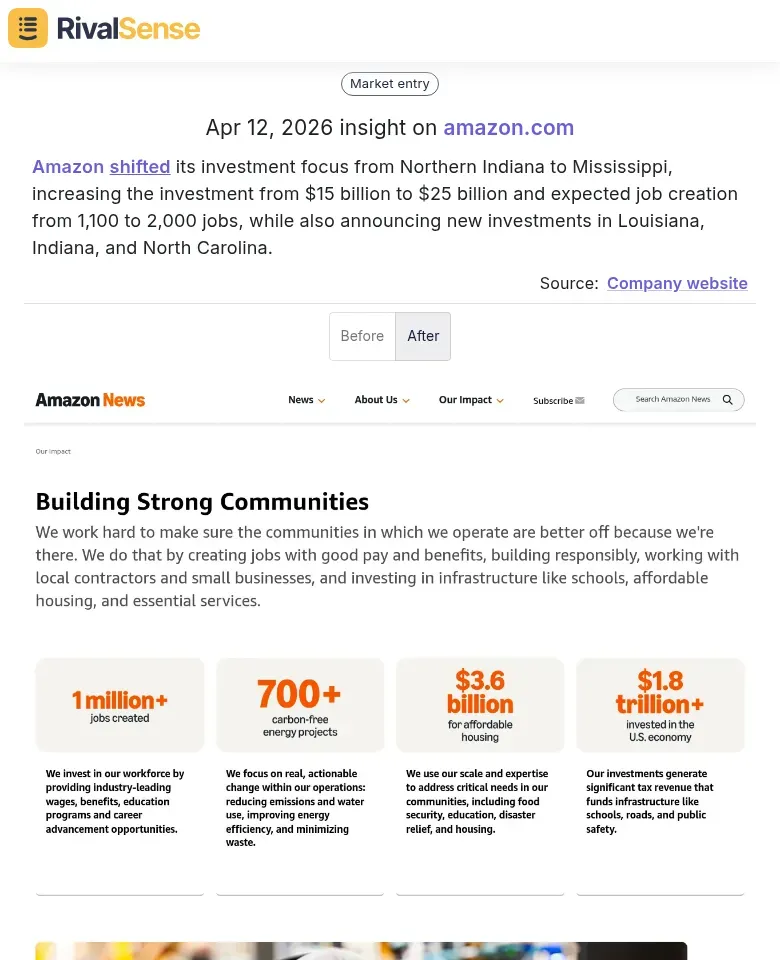
Consider this real-world example from RivalSense insights: Amazon shifted its investment focus from Northern Indiana to Mississippi, increasing the investment from $15 billion to $25 billion and expected job creation from 1,100 to 2,000 jobs, while also announcing new investments in Louisiana, Indiana, and North Carolina. This insight is valuable because it shows geographic rebalancing toward emerging AI infrastructure markets, signaling where competitive pressure might intensify.
Practical Checklist for Tracking Investment Shifts:
✅ Monitor Regional Investment Announcements: Track competitor press releases, regulatory filings, and local government announcements for capital expenditure disclosures
✅ Analyze Job Creation Targets: When competitors commit to creating thousands of jobs in specific regions, this reveals market confidence levels and growth priorities
✅ Track Capital Reallocation Patterns: Use tools like RivalSense to automate monitoring of competitor investment movements across 80+ sources
✅ Set Up Geographic Intelligence Alerts: Configure alerts for competitor names combined with location-specific keywords
✅ Calculate Investment Velocity: Measure (New Regional Investment ÷ Total Investment) × 100 quarterly to identify strategic shifts
Warning Signs You're Missing:
- 🔴 Competitors increasing regional commitments by 50%+ within 6 months
- 🔴 Job creation targets exceeding industry averages in specific markets
- 🔴 Capital expenditure announcements preceding product launches by 3-4 months
Pro Tip: Investment patterns typically signal market moves 90-180 days before revenue impacts. Early detection allows you to strengthen relationships in targeted regions before competitive pressure intensifies.
Mistake 2: Underestimating Talent Acquisition as a Competitive Signal
One of the most critical yet overlooked competitive signals is talent acquisition. When competitors hire strategically, they're revealing their expansion plans before they launch products or services. Key account managers who ignore hiring patterns miss early warning signs of market entry and strategic pivots that could affect client relationships.
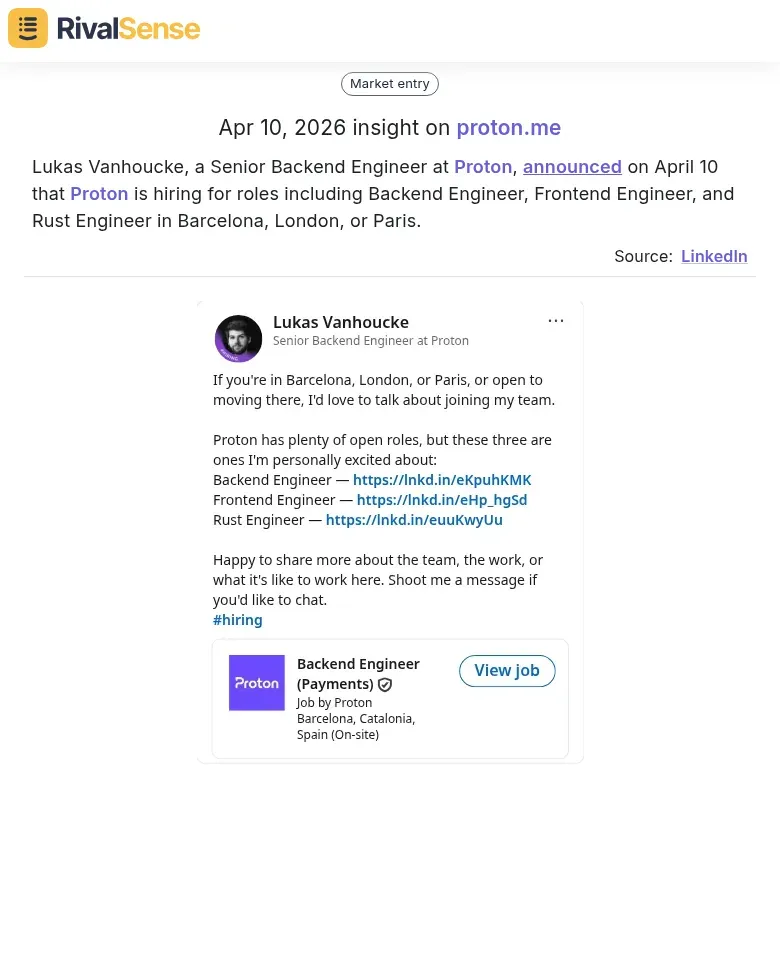
For instance, RivalSense captured this insight: Lukas Vanhoucke, a Senior Backend Engineer at Proton, announced on April 10 that Proton is hiring for roles including Backend Engineer, Frontend Engineer, and Rust Engineer in Barcelona, London, or Paris. This type of insight is valuable because it indicates Proton's focus on expanding its tech team in key European hubs, hinting at upcoming product developments or market pushes.
Common mistakes to avoid:
- Ignoring hiring surges: When competitors post multiple roles in a new region, they're likely establishing a local presence.
- Overlooking specialized roles: Specific positions like "Enterprise Sales Director - Healthcare" signal strategic priorities.
- Missing timing patterns: Hiring often precedes market entry by 3-6 months as companies build teams before launching.
Practical steps to monitor talent signals:
- Set up alerts for competitor job postings in key regions
- Analyze role types to identify strategic focus areas
- Track leadership hires - new executives often signal strategic shifts
- Monitor LinkedIn for employee location changes and new team formations
- Create a hiring dashboard to visualize competitor talent acquisition patterns
Pro tip: Combine hiring data with other signals like office expansions or new certifications to validate market entry hypotheses. Talent moves are often the first domino to fall in competitive strategy.
Mistake 3: Ignoring Geographic Expansion and Localization Strategies
Key account managers often make the critical error of overlooking competitors' regional moves and adaptation strategies. This includes failing to track competitor expansion announcements in real-time, missing their localization approaches for specific markets, and underestimating how they modify solutions for regional compliance and customer preferences. These oversights can lead to misaligned offerings and lost opportunities.
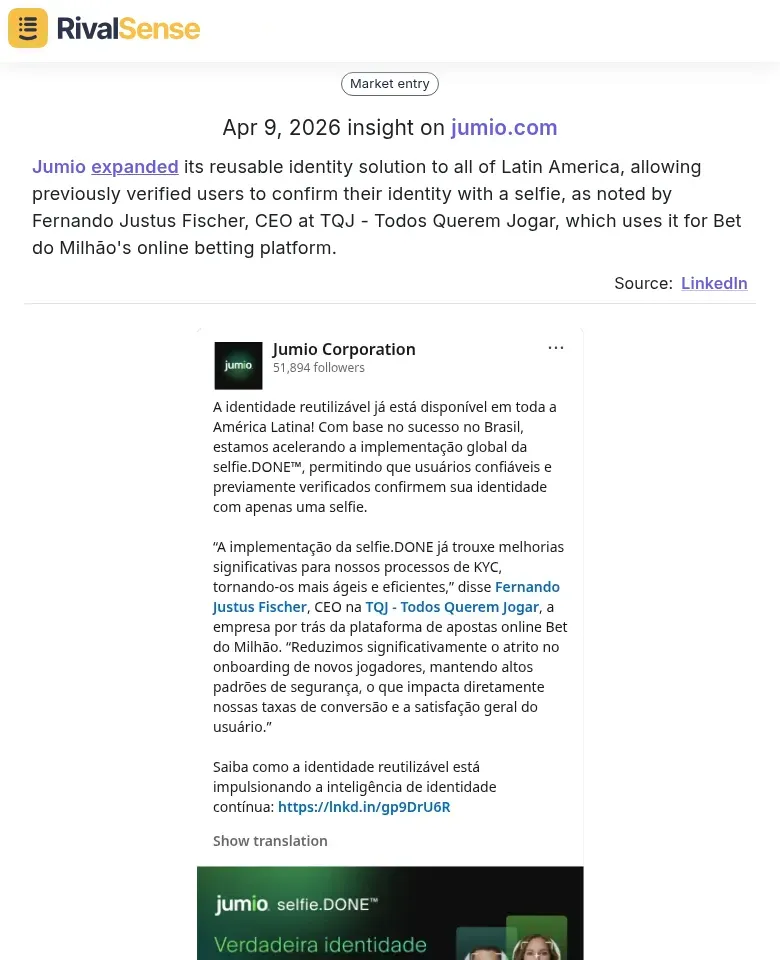
Take this RivalSense insight as an example: Jumio expanded its reusable identity solution to all of Latin America, allowing previously verified users to confirm their identity with a selfie, as noted by Fernando Justus Fischer, CEO at TQJ - Todos Querem Jogar, which uses it for Bet do Milhão's online betting platform. This insight is valuable because it highlights Jumio's strategic geographic expansion into a growing market, showcasing how they adapt solutions for regional compliance and user convenience.
Practical Checklist:
✅ Set up automated alerts for competitor press releases, job postings, and regulatory filings in target regions
✅ Monitor competitors' website changes, language additions, and regional pricing adjustments
✅ Analyze how competitors adapt products for local compliance (GDPR, data sovereignty, etc.)
✅ Track competitor partnerships with local distributors or service providers
✅ Review customer feedback from different regions to identify localization gaps
Pro Tip: Use competitive intelligence tools to create geographic heat maps showing where competitors are gaining traction. Pay special attention to how they modify messaging, payment methods, and support channels for different cultural contexts. Remember that successful localization goes beyond translation - it involves adapting the entire customer experience to regional expectations.
Mistake 4: Neglecting Partnership and Integration Ecosystem Signals
Neglecting partnership and integration ecosystem signals is a critical oversight when entering new markets. Competitors often reveal their market penetration strategies through strategic alliances with local leaders and integration announcements that demonstrate how they plan to leverage existing infrastructure. Missing these signals can leave you blindsided by well-connected competitors.
Practical Steps to Avoid This Mistake:
- Monitor Partnership Announcements: Track competitor collaborations with local market leaders, industry associations, and complementary service providers. These partnerships often signal market entry strategies and reveal which local players they consider valuable.
- Analyze Integration Patterns: When competitors announce integrations with popular local platforms, payment systems, or communication tools, they're revealing their go-to-market approach. Document which integrations they prioritize first.
- Map Customer Base Leverage: Identify how competitors use their existing customer relationships to enter new regions. Do they offer cross-border services first? Do they reference success stories from similar markets?
Quick Checklist:
- 🔍 Set up alerts for competitor partnership announcements
- 📊 Create a matrix tracking competitor integrations by region
- 💡 Analyze how competitors reference existing customers in new market communications
- 🎯 Monitor local industry events where partnerships are typically announced
Key Insight: The most successful market entries often come from competitors who strategically partner with established local players rather than trying to build everything from scratch. These ecosystem signals reveal their true market penetration timeline and resource allocation.
Mistake 5: Relying on Static Competitor Analysis in Dynamic Markets
In fast-moving markets, static competitor profiles become obsolete within weeks. Key account managers who rely on quarterly competitor reports miss critical real-time developments—new product launches, pricing changes, or strategic partnerships that reshape competitive landscapes overnight. This mistake leads to reactive strategies and missed opportunities to protect key accounts.
Practical Steps to Avoid This Mistake:
- Implement Real-Time Monitoring: Set up automated alerts for competitor website changes, social media announcements, and news mentions. Track pricing fluctuations and feature updates weekly.
- Measure Competitor Velocity: Don't just track what competitors are doing—track how fast they're moving. Create a simple scoring system for competitor activity frequency across product, marketing, and sales channels.
- Connect Multiple Signals: Combine pricing data with hiring patterns, customer reviews with feature releases, and partnership announcements with market expansion moves. Look for patterns across 3+ data sources.
- Weekly Competitive Pulse Check: Dedicate 30 minutes weekly to review automated alerts and update competitor positioning. Focus on changes that impact your key accounts specifically.
- Create Actionable Insights Framework: For each competitor signal, ask: (1) How does this affect our key accounts? (2) What immediate action is required? (3) What strategic adjustment is needed?
Remember: In dynamic markets, yesterday's competitive intelligence is today's competitive disadvantage. The most successful key account managers treat competitor analysis as a continuous process, not a periodic exercise.
Mistake 6: Failing to Analyze Competitor Customer Feedback and Sentiment
Overlooking competitor customer feedback and sentiment is a common pitfall that prevents key account managers from understanding market perceptions. Competitor reviews, social media mentions, and support forums reveal pain points, feature requests, and satisfaction levels that can inform your own market entry strategy. Ignoring this data means missing chances to differentiate and address unmet needs.
Actionable Steps to Leverage Customer Insights:
- Monitor Review Platforms: Track competitor ratings on sites like G2, Capterra, or Trustpilot for your target market. Look for recurring complaints or praises.
- Analyze Social Sentiment: Use social listening tools to gauge public perception of competitors' products or services in the new region.
- Identify Feature Gaps: Compile customer requests from competitor forums to prioritize development of features that competitors lack.
- Benchmark Satisfaction Metrics: Compare net promoter scores (NPS) or customer satisfaction scores (CSAT) against competitors to set realistic goals.
Pro Tip: Customer sentiment insights can help you craft compelling value propositions that directly address competitor weaknesses, making your offering more attractive to key accounts from day one.
Mistake 7: Overlooking Regulatory and Compliance Changes in New Markets
Entering a new market without closely monitoring regulatory and compliance changes affecting competitors is a risky oversight. Key account managers must understand how local laws, data privacy regulations, or industry standards impact competitive dynamics. Competitors' adaptations to these changes can signal their commitment and readiness in the market.
How to Stay Ahead:
- Track Regulatory Filings: Set up alerts for competitor submissions to local regulatory bodies, such as licensing applications or compliance reports.
- Monitor Legal Updates: Follow industry news for changes in regulations that might force competitors to adjust their offerings.
- Analyze Competitor Communications: Look for announcements about compliance certifications or partnerships with legal firms in the region.
- Assess Risk Exposure: Evaluate how regulatory changes could affect competitors' cost structures or service delivery, revealing vulnerabilities you can exploit.
Quick Checklist:
- 📜 Subscribe to regulatory news feeds for your target market
- ⚖️ Review competitor privacy policies and terms of service updates
- 🔗 Note any competitors withdrawing from regions due to compliance issues
- 🛡️ Use insights to preemptively address compliance in your market entry plan
Conclusion: Building a Proactive Competitor Intelligence Framework
Building a proactive competitor intelligence framework transforms market entry from reactive guesswork to strategic foresight. Start by implementing systematic tracking: use tools to monitor competitor pricing, product launches, and marketing campaigns weekly. Create a centralized dashboard with key metrics—market share changes, customer sentiment, and win/loss analysis.
Develop early warning systems by setting alerts for competitor announcements, leadership changes, and funding rounds. Establish a monthly competitive review meeting where your team analyzes patterns and predicts strategic shifts. Track not just direct competitors but adjacent players who might pivot into your space.
Translate insights into actionable account strategies with a simple framework:
- Identify competitor vulnerabilities in each key account
- Develop counter-messaging for their strengths
- Create account-specific battle cards with competitive differentiators
- Establish quarterly competitive positioning reviews with your sales team
Remember: intelligence without action is wasted. Assign clear owners for each competitive threat, create response playbooks for common scenarios, and measure success through competitive win rates and account retention metrics. Your framework should evolve as you enter new markets—what works in one territory may need adjustment for another.
Ready to Avoid These Mistakes in Your Market Entry?
Streamline your competitor tracking with RivalSense, which automates monitoring of product launches, pricing updates, event participations, partnerships, regulatory changes, management shifts, and media mentions across company websites, social media, and various registries. Get all insights delivered in a weekly email report to stay ahead.
Try RivalSense for free today at https://rivalsense.co/ and get your first competitor report to start making smarter market entry decisions.
📚 Read more
👉 Real-World Competitor Loyalty Program Analysis: Leveraging Internet Insights
👉 2026 Print-on-Demand Benchmarking: Uncover Competitor Innovation Advantages
👉 SaaS Product Offering Analysis Framework: Turn Competitor Insights into Strategy
👉 Decodo's Residential Proxy Pricing Update: Competitive Insights and Actionable Tips