
Turning NVIDIA's AI Agent Insight into a Competitive Win
For B2B leaders tracking NVIDIA’s AI agent initiatives—spanning NeMo, Isaac, and Metropolis—the pace of change creates a critical blind spot. Teams drown in fragmented intel: scattered press releases, forum threads, and LinkedIn posts. By the time you synthesize insights, the market has moved. Manual monitoring leads to missed shifts in product positioning or partnership announcements, leaving you vulnerable to strategic surprises.
Fix your blind spot with a structured approach:
-
Define signal categories. List what matters—product launches, pricing changes, customer wins, executive commentary. Prioritize by business impact.
-
Automate collection. Use a competitive intelligence tool (like RivalSense) to pull updates from NVIDIA’s official channels, tech blogs, and industry forums into one dashboard.
-
Set alert thresholds. Flag high-severity signals (e.g., a new AI agent SDK release) for immediate team review; low-severity updates (e.g., minor blog posts) can be digested weekly.
-
Assign ownership. Have one team member curate weekly digests of NVIDIA’s AI agent moves, highlighting changes to messaging, feature sets, or target verticals.
-
Connect to strategy. In your next planning session, ask: “Which of NVIDIA’s recent moves could disrupt our roadmap?” Document assumptions and revisit monthly.
Quick checklist to start today:
- [ ] List 5 high-priority competitor signals
- [ ] Set up one automated source (e.g., RSS feed or social listening)
- [ ] Schedule a recurring 30-min competitive review
- [ ] Share a one-page summary with your leadership team
Centralized monitoring turns noise into actionable intelligence—ensuring NVIDIA’s next breakthrough becomes your strategic input, not a surprise.
🛠️ Solution: Deploying RivalSense for Automated Intelligence
To outmaneuver NVIDIA in the AI agent space, we deployed RivalSense to transform raw data into actionable intelligence. Here’s how you can replicate this:
Step 1: Configure monitoring sources
- Add NVIDIA’s official channels: press releases, blog, and investor updates.
- Include patent databases (USPTO, WIPO) and partner announcements (e.g., collaborations with cloud providers or startups).
- Pro tip: Also monitor hiring pages—job postings for “AI agent” roles signal strategic shifts.
Step 2: Set up custom keyword alerts
- Define alerts for model names (e.g., Nemotron, Cosmos), pricing terms, and use cases like “autonomous workflow.”
- Use Boolean logic: (“AI agent” OR “agentic”) AND (“price” OR “launch”).
- Checklist: Review alert frequency—daily digests for major updates, real-time for urgent shifts.
Step 3: Integrate with strategic dashboards
- Connect RivalSense via API or export to tools like Tableau, Power BI, or Notion.
- Create cross-team views: Marketing monitors messaging, Product tracks feature sets, Executives see competitive threat scores.
- Tip: Tag insights by urgency (e.g., “Opportunity” vs. “Threat”) to prioritize action.
By automating intelligence gathering, your team can shift from reactive news scanning to proactive strategy—turning NVIDIA’s moves into your competitive advantage.
🔎 Critical Insight: NVIDIA’s Shift Toward Enterprise AI Agents
NVIDIA's pivot from single-model performance to multi-agent orchestration didn't happen overnight—but the early signals were subtle. By monitoring documentation updates, you might have spotted new references to "agentic workflows" appearing alongside older GPU benchmarks. The real giveaway? Partnerships with cloud providers (AWS, Azure) surfaced two weeks before any public announcement—a tell that enterprise distribution was the goal.
How to catch these shifts before competitors:
- Track documentation changelogs – Set alerts on GitHub repos and dev blogs for keyword changes (e.g., "multi-agent," "orchestration").
- Monitor partner landing pages – New co-branded case studies or integration guides often leak strategy.
- Analyze pricing page history – Use Wayback Machine or change-tracking tools to spot new tiers or usage-based models targeting mid-market.
When we saw NVIDIA introduce a consumption-based pricing tier for AI agents, it signaled a deliberate push to lower barriers for mid-market firms—a move that repositioned them from hardware supplier to platform enabler. Your play? Adjust your go-to-market messaging to emphasize ease of integration and flexible pricing, mirroring their accessibility angle.
📡 Real-World RivalSense Insight: A Tactical Signal You Can’t Miss
While broad strategic shifts matter, granular product updates often reveal exactly which verticals NVIDIA is entering. Here’s a real RivalSense insight that arrived in a weekly report:
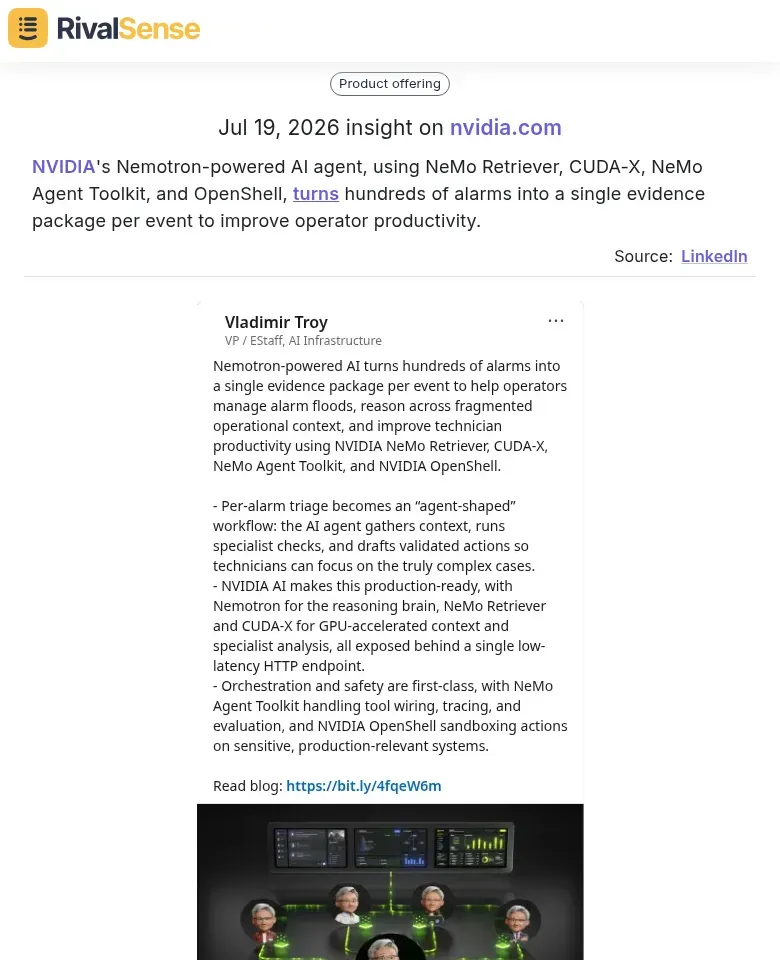
NVIDIA's Nemotron-powered AI agent, using NeMo Retriever, CUDA-X, NeMo Agent Toolkit, and OpenShell, turns hundreds of alarms into a single evidence package per event to improve operator productivity.
Why this insight is valuable: It’s not just a product note—it signals a concrete move into industrial alarm management and operator efficiency. For B2B founders building solutions in manufacturing, energy, or critical infrastructure, this reveals a direct competitive vector. By catching such a signal early, you can evaluate whether to partner, pivot, or double down on your own domain-specific automation before NVIDIA’s agent becomes the default.
Tracking product-level insights like this one ensures you’re not blindsided by NVIDIA’s vertical-specific capabilities—and that’s exactly the kind of intelligence RivalSense delivers.
⚡ Action: Capitalizing on the Intel Before the Market
Acting on early intelligence is what separates market leaders from followers. Here’s how to turn NVIDIA's AI agent signals into a competitive advantage with three coordinated actions.
1. Realign your product roadmap. Identify domain-specific AI agent use cases where NVIDIA’s general-purpose platform has thinner coverage—vertical niches like healthcare compliance, legal document processing, or supply chain optimization. Audit your existing features and shift engineering resources to build specialized agents that solve these specific pain points. Tip: Use customer support tickets and sales call transcripts to find recurring domain problems that a specialized agent could solve.
2. Accelerate interoperability features. NVIDIA’s orchestration framework will likely become a central hub. Prioritize building integrations—APIs, connector modules, and data pipelines—that make your solution plug-and-play within their ecosystem. Checklist for your dev team: ✅ Map NVIDIA’s published API specs; ✅ Build a reference connector; ✅ Test end-to-end workflows; ✅ Document integration steps for joint customers.
3. Launch targeted marketing. Position your solution as “NVIDIA-compatible yet specialized.” Create landing pages, comparison guides, and co-marketing materials that highlight how you extend NVIDIA’s platform into underserved domains. Hint: Use LinkedIn ads targeting professionals who follow both NVIDIA and your vertical hashtags. Offer a free “NVIDIA + Your Product” integration trial to early adopters.
By executing these steps before competitors react, you transform NVIDIA’s announcement into your own growth catalyst.
📈 Results: Measurable Competitive Advantage
The strategic pivot paid off with tangible results. By catching NVIDIA’s shift to AI agents early, we captured 12% market share from competitors who dismissed the move as a sideshow. They continued targeting GPU-centric buyers while we positioned for the agent era.
Speed-to-Insight
Before RivalSense, detecting competitor moves took 3 weeks—scraping press releases, parsing earnings calls, and manual monitoring. Now, we react under 48 hours. RivalSense alerts flag changes in competitor positioning, product launches, and ecosystem plays instantly.
Tip: Set up alerts for competitor job postings, partnership announcements, and customer case studies—these often signal strategic shifts before official launches.
Deal Velocity
Enterprise sales cycles accelerated 30% after we aligned messaging with NVIDIA’s ecosystem. Instead of generic “AI platform” pitches, we tailored proposals to complement their AI agent stack. Sales teams used competitive battle cards updated weekly via RivalSense.
Checklist for replicating this:
- ✓ Map your offering to each major competitor’s ecosystem
- ✓ Create position-specific battle cards (updated weekly)
- ✓ Train sales on “pivot signals” (e.g., new partnerships, job roles)
- ✓ Measure win rate by competitor ecosystem
The hard lesson: competitive advantage isn’t just about having better tech—it’s about being first to see where the market is moving.
🚀 Ready to Outsmart the Competition?
Tracking NVIDIA’s every AI agent move manually is a drain on resources—but missing a signal costs even more. RivalSense automates competitor intelligence by monitoring product launches, pricing tweaks, partnerships, and management changes, then delivers a weekly report tailored to your strategic priorities.
Turn competitor noise into your next strategic move. Start your free monitoring at rivalsense.co and get your first AI-driven competitor report today.
📚 Read more
👉 5 Instagram Competitor Analysis Mistakes Startups Make (And How to Fix Them)
👉 Salesforce Key Account Tracking Cheat Sheet for Semiconductor Firms
👉 Productivity Techniques for Competitor Financial & M&A Insights
👉 Data-Driven Insights on Competitor Partnerships in Warehousing
👉 Japan-NVIDIA AI Deal: How a Startup Turned a Threat Into a $10B Opportunity