
Workflow Breakdown: Telecom Competitor Market Research Reports
In today’s telecom landscape, rapid technological shifts—from 5G rollout to edge computing and IoT—make continuous competitor intelligence a survival imperative. Without structured research, teams react to price changes too late or miss partnership opportunities entirely. A formalized market research workflow transforms raw data into actionable insights for pricing, product roadmaps, and strategic alliances.
Practical Steps for Getting Started:
- Identify Key Competitors – Segment by tier (e.g., global MNOs, regional players, OTT disruptors) to avoid overload.
- Define Data Sources – Combine financial filings, press releases, social listening, and network testing tools.
- Establish a Cadence – Weekly scans for pricing/news; monthly deep dives on capex and spectrum holdings.
💡 Pro Tip: Build a competitive taxonomy (e.g., coverage, speed, pricing, customer sentiment) before collecting data. This ensures your reports compare apples to apples.
From raw data to a final report, the workflow typically spans four phases: Collect (🔍 gather signals), Analyze (📊 contextualize trends), Synthesize (🧩 distill into key findings), and Act (🚀 recommend pricing, product, or partnership moves). Following this structure helps leaders make faster, evidence-based decisions in a sector where delay costs millions.
Step 1: Defining Research Objectives and Key Questions
Start by mapping your competitive landscape into three tiers: direct competitors (same product, same market), indirect competitors (different product, same need), and emerging players (startups or adjacent entrants). Use a simple matrix: list each competitor, their target segment, and your key concern about them.
Formulate specific research questions — avoid vague ones like “What are competitors doing?” Instead, ask:
- “Which competitors have gained/lost market share in the last quarter, and why?”
- “What new product features did competitors launch, and how do they compare to ours?”
- “What go-to-market channels are competitors using to enter [target region]?”
Align scope with business goals. If you’re entering a new region, focus on local players, pricing models, and regulatory barriers. If defending core markets, zero in on feature gaps, customer churn triggers, and marketing tactics.
💡 Tip: Create a “research canvas” with columns for Competitor, Category (direct/indirect/emerging), Key Questions, Data Sources, and Priority (High/Medium/Low). This keeps your team aligned and prevents scope creep.
Quick checklist:
- [ ] Competitor tiers identified (min. 3 per tier)
- [ ] Top 5 research questions formulated
- [ ] Questions mapped to specific business decisions
- [ ] Priority scores assigned to each competitor
Step 2: Systematic Data Collection from Public and Proprietary Sources
To build a robust telecom competitive intelligence (CI) picture, blend public and proprietary data systematically.
1. Mine Public Sources for Quantitative Data
- Press releases & investor filings (SEC, EDGAR): Extract revenue breakdowns, subscriber counts, ARPU, churn rates, and CAPEX plans. Set up automated alerts via services like AlphaSense or SEC Alerts.
- Industry reports (GSMA, Ovum, Dell’Oro): Use for market sizing, spectrum holdings, and technology roadmaps. Create a shared drive with indexed key findings.
2. Monitor Competitors’ Digital Footprints
- Websites & social media: Track product page changes, blog posts, LinkedIn hiring surges, and pricing updates. Use tools like Visualping for page change detection.
- Job postings: Scrape LinkedIn, Indeed, and company career pages for new roles in 5G/RAN, fiber, or IoT which signal strategic shifts.
3. Automate with CI Tools
- Deploy Crayon, Klue, or RivalSense to aggregate alerts on news, funding, and feature launches.
- Set up real-time Slack/email notifications for competitor job postings, press releases, and website changes.
🔎 Real Competitor Signals Tracked by RivalSense
While telecom-specific, the following real-world examples from RivalSense demonstrate the granularity of intelligence you can capture—whether a new partnership, a product innovation, or a content play. Each type can signal a strategic move that demands your attention.

🤝 Partnership Signal: VSPARTICLE joined CuspAI's 'AI Materials Foundry' as a founding member, a global network including Meta, NVIDIA, and others to accelerate materials discovery.
This type of alert reveals expanding cooperation networks—crucial for assessing potential consortium plays, shared standards, or collaborative R&D that could reshape competitive dynamics. In telecom, similar alerts on infrastructure-sharing pacts or joint 6G trials are invaluable.
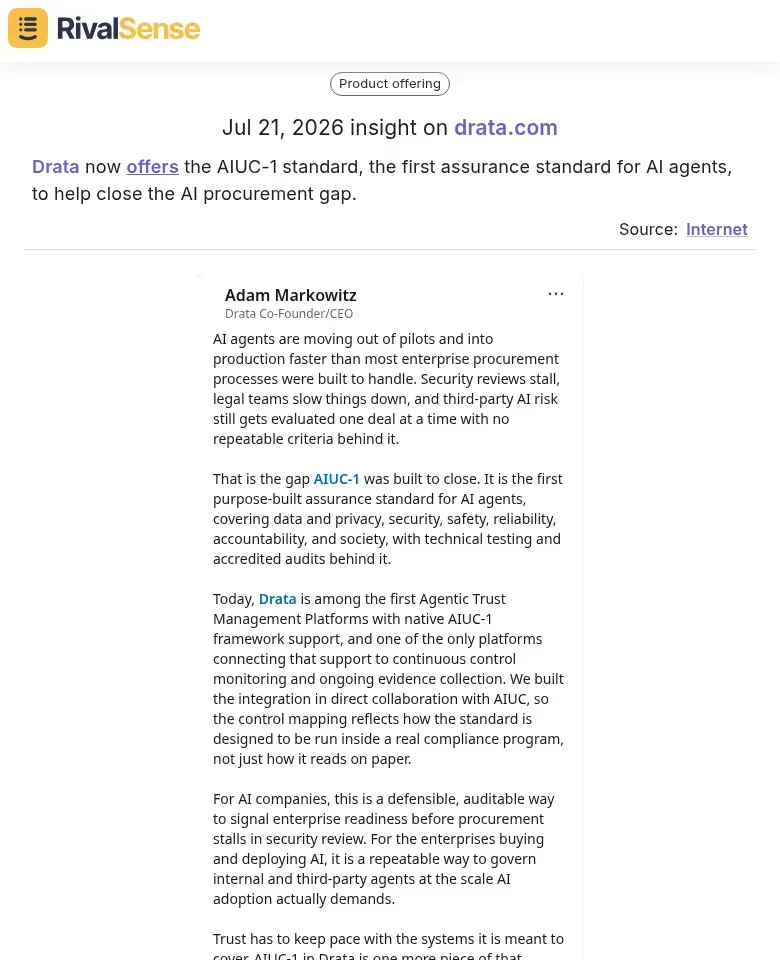
🚀 Product Innovation Signal: Drata now offers the AIUC-1 standard, the first assurance standard for AI agents, to help close the AI procurement gap.
Tracking new product standards or feature launches tells you when a competitor raises the bar. Early notice lets you brief product teams and adjust roadmaps before the move gains traction. For a telco, this could be a new edge computing SLA or an API monetization tier.
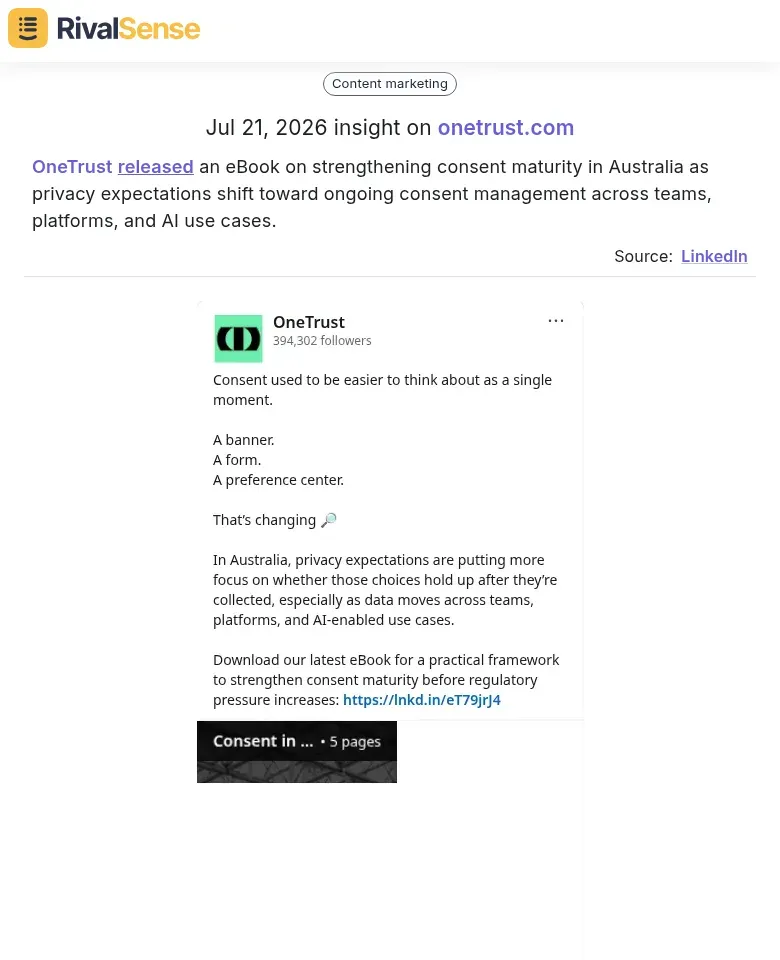
📚 Content & Thought Leadership Signal: OneTrust released an eBook on strengthening consent maturity in Australia as privacy expectations shift toward ongoing consent management across teams, platforms, and AI use cases.
Content moves signal where a competitor sees growth opportunities and how they’re trying to educate the market. This can guide your own content strategy or reveal regional focus. In telecom, an eBook on private 5G for manufacturing would hint at enterprise push.
RivalSense applies the same detection methodology to telecom-specific moves—such as new spectrum-sharing deals, MVNO partnerships, or 5G API launches—helping you catch critical signals early.
Pro Tips:
- Create a master source list (URLs, RSS feeds, API endpoints) and assign ownership per competitor.
- Use a tracking spreadsheet columns: Competitor, Source Type, Update Frequency, Last Checked, Key Insights.
- Validation check: Cross-reference financial claims with regulatory filings (e.g., FCC spectrum reports) to avoid marketing puffery.
By structuring collection into public → digital → automated layers, you capture both lagging indicators (earnings) and leading signals (hiring, pricing) in near real-time.
Step 3: Structuring and Analyzing Competitive Intelligence
Once raw data is collected, structure it using a standardized framework. For telecom, track these dimensions:
| Dimension | What to Capture |
|---|---|
| Coverage | Network type (5G SA/NSA, LTE-M, NB-IoT), geographic reach, spectrum bands |
| Pricing | Plan tiers, overage rates, contract terms, promotional discounts |
| SLA | Uptime guarantees, latency targets, credits for breaches |
| Tech Stack | Core network vendors (Ericsson, Nokia), OSS/BSS systems, APIs |
💡 Pro tip: Use a shared spreadsheet or CI platform with dropdowns to enforce consistency.
Next, run a SWOT analysis for each competitor and benchmark against market leaders. Focus on:
- Strengths: Spectrum holdings, brand loyalty
- Weaknesses: Coverage gaps, customer churn
- Opportunities: Enterprise IoT, private 5G
- Threats: Regulatory changes, new entrants
Checklist for benchmarking:
- [ ] Identify top 3 competitors by market share
- [ ] Compare pricing vs. feature set
- [ ] Map coverage maps side-by-side
- [ ] Review SLA fine print
Finally, identify patterns in competitor moves. Track M&A activity, spectrum auctions won, and strategic partnerships (e.g., cloud providers, tower companies).
Pattern-spotting hint: Use a timeline visualization to spot clusters of moves—e.g., three competitors launching fixed wireless access within one quarter signals a market shift.
This structured approach transforms raw data into actionable strategic insights.
Step 4: Synthesis and Report Creation for Stakeholders
Tailor reports to audience needs. C-suite gets a 1-page executive summary with strategic risks, market shifts, and revenue implications. Product teams receive detailed feature comparisons, roadmap gaps, and technical analysis with heatmaps. Sales teams get battle cards, pricing updates, and win/loss data.
Visualize for impact: Use dashboards (Tableau, Google Data Studio) with trend graphs for market share, feature adoption, and pricing changes. Heatmaps highlight competitive strengths/weaknesses at a glance. Color-code urgency: red for immediate threats, yellow for monitoring, green for advantages.
Actionable insights are key. Every report must answer: "So what?" and "Now what?" Include:
- Early warning signals: New funding, leadership hires, patent filings, beta launches.
- Recommendations table: Threat, impact (high/medium/low), recommended action, owner, deadline.
- Checklist for readers: "3 things to act on this week."
💡 Pro tip: Use a standardized template with modular sections so stakeholders can drill down as needed. Keep reports to 5-7 pages max, with an appendix for raw data. Schedule recurring delivery (weekly pulse, monthly deep-dive) to build a competitive intelligence rhythm.
Step 5: Establishing a Continuous Monitoring and Feedback Loop
Competitor landscapes shift rapidly in telecom. A one-time report is insufficient—you need a system for ongoing tracking.
Set Update Cadences
- Weekly: Monitor news, product launches, pricing changes. Use tools like RivalSense for automated alerts.
- Monthly: Synthesize key moves into a brief internal memo (e.g., "Competitive Radar").
- Quarterly: Produce a full report analyzing strategy shifts, market share data, and implications for your roadmap.
Integrate Insights into Strategy
- Product Roadmaps: Tag every feature request with competitor context (e.g., "Vodafone launched X; we should prioritize Y").
- Strategic Planning: Dedicate 15 minutes of monthly leadership meetings to review competitor trends.
- Tip: Create a shared dashboard (Notion, Airtable) where teams log competitive observations.
Measure Impact & Refine
- Track metrics: How many product decisions were influenced by research? Did we react faster to threats?
- Conduct a quarterly retrospective: What insights were most valuable? What sources missed the mark?
- Checklist for feedback loop:
- [ ] Are insights reaching the right stakeholders?
- [ ] Are we over- or under-monitoring certain areas?
- [ ] Has our research led to measurable outcomes?
Continuous monitoring turns data into a competitive advantage. Adjust cadences and channels quarterly to stay lean and relevant.
To put this entire workflow into practice without the manual grind, let RivalSense be your radar. It automatically tracks competitor product launches, pricing changes, partnerships, regulatory moves, and more—delivering everything in a clean weekly email report. Sign up free and get your first competitor report today.
📚 Read more
👉 Turning NVIDIA's AI Agent Insight into a Competitive Win
👉 5 Instagram Competitor Analysis Mistakes Startups Make (And How to Fix Them)
👉 Salesforce Key Account Tracking Cheat Sheet for Semiconductor Firms
👉 Productivity Techniques for Competitor Financial & M&A Insights
👉 Data-Driven Insights on Competitor Partnerships in Warehousing