
Productivity Techniques for Competitor Financial & M&A Insights
Financial and M&A intelligence is a strategic imperative, not a luxury. A competitor’s balance sheet reveals their runway, R&D burn rate, and ability to weather downturns. For instance, a sudden drop in cash reserves paired with rising debt might signal an upcoming capital raise or acquisition pause—giving you a window to capture market share.
M&A activity is an even richer signal. When a rival acquires a niche AI startup, they’re telegraphing their tech roadmap. When they buy a distributor in a new region, that’s a geographic expansion play you need to counter.
How to extract actionable insights efficiently:
- Set up automated alerts for SEC filings (Edgar), press releases, and earnings calls. Use tools like RivalSense to aggregate competitor news and track financial filings in one dashboard.
- Scan quarterly reports for “Risk Factors” and “MD&A” sections—these reveal where leadership is worried or investing.
- Track M&A patterns with a simple spreadsheet: log target company, deal size, rationale (technology, talent, market access). After 3–4 deals, patterns emerge.
- Use the “Three-Bucket Framework” to categorize insights: (1) Health signals (revenue trends, margins), (2) Investment signals (R&D spend, CapEx), (3) Strategic signals (M&A, partnerships).
Checklist for a 30-minute weekly scan:
- [ ] Review one competitor’s 10-Q or 10-K (focus on cash flow, debt, and revenue concentration).
- [ ] Search Crunchbase or PitchBook for any new rounds or acquisitions.
- [ ] Update your competitive matrix with the top three financial takeaways.
This routine turns raw data into a decision-ready narrative, helping you anticipate moves before they happen.
Efficiently Capturing Key Financial Metrics from Earnings Reports
To streamline competitor financial tracking, focus on core metrics: revenue, EBITDA, free cash flow, and regional breakdowns. These reveal growth trends, profitability, cash health, and geographic exposure.
Create a Standardized Template – Build a spreadsheet with rows for each competitor and columns for key metrics across quarters. Include fields for revenue (total and by region), EBITDA margin, and free cash flow. Use formulas to calculate year-over-year changes and flag anomalies. This enables side-by-side comparisons and trend spotting in minutes.
Set Up Automated Alerts – Use tools like Google Alerts, SEC filing notifications, or investor relations RSS feeds. Configure alerts for “[Competitor Name] earnings release” and “[Competitor Name] investor call.” Services like RivalSense can aggregate earnings dates and transcripts into one dashboard, eliminating manual checks.
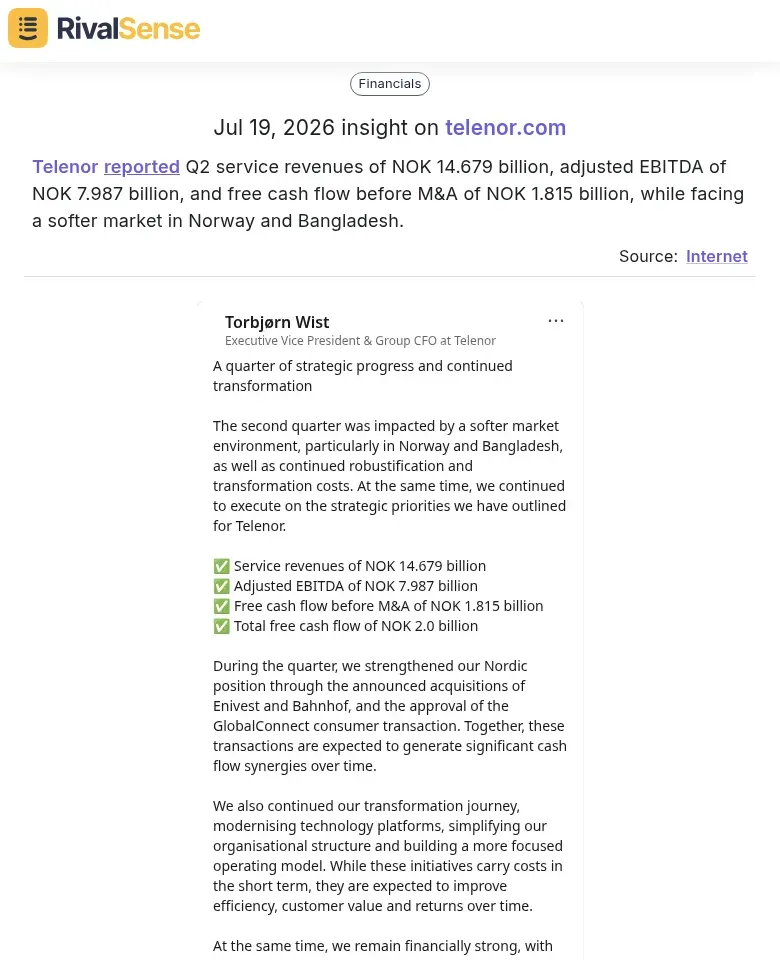
Financial snapshots from RivalSense bring numbers to life without sifting through dense filings. For example, Telenor’s Q2 report surfaced service revenues of NOK 14.679 billion, adjusted EBITDA of NOK 7.987 billion, and free cash flow before M&A of NOK 1.815 billion—while flagging a softer market in Norway and Bangladesh. Such a summary instantly highlights regional pressure points, vital for assessing where a rival is vulnerable or where you can double down.
Pro Tip: Add a “Notes” column to your template for key takeaways from every earnings call—e.g., guidance changes, new market entries, or currency impacts. Over time, this becomes a rich reference for strategic decisions.
Decoding M&A Moves: Technology and Talent Acquisition
Analyzing competitors’ acquisitions reveals strategic priorities. Here’s how to decode M&A moves efficiently:
1. Identify Technology Gap-Fillers
Search for acquisitions that plug product holes or accelerate capabilities. Use tools like Crunchbase or PitchBook to spot patterns. For example, when NetApp acquired DataPelago, whose Nucleus engine uses GPU acceleration to process data in place, it was a clear signal of deep investment in AI analytics infrastructure. RivalSense surfaced this acquisition early, showing how monitoring niche tech buys gives you a preview of product evolution.

Acquisitions like this reveal where a competitor is placing their R&D bets, helping you adjust your own roadmap before they ship new features. Create a matrix mapping each acquisition to your competitor’s product roadmap.
2. Infer Roadmaps from Target Industries
Look beyond the acquirer. If a rival buys three cybersecurity firms in six months, they’re building a security suite. Track target company descriptions, patents, and leadership backgrounds. A tool like RivalSense can automate this pattern detection across thousands of news sources.
3. Assess Integration Risk & Track Outcomes
Acquisitions often fail post-close. Monitor these signals:
- Founder departures (LinkedIn alerts)
- Product launch delays (track promised vs. actual ship dates)
- Customer churn in acquired customer base
Quick Checklist:
- [ ] List all acquisitions in past 12 months
- [ ] Map each to a product category (e.g., AI, data, security)
- [ ] Check if acquired products were integrated or killed
- [ ] Set Google Alerts for acquisition announcements + “layoff” or “integration”
Pro tip: Use a competitive intelligence tool that automates M&A tracking and surfaces patterns—saving hours of manual research.
Mapping Strategic Expansion Through Contracts and Partnerships
To map strategic expansion, track new contracts and defense deals—these reveal growth areas and market entry points. For example, if a competitor lands a multi-year broadband deal in a specific region, that signals geographic prioritization.
Actionable steps:
- Set up alerts for contract wins (e.g., via government procurement databases, press releases, or tools like RivalSense).
- Categorize deals by type (e.g., infrastructure, software, services) and geography.
- Cross-reference with acquisitions: A broadband deal in Texas followed by a local ISP acquisition confirms a regional push.
- Connect to leadership statements: Analyze quarterly earnings call transcripts for mentions of the region or vertical.
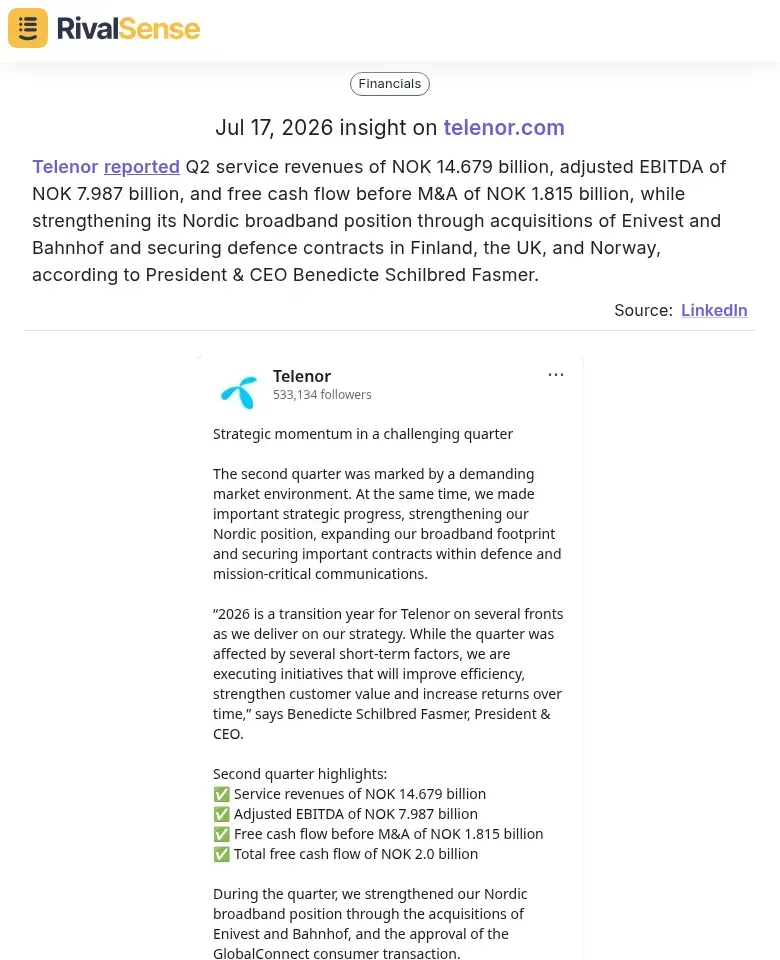
A single insight can tie multiple threads together. Telenor’s Q2 update, captured by RivalSense, not only detailed financials but also highlighted strengthening its Nordic broadband position through acquisitions of Enivest and Bahnhof and securing defence contracts in Finland, the UK, and Norway—per President & CEO Benedicte Schilbred Fasmer. This type of combined financial-plus-contract intelligence paints a full picture of strategic momentum, letting you anticipate where your competitor will invest next.
Pro tip: Create a simple matrix with columns for deal date, value, region, and executive quote. This turns raw data into a strategic map of where your competitor is heading.
Streamlining Your Competitive Intelligence Workflow
To streamline your competitive intelligence workflow, start by automating the tedious parts. Use tools like RivalSense to automatically monitor SEC filings (10-Ks, 8-Ks), press releases, and news for your key competitors. This eliminates manual searching and ensures you never miss critical financial or M&A signals.
Next, build a real-time dashboard that consolidates all competitor tracking into one view. Include metrics like revenue changes, funding rounds, and acquisition announcements. Platforms like Geckoboard or Klipfolio can pull from your automated feeds, giving you a single pane of glass for rapid assessment.
Finally, establish a regular review cadence. Schedule weekly 30-minute ‘CI syncs’ with your team. Use a structured checklist: 1) Review dashboard for any new alerts, 2) Analyze two notable moves per competitor, 3) Update a shared SWOT document, 4) Identify action items (e.g., adjust pricing, accelerate feature launch). Pro tip: assign a rotating owner each week to keep engagement fresh. This routine turns raw data into strategic decisions, keeping your entire org aligned on the competitive landscape.
Turning Insights into Action: From Data to Strategic Decisions
To transform raw financial and M&A data into actionable strategy, follow this three-step synthesis framework:
1. Build Competitor Profiles
Combine financial health indicators (revenue growth, margins, cash reserves), M&A patterns (acquisition targets, integration success rates), and contract wins/losses into unified profiles. Use a simple scoring system: green (strong), yellow (neutral), red (vulnerable) for each dimension.
2. Identify Vulnerabilities & Opportunities
Look for disconnects – e.g., a competitor with aggressive M&A but declining cash reserves suggests future slowdown. Map contract wins to revenue concentration; a single customer accounting for >30% of revenue is a risk. Cross-reference with industry trends: a competitor acquiring AI startups may signal pivoting away from their core.
3. Executive Summaries
For leadership, create one-page snapshots using this template:
- Status: Financial health score + trend arrow
- Movements: Key M&A/contract activity (last 90 days)
- Implications: Top 1-2 vulnerabilities they face
- Our Play: Specific actions (e.g., target their overstretched clients, poach talent from integrated companies)
Pro tip: Set up automated alerts when a competitor’s financial or M&A score crosses thresholds – proactive beats reactive every time.
All of these techniques get a massive efficiency boost when you stop manually hunting for signals. RivalSense does the heavy lifting—tracking competitor product updates, pricing moves, partnerships, management changes, and more across websites, social media, and registries—then delivering a weekly email report that fits into your workflow. Try RivalSense for free and get your first competitor report today.
📚 Read more
👉 Data-Driven Insights on Competitor Partnerships in Warehousing
👉 Japan-NVIDIA AI Deal: How a Startup Turned a Threat Into a $10B Opportunity
👉 Quick Hacks: Spot Competitor Innovation in AI Coding Tools
👉 Common Mistakes to Avoid When Tracking Competitor Employee Changes