
5 Instagram Competitor Analysis Mistakes Startups Make (And How to Fix Them)
Competitor analysis on Instagram goes far beyond counting likes. Yet many startups fixate on surface-level signals and miss the deeper insights that drive real market advantage. Here are five common mistakes—and how to correct them, using real competitor intelligence from RivalSense.
1. Neglecting Event and Community-Building Content
Many startups focus their competitor Instagram analysis solely on product posts and polished brand content, completely missing the goldmine of event and community-building activity. This mistake leaves them blind to how rivals are fostering loyalty and generating real-world buzz.
Why this matters: A competitor’s event content—from product launches to pop-ups—reveals their community strength, ambassador impact, and local engagement tactics. Ignoring it means copying the wrong signals.
For example, RivalSense recently surfaced that adidas Golf launched its Fall Winter 2026 Originals Golf collection in Thailand at Siam Paragon, with brand ambassadors and celebrities in attendance. This kind of insight is pure gold for competitive strategy: you can see exactly how a brand activates physical spaces, which influencers they trust, and how they localize a global campaign.
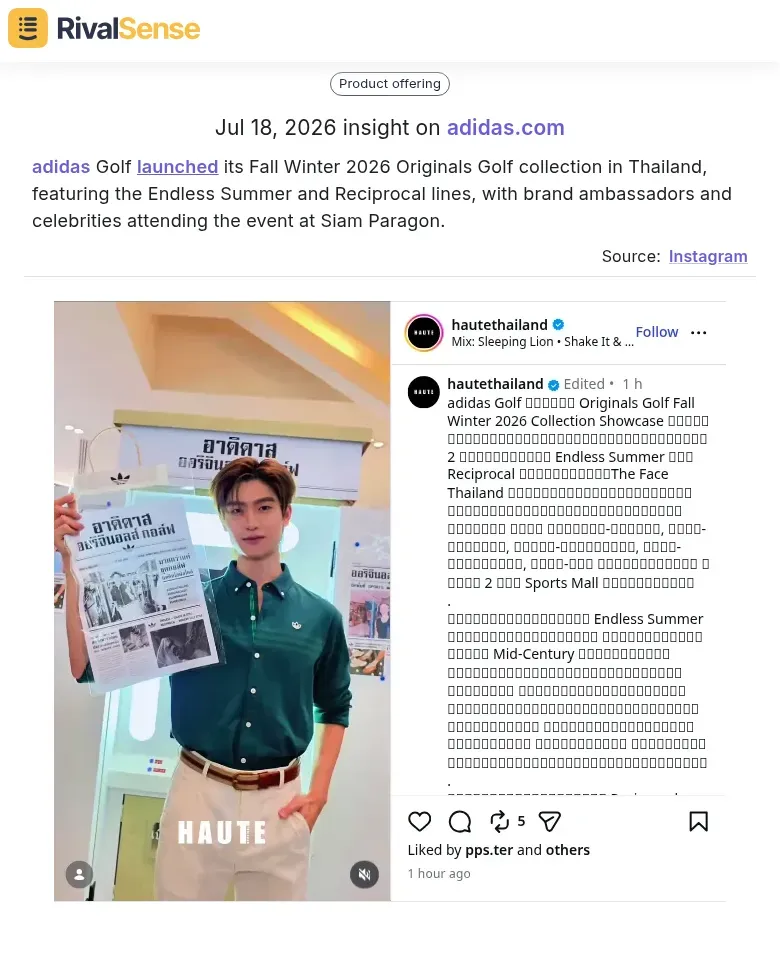
Tracking event-based competitor activity helps you benchmark community engagement, not just content output.
Actionable tips:
- Scan tagged and location-based posts for event mentions (e.g., #BrandNameLaunch, geo-tags at venues). These often show attendee reactions and influencer presence.
- Track ambassador and celebrity appearances by monitoring tagged accounts and story highlights. Note engagement spikes—they indicate partnership ROI.
- Capture local buzz by reviewing comments and user-generated content from event attendees. Look for sentiment, check-ins, and repeat attendance trends.
- Benchmark experiential outcomes: Compare competitors’ event-related metrics (e.g., story views, share rates, follower growth post-event) to gauge community-building success.
Quick checklist:
- [ ] Did the competitor’s event content boost follower growth by >5%?
- [ ] Are local influencers or celebrities driving higher engagement than brand posts?
- [ ] How does attendee sentiment compare to online sentiment?
Use these insights to build an authentic community strategy, not just a content calendar.
2. Overlooking Cross-Platform Content Promotion
Many startups obsess over Instagram-specific metrics—likes, comments, saves—while ignoring how their content performs across other platforms. That’s a missed opportunity. If you only analyze Instagram in isolation, you’ll never see the full picture of your competitors’ reach and influence.
The Blind Spot: Content Syndication
Competitors often repurpose Instagram content on podcasts, YouTube, LinkedIn, or newsletters. A carousel post might become a podcast episode; a Reel could be a TikTok. If you’re not tracking these syndicated versions, you’re missing key engagement data and audience crossover.
Consider this real RivalSense insight: John Leguizamo discussed joining 'The Odyssey' and his character Eumaeus on Spotify’s 'One Nightstand' podcast. Even if that podcast is promoted via Instagram, monitoring only Instagram metrics would hide the actual reach and authority building happening off-platform.

Spotting a competitor’s podcast or media appearances reveals where they’re investing in thought leadership and audience expansion.
How to Fix It
- Map cross-platform presence: For each competitor, list all platforms where they share content (e.g., podcast, YouTube, blog).
- Track off-Instagram metrics: Use tools to measure podcast downloads, YouTube views, or newsletter open rates.
- Identify audience overlap: Look for Instagram comments that reference other platforms (e.g., “Loved your podcast episode on this!”). This signals strong cross-platform synergy.
Quick Checklist
- [ ] Have you found at least 3 non-Instagram channels each competitor uses?
- [ ] Are you monitoring podcast episodes or YouTube videos that repurpose Instagram content?
- [ ] Do you know which Instagram posts drive traffic to their other media?
Pro Tip: Set up automated monitoring (like RivalSense) to detect when a competitor publishes content outside Instagram. You’ll get a real-time view of their full content strategy—not just the Instagram slice.
3. Ignoring Localized and Regional Campaigns
Many startups analyze competitor Instagram activity at a global level, missing critical geo-specific insights. Competitors often run region-specific campaigns, partner with local venues, or leverage local influencers—all of which can reveal untapped opportunities.
The Mistake: Treating all competitors’ content as globally relevant. A campaign that seems underperforming in your market might be thriving elsewhere due to localized partnerships.
To see this in action, look at how Green SM launched the Green Mall Tour with the first stop at Vincom Landmark 81 in Ho Chi Minh City on July 18-19. This insight—captured by RivalSense—shows a competitor executing a hyper-local experiential campaign. If you were only scanning their main Instagram feed, you might miss the regional nuance entirely.

Monitoring regional events helps you map competitors’ geographic expansion and partnership strategies.
What to Do Instead:
- Segment by location: Use Instagram’s location tags or hashtags (#CityName, #LocalBusiness) to filter competitor posts. Track engagement metrics per region.
- Monitor local partnerships: Watch for tagged venue accounts, local event collaborations, or regional influencer shoutouts. These indicate market-specific trust-building strategies.
- Adapt, don’t copy: If a competitor’s mall tour or pop-up drives buzz, explore similar partnerships in your own target cities. Adjust their playbook to fit local culture and consumer behavior.
Pro Tip: Create a spreadsheet with columns for competitor, location, partnership type, and engagement rate. Review monthly to spot regional patterns you can leverage.
By digging into localized campaigns, you’ll uncover insights that give you a competitive edge in specific markets—and avoid bland, one-size-fits-all strategies.
4. Focusing Solely on Vanity Metrics Rather Than Engagement Quality
Startups often obsess over likes—but likes are a hollow metric. True engagement lies elsewhere. A competitor audit that only counts followers or likes misses the signals that predict loyalty, authority, and conversion.
Analyze comment depth and sentiment. Instead of counting comments, categorize them: are they generic (“Nice!”) or substantive? Use sentiment analysis to gauge positive vs. negative tone. A post with 50 thoughtful comments beats one with 200 “great post” one-liners.
Track saves, shares, and reposts. These indicate that content is valuable enough to bookmark or forward. On Instagram, saves are a strong signal of utility. Shares expand reach organically. Compare save-to-like ratios against competitors to surface high-resonance content.
Identify influencer impact beyond follower counts. Micro-influencers often drive higher engagement rates. Evaluate an influencer’s comment quality, story replies, and swipe-up click-throughs. Look for consistent audience interaction, not just big numbers.
Quick checklist for your next competitor audit:
- [ ] What’s the average comment depth (replies within threads)?
- [ ] What’s the save-to-like ratio on top posts?
- [ ] Which influencers have the highest engagement rate (not just follower count)?
- [ ] Are shares coming from stories or DMs (use UTM parameters)?
Stop counting vanity metrics. Start measuring what builds real community and authority.
5. Missing Out on Niche and Thought Leadership Content
Many startups obsess over competitors’ product launches and feature updates, completely ignoring the goldmine of thought leadership and niche content. Competitors often post about industry trends, challenges, and insights—not just product plugs. These posts reveal audience sentiment, pain points, and what topics resonate. By skipping this, you miss chances to identify content gaps, spot emerging trends, and understand what your shared audience truly cares about.
Actionable Steps:
- Audit competitor non-product content: Use monitoring tools to track posts tagged as “opinion,” “industry analysis,” or “thought leadership.”
- Analyze engagement: Look at comments and shares on these posts. High engagement signals topics your audience values.
- Identify content gaps: Note which niche topics your competitors cover well—and where they don’t. Fill those gaps with your own authoritative content.
- Create a thought leadership calendar: Repurpose winning angles into your own posts, webinars, or LinkedIn articles.
Pro Tip: Set up alerts for competitors’ guest posts, podcast appearances, or bylined articles. These often signal authority-building topics worth your attention.
Tired of manually piecing together competitor moves? RivalSense automatically tracks product launches, event participations, partnerships, and more across websites, social media, and registries—delivering everything in a concise weekly email.
👉 Try RivalSense free and get your first competitor report today.
📚 Read more
👉 Salesforce Key Account Tracking Cheat Sheet for Semiconductor Firms
👉 Productivity Techniques for Competitor Financial & M&A Insights
👉 Data-Driven Insights on Competitor Partnerships in Warehousing
👉 Japan-NVIDIA AI Deal: How a Startup Turned a Threat Into a $10B Opportunity