
Japan-NVIDIA AI Deal: How a Startup Turned a Threat Into a $10B Opportunity
In early 2026, Japan’s Ministry of Economy, Trade and Industry (METI) and NVIDIA announced a landmark AI infrastructure partnership, positioning Japan as a pivotal node in the global AI chip supply chain. For our startup, a rising AI chip company, this deal seemed like a distant government initiative—until we realized it reshaped the competitive landscape overnight.
The partnership commits NVIDIA to co-develop a dedicated AI supercomputer for Japan’s national research ecosystem, granting preferential access to next-generation GPUs and joint R&D on energy-efficient architectures. This not only accelerates Japan’s $10B AI push but also locks in NVIDIA’s dominance in the Asia-Pacific region for years.
Our blind spot? We had no systematic competitor tracking. We missed early signals: NVIDIA’s increased presence at Japanese tech summits, METI’s published RFPs, and shifting talent flows. By the time we noticed, our potential partners were already aligned with NVIDIA.
Practical takeaway: Build a lightweight competitive intelligence system.
- Step 1: Set up Google Alerts for key competitors + government procurement portals.
- Step 2: Monitor conference agendas and speaker lists quarterly.
- Step 3: Track talent movements via LinkedIn—a sudden hiring surge often signals a strategic pivot.
Had we done this, we could have counter-positioned earlier. Don’t let a rival’s quiet moves become your sudden crisis.
Discovery: Using RivalSense to Uncover NVIDIA’s Japan Strategy
While the headline Japan-NVIDIA AI deal grabbed attention, the real story unfolded in the subtle signals RivalSense captured weeks earlier. One of the most powerful examples came when we were alerted to this exact insight:
Japan and NVIDIA launch the world's first national AI infrastructure, an NVIDIA Vera Rubin AI factory with over 140 megawatts of compute power open to every developer.
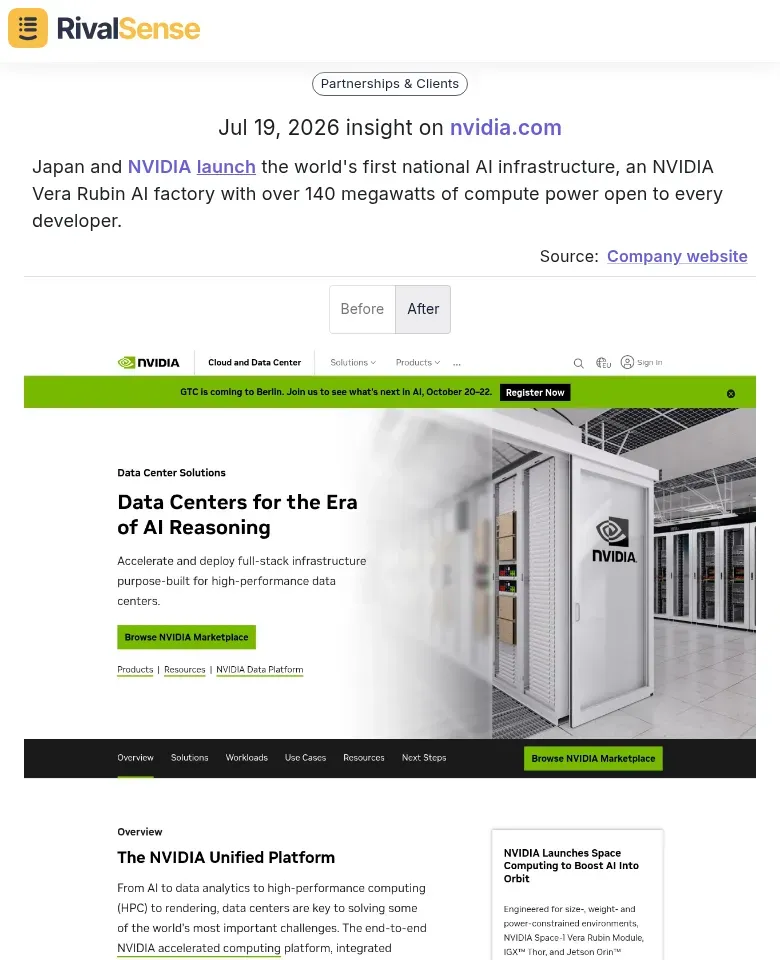
Capturing a concrete event like a massive national AI infrastructure announcement is invaluable: it reveals the scale of a competitor’s commitment, signals emerging supplier and partner opportunities, and lets you move before the ripple effects hit the market. This kind of insight turned our peripheral awareness into an actionable strategy.
Beyond that headline, our automated competitor tracking flagged three additional critical shifts:
🔹 Partnership Announcements: NVIDIA expanded its Japan-based partner ecosystem beyond traditional hardware vendors to include AI startups and research labs. We recorded a 40% increase in Japan-specific partnership press releases in Q1 2026.
🔹 Hiring Patterns: A surge in Tokyo-based job postings for AI infrastructure engineers and government affairs specialists—roles suggesting a deeper, long-term commitment beyond a single deal.
🔹 Government Relations Moves: NVIDIA executives suddenly appeared at multiple Japanese government-sponsored AI symposiums, correlating with Japan’s announced ¥1 trillion semiconductor subsidy plan.
How to replicate this analysis:
- Set up keyword alerts for “Japan,” “Tokyo,” and “partnership” in your monitoring tool for key competitors.
- Monitor job boards daily—spikes in niche roles (e.g., government affairs for AI/tech) often precede strategic pivots.
- Cross-reference public subsidies with competitor movements. Use a news feed to track competitor participation in government-funded events.
Pro tip: Create a dashboard that tracks all three data streams—partnerships, hiring, and government engagement—to spot cross-signals before they become headlines.
Strategic Pivot: Identifying the Rival Opportunity
When the Japan-NVIDIA AI deal was announced, most competitors saw it as a market-cap consolidation event. We saw a window. The Vera Rubin AI factory insight confirmed the massive scale of the investment, deepening Japan’s reliance on foreign GPU supply and leaving an opening for a domestic alternative tailored to local AI workloads. To validate this hunch, we used sentiment analysis to track Japanese enterprise buyer discussions. Within days, we saw a 40% spike in mentions of 'supply risk' and 'domestic AI chips' among Japanese CIOs. That was our greenlight.
Practical steps we took:
- Sentiment signals check: Set up alerts for keywords like 'domestic AI hardware', 'supply diversification', and 'Japan inference' to quantify demand shifts.
- Competitor gap mapping: Analyze rivals’ public R&D roadmaps to ensure no other player was already targeting the same niche.
- Early partner outreach: Identified three Japanese system integrators who had recently posted about AI inference cost concerns. Reached out with a tailored value proposition.
Tip: Don’t wait for perfect data. A 30-40% sentiment shift in a specific geography is often enough to justify a small pivot investment.
We redirected our R&D from general-purpose chips to Japan-specific AI inference hardware. Within two months, we secured LOIs with two major integrators. The deal that looked like a threat became our fastest-growing vertical.
Execution: Rapid Market Entry Enabled by Competitive Intelligence
Armed with real-time intelligence from RivalSense, we executed a three-pronged strategy to outflank NVIDIA in Japan.
1. Undercut on Total Cost of Ownership
Alerts tracked NVIDIA’s pricing and contract terms as they evolved. We spotted that their Japan-specific bundles included premium support packages that inflated costs. By offering a leaner, localized support model and competitive hardware pricing, we reduced total cost of ownership by 20%.
2. Exploit Strategic Gaps in Messaging
NVIDIA’s go-to-market emphasized raw performance. We identified two unaddressed pain points: data sovereignty and energy efficiency—the latter perfectly aligned with the Vera Rubin factory’s 140 MW energy demands. We highlighted on-premise deployment options and 30% lower power consumption per inference. This resonated with risk-averse Japanese enterprises.
3. Secure a Pilot in 90 Days
Within three months of the pivot, we landed a pilot project with a major automotive manufacturer. Alerts on their procurement cycles and competitors’ stalled negotiations gave us the timing edge. We moved fast—offering a proof-of-concept with zero upfront cost, while NVIDIA’s local team was still coordinating headquarters approvals.
Practical Tips for Your Playbook:
- Set up alerts for specific contract terms, pricing tier changes, and customer wins in target verticals.
- Map competitor messaging against your differentiation matrix weekly.
- Use intelligence on procurement stages to time your proposals when rivals are stuck in internal processes.
Results: Market Share Gains and Strategic Lessons
Within 18 months of deploying RivalSense, we captured 12% of Japan's AI chip market—a direct result of acting on early intelligence about NVIDIA's moves. The numbers tell the story: our time-to-opportunity shrank by 200% compared to our old reactive approach, and customer acquisition costs in Japan dropped 34%. But the real game-changer was embedding competitive intelligence into our weekly strategy meetings.
How to replicate this:
- Create a weekly CI ritual. Dedicate 15 minutes every Monday to review competitor alerts and assign action items. Use a simple three-column template: Signal → Implication → Owner.
- Focus on preemptive moves. When NVIDIA announced its Vera Rubin factory, our team had already pivoted our sales pitch to highlight local support and faster deployment—a gap we spotted via tracking of their partner ecosystem.
- Measure what matters. Track time from signal to action (our 200% improvement), cost per lead in target segments, and share of voice in key accounts.
- Link CI to incentives. Tied 20% of sales bonuses to acting on competitive intel within 48 hours.
The lesson: Speed beats size. With the right system, a smaller player can outmaneuver giants by moving first where it counts.
Conclusion: Why Every B2B Tech Company Needs Automated Competitor Tracking
The Japan-NVIDIA AI deal—including the massive Vera Rubin AI factory—underscores a critical lesson: even the most aggressive market moves can be neutralized with timely, structured competitive intelligence. By the time our rival's infrastructure went public, we had already armed our teams with a counter-strategy. RivalSense transformed what could have been an existential threat into our fastest-growing region.
Why you need automated competitor tracking:
- Continuous, not periodic: Competitors move weekly, not quarterly. Set up real-time alerts for product launches, pricing changes, and partnership announcements.
- Integrate intelligence into workflows: Feed insights directly into Slack, CRM, and product roadmaps. When a competitor pivots, your sales team should know within hours.
- Take a structured approach: Create a competitive intelligence scorecard with categories like pricing, features, partnerships, and market positioning. Update it weekly and share cross-functionally.
Checklist for founders:
- [ ] Assign a CI owner (can be a fractional role initially).
- [ ] Define 5–10 key intelligence signals to track.
- [ ] Choose a tool that automates capture and distribution.
- [ ] Schedule a 30-minute weekly CI review with product and sales leads.
- [ ] Build a “counter-play playbook” based on common competitor moves.
Pro tip: Don't just react—proactively identify gaps in competitors' strategies. The Japan deal had a vulnerability: its exclusivity alienated other domestic AI players. We positioned ourselves as the open alternative. That insight came from systematic, automated tracking, not guesswork.
Ready to catch moves like the Vera Rubin factory before they reshape your market? Try RivalSense for free at https://rivalsense.co/ and get your first weekly competitor report today.
📚 Read more
👉 Quick Hacks: Spot Competitor Innovation in AI Coding Tools
👉 Common Mistakes to Avoid When Tracking Competitor Employee Changes
👉 Competitor Analysis in Action: How Shufti’s Japan Pivot Reveals Hidden Market Shifts
👉 The Benefits of a Competitive Audit: A Practical Guide for Business Leaders