
Trend Analysis: Competitor Matrix Benefits in Pharma Logistics
The Evolving Landscape of Pharma Logistics
The pharma logistics landscape is shifting faster than ever. Cold chain complexities have intensified—temperature excursions can compromise multi-million dollar biologics, while regulations like GDP and DSCSA demand airtight compliance. Niche providers (e.g., Marken, World Courier) are aggressively expanding temperature‑controlled networks, eroding traditional carriers’ market share. To stay competitive, you must continuously monitor rivals’ capabilities: are they investing in IoT‑enabled real‑time tracking? Do they offer validated cold chain packaging for CAR‑T therapies? Ignorance is a risk. Start by building a competitor matrix that maps key players across dimensions like temperature range, regulatory certifications, and last‑mile reach. Update it quarterly. Pro tip: Use a weighted scoring system—assign higher weights to capabilities that matter most to your target pharma segments (e.g., cell & gene therapy logistics). This matrix turns raw data into strategic foresight, helping you differentiate on reliability, speed, or compliance. For immediate action, schedule a monthly ‘competitive pulse check’ where your team screens for new service launches or facility expansions. The goal: spot threats before they become gaps in your own offering.
Understanding the Competitor Matrix Framework
The Competitor Matrix Framework is a structured comparison tool that helps pharma logistics leaders evaluate competitors across critical parameters. To build one, start by selecting 5–7 key metrics relevant to your strategy—temperature control capabilities (e.g., cold chain range, real‑time monitoring), global reach (covered regions, port‑to‑door networks), and compliance certifications (GDP, IATA CEIV, WHO PQ). Rate each competitor on a scale of 1–5 or use a color‑coded heatmap for quick visual insights.
Practical Steps:
- Identify parameters that differentiate value (e.g., temperature deviation tolerance).
- Gather data from public reports, client reviews, and direct feedback.
- Plot the matrix using a simple spreadsheet—competitors as rows, parameters as columns.
- Update quarterly to reflect new certifications or expansion moves.
Pro Tip: Add a "weight" column for each parameter based on your customers’ priorities (e.g., compliance may be heavier than reach for regulated biologics). Use the matrix to spot gaps—if no competitor excels in both temperature control and reach, that’s your strategic edge. This framework turns raw data into dynamic, decision‑ready intelligence for resource allocation and market positioning.
Strategic Advantages of Competitor Analysis in Pharma Supply Chain
A robust competitor matrix delivers three strategic advantages for pharma logistics leaders.
1. Identify Service Gaps and Differentiation Opportunities
Map your top 5 competitors across dimensions like cold‑chain capabilities, last‑mile coverage, and regulatory compliance. Use a simple scoring system (1–5) to spot underserved areas. For example, if most competitors offer standard temperature monitoring but few provide real‑time GPS tracking with temp alerts, that’s your differentiator.
2. Benchmark Pricing and SLAs
Collect competitors’ published rates and contractual terms. Create a comparison table showing base pricing, volume discounts, and penalty clauses. Track SLA metrics like on‑time delivery rates (e.g., 98% vs 95%) and deviation response times. A practical tip: use RFP responses and press releases for data, then update quarterly.
3. Anticipate Competitor Moves and Market Shifts
Monitor patent filings, partnership announcements, and hiring patterns. If a competitor expands their fleet in a region, expect price pressure within 6–12 months. Build a scenario matrix: “If Competitor X launches drone delivery, we must accelerate our cold‑chain automation.”
Action Checklist:
- ☐ Map 5 key competitors monthly
- ☐ Score differentiation gaps quarterly
- ☐ Review SLA benchmarks bi‑annually
- ☐ Run scenario planning sessions semi‑annually
Application of Competitor Matrix in Real‑World Pharma Logistics
In pharma logistics, a competitor matrix transforms abstract data into actionable strategy. Consider a mid‑sized biotech firm managing clinical trial logistics. By mapping 3PL providers across metrics like temperature control reliability, regulatory compliance speed, and global reach, they identified a gap: most competitors lacked real‑time cold chain monitoring. This insight led to a differentiated RFP, boosting bid win rates by 35% within a year.
Trend: AI‑Driven Automation & Real‑Time Signals
Manual matrix updates are obsolete. AI tools now scrape logistics news, patent filings, and customer reviews to auto‑populate competitor moves. This is where platforms like RivalSense shine—they monitor company websites, social media, registries, and the internet to deliver a weekly email report of critical competitor activities. Here are three real examples of the kind of intelligence that can keep your matrix effortlessly current.
🚀 Product Launches – Innovation Signals
RivalSense detected that OneTrust launched a Third‑Party Risk Agent that automates vendor research, assessment completion, and risk finding generation, reducing weeks of work to minutes.
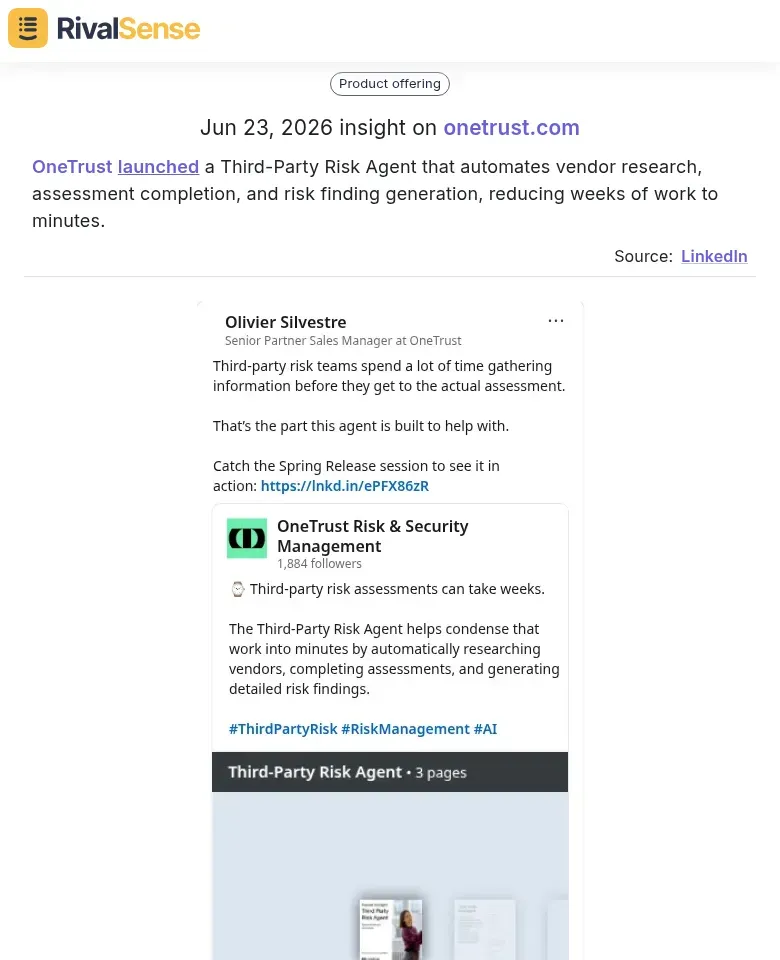
Why this matters: A product launch like this reveals a shift toward automating risk assessments in the supply chain ecosystem. If your competitors adopt similar tools, they could deliver faster, lower‑cost compliance services. Tracking such launches lets you anticipate which capabilities you’ll need to match—or outpace—before it shows up in an RFP.
📍 Event Participation – Strategic Focus
RivalSense also tracks where competitors are investing their time and presence. For example, MetricStream will attend Risk Live Europe on June 23, 2026, with experts at Booth #81.
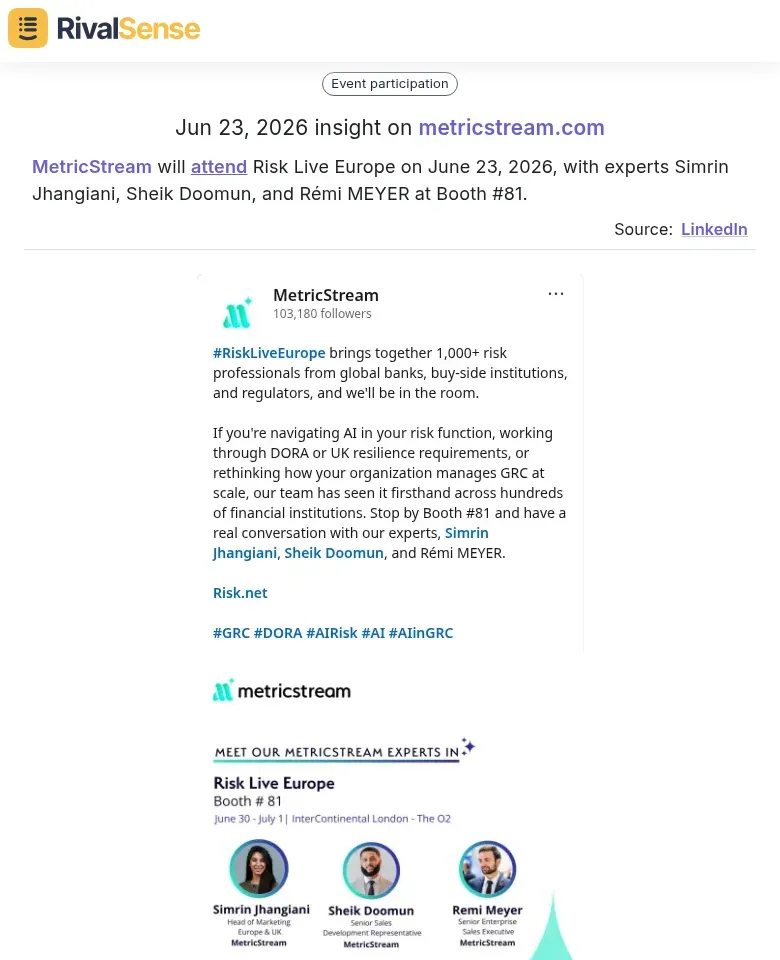
Why this matters: Conference appearances signal thought‑leadership ambitions and target markets. If multiple competitors flock to a niche event, it’s a strong indicator of where the industry (and your customers) are heading. Use this to decide which events you sponsor or which regions you prioritize.
🌍 Niche Exhibitions – Geographic Expansion
Similarly, AddSecure will exhibit at the East Midlands Central Station Solutions Day on July 8–9.
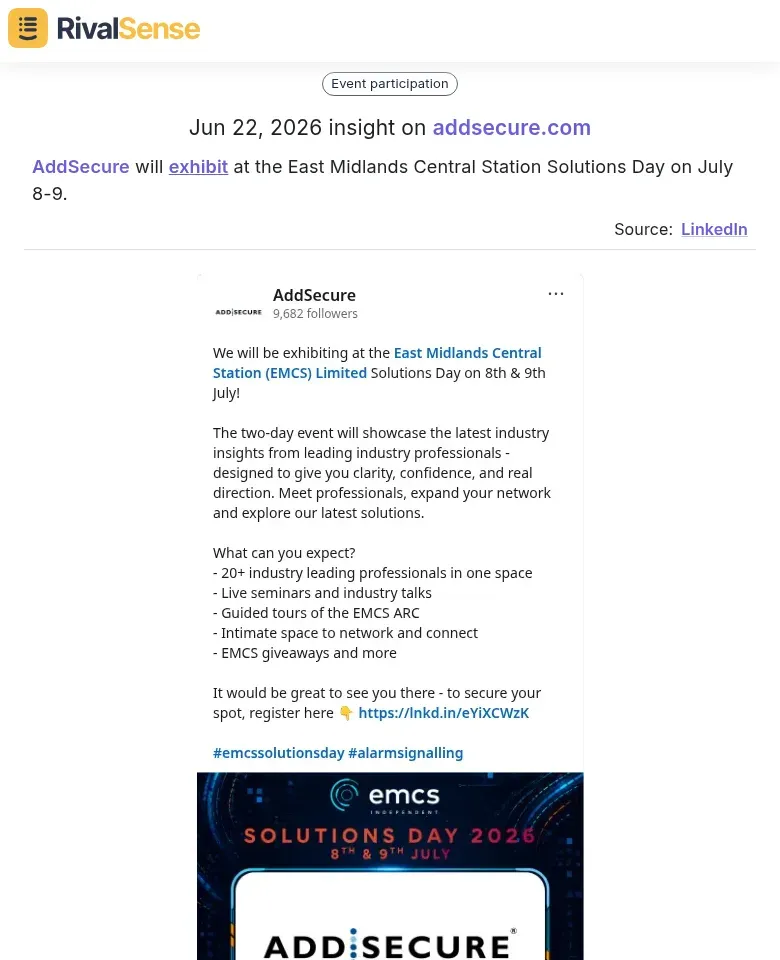
Why this matters: Exhibiting at a local or specialized event often reveals an intent to enter a new geographic or industrial market. Monitoring such insights via RivalSense can uncover expansion plans months before official announcements, giving you time to reinforce your own presence or form defensive partnerships.
By feeding these real‑time signals into your matrix, you replace stale annual reviews with a living map of the competitive landscape. For instance, if a rival opens a new cold chain depot (detected by RivalSense), your matrix updates overnight—freeing your team for strategic response.
Practical Steps for Pharma Leaders
- Define 5 KPIs critical to your niche (e.g., GDP compliance, last‑mile accuracy).
- Score competitors quarterly—don’t guess; use public audits, customer feedback, and AI‑gathered insights.
- Automate alerts: Set triggers for KPI changes (e.g., competitor opens new cold chain depot) using a monitoring tool like RivalSense.
Retention & Win Rates
One pharma firm used the matrix to preempt a competitor’s pricing shift, adjusting contracts early. Customer retention rose 20% as clients saw proactive value. Another matched service gaps identified in the matrix, winning 3 out of 5 bids against larger rivals.
Pro Tip: Pair your matrix with win/loss analysis. If you lose a bid, check which matrix row the winner dominated—then close that gap before the next RFP.
Building a Practical Competitor Matrix for Your Pharma Logistics Business
A well‑structured competitor matrix turns raw data into actionable intelligence. Here’s how to build one that drives real decisions.
Step 1: Define Your Criteria. Focus on factors that matter in pharma logistics: cold chain capabilities, regulatory compliance (GDP, FDA), geographic coverage, delivery SLAs, technology integrations (WMS, TMS), and client industries served. Limit to 10–15 criteria to avoid analysis paralysis.
Step 2: Gather Data Systematically. Use multiple sources: official websites, press releases, RFPs, industry reports, and customer reviews. For real‑time tracking, leverage competitive intelligence platforms that automate data collection (RivalSense delivers weekly updates directly to your inbox, so you never miss a launch, event, or regulatory filing). Spreadsheets work for initial setups but become unwieldy; migrate to a CI tool once you track 5+ competitors.
Step 3: Update Regularly. Pharma logistics evolves fast. Schedule monthly reviews—flag changes in service offerings, pricing, or compliance certifications. A ‘last updated’ column prevents stale data.
Pro Tip: Add a priority column (High/Medium/Low) to focus sales and strategy efforts on competitors that overlap with your target accounts.
Integrating into Strategy & Sales:
- Sales enablement: Share matrix snapshots with reps before key deals to highlight competitor weaknesses.
- Strategic planning: Use gaps in competitors’ geographic or temperature‑range coverage to prioritize new service launches.
- Positioning: Update your website and pitch decks with direct comparisons (e.g., “Only provider with 24/7 real‑time cold chain monitoring across 50+ countries”).
Checklist for Your First Matrix:
☐ Defined 10–15 criteria
☐ Populated data for top 5 competitors
☐ Verified sources within last 30 days
☐ Integrated into CRM for sales alerts
☐ Scheduled monthly update reminder
☐ Set up an AI monitoring feed to catch real‑time signals (product launches, events, management changes)
Future Trends and Conclusion
As pharma logistics consolidates, predictive analytics will transform competitor matrices from retrospective tools into forward‑looking strategic assets. By blending historical data with market signals—shipping volumes, pricing shifts, regulatory filings, and the kind of real‑time event/launch intelligence described above—you can forecast competitors’ capacity expansions or service gaps 6–12 months ahead.
Practical tip: Feed your matrix with 5 years of shipment data plus weekly alerts on competitor facility investments (e.g., via RivalSense). Use simple regression models to predict who will have capacity shortages next peak season.
Partner selection & M&A: A dynamic competitor matrix also helps identify ideal acquisition targets or partners whose strengths fill your matrix gaps. Checklist for M&A: (1) Map each candidate on 5 dimensions: geographic coverage, cold chain reliability, real‑time tracking, regulatory compliance, financial health. (2) Score against your current top competitor. (3) Prioritize candidates that close at least two gaps.
Summary: In a consolidating market, the competitor matrix is no longer optional. It’s your early‑warning system, M&A filter, and strategic compass. To keep it truly dynamic—without manual drudgery—tool it with AI‑powered monitoring.
🚀 Ready to see what your competitors are up to? Try RivalSense for free and get your first competitor report today: https://rivalsense.co/.
📚 Read more
👉 Struggling to Win Key Accounts? Twitter Reveals Competitor Intel
👉 Real-World Examples: How to Identify Key Accounts in Tech
👉 Trend Analysis: Pricing Insights from Competitor Journey Mapping