
Tracking Industry Leaders: Unlock Product Strategy Insights
In the fast-paced B2B landscape, your competitors' product changes are a goldmine of strategic intelligence. Every feature launch, pricing tweak, or UI overhaul signals where they're investing resources and which market segments they're targeting. By systematically tracking these updates, you can spot emerging trends early, identify gaps in your own product roadmap, and make data-driven decisions that keep you ahead.
Why this matters:
- Decode priorities: A competitor adding AI-powered analytics? They're betting on automation. A new integration with Slack? They're chasing collaboration workflows.
- Spot trends early: If three rivals release a self-serve onboarding flow within a quarter, that's a market shift—not a coincidence.
- Find your blind spots: Their moves may reveal customer needs you've overlooked.
Practical steps to get started:
- Set up alerts for competitor changelogs, press releases, and social media.
- Categorize changes (e.g., new feature, pricing, UX, partnership) to see patterns.
- Ask “why?” for each update—connect it to their stated strategy or customer feedback.
Three real-world examples below will show you how to decode these moves and turn them into actionable insights for your own product strategy.
Expanding Product Categories: Signals of Market Ambition
When a competitor adds new product lines, it’s a clear signal they’re pushing into adjacent markets or targeting new customer segments. For example, a B2B SaaS platform introducing a freemium tier or a hardware company offering subscription services indicates a strategic pivot.
Why tracking category expansions matters: It reveals their growth direction—are they moving into higher-margin niches, broadening their addressable market, or testing new revenue streams? A sudden addition of physical products (like banners, posters, or custom signage) tells you they're diversifying away from digital-only offerings and chasing omnichannel clients.
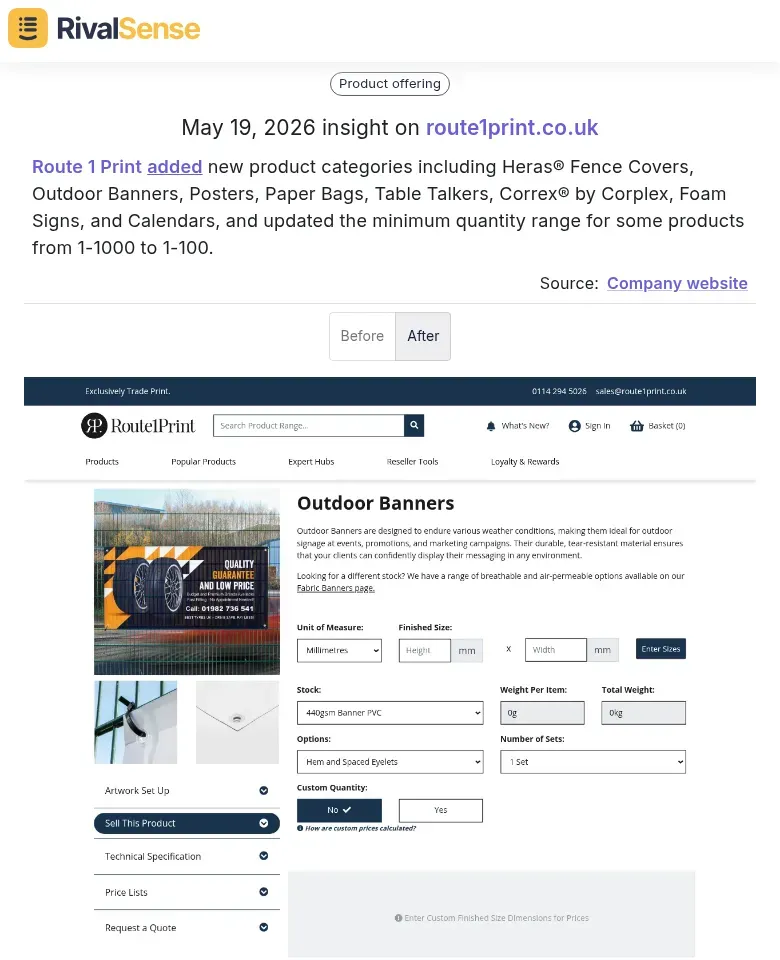
Example from RivalSense: Route 1 Print added new product categories including Heras® Fence Covers, Outdoor Banners, Posters, Paper Bags, Table Talkers, Correx® by Corplex, Foam Signs, and Calendars. They also updated the minimum quantity range for some products from 1–1000 to 1–100. This signals a shift toward smaller, more agile orders and a push into event signage and packaging—a move that smaller design agencies could leverage.
Practical tip: Monitor changes in minimum order quantities (MOQs). A drop in MOQs often signals a shift toward smaller, more agile customers, while rising MOQs may indicate a focus on enterprise accounts.
Actionable step: Create a category expansion tracker. List your top 5 competitors and note any new product lines or service offerings quarterly. Look for patterns—are they moving upmarket, downmarket, or into a complementary niche? Use tools like RivalSense to automate this tracking and receive alerts when competitors launch new categories.
Checklist:
- [ ] Identify new product lines monthly
- [ ] Compare MOQ changes
- [ ] Map expansions to customer segments
- [ ] Prioritize which competitor moves to respond to first
By anticipating these shifts, you can adjust your own product roadmap and stay ahead.
Launching New Features or Products: Innovation as a Competitive Weapon
When a competitor launches a new feature or product, it’s rarely random—it’s a signal about their view of the market. For example, if a cybersecurity firm releases an AI-powered red teaming tool, they’re betting that customers need automated, scalable security testing. The move toward automation (red teaming, self-serve onboarding, AI copilots) often indicates a shift from manual, high-touch solutions to efficiency at scale.
Why tracking new launches matters: They reveal which customer pain points competitors consider urgent and profitable. By analyzing the technology stack and target persona, you can sense where the market is moving before it becomes obvious.
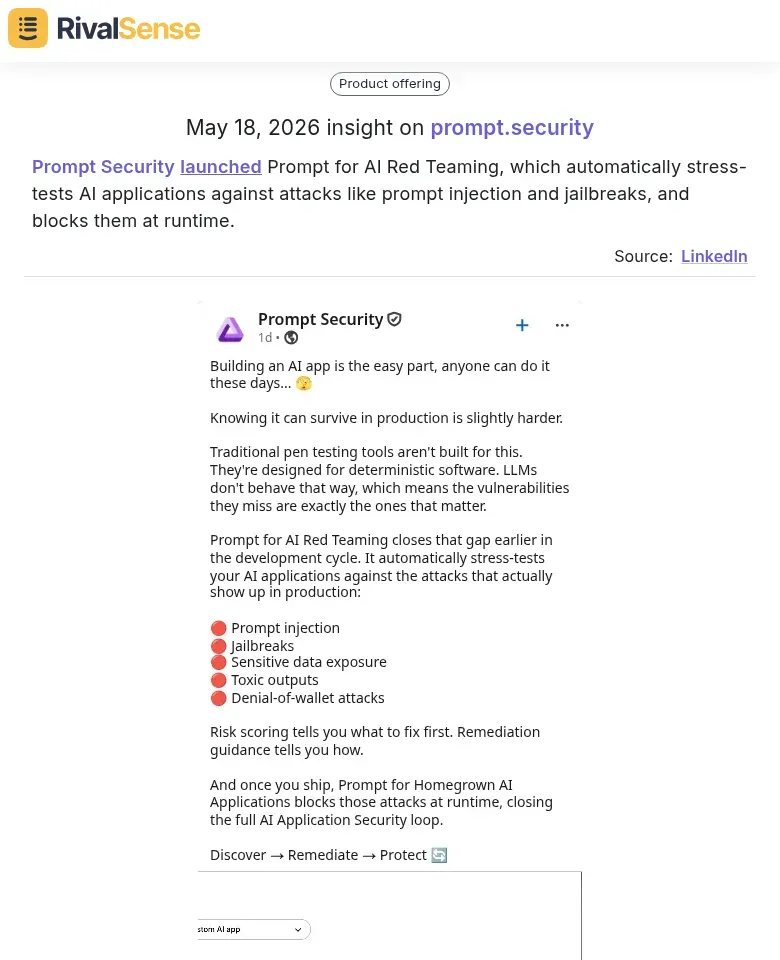
Example from RivalSense: Prompt Security launched Prompt for AI Red Teaming, which automatically stress-tests AI applications against attacks like prompt injection and jailbreaks, and blocks them at runtime. This confirms that AI security is becoming a must-have, not a nice-to-have—and competitors who ignore it risk losing enterprise trust.
How to analyze launches for strategic insights:
- Identify the pain point – What specific problem does the feature solve? If it’s a compliance dashboard, the competitor sees regulatory burden as a key market need.
- Look for emerging threats – AI security features suggest the competitor anticipates AI-driven attacks becoming mainstream.
- Assess the automation angle – Automated solutions imply they’re targeting enterprise customers who need to scale without adding headcount.
- Map to your roadmap – If they’re solving a problem you haven’t addressed, consider whether you should prioritize it.
Pro tip: Set up alerts for competitor product launch announcements (e.g., via press releases, changelogs, or social media). Within 48 hours, document the feature, the problem it solves, and the target persona. Over time, patterns will reveal their strategic bets—and gaps you can exploit.
Rebranding and Repositioning: The Story Behind the Name
Rebranding isn't just a new logo—it's a signal. When a competitor changes its name or drops a feature from its messaging, it often reveals a strategic pivot. For example, a tool once called "ChatBot Builder" that rebrands to "AI Engagement Platform" signals a shift from narrow functionality to a broader AI ecosystem. Similarly, removing "analytics" from a product tier may indicate deprioritization of that feature.
Why tracking rebrands matters: They expose internal strategy shifts that aren't announced in press releases. Dropping keywords like "AI" from brand pages while renaming a product suite tells you they're repositioning for a different buyer persona—perhaps moving from developer tools to enterprise solutions.
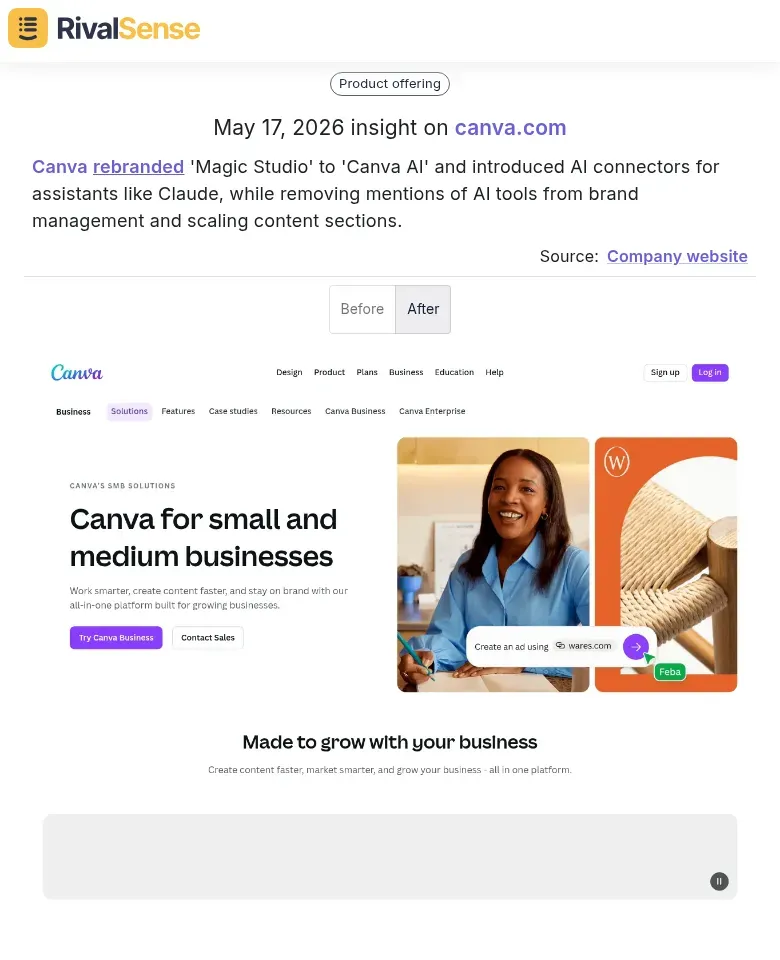
Example from RivalSense: Canva rebranded 'Magic Studio' to 'Canva AI' and introduced AI connectors for assistants like Claude, while removing mentions of AI tools from brand management and scaling content sections. This suggests they're doubling down on AI as a core differentiator while simplifying their product narrative for non-technical users.
Practical steps to decode rebranding:
- Track naming changes over time. Use tools like Wayback Machine or RivalSense to capture old taglines, product names, and feature lists.
- Compare old vs. new messaging. Highlight dropped keywords (e.g., "real-time," "mobile-first")—these often reveal deprioritized areas.
- Map to market moves. Did the rebrand coincide with a funding round, new competitor entry, or customer shift? Context is key.
Quick checklist:
- [ ] Set alerts for competitor website changes.
- [ ] Archive homepage copy monthly.
- [ ] Note any feature removal from pricing pages.
- [ ] Cross-reference with press releases for strategic context.
Pro tip: A name change from "[Feature] AI" to "[Industry] Cloud" often signals a pivot from tool to platform. Watch for these shifts to anticipate where your competitors are investing next.
Synthesizing Insights: Building Your Competitive Intelligence Framework
To build a robust competitive intelligence framework, start by aggregating multiple signals—product additions, feature launches, pricing changes, and rebranding efforts—into a single dashboard or spreadsheet. This holistic view reveals patterns that single signals miss. For example, a competitor's simultaneous feature launch and pricing change may signal a strategic pivot.
Step 1: Set up a tracking cadence. Weekly scans for product updates, monthly deep dives into strategic moves. Use tools like RivalSense to automate alerts.
Step 2: Categorize changes by type (e.g., new feature, acquisition, rebrand) and impact (incremental vs. disruptive).
Step 3: Analyze implications. Ask: Does this address a customer pain point we overlooked? Does it open a new market segment? Map findings to your own product roadmap using a simple matrix: urgency vs. strategic fit.
Pro tip: Create a “Competitor Moves” board (physical or digital) with columns for Signal, Impact, and Response. Regularly review with your product team to decide whether to counter, ignore, or leapfrog.
Checklist for weekly intelligence:
- [ ] New features or updates?
- [ ] Pricing or packaging changes?
- [ ] Leadership hires or departures?
- [ ] Customer sentiment shifts?
By institutionalizing this process, you transform raw data into actionable strategy—ensuring your roadmap stays ahead of the curve.
Conclusion: Turn Competitor Tracking into Strategic Advantage
In fast-moving markets, regular competitor monitoring is no longer optional—it's essential for staying ahead. But the real strategic advantage lies not in tracking every move, but in understanding the 'why' behind changes. When a competitor launches a new feature, ask: Are they targeting a new customer segment? Reacting to a market shift? Testing a pricing model? This deeper analysis transforms raw data into actionable insights.
To turn competitor tracking into a strategic advantage, follow this checklist:
- Set a cadence: Review competitor updates weekly, not just when you have time.
- Focus on intent: For each change, document the likely rationale and potential impact on your strategy.
- Automate the mundane: Use tools like RivalSense to automatically track competitor websites, product updates, and messaging changes—freeing your team to focus on analysis.
- Share insights cross-functionally: Distill findings into briefs for product, marketing, and leadership teams.
- Act on insights: Assign ownership for each strategic response, whether it's a feature pivot, messaging adjustment, or market repositioning.
Remember: The goal isn't to copy competitors, but to outmaneuver them. By automating tracking and prioritizing strategic analysis, you turn competitive intelligence into a continuous cycle of learning and advantage.
🚀 Ready to gain an edge? Try RivalSense for free at rivalsense.co and get your first competitor report today—no credit card required. Start uncovering the moves that matter and turn them into your next strategic win.
📚 Read more
👉 How to Turn Event Sponsorships into Competitor Insights
👉 How to Turn Competitor Research into a Real Competitive Advantage
👉 5 Productivity Techniques for Faster Competitor Analyst Report Summaries
👉 How a Rival Outpaced Broadcom by Tracking VMware Updates
👉 Unlock Competitor Insights on Facebook to Boost Key Account ROI