
How to Turn Competitor Research into a Real Competitive Advantage
Most founders treat competitor analysis like a chore: something you do once for the business plan and then forget about. But the best entrepreneurs use it as a continuous strategic tool to spot gaps, anticipate moves, and stay ahead.
Here’s how to move beyond basic research and build a real competitive advantage.
1. Go Beyond the Obvious Competitors
You probably know your direct competitors—companies that sell similar products to similar customers. But real advantage often comes from watching indirect competitors (who solve the same problem differently) and even adjacent players (who might enter your space).
Practical step: Create three lists: direct, indirect, and emerging competitors. Update them quarterly. Use tools like Google Alerts, industry news, and competitor tracking platforms to catch new entrants early.
2. Build a Competitive Framework (Don’t Just Collect Data)
Random data points won’t help you. You need a structured comparison. Define 5–7 criteria that matter most to your target customers: pricing, features, customer support, time-to-value, integrations, etc.
Checklist for your framework:
- Market share (estimated)
- Key features/offerings
- Pricing model & levels
- Distribution channels
- Target customer segments
- Marketing channels used
- Customer reviews & sentiment
3. Research Smarter, Not Harder
Manual research is time-consuming. Focus on high-impact sources:
- Competitor websites (pricing pages, changelogs, blog)
- Social media (LinkedIn, Twitter for product updates)
- Customer reviews (G2, Capterra, Trustpilot)
- Industry reports & press releases
- Public financial statements (if available)
Pro tip: Instead of checking 20 sources manually every week, use a tool like RivalSense that monitors 80+ sources—including websites, social media, registries, and news—and delivers a weekly email summary of product launches, pricing changes, partnerships, and more. This frees up hours of research time.
4. Identify Strengths, Weaknesses, Opportunities & Threats
For each competitor, rate them against your framework. Then ask:
- Where do they outperform us? (Threats)
- Where do we outperform them? (Strengths)
- What are they ignoring? (Opportunities)
- What market shifts could hurt us both? (Threats)
Actionable output: Create a simple SWOT for each key competitor. Then synthesize into a single competitive matrix that shows your positioning at a glance.
5. Translate Analysis into Strategy
A competitive analysis is useless if it doesn’t change what you do. Use your findings to:
- Differentiate: If competitors all lack a feature you can build, prioritize it.
- Position: Adjust your messaging to highlight your unique strengths.
- Pricing: If competitors are premium, consider a value play—or vice versa.
- Targeting: Find underserved segments that competitors overlook.
Example: If your matrix shows all competitors focus on enterprise, you might target SMBs with a simpler, cheaper solution.
6. Keep It Ongoing (But Don’t Obsess)
Competitive advantage erodes quickly. Set a regular cadence for review—monthly for fast-moving markets, quarterly for stable ones. But don’t let competitor tracking consume your team. The goal is awareness, not paralysis.
Balance tip: Spend 80% of your competitive intelligence time on customers and 20% on competitors. Use automated monitoring to stay informed without constant manual checking.
Real-World Examples of Competitor Advantage Research
Tracking competitor moves reveals patterns and opportunities you can act on. Here are three recent insights from RivalSense that show how paying attention to the right signals can shape your strategy.
Product Updates: Simplify to Win
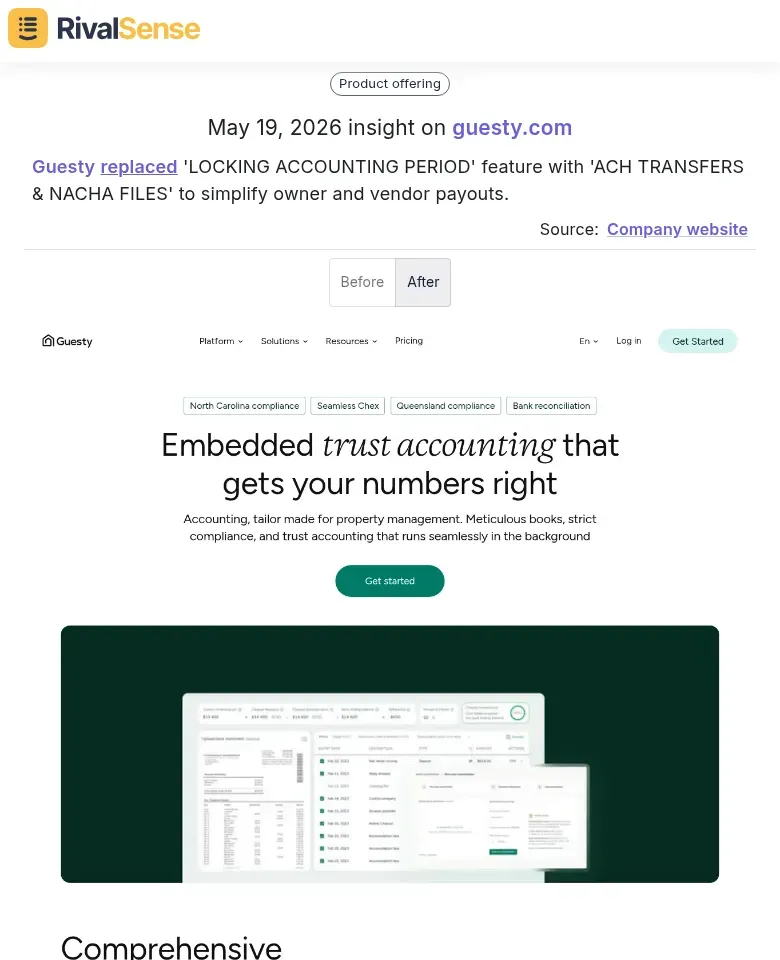
Guesty replaced 'LOCKING ACCOUNTING PERIOD' feature with 'ACH TRANSFERS & NACHA FILES' to simplify owner and vendor payouts.
Why this matters: A feature change like this signals a shift in customer pain points. If your competitor is streamlining payments, your customers might expect similar simplicity. It’s a chance to evaluate your own payout flows and jump ahead with a smoother experience.
Regulatory Compliance: Turn Complexity into a Moat
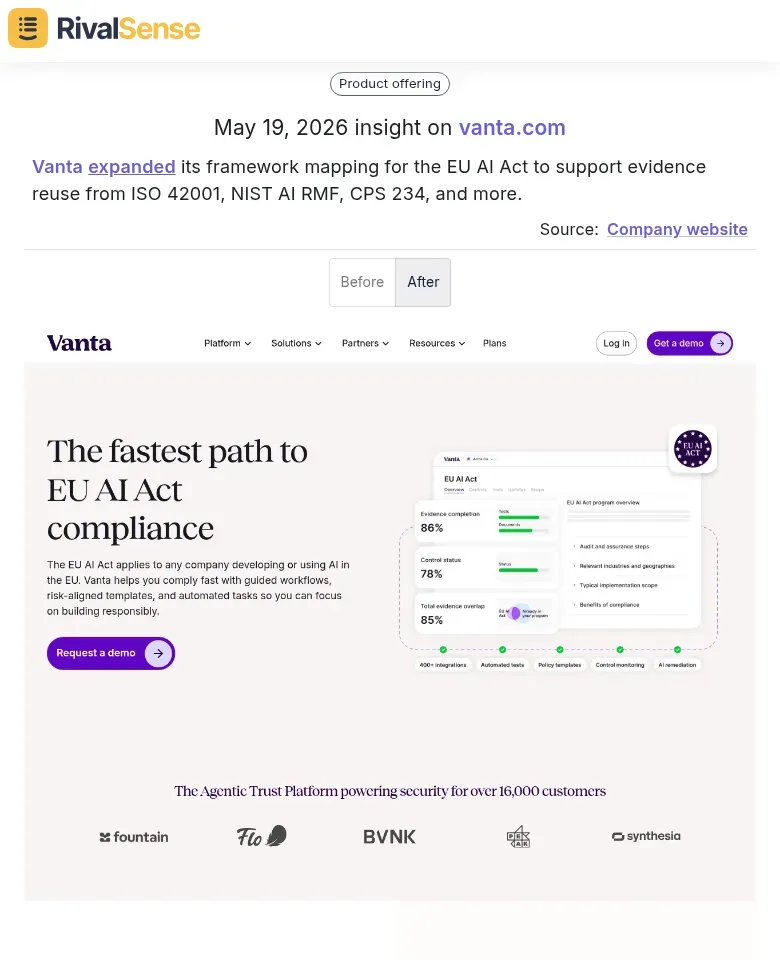
Vanta expanded its framework mapping for the EU AI Act to support evidence reuse from ISO 42001, NIST AI RMF, CPS 234, and more.
Why this matters: When competitors invest in regulatory capabilities, they’re building trust and reducing friction for customers. Monitoring such updates helps you anticipate what standards will become table stakes—and decide whether to match, partner, or differentiate.
New Use Cases: Spot Where the Market Is Moving
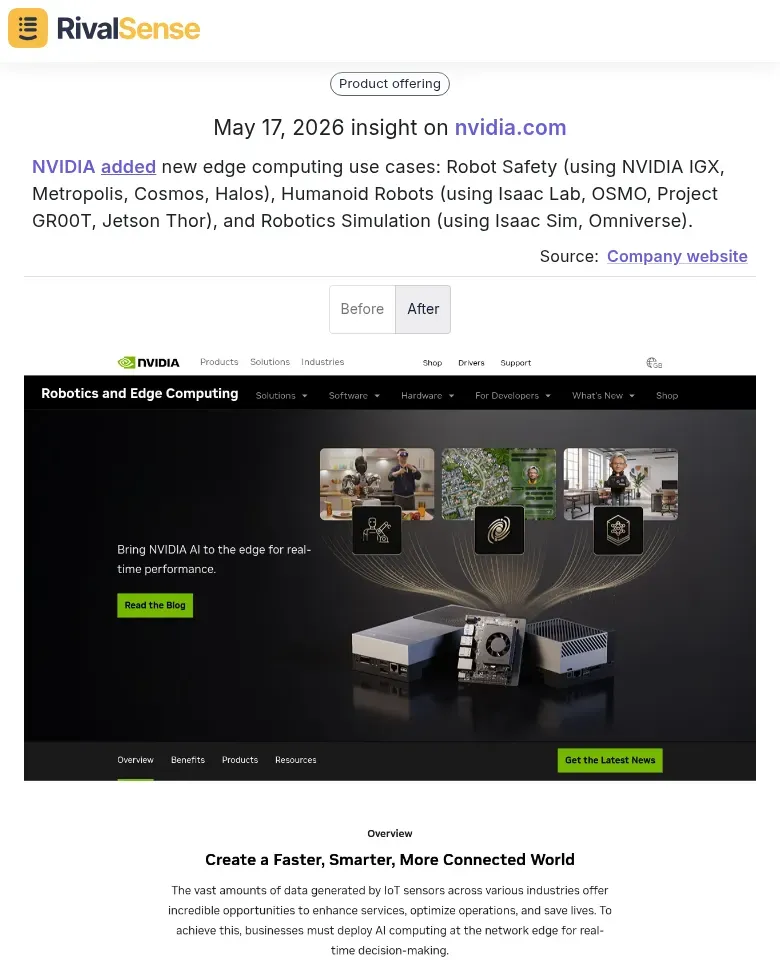
NVIDIA added new edge computing use cases: Robot Safety (using NVIDIA IGX, Metropolis, Cosmos, Halos), Humanoid Robots (using Isaac Lab, OSMO, Project GR00T, Jetson Thor), and Robotics Simulation (using Isaac Sim, Omniverse).
Why this matters: New use cases reveal where a competitor is betting future resources. If you’re in an adjacent space, this can validate a niche you’re considering—or warn you that a giant is about to enter your territory. Use it to refine your own roadmap.
Why Competition Is Actually Good for You
- Validates your market: Competitors prove there’s demand.
- Educates customers: They help build awareness, reducing your marketing costs.
- Forces innovation: Without competition, businesses get complacent.
- Sharpens focus: You must differentiate, which clarifies your value proposition.
What If You Have No Direct Competitors?
Ask yourself:
- Is there a reason no one else is doing this? (Maybe no market.)
- How are customers currently solving the problem? (Indirect competition.)
- Could a related business easily enter your space?
If you truly have no competition, you still have a marketing challenge: you must educate the market from scratch. That’s expensive. Sometimes a little competition is a blessing.
Final Checklist for Competitive Advantage Research
- [ ] Identify direct, indirect, and emerging competitors
- [ ] Define 5–7 comparison criteria
- [ ] Gather data from 5+ source types
- [ ] Build a competitive matrix and positioning map
- [ ] Extract 3 actionable strategic takeaways
- [ ] Set up ongoing monitoring (automated if possible)
- [ ] Review and update quarterly
Competitive advantage isn’t a one-time project—it’s a habit. By systematically tracking what others are doing, you can spot opportunities faster, avoid blind spots, and make smarter strategic moves. And with the right tools, you can do it without drowning in data.
Ready to put competitor advantage research on autopilot? Try RivalSense for free and get your first competitor report today.
📚 Read more
👉 5 Productivity Techniques for Faster Competitor Analyst Report Summaries
👉 How a Rival Outpaced Broadcom by Tracking VMware Updates
👉 Unlock Competitor Insights on Facebook to Boost Key Account ROI
👉 AWS Competitor Monitoring: Workflow for Key Account Insights
👉 The Competitor Financial Intelligence Cheat Sheet: Decoding Funding, M&A, and Analyst Signals