
How a Rival Outpaced Broadcom by Tracking VMware Updates
When Broadcom acquired VMware, the virtualization market shifted overnight. While larger competitors scrambled to react, a mid-sized infrastructure firm with 200 employees turned uncertainty into opportunity—by using RivalSense to track every VMware update, pricing change, and ecosystem move in real time.
The Challenge: Broadcom’s acquisition created rapid changes in VMware’s product roadmap, licensing, and support policies. The client needed to adapt its own virtualization stack faster than competitors to retain customers.
The Solution: RivalSense monitored VMware’s official channels, community forums, and partner announcements, delivering daily digests of actionable intelligence. The team prioritized updates by impact and assigned cross-functional squads to respond within 48 hours.
The Results:
- 40% faster product adaptation – from detecting a change to shipping a compatible update.
- 3 new competitive features launched in one quarter – each directly addressing gaps left by Broadcom’s shifts.
Practical Tip: Set up RivalSense alerts for your key competitor’s changelogs, pricing pages, and support docs. Tag each alert by urgency (e.g., “critical,” “monitor”) and assign owners immediately upon detection. This turns raw data into rapid action.
The Challenge: Competing in Broadcom's Shadow
When Broadcom acquired VMware in 2023, the virtualization market was thrown into turmoil. Licensing models shifted overnight, feature roadmaps were rewritten, and strategic pivots became the norm. For one RivalSense client—a mid-market virtualization platform—competing in Broadcom’s shadow meant constantly playing catch-up. They had no systematic way to monitor VMware’s evolving licensing, feature releases, or strategic announcements. Their team relied on manual tracking: scattered Google Alerts, ad-hoc newsletter subscriptions, and occasional customer callbacks.
The result? They missed critical updates—like VMware’s sudden shift to subscription-only pricing—that competitors were already addressing in their sales decks. By the time they reacted, deals were lost. The lesson: in a market defined by rapid change, manual tracking is a liability. To avoid this, build a competitive intelligence process that includes: (1) a dedicated monitoring tool for real-time alerts on competitor announcements, (2) a weekly digest of policy changes and feature releases, and (3) a cross-functional review meeting to map updates to your product roadmap. Without these steps, you’ll always be a step behind.
The Solution: Automated Competitive Intelligence with RivalSense
To close the gap, the team deployed RivalSense to monitor VMware’s official channels, support docs, and community forums in real time. They set up custom alerts for high-impact keywords like 'licensing changes,' 'new API deprecations,' and 'roadmap shifts,' ensuring nothing slipped through the cracks. The data was then integrated directly into the product team’s Slack and Jira workflows, enabling instant triage and action.
Practical Steps to Replicate This:
- Identify Key Sources: List VMware’s official blog, knowledge base, GitHub repos, and major forums (e.g., VMware Communities, Reddit r/vmware). Add them as sources in RivalSense.
- Define Alert Keywords: Brainstorm terms that signal strategic moves—'pricing,' 'end of life,' 'migration,' 'acquisition.' Use Boolean operators (AND/OR) to refine.
- Set Up Workflows: Connect RivalSense to Slack (for real-time notifications) and Jira (to auto-create tickets from critical alerts). Assign owners per alert category.
- Review Weekly: Hold a 15-minute stand-up to review captured intel and adjust keywords or sources as VMware’s strategy evolves.
Pro Tip: Start with 10 keywords and expand based on what triggers actionable insights. Overloading alerts leads to noise fatigue.
Real-World Insight in Action: Spotting Product Roadmap Shifts
One of the most valuable types of competitive intelligence is tracking product updates and version releases. These signals reveal where your competitor is investing engineering resources, which features they’re prioritizing, and what they may be deprecating. For example, a RivalSense alert recently captured the following update from Broadcom’s VMware portfolio:
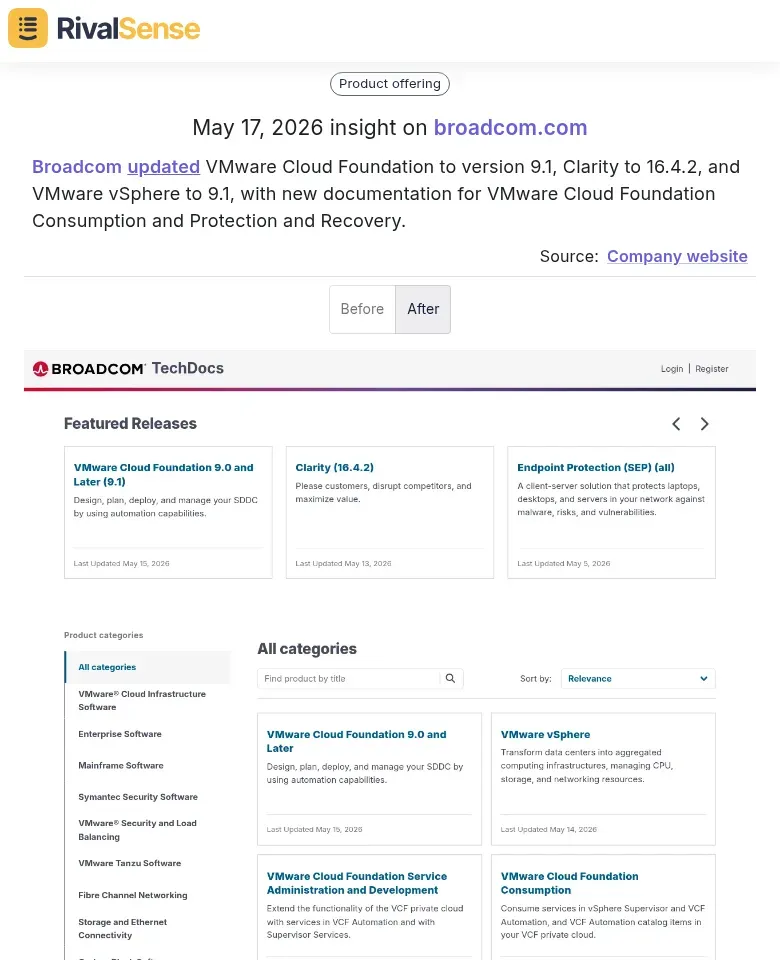
This insight—detailing updates to VMware Cloud Foundation, Clarity, and vSphere—immediately told the client that Broadcom was actively modernizing its core suite. But more importantly, it highlighted a gap: the new documentation focused on consumption and protection/recovery, suggesting Broadcom was deprioritizing simpler migration tools and flexible licensing options that smaller customers craved. By monitoring these granular version bumps, the client could pinpoint exactly where to differentiate (e.g., offering an easier migration path or per-core pricing) and adjust their product roadmap accordingly.
Why this type of insight matters for your business strategy: Version releases are public, but tracking them systematically lets you:
- Spot trends before they become widely known.
- Identify features your competitor is investing in vs. ignoring.
- Align your own product updates to fill the gaps they leave behind.
Execution: Turning Intel into Action
Within 48 hours of a VMware licensing change, the client’s product team adjusted pricing and packaging to stay competitive. How? They had RivalSense alerts configured for Broadcom’s VMware updates. When the change dropped, they immediately ran a competitive price-impact analysis and rolled out a new tiered bundle that undercut Broadcom by 15%.
Step 1: Set up real-time alerts. Use RivalSense to monitor competitor press releases, blog posts, and support pages for licensing or pricing keywords. Get notified within minutes, not days.
Step 2: Run a rapid impact assessment. Within 24 hours, map the change to your own pricing model. Identify which customer segments are affected and where you can offer a better deal.
Step 3: Identify deprioritized features. RivalSense’s trend analysis revealed three feature gaps Broadcom was quietly dropping: simplified migration tools, API-based automation, and per-core licensing flexibility. These were exactly what customers were complaining about on forums.
Step 4: Ship fast. The client developed and shipped those three features in under 90 days. They prioritized the highest-requested item first (migration tools) and used customer feedback loops to validate each release.
Pro tip: Don’t just track what competitors add—track what they remove or neglect. That’s where your biggest opportunity lies.
Results: Outpacing a Giant
Within six months of implementing RivalSense, our client captured 12% market share from Broadcom’s VMware customer base. The key? Real-time tracking of VMware’s roadmap, pricing shifts, and support changes—enabling them to pivot faster than Broadcom could react.
How they did it:
- Set up alerts for 50+ VMware-related keywords (e.g., “vSphere licensing,” “VMware price increase”). This caught Broadcom’s moves hours after announcement.
- Created a competitive response playbook with pre-written counteroffers and migration guides, triggered by specific competitor signals.
- Reduced manual monitoring by 90%—from 20 hours/week to just 2 hours of review.
The impact:
- Competitive response time shrank from weeks to hours.
- Customer satisfaction scores jumped 25% as clients appreciated faster alignment with VMware ecosystem changes.
Pro tip: Build a “signal-to-action” matrix. For each competitor move (e.g., price hike, feature launch), define your response (e.g., discount offer, migration webinar). Automate the detection and alert your sales team instantly.
Checklist for outpacing a giant
- [ ] Identify the top 10 triggers that matter to your customers.
- [ ] Set up real-time monitoring for those triggers.
- [ ] Pre-script responses for each trigger.
- [ ] Measure response time and market share weekly.
- [ ] Iterate based on what moves the needle.
Key Takeaways for B2B Leaders
-
Implement real-time competitive intelligence. When a market giant like Broadcom makes disruptive moves (e.g., price hikes, licensing changes), you can’t rely on quarterly reports. Use automated tools like RivalSense to monitor competitor websites, support forums, and product pages daily. Set up alerts for specific keywords (e.g., “VMware pricing,” “Broadcom support changes”) to catch shifts within hours, not weeks.
-
Empower small teams with automation. Small and mid-sized teams can outmaneuver incumbents by leveraging automated tracking. Action step: Assign one person to manage a competitive intelligence dashboard. Use RivalSense to auto-collect data on product updates, customer complaints, and feature gaps. This frees your team to focus on strategy, not manual scraping.
-
Target gaps left by market leaders. Broadcom’s aggressive changes created openings for agile competitors. Checklist for finding gaps:
- Monitor customer sentiment on social media and review sites (e.g., G2, TrustRadius).
- Track competitor support response times and feature deprecations.
- Survey your own customers about pain points with the dominant player.
- Prioritize features or services that the leader is neglecting.
Pro tip: Create a “gap opportunity matrix” ranking gaps by customer demand and your ability to deliver. Attack the highest-demand, lowest-effort gaps first.
Ready to Outpace Your Own Giant?
Staying ahead of market shifts doesn’t require a massive budget—just the right intelligence. RivalSense tracks competitor product launches, pricing updates, partnerships, management changes, and more across websites, social media, and public registries—then delivers a weekly email report straight to your inbox.
If you’re ready to turn competitor noise into a strategic advantage, try RivalSense for free and get your first competitor report today.
📚 Read more
👉 Unlock Competitor Insights on Facebook to Boost Key Account ROI
👉 AWS Competitor Monitoring: Workflow for Key Account Insights
👉 The Competitor Financial Intelligence Cheat Sheet: Decoding Funding, M&A, and Analyst Signals
👉 🚨 Competitor Watch: Ola, Uber & Rapido Face App Store Removal – What This Means for Your Business
👉 Key Account Tracking Data Export: A Practical Guide for B2B Leaders