
Unlock Competitor Insights on Facebook to Boost Key Account ROI
Introduction: Why Facebook Is a Goldmine for Competitor Intelligence
Facebook remains a high-engagement platform where B2B and B2C brands share real-time updates, product launches, and partnership announcements. Competitor Facebook pages offer unfiltered glimpses into marketing strategies, customer reactions, and positioning shifts. Leveraging these insights can directly improve key account ROI by identifying gaps, trends, and opportunities to differentiate.
Practical Steps to Mine Facebook for Competitor Intel:
- Follow key competitors and enable notifications for their posts.
- Analyze engagement metrics – high comment counts often signal controversial or highly relevant topics.
- Scan comments for customer pain points, feature requests, and sentiment shifts.
- Track post types – video vs. image vs. link – to see what drives engagement.
- Monitor ad libraries (Facebook Ad Library) to see competitor ad creatives and targeting.
Quick Checklist for Weekly Review:
- [ ] New product or feature announcements?
- [ ] Partnerships or integrations revealed?
- [ ] Customer complaints or praise patterns?
- [ ] Content themes or messaging changes?
- [ ] Promotions or pricing moves?
Tip: Use a tool like RivalSense to automate competitor page monitoring and get weekly digests of changes, so you never miss a critical signal. By systematically tracking these signals, you can proactively adjust your key account strategy – whether by addressing a competitor’s weakness or capitalizing on a market gap – directly boosting ROI.
Spotting Product Innovation and Feature Launches Early
To spot product innovation and feature launches early, monitor your competitors' Facebook pages for posts that hint at new offerings. Companies often tease or announce features on Facebook before updating their official website or issuing press releases. Catching these early signals is crucial—it gives you time to adjust your own roadmap, prepare counter-messaging, or even accelerate development to stay ahead. For example, BounceTogether launched Bounce Alerts—a proactive wellbeing monitoring system—by sharing real-life stories on Facebook that illustrated how the tool surfaces hidden emotional needs. This early signal allowed competitors to anticipate the move and adjust their roadmaps.
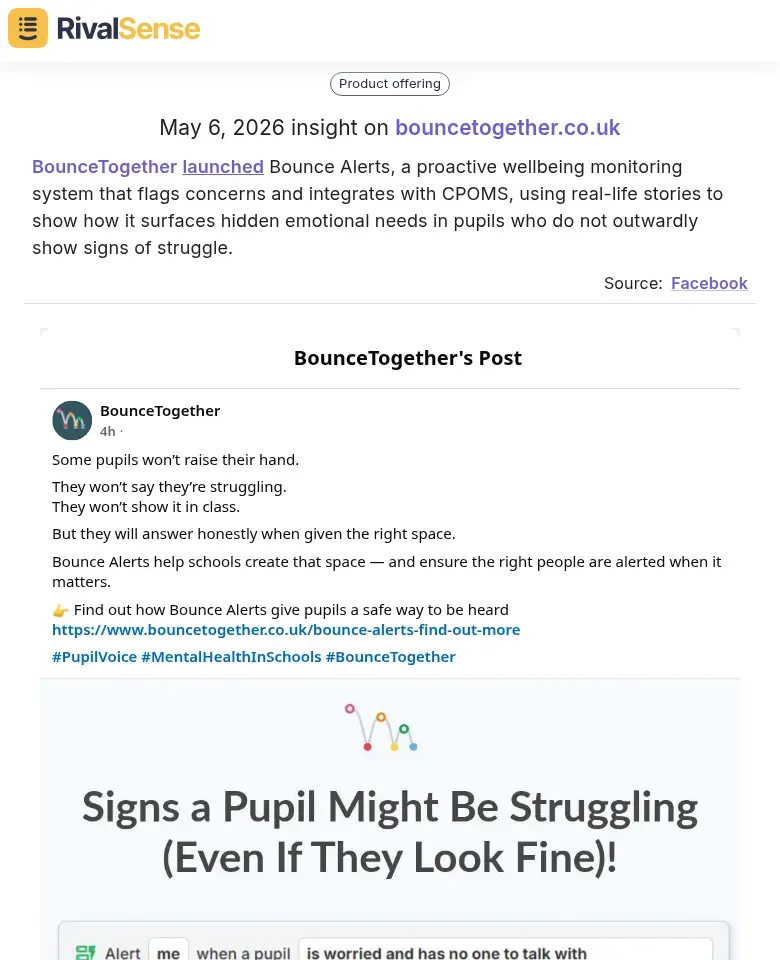
Why this matters: Product launch insights help you understand where your competitor is investing R&D, which segments they're targeting, and what problems they're solving. You can then refine your own value proposition or accelerate your own similar feature to retain key accounts.
Practical steps:
- Create a Facebook monitoring list – Use tools like RivalSense or Facebook’s “See First” feature to prioritize competitor pages.
- Scan for pattern changes – Look for increased posts about a specific problem, new terminology, or user stories that hint at a solution.
- Track engagement metrics – High comment counts or shares on a post may indicate a significant announcement.
- Set up alerts – Use social listening tools to notify you when competitors post about keywords like “launch,” “new,” “introducing,” or “beta.”
Checklist for early detection:
- [ ] Identify top 5 competitors on Facebook.
- [ ] Enable notifications for their posts.
- [ ] Review weekly for new product hints.
- [ ] Cross-reference with website changes.
By catching these signals early, you can adjust your product roadmap or tailor sales messaging for key accounts before the competitor gains market traction.
Decoding Promotional Tactics and Customer Engagement Strategies
To decode promotional tactics on Facebook, start by monitoring competitors' posts for time-limited offers, loyalty program perks, and seasonal campaigns. These reveal pricing and bundling strategies that can inform your own key account management. Understanding promotions is valuable because it highlights how competitors are incentivizing customer loyalty, driving repeat purchases, or reactivating dormant accounts—all moves that could directly threaten your own key accounts.
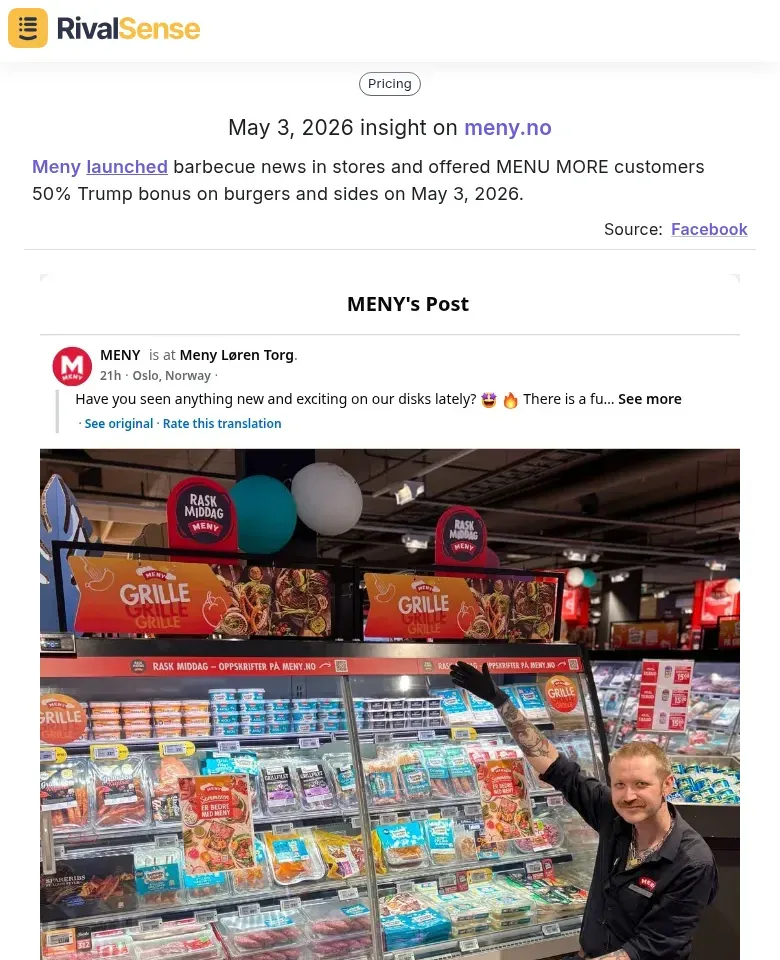
Example Insight: Meny's barbecue post offered a 50% Trump bonus on burgers and sides exclusively for MENU MORE customers. This signals a retention strategy using exclusive discounts to drive foot traffic.
Practical Steps:
- Set up a Facebook monitoring list of top competitors and key accounts.
- Categorize posts by type: flash sales, loyalty bonuses, seasonal bundles.
- Track frequency and timing to identify patterns (e.g., weekly discounts, holiday pushes).
Actionable Tips:
- Counter-offer: Create a similar exclusive deal for your key accounts, but with a twist (e.g., bundle a free item).
- Value-add: If a competitor offers a loyalty perk, enhance your own program with personalized rewards based on purchase history.
- Prevent churn: Use these insights to proactively offer a retention discount before a competitor's campaign ends.
Checklist:
- [ ] Identify 3 competitors' recent promotional posts
- [ ] Note discount percentages and exclusivity conditions
- [ ] Map each promotion to a potential counter-strategy for your key accounts
By systematically analyzing these tactics, you can craft targeted offers that keep your key accounts engaged and reduce churn.
Uncovering Partnership and Ecosystem Moves
Strategic partnerships are a powerful signal of ecosystem expansion and new market plays. Facebook is often the first place companies announce these alliances—before press releases or LinkedIn posts. By monitoring competitors' Facebook pages, you can catch early indicators of moves that may affect your key accounts. Partnership insights are valuable because they reveal new distribution channels, technology integrations, or market segments your competitor is entering, which could either threaten your accounts or inspire you to form counter-partnerships.

Example Insight: Dialpad announced a partnership with Hopper, the largest value-based MSK care organization, on Facebook. The collaboration uses Agentic AI to transform surgery scheduling—revealing how competitors leverage AI to solve operational pain points. This signals a push into healthcare and AI-driven efficiency, which could threaten or inspire your own key account strategy.
Practical Steps to Track Partnership Moves:
- Set up Facebook page monitoring for competitors using tools like RivalSense or manual alerts.
- Create a partnership tracker spreadsheet: log partner names, announcement dates, value propositions, and target segments.
- Analyze the 'why' behind each partnership—does it fill a product gap, enter a new vertical, or strengthen distribution?
- Share insights with your key account team weekly. Ask: Does this partnership compete with, complement, or threaten our key accounts?
Pro Tip: Look for Facebook posts that tag partners or use phrases like "excited to announce"—these often precede formal press releases by 24–48 hours, giving you a first-mover advantage in crafting your response.
Mining Customer Sentiment and Pain Points from Social Feedback
To mine customer sentiment and pain points from social feedback, start by monitoring comments and reactions on your competitors' Facebook posts. Look for recurring themes—both positive and negative. For instance, BounceTogether’s posts about hidden struggles in pupils reveal deep emotional pain points that their product addresses. Understanding sentiment is valuable because it directly shows you what customers love or hate about your competitor's offering—giving you ammunition to differentiate and win key accounts.
Actionable Steps:
- Set up alerts for competitor posts using tools like RivalSense or manual tracking.
- Categorize feedback into themes (e.g., pricing, usability, support).
- Identify unmet needs—what do customers wish existed? For example, if users complain about a competitor’s lack of integration, that’s your opportunity.
Pro Tip: Use sentiment analysis tools to quantify praise vs. complaints. Then, refine your value proposition to address those specific gaps. Tailor your key account pitches by referencing these pain points—showing you understand their challenges better than competitors.
Turning Facebook Insights into Actionable Key Account Strategies
To turn Facebook insights into key account strategies, establish a systematic capture process. Use a spreadsheet or CRM tag to categorize competitor posts by theme: Product (feature launches), Promotion (discounts), Partnership (co-marketing), and Sentiment (customer praise/complaints).
Action Steps:
- Weekly scan – Review competitor Facebook pages, noting posts that signal shifts. Use tools like RivalSense to automate collection.
- Map to accounts – For each key account, identify which competitor moves are relevant. If a competitor launches a similar feature, proactively offer a demo of your superior alternative. If they run a promotion, prepare a counter-offer.
- Track ROI – Measure account retention, upsell rates, and win-back success after applying competitor-informed tactics. Use a simple dashboard: compare 90-day metrics before vs. after implementation.
Checklist:
- [ ] Set up weekly competitor post review
- [ ] Tag posts by theme
- [ ] Assign insights to specific key accounts
- [ ] Execute proactive outreach within 48 hours
- [ ] Review ROI quarterly
Tip: Prioritize accounts with highest churn risk—competitor moves often target your weakest spots first.
Ready to automate all this? Try RivalSense for free at rivalsense.co and get your first competitor report today.
📚 Read more
👉 AWS Competitor Monitoring: Workflow for Key Account Insights
👉 The Competitor Financial Intelligence Cheat Sheet: Decoding Funding, M&A, and Analyst Signals
👉 🚨 Competitor Watch: Ola, Uber & Rapido Face App Store Removal – What This Means for Your Business
👉 Key Account Tracking Data Export: A Practical Guide for B2B Leaders
👉 5 Key Competitor Tracking API Mistakes in Custom Software Development