
Predicting Print Industry Trends: The Power of Competitor Benchmarking
The print industry is undergoing a rapid digital transformation, making real-time competitor intelligence essential for staying ahead. Benchmarking isn't just about keeping tabs—it reveals hidden signals in pricing shifts, product spec changes, and brand strategy moves that collectively shape market direction. By systematically tracking these signals, you can spot emerging trends before they become mainstream and make proactive, data-driven decisions.
Practical steps to start benchmarking:
- Identify key competitors – Focus on direct rivals and innovative newcomers.
- Monitor pricing & promotions – Track price changes, bundle offers, and volume discounts weekly.
- Analyze product specs – Note new features, materials, or sustainability claims.
- Watch brand messaging – Look for shifts in tone, target audience, or value propositions.
- Set up alerts – Use tools like Google Alerts or competitor tracking software for real-time updates.
Tip: Create a simple scorecard to compare competitors across these dimensions monthly. The patterns you uncover will help predict where the market is heading—and position your business to lead the change.
Pricing Adjustments as Market Signals
Pricing adjustments by competitors are among the most telling signals in the print industry. A sudden price drop on custom shapes may indicate a new entrant with lower production costs or a strategic push to capture market share. Conversely, price hikes on standard items like business cards often signal rising material costs or a shift toward premium positioning. To decode these signals, create a monthly pricing tracker: log prices for your top 10 SKUs across 3–5 key competitors. Categorize changes as increases, decreases, or stable. After three months, patterns emerge—commoditized categories (e.g., flyers) show frequent price drops, while premium segments (e.g., specialty packaging) hold or raise prices. Use this data to calibrate your own pricing: match decreases only if you have cost advantages; otherwise, differentiate on service or quality. For commoditized items, consider bundling or value-adds to avoid margin erosion. A practical tip: set price alerts for key competitors using tools like Prisync or manual weekly checks. This turns raw data into a strategic compass, helping you stay competitive without chasing every market swing.
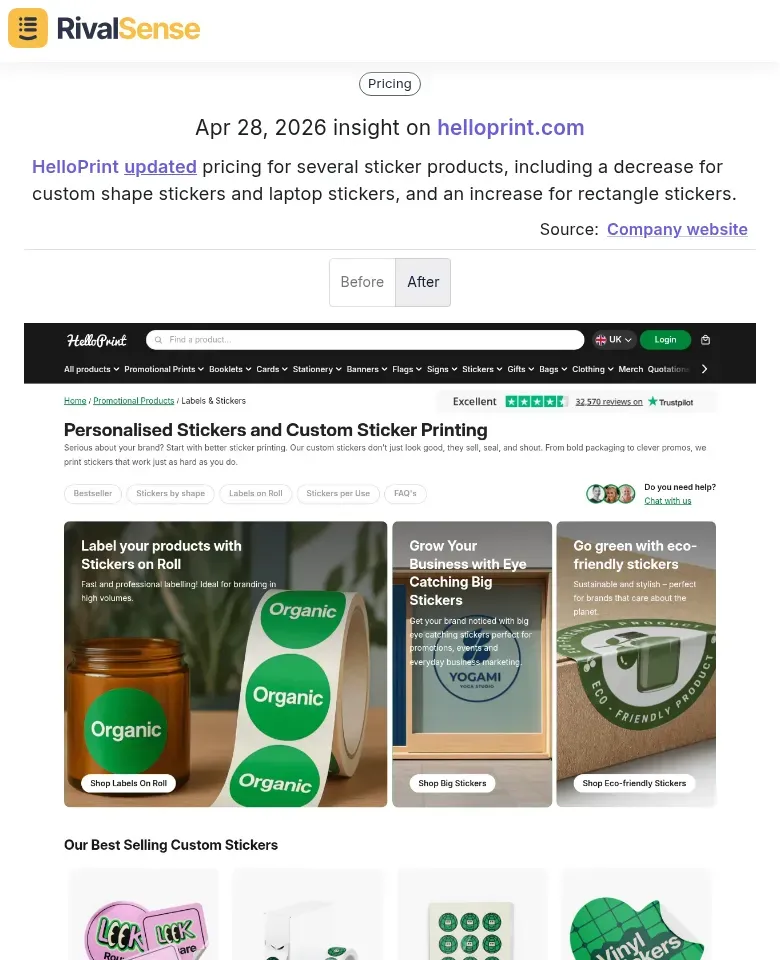
Real Insight: RivalSense detected that HelloPrint updated pricing for several sticker products, including a decrease for custom shape stickers and laptop stickers, and an increase for rectangle stickers. Tracking such granular pricing moves reveals where a competitor is adjusting margins or targeting specific segments—informing your own pricing strategy on similar items.
Product Specification Changes Reveal Customer Preferences
When a competitor updates product specs, it's a direct signal of shifting customer preferences. Here's how to decode those changes:
1. Size Options Signal Demand for Variety
If a competitor adds A4, A7, or custom sizes, they're responding to demand for flexibility. Track new sizes quarterly—if they expand, customers likely want more customization in standard lines.
2. Material Weight Adjustments Reveal Cost vs. Quality Trade-offs
A shift from 350 GSM to 300 GSM Silk may indicate cost optimization or changing quality expectations. Compare your material specs to theirs; if they downgrade but maintain pricing, they're protecting margins. If they upgrade, customers may be demanding higher quality.
3. Finishing & Delivery Changes Reflect Service Expectations
New finishing options (e.g., foil stamping, spot UV) or altered delivery fees signal evolving service needs. If they lower delivery fees, customers may be price-sensitive on shipping. If they add premium finishing, customers are willing to pay for speed or aesthetics.
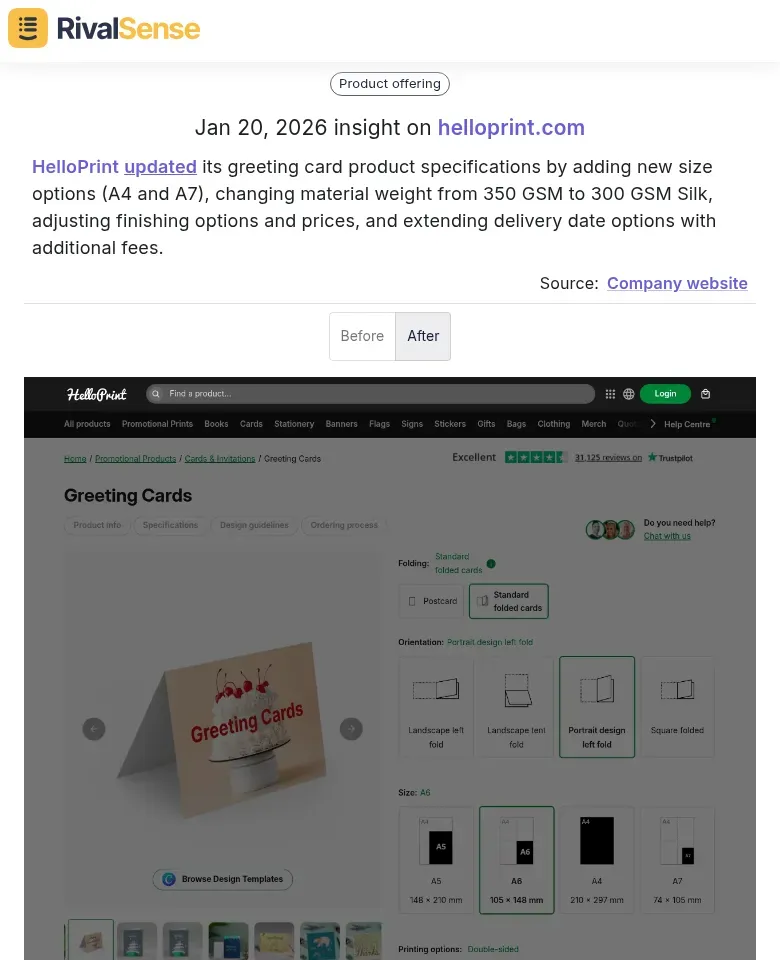
Real Insight: RivalSense alerted us to HelloPrint updating its greeting card product specifications by adding new size options (A4 and A7), changing material weight from 350 GSM to 300 GSM Silk, adjusting finishing options and prices, and extending delivery date options with additional fees. This kind of spec change reveals how a competitor balances cost savings with new offerings—directly hinting at what customers are demanding.
Actionable Checklist:
- [ ] Monitor product page changes monthly (use Wayback Machine or competitor tracking tools).
- [ ] Note any new size, material, or finishing options.
- [ ] Compare pricing changes alongside spec changes.
- [ ] Survey your own customers on similar preferences.
Tip: Create a simple spreadsheet tracking spec changes over time. Patterns emerge quickly—e.g., if three competitors add A7 size within a quarter, it's a market trend, not an outlier.
Brand Consolidation and SEO Strategy Moves
When a competitor merges multiple brands into one, like Drukzo into HelloPrint, it’s more than a rebrand—it’s a strategic SEO play. Consolidating domains funnels link equity, boosts domain authority, and simplifies user experience. For you, this signals a long-term focus on digital asset strength and unified market presence.
How to track and act on these moves:
- Monitor domain changes – Use tools like Ahrefs or SEMrush to detect 301 redirects, drops in backlinks, or new canonical URLs.
- Analyze the rationale – Is the competitor unifying regional sites? Eliminating overlapping brands? This reveals expansion plans or efficiency drives.
- Audit your own brand architecture – If you have multiple sub-brands, consider whether consolidation could strengthen your SEO and customer journey.
- Check for content gaps – After a merger, competitors may remove or merge pages. Identify orphaned content you can target.
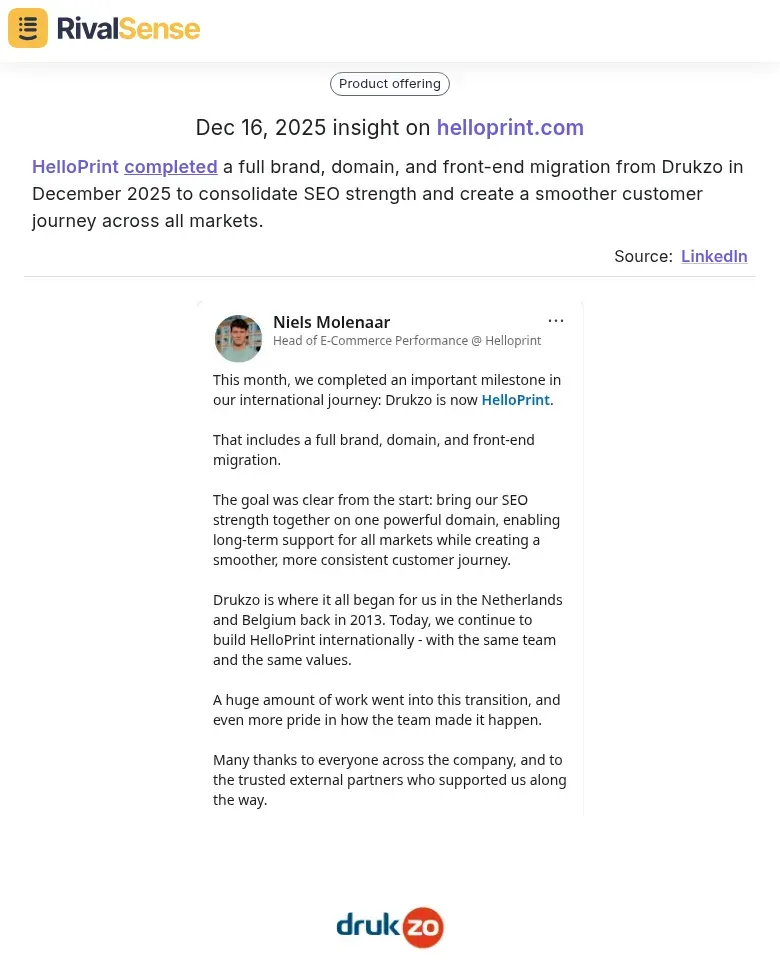
Real Insight: RivalSense captured that HelloPrint completed a full brand, domain, and front-end migration from Drukzo in December 2025 to consolidate SEO strength and create a smoother customer journey across all markets. Understanding such consolidation moves helps you anticipate shifts in competitor authority and plan your own digital strategy accordingly.
Practical checklist:
- [ ] Set alerts for competitor domain changes (e.g., via Google Alerts or ChangeDetection).
- [ ] Map old vs. new URL structures to see what’s retained or dropped.
- [ ] Evaluate if a similar consolidation would benefit your brand’s authority and user experience.
By tracking these shifts, you can anticipate competitor expansion and optimize your own brand architecture before the market shifts.
Actionable Insights from Competitor Benchmarking
To turn competitor benchmarking into actionable insights, follow a structured approach. First, set up regular monitoring of pricing, product specs, and brand moves—using tools like RivalSense or manual trackers. Create a shared spreadsheet or dashboard to log changes weekly. When you spot a price drop or new feature launch, note the timing and context.
Next, use a comparison framework: list your top 3–5 competitors and track changes across columns (e.g., pricing, features, marketing channels). Look for patterns—if two competitors lower prices within the same month, it may signal a market shift toward cost sensitivity.
Finally, translate insights into concrete actions:
- Adjust pricing tiers: If competitors are undercutting, consider introducing a budget tier or bundling premium features.
- Diversify product lines: If rivals are adding AI-powered tools, explore a similar feature or a complementary service.
- Refine SEO strategy: If competitors target new keywords, update your content and meta tags to compete.
Checklist for weekly benchmarking:
- Log competitor price changes.
- Note new product features or removals.
- Track brand messaging shifts (e.g., new taglines, campaigns).
- Identify at least one pattern across competitors.
- Decide one action to test next week.
By consistently applying this framework, you’ll move from reactive to proactive strategy.
Conclusion: Building a Predictive Competitive Intelligence Practice
Competitor benchmarking is the engine that turns raw data into forward-looking predictions. To build a predictive competitive intelligence practice, start by investing in tools that automate continuous tracking of key dimensions: pricing, product launches, marketing tactics, and customer sentiment. Use a structured framework like the following:
- Identify Key Competitors: Focus on direct rivals and adjacent innovators.
- Define Metrics: Choose quantifiable indicators (e.g., ad spend, feature releases, review scores).
- Automate Data Collection: Use tools like RivalSense to capture changes in real time.
- Analyze Patterns: Look for recurring moves (e.g., seasonal promotions, tech adoption cycles).
- Predict Next Moves: Extrapolate from historical patterns and current signals.
- Act Early: Test counter-strategies before trends go mainstream.
Checklist for success:
- ☐ Set up weekly automated reports
- ☐ Create a shared dashboard for leadership
- ☐ Review competitor moves in monthly strategy meetings
- ☐ Document predictions and track accuracy
The print industry’s future belongs to those who read signals and act before the trend becomes obvious. Start benchmarking today to lead tomorrow.
Ready to automate your competitor tracking? Try RivalSense for free to get your first competitor report today—covering pricing, product specs, brand moves, and more—so you can turn insights into action.
📚 Read more
👉 Tracking Industry Leaders: Unlock Product Strategy Insights
👉 How to Turn Event Sponsorships into Competitor Insights
👉 How to Turn Competitor Research into a Real Competitive Advantage
👉 5 Productivity Techniques for Faster Competitor Analyst Report Summaries