
Track Competitor Podcasts: A Data Quality Guide
Podcasts are a goldmine for competitive intelligence because they offer unfiltered, long-form conversations where executives reveal strategies, culture, and roadmaps in ways polished marketing materials never do. Unlike press releases or blog posts, podcasts capture spontaneous discussions about challenges, market positioning, and thought leadership. By systematically tracking competitor podcasts, you can detect early signals of product pivots, funding news, and shifting market focus before they hit the mainstream.
Practical steps to get started:
- Identify key shows – Search Apple Podcasts, Spotify, and YouTube for episodes featuring your competitors’ founders, CTOs, or product leaders.
- Set up alerts – Use tools like Google Alerts with “competitor name + podcast” or leverage podcast-specific monitoring platforms.
- Create a listening checklist – Note mentions of new features, customer pain points, hiring plans, or partnership announcements.
- Transcribe and tag – Use AI transcription tools (e.g., Otter.ai) to convert episodes into searchable text, then tag by theme (e.g., “pricing,” “roadmap,” “culture”).
- Review monthly – Compile a brief intelligence brief summarizing key signals and share with your product and strategy teams.
Pro tip: Pay attention to what competitors don’t say—silence on a trending topic can indicate a strategic blind spot or deliberate omission.
Sourcing the Right Podcasts: Where and How to Find Competitor Episodes
To track competitor podcasts effectively, start by identifying the shows they appear on. Search for your competitors’ names on podcast platforms like Apple Podcasts, Spotify, or Google Podcasts. Also check conference panels and thought leader interviews—sites like YouTube and industry event pages are goldmines. Use podcast search engines such as Listen Notes or Podchaser to find episodes by company or executive name.
Automate discovery with RSS feeds: subscribe to shows your competitors frequent using a feed reader like Feedly. Set up Google Alerts for "[competitor name] podcast" or "[competitor name] interview" to get notified of new episodes. Tools like Brand24 or Mention can also track mentions across audio content.
Prioritize episodes featuring C-suite or product leaders—they often reveal strategic pivots, roadmap hints, or market positioning. Create a checklist: (1) Search competitor name + "podcast" weekly, (2) Monitor RSS feeds for priority shows, (3) Set alerts for executive names, (4) Log episodes with timestamps for key insights. This systematic approach ensures you never miss a critical signal.
Extracting Actionable Data: From Audio to Structured Insights
To extract actionable data from competitor podcasts, start by converting audio to searchable text using transcription tools like Otter.ai, Rev, or Whisper. Pair these with AI summarizers (e.g., ChatGPT, Claude) to generate concise summaries and highlight key themes.
Step 1: Transcribe & Summarize
- Use automated transcription (check accuracy for technical terms).
- Run the transcript through an AI summarizer to extract main points.
Step 2: Tag & Categorize
Create a taxonomy with tags such as:
- Product Features: "new integration," "AI-powered"
- Customer Pain Points: "scaling issues," "data silos"
- Competitive Positioning: "vs. competitor X," "unique value prop"
- Funding Milestones: "Series B," "$10M raised"
Step 3: Extract Quantitative & Qualitative Data
- Quantitative: Note growth rates (e.g., "200% YoY"), customer counts, revenue figures. Verify against other sources.
- Qualitative: Capture vision statements, company values, and strategic shifts. Use sentiment analysis to gauge tone.
Pro Tip: Build a structured database (e.g., Airtable) with fields for date, podcast name, speaker, tag, quote, and insight. This enables trend analysis over time.
Checklist:
- [ ] Transcription accuracy reviewed
- [ ] Tags applied consistently
- [ ] Quantitative claims cross-referenced
- [ ] Qualitative insights logged with context
Validating Data Quality: Avoiding Misinterpretation and Bias
When extracting competitive intelligence from podcasts, data quality is paramount. Misinterpreting a casual remark as a strategic shift can lead to costly missteps. Follow these steps to validate accuracy and avoid bias.
1. Cross-Reference Claims
Always verify podcast statements against official sources. If a CEO hints at a new product, check press releases, SEC filings, or company blogs. Use third-party validation from analyst reports, news articles, or customer reviews. For example, a claim about market share should be corroborated by independent data.
2. Distinguish Aspirational from Factual
Podcasts often feature offhand comments or aspirational visions. A CEO might say, “We’re exploring AI,” but that doesn’t mean AI is in development. Look for commitment signals: specific timelines, named initiatives, or past execution patterns. Flag language like “thinking about,” “might,” or “would love to” as low confidence.
3. Track Changes Over Time
Compare statements across multiple episodes. A shift from “no plans for an IPO” to “we’re evaluating options” signals a real change. Create a simple log:
- Episode date
- Topic
- Key claim
- Confidence level (High/Medium/Low)
- Cross-reference status
4. Use Real-World Examples to Validate
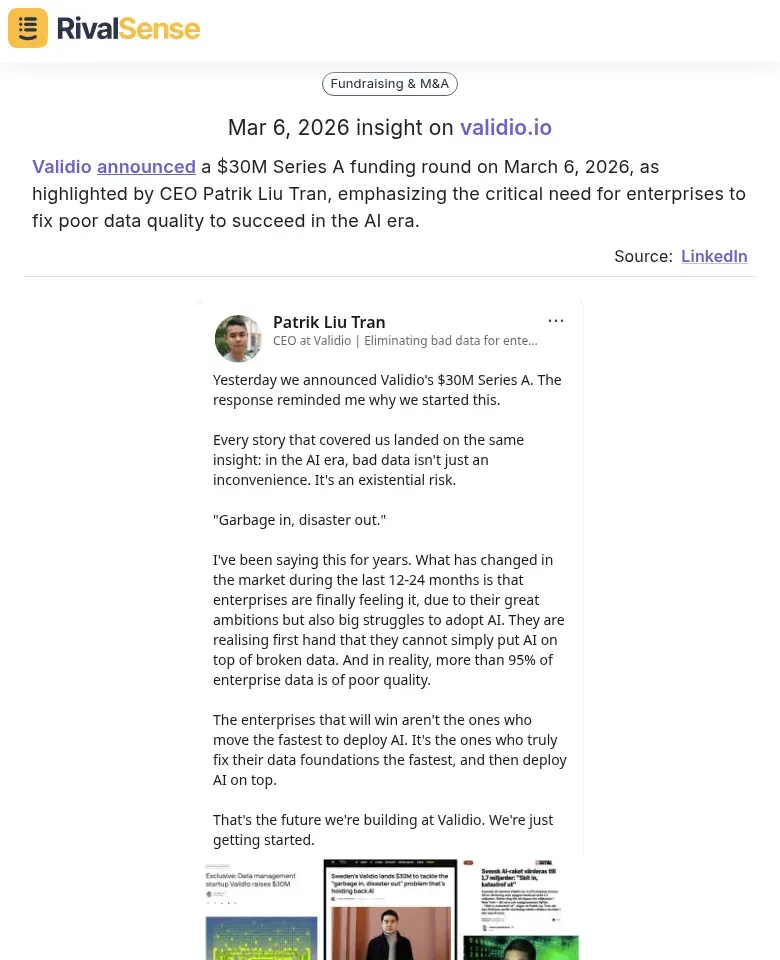
Take funding announcements, for instance. When Validio disclosed its $30M Series A on a podcast, the CEO emphasized the critical need for enterprises to fix poor data quality to succeed in the AI era. By cross-referencing this statement with the official press release and independent news coverage, you can confirm the accuracy of the funding amount, timing, and strategic rationale. Such cross-referencing turns podcast chatter into reliable intelligence.
Pro Tip: Use a shared spreadsheet or CI tool to catalog quotes and link them to evidence. This creates an audit trail and reduces confirmation bias. Regularly review your logs to spot emerging patterns before they become public. By applying this rigor, you turn podcast chatter into reliable strategic input.
Turning Insights into Strategy: How to Use Podcast Intelligence
Podcast intelligence is only valuable when it translates into action. Here’s how to turn insights into strategy:
1. Identify Event Attendance
Listen for mentions of conferences like the Gartner CDAO Summit. If a competitor is speaking or attending, note their messaging and audience questions. For example, Validio will attend the Gartner CDAO Executive Summit in New York City on May 6 to discuss how to trust data for AI with data leaders. This type of insight is valuable for business strategy because it reveals where your competitor is positioning itself, who they’re targeting, and what key message they plan to emphasize. You can use this intel to decide whether to attend, sponsor, or craft counter-messaging.

Tip: Create a calendar of recurring events your competitors mention.
2. Analyze Funding & Growth
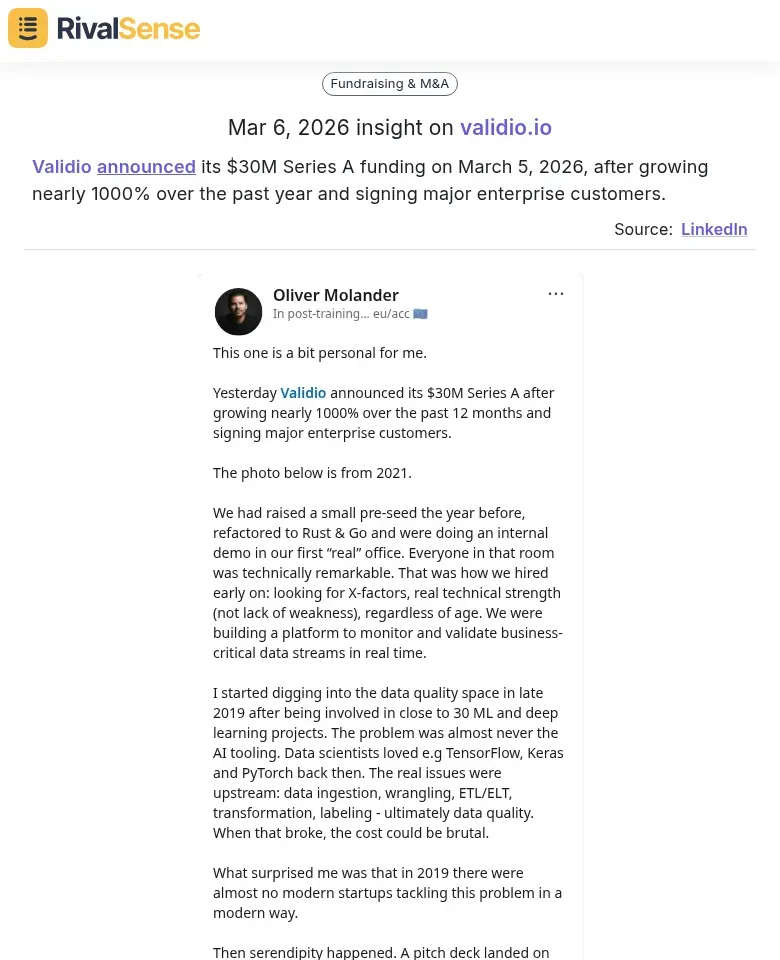
Track funding announcements, revenue hints, and hiring plans. A Series B raise signals aggressive expansion. For instance, Validio announced its $30M Series A funding on March 5, 2026, after growing nearly 1000% over the past year and signing major enterprise customers. This type of insight is valuable for business strategy because it signals a competitor’s financial strength, market validation, and potential for accelerated product development or sales expansion. Action: Adjust your positioning—if they’re scaling sales, differentiate on support or niche features.
Checklist: Note funding amount, stage, investors, and stated use of funds.
3. Refine Product & Sales
Customer pain points and success stories shared on podcasts are gold. Action: Map these to your roadmap—if customers struggle with X, prioritize solving it. For sales, weave competitor weaknesses (e.g., “they lack integrations”) into your pitch. Hint: Record snippets of customer stories to share with your product and sales teams weekly.
By systematically applying these steps, podcast intelligence becomes a strategic asset that drives real business decisions.
Building a Repeatable Podcast Tracking System
To build a repeatable podcast tracking system, start by establishing a dedicated workflow. Use tools like ListenNotes or Chartable for discovery, Otter.ai or Rev for transcription, and a spreadsheet or Notion for analysis and storage. Automate where possible: set up RSS feed alerts for new episodes from competitors.
Assign ownership to a team member (e.g., a competitive intelligence analyst) and set a weekly cadence for review. Each week, listen to or read transcripts of 2–3 competitor podcasts, extract key insights (product updates, strategic shifts, customer pain points), and tag them by theme.
Integrate findings into your competitive intelligence dashboard (e.g., using Geckoboard or Tableau) with categories like "Product Announcements" and "Market Positioning." Share a weekly summary via Slack or email to relevant teams (product, marketing, sales).
Checklist for weekly tracking:
- [ ] Identify new episodes from top 5 competitors
- [ ] Transcribe or skim transcripts
- [ ] Log 3–5 key insights in a central database
- [ ] Update dashboard with new data points
- [ ] Send a 1-page summary to stakeholders
Pro tip: Create a template for insight capture (e.g., episode title, date, key quote, implication for your strategy) to ensure consistency across team members.
Need a Hand? Let RivalSense Do the Heavy Lifting
Manually tracking every competitor podcast, event, funding round, and product update is time‑consuming. RivalSense monitors your competitors across their website, social media, the internet, and various registries, and delivers a concise weekly report straight to your inbox. You get product launches, pricing changes, event participations, partnerships, management moves, and media mentions—all in one place. Start your free trial today and get your first competitor report in minutes. No credit card required.
📚 Read more
👉 Key Account Intelligence: A Content Marketing Framework for Competitor Media Mentions
👉 How to Leverage Competitor Insights: The NAVEX Guide Example
👉 How to Track Key Account Contracts: A Practical Guide for B2B Leaders
👉 Unlock Growth: 5 Data-Driven Benefits of Competitor Analysis
👉 How One Price Shift Revealed a Competitor's Summer Strategy (and How You Can Do the Same)