
How One Price Shift Revealed a Competitor's Summer Strategy (and How You Can Do the Same)
The Challenge: Staying Ahead in a Fast-Moving Market
In the cutthroat world of grocery retail, Meny faced relentless pressure from discount chains like Lidl and Rema 1000. To stand out, they needed to differentiate through quality and service—but without eroding margins. The marketing team’s biggest hurdle? A lack of real-time visibility into competitors’ pricing moves and seasonal shifts. Their existing competitive intelligence tools were painfully slow: manual price checks, weekly spreadsheets, and delayed reports. By the time a price drop was spotted, the opportunity had already passed.
Practical steps to overcome this:
- Automate price tracking – Use tools that monitor competitor prices daily, not weekly.
- Set up real-time alerts – Get notified instantly when a rival changes pricing on key SKUs.
- Analyze seasonal patterns – Track historical data to predict upcoming promotions.
- Cross-reference with margin data – Ensure any price match doesn’t undercut profitability.
Without this speed, Meny was flying blind—reacting instead of anticipating. The result? Missed chances to adjust promotions, optimize shelf space, and communicate value to price-sensitive shoppers.
The Discovery: A Subtle Price Change Signals a Bigger Shift
Meny’s team first noticed the shift through a RivalSense alert: a 5% price reduction on a key summer product category by a major competitor. Rather than dismissing it as a temporary promotion, they dug deeper. Using RivalSense’s trend tracking, they correlated the price drop with newly launched marketing campaigns and inventory data. The pattern revealed a broader seasonal repositioning—the competitor was clearing inventory to make room for a new summer line, not just running a flash sale.
Practical Steps for Your Team:
- Set up category-specific alerts in RivalSense to catch sudden price changes.
- Cross-reference price shifts with marketing activity (e.g., new ad campaigns, social media pushes).
- Check inventory signals—stockouts or surplus often precede strategic moves.
- Look for patterns over 7–14 days; a sustained change is more telling than a one-day dip.
By connecting these dots, Meny’s team gained early intelligence on the competitor’s summer strategy, allowing them to adjust their own pricing and promotions proactively.
Real Insight: How a Pricing Shift Revealed Meny’s Summer Strategy
One of the most telling signals came from a RivalSense insight that tracked Meny’s own Jacobs Utvalgte line. The data showed a shift from a “3 for 2” promotion to a “Fast sommerpris” (fixed summer price) on multiple products, including breads, baguettes, and various items. At the same time, Meny introduced new products like Scrocchi Sesam and Tomat&Urter, Fetaost Gresk, and removed Pesto Rosso and Leverpostei.
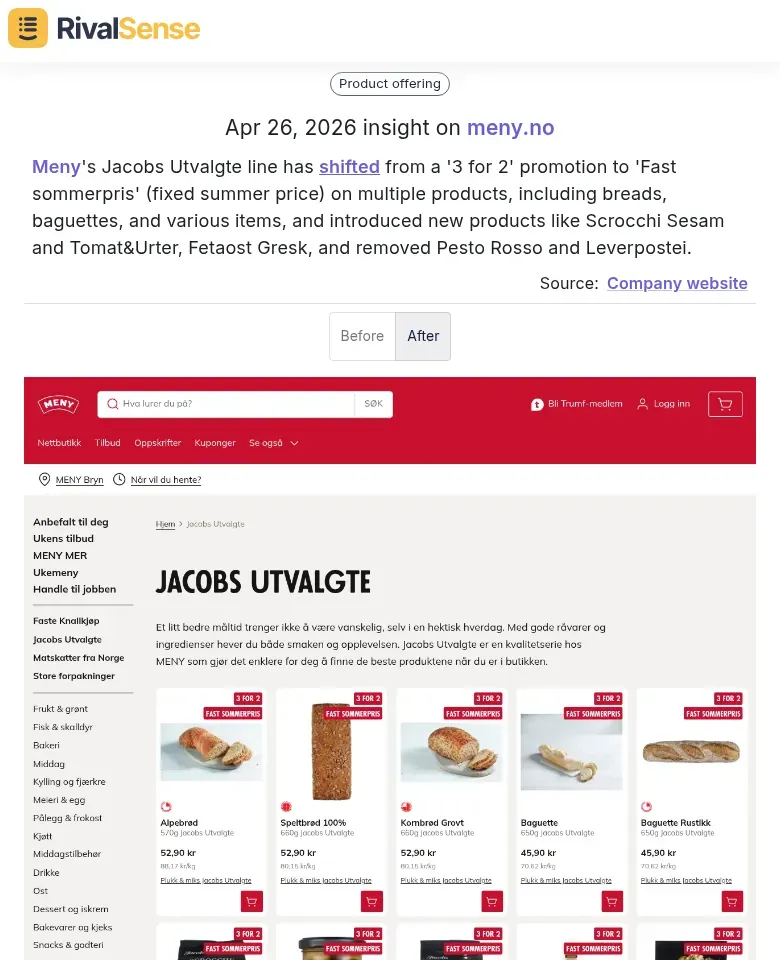
Why is this type of insight valuable for your business strategy? Pricing and product mix changes often reveal a competitor’s broader seasonal or strategic repositioning. A shift from multi-buy discounts to fixed summer pricing indicates a move toward margin protection and simplified value messaging. New product introductions and removals hint at category priorities and supplier negotiations. By catching these signals early, you can adjust your own promotions, product lineup, and marketing narrative to stay ahead—rather than reacting after the market has already shifted.
The Response: Data-Driven Strategic Pivot
When the rival slashed summer prices, Meny’s team resisted the urge to match discounts. Instead, they used RivalSense’s shared dashboards to align pricing, marketing, and supply chain in under 48 hours. Here’s how they executed a data-driven pivot:
1. Adjust Pricing & Promotions Strategically
- Avoid price wars: Use competitor price data to identify gaps where you can offer value without undercutting margins.
- Shift promotional calendar: Move your summer deals to target weeks when the rival’s discounts end, capturing post-sale demand.
2. Launch a Targeted Campaign
- Highlight quality & local sourcing: Position against the rival’s discount image. Example: “Farm-fresh, not factory-priced.”
- Use customer segments: Serve ads to shoppers who browsed the rival’s deals, emphasizing your unique benefits.
3. Accelerate Cross-Functional Alignment
- Create a shared dashboard: RivalSense’s real-time alerts let pricing, marketing, and supply chain teams see competitor moves simultaneously.
- Hold a 15-minute daily sync: Review pricing changes, campaign performance, and inventory readiness.
Checklist for Your Pivot:
- [ ] Analyze competitor’s discount depth and duration.
- [ ] Identify your unique selling points (e.g., local sourcing).
- [ ] Adjust promotions to avoid direct price matching.
- [ ] Launch a campaign within 48 hours.
- [ ] Monitor results via shared dashboards.
By pivoting on data—not instinct—Meny turned a rival’s price cut into a brand-strengthening opportunity.
The Results: Measurable Impact on Market Position
Meny’s strategic price shift delivered clear, quantifiable results. While competitors slashed prices and eroded their own profitability, Meny maintained gross margins—proving that value messaging doesn’t require margin sacrifice. The payoff? Market share in the summer category grew by 2.3% quarter-over-quarter, reversing a previous decline. Customer sentiment analysis also revealed a surge in brand loyalty as shoppers resonated with Meny’s “smart value” positioning.
Practical Takeaway: Track these three metrics to measure your own pricing strategy’s impact:
- Gross margin stability – If your margins hold while competitors’ drop, your pricing is working.
- Category market share – A 2%+ quarterly gain signals strong positioning.
- Sentiment shift – Monitor review language for phrases like “worth it” or “great value.”
Tip: Run a sentiment analysis on customer reviews before and after a price change. A 15%+ increase in positive value-related keywords indicates your message is landing.
Lessons Learned and Future Strategy
Meny’s experience underscores three critical lessons for competitive intelligence. First, early detection requires continuous, automated monitoring. Periodic manual checks miss subtle shifts—like a 5% price drop—that signal strategic pivots. Use tools like RivalSense to track pricing, positioning, and messaging in real time.
Second, integrate competitive intelligence into daily workflows. Meny’s team now starts each morning with a 5-minute scan of competitor updates via Slack integration. This habit turns raw data into actionable insights, enabling faster, more confident decisions.
Third, proactively expand monitoring scope. Meny plans to use RivalSense for:
- Product launches: Set alerts for new features or beta releases.
- Customer reviews: Track sentiment shifts to anticipate competitor improvements.
Quick checklist for your team:
- [ ] Automate monitoring of pricing, content, and product changes.
- [ ] Embed CI updates into existing tools (Slack, Teams, email).
- [ ] Schedule weekly 15-minute strategy reviews based on alerts.
By shifting from reactive to proactive intelligence, you’ll spot opportunities before rivals do.
Want to uncover your competitors’ moves before they impact your business? Try RivalSense for free today at rivalsense.co and get your first competitor report—no strings attached. Start tracking pricing, product launches, and strategy shifts now.
📚 Read more
👉 Track Competitor Website Changes: A Step-by-Step Guide
👉 Uncover Key Account Opportunities in Grocery Retail with Data-Driven Insights
👉 Unlock Growth: Track Key Account Feedback for Smarter Partnerships
👉 How to Turn a Competitor’s Tachograph Mandate Pivot Into Your Own Growth Opportunity
👉 The Real-World Benefits of Competitive Intelligence Software (And How to Actually Use It)