
Key Account Intelligence: A Content Marketing Framework for Competitor Media Mentions
Key account intelligence is the practice of systematically monitoring competitor media mentions—coverage in industry publications, awards, research reports, and analyst briefings—to uncover content opportunities. For B2B leaders, tracking how competitors are featured reveals gaps in your own thought leadership, emerging industry narratives, and positioning moves by rivals.
Why does this matter? Media mentions signal what journalists, analysts, and industry bodies consider noteworthy. If a competitor is quoted in a trend report or wins an award, that coverage shapes buyer perception. By monitoring these mentions, you can:
- Identify topics your audience cares about (e.g., a competitor’s feature on AI in supply chain suggests that angle resonates).
- Spot unclaimed territory—areas where no competitor has authoritative content.
- Reverse-engineer successful pitches: note which publications cover competitors and what angles they use.
Practical steps to get started:
- Set up alerts for top competitors using tools like Google Alerts, Mention, or RivalSense. Filter by publication domain (e.g., Forbes, TechCrunch) and mention type (news, awards, reports).
- Categorize mentions by theme (product launch, funding, thought leadership) and sentiment (positive, neutral, negative).
- Map gaps: Compare competitor coverage against your own content calendar. Where are they quoted but you aren’t? That’s your opportunity.
- Pitch proactively: Use insights to craft pitches to journalists covering those beats, offering a unique perspective or data.
Leveraging Awards and Partnerships: What Civic Marketplace’s ETCOG Win Teaches Us
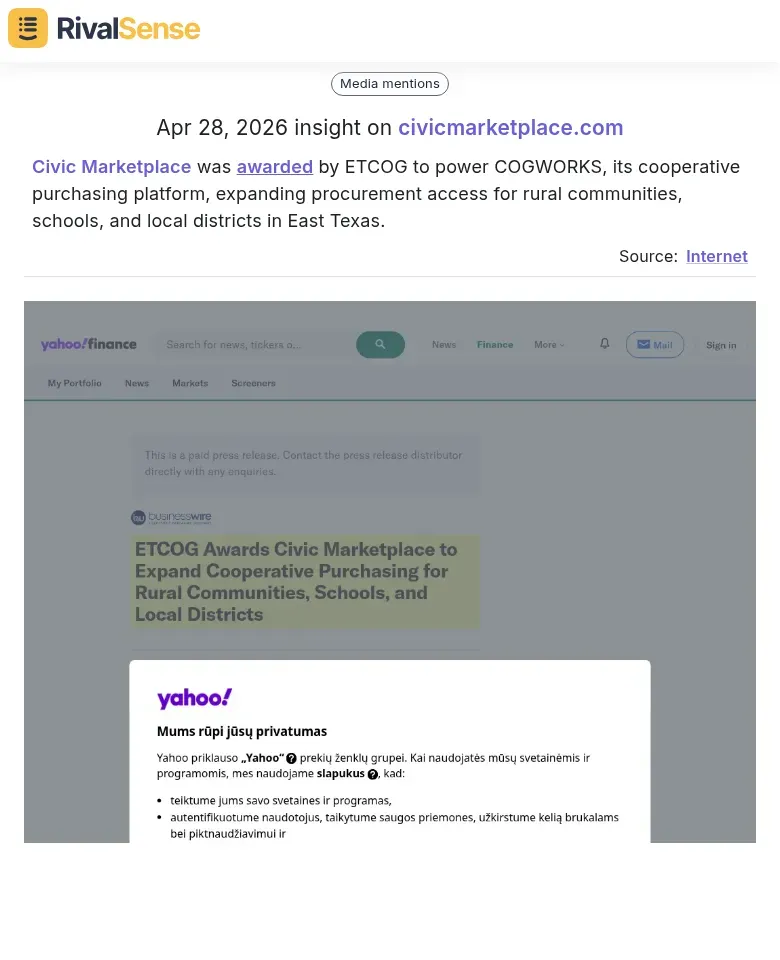
When a competitor wins an award or lands a government partnership, it’s a signal worth decoding—not a cause for panic. For example, Civic Marketplace was recently awarded by ETCOG to power COGWORKS, its cooperative purchasing platform, expanding procurement access for rural communities, schools, and local districts in East Texas.
Why is this type of insight valuable? Awards and government recognitions highlight underserved market segments and emerging demand signals. They show you exactly where the market is moving—and where your own content can differentiate. Instead of viewing this as a loss, use it as a strategic lens to identify gaps.
Step 1: Analyze the signal. What specific pain point did the award address? In Civic Marketplace’s case, it tackled limited procurement access for rural areas. Step 2: Map your strengths. Where does your product offer a unique advantage for similar segments—perhaps faster onboarding or lower cost? Step 3: Create targeted content. Develop case studies or white papers that speak directly to the challenges of rural communities, schools, or local districts. For example, a white paper titled “Bridging the Digital Procurement Divide: 3 Strategies for Rural School Districts” can position you as an expert.
Pro tip: Use competitor awards as a content hook. Write a blog post like “What Civic Marketplace’s ETCOG Award Means for Rural Tech Adoption” and subtly contrast your approach. Include a checklist for local governments evaluating vendors—covering integration ease, data privacy, and scalability. This not only educates but also positions your solution as the practical alternative.
Capitalizing on Buyer’s Guides and Educational Content: Insights from Cato Networks
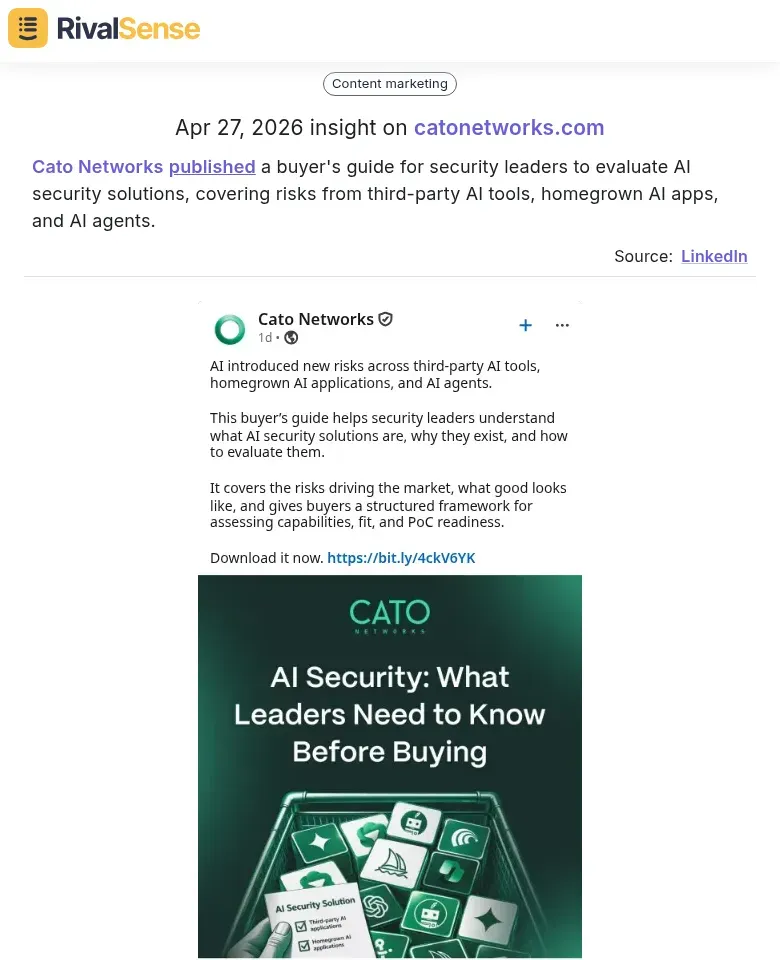
Competitor buyer’s guides are goldmines for understanding the criteria and risks they emphasize. For instance, Cato Networks published a buyer’s guide for security leaders to evaluate AI security solutions, covering risks from third-party AI tools, homegrown AI apps, and AI agents.
Why is this type of insight valuable? Buyer’s guides reveal the exact evaluation framework your prospects are likely to use. By analyzing what a competitor prioritizes, you can build a more compelling counter-narrative or address overlooked concerns.
Practical Steps:
- Extract criteria: List the top 5–7 factors your competitor stresses (e.g., data privacy, latency, integration ease).
- Map your strengths: For each criterion, note how your solution outperforms or offers a unique angle (e.g., “Our zero-trust architecture eliminates third-party risks without agent overhead”).
- Create a comparison guide: Develop a side-by-side evaluation table that positions your solution as more comprehensive or simpler to implement.
Content Ideas:
- “The Ultimate Buyer’s Checklist for AI Security” (address same concerns with your twist).
- “5 Questions Your AI Security Vendor Should Answer” (mirror their criteria but lead to your differentiators).
Tip: Use the competitor’s language in your content to capture search intent—then pivot to your unique value proposition. This approach not only educates but also preemptively counters competitor narratives.
Using Industry Research Features: Five9’s AI Journal Spotlight
Industry research reports and journal features are goldmines for understanding what journalists and analysts care about. When Five9 was featured in The AI Journal’s 2026 research on leading voice AI platforms for customer service, it signaled a trend worth doubling down on.
Why is this type of insight valuable? Being featured in industry research validates the importance of a specific category or use case. It tells you that the market conversation is shifting—and you can either join it or lead it.
Here’s how to leverage such mentions:
1. Identify the Report & Angle
Search for competitor names in reports from publications like The AI Journal, Gartner, Forrester, or IDC. Note the specific category (e.g., “Voice AI Platforms”) and the key trends highlighted.
2. Pitch a Fresh Take
Reach out to the same publication with a unique angle. Offer proprietary data, a contrarian viewpoint, or a case study that extends the report’s findings. For example, if the report focused on enterprise adoption, pitch a piece on “Voice AI for SMBs: Untapped Potential.”
3. Build a Content Series
Create a blog series around the research topic. Use the report’s terminology to optimize for SEO. For instance, a series on “Voice AI Platforms” could include:
- “Top 5 Voice AI Use Cases in Customer Service”
- “How Voice AI Reduces Handle Time: A Data Analysis”
- “Voice AI vs. Chatbots: When to Use Each”
Checklist:
- [ ] Identify 3 industry reports mentioning competitors
- [ ] Note the key trend/category
- [ ] Draft a pitch with proprietary data
- [ ] Outline a 4-part blog series
- [ ] Optimize posts for the report’s keywords
Building a Systematic Framework for Competitor Media Monitoring
To turn sporadic monitoring into a repeatable process, start by setting up alerts and dashboards. Use tools like Google Alerts, Mention, or RivalSense to track keywords (e.g., competitor names, product terms) across news, awards, research reports, and buyer’s guides. Create a centralized dashboard (e.g., in Airtable or Notion) to log each mention with date, source, type, and URL.
Next, categorize mentions into types: awards, buyer’s guides, feature articles, research citations. Map each to content opportunities: awards → case studies highlighting your differentiators; buyer’s guides → comparison posts or “alternatives to [competitor]” content; feature articles → trend reports or thought leadership; research citations → data-driven rebuttals or original research.
Establish a regular cadence: weekly scan for new mentions, bi-weekly categorization and gap analysis, monthly content calendar updates. Assign a team member to own this process. Use a simple checklist:
- Check alerts daily
- Log mentions with type and opportunity
- Review gaps vs. your content pillars
- Update calendar with new topics
- Archive old mentions for trend analysis
This system ensures you never miss a chance to leverage competitor coverage for your own content strategy.
Conclusion: Turning Competitor Insights into Actionable Content Strategy
Competitor media mentions are a goldmine for content ideas. Awards and partnerships highlight untapped market segments; buyer’s guides reveal evaluation criteria; industry research features validate trending topics. The key is speed—respond within 48 hours to ride the wave of attention—and differentiation: never just echo; always add unique value.
Actionable Checklist:
- Set up alerts for competitor mentions (Google Alerts, Brand24, or RivalSense).
- Categorize each mention: analyst report, news, social buzz.
- Map to content format: report → data-driven blog, news → op-ed, social → quick video or LinkedIn post.
- Draft within 24 hours, publish within 48.
- Track engagement to refine your approach.
To make this process effortless, try RivalSense for free. It tracks competitor product launches, pricing updates, event participations, partnerships, regulatory changes, management moves, and media mentions across company websites, social media, and registries—all delivered in a weekly email report. Get your first competitor report today and turn intelligence into action.
📚 Read more
👉 How to Leverage Competitor Insights: The NAVEX Guide Example
👉 How to Track Key Account Contracts: A Practical Guide for B2B Leaders
👉 Unlock Growth: 5 Data-Driven Benefits of Competitor Analysis
👉 How One Price Shift Revealed a Competitor's Summer Strategy (and How You Can Do the Same)