
Unlock Growth: 5 Data-Driven Benefits of Competitor Analysis
Introduction: Why Competitor Analysis Matters for Growth
In today’s hyper-competitive B2B landscape, growth isn’t just about having a better product—it’s about making smarter strategic moves. Competitor analysis bridges the gap between raw market noise and actionable growth strategies. Yet many founders treat it as a one-time project, not a systematic discipline. That oversight costs them: they miss shifts in pricing, messaging, or feature adoption that rivals exploit.
Data-driven competitor tracking eliminates guesswork. Instead of relying on gut feelings, you base decisions on real evidence—what’s working for others and where their blind spots are. This reduces wasted resources and increases ROI on every strategic bet.
Practical steps to start:
- Set up a tracking cadence – Review top 3 competitors weekly (news, product updates, reviews). Use tools like RivalSense to automate alerts.
- Create a competitive matrix – List 5–7 key metrics (pricing, features, GTM channels, customer sentiment). Update monthly.
- Identify one “exploit” per quarter – Find a weakness in a competitor’s offering or positioning and test a counter-strategy.
Pro tip: Don’t just track—act. Assign one team member to own competitive insights and tie each finding to a specific growth experiment.
Benefit 1: Identify Market Gaps and Untapped Opportunities
Competitor analysis isn't just about keeping up—it's about finding where others fall short. By systematically analyzing competitor offerings, you can spot unmet customer needs or underserved segments that represent your next growth vector.
How to uncover gaps:
- Build a feature comparison matrix. List your top 3–5 competitors and map their core features against customer pain points. Highlight features they lack or do poorly.
- Mine customer reviews and support forums. Look for recurring complaints about competitors—these signal opportunities. For example, if users consistently lament poor mobile experience, that's your opening.
- Survey your own sales team. They hear daily why prospects chose you—or didn't. Capture those insights.
Practical tip: Use a simple spreadsheet with columns for "Competitor," "Feature," "Customer Pain Point," and "Gap Score" (1–5). Update quarterly.
Checklist for action:
- [ ] Identify 3 features competitors ignore
- [ ] Validate demand via customer interviews
- [ ] Prioritize gaps with highest revenue potential
- [ ] Update product roadmap to address top 2 gaps
By leveraging these gaps, you position your brand as the unique solution that truly solves what others overlook.
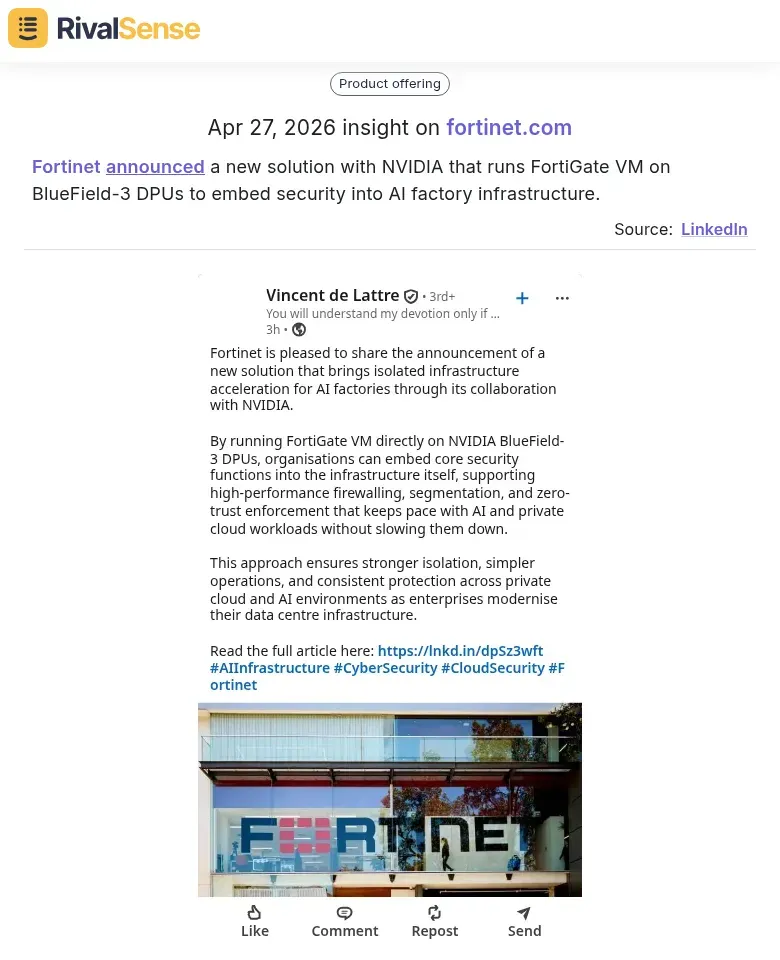
⚠️ Real insight in action: Tracking competitor partnerships can reveal new market openings. RivalSense recently detected Fortinet’s announcement of a joint solution with NVIDIA to run FortiGate VM on BlueField-3 DPUs—embedding security into AI factory infrastructure. This type of partnership intelligence helps you spot where rivals are forging alliances to enter emerging segments (like AI infrastructure security), allowing you to respond with complementary offerings or differentiated positioning before the market matures.
Benefit 2: Refine Pricing and Positioning Strategies
Competitor analysis sharpens your pricing and positioning by revealing what the market truly values. Start by benchmarking competitor pricing models—map out their tiers, features, and price points. Use a simple spreadsheet to compare your offering against top competitors on dimensions like core features, support level, and contract flexibility.
Practical steps:
- Identify perceived value drivers: Analyze competitor reviews, testimonials, and case studies to spot what customers praise most (e.g., ease of use, integrations, customer support). These are your positioning levers.
- Adjust packaging or bundling: If competitors bundle features you sell separately, consider unbundling or creating new packages to differentiate. For example, if rivals charge for premium support, you could offer it free to win over price-sensitive segments.
- Test price elasticity: Run A/B tests on pricing pages or offer limited-time discounts to gauge demand at different price points.
Checklist:
- [ ] List top 3 competitors and their pricing tiers
- [ ] Highlight features where you outperform competitors
- [ ] Identify gaps in competitor offerings you can exploit
- [ ] Draft positioning statements that emphasize your unique value
By systematically analyzing competitor moves, you avoid price wars and instead position your product as the best solution for your target audience.
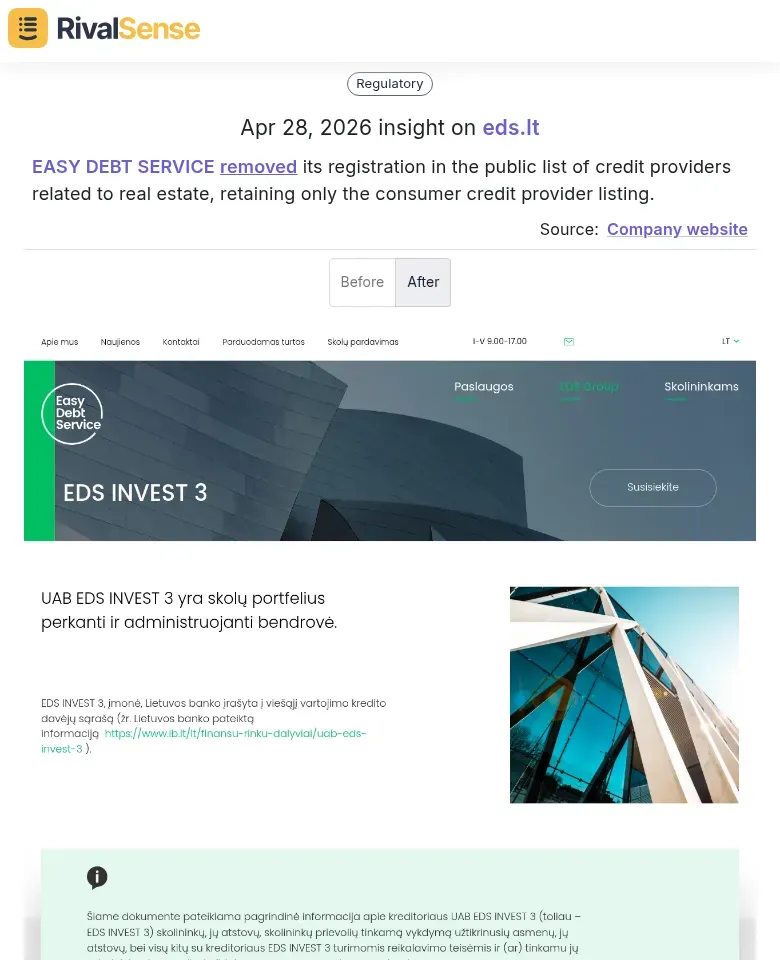
⚠️ Real insight in action: Sometimes a competitor’s regulatory change hints at a strategic pivot. RivalSense flagged that EASY DEBT SERVICE removed its registration in the public list of credit providers related to real estate, retaining only consumer credit provider listing. Such a shift could signal a focus change away from real estate lending—opening an opportunity for you to capture that segment or adjust your positioning to fill the void. Monitoring regulatory filings can uncover early signals of market exits or repositioning.
Benefit 3: Enhance Product Development with Competitive Intelligence
Competitive intelligence (CI) directly fuels smarter product decisions. By systematically tracking competitor feature releases, you can prioritize your own development backlog based on market demand rather than guesswork. Practical step: Set up alerts for competitor changelogs, product blogs, and app store updates. When a rival ships a new feature, ask: Is this solving a real customer need we’ve overlooked?
Customer reviews and support forums are goldmines for identifying pain points. Analyze recurring complaints about competitors—these are your opportunities. Checklist for review mining:
- Collect 50+ recent reviews from G2, Capterra, or Reddit.
- Tag each by theme (e.g., UX, pricing, missing feature).
- Rank themes by frequency and severity.
- Map top pain points to your product roadmap.
CI also helps validate or pivot product hypotheses before heavy investment. Before building a new module, test demand by monitoring competitor pricing, usage trends, and customer sentiment. Tip: Use a simple scorecard—rate each hypothesis on market need (from reviews), competitive gap (no rival solves it well), and strategic fit. Only green-light ideas scoring 8+ out of 10. This lean approach reduces wasted dev cycles and ensures every feature moves the needle.
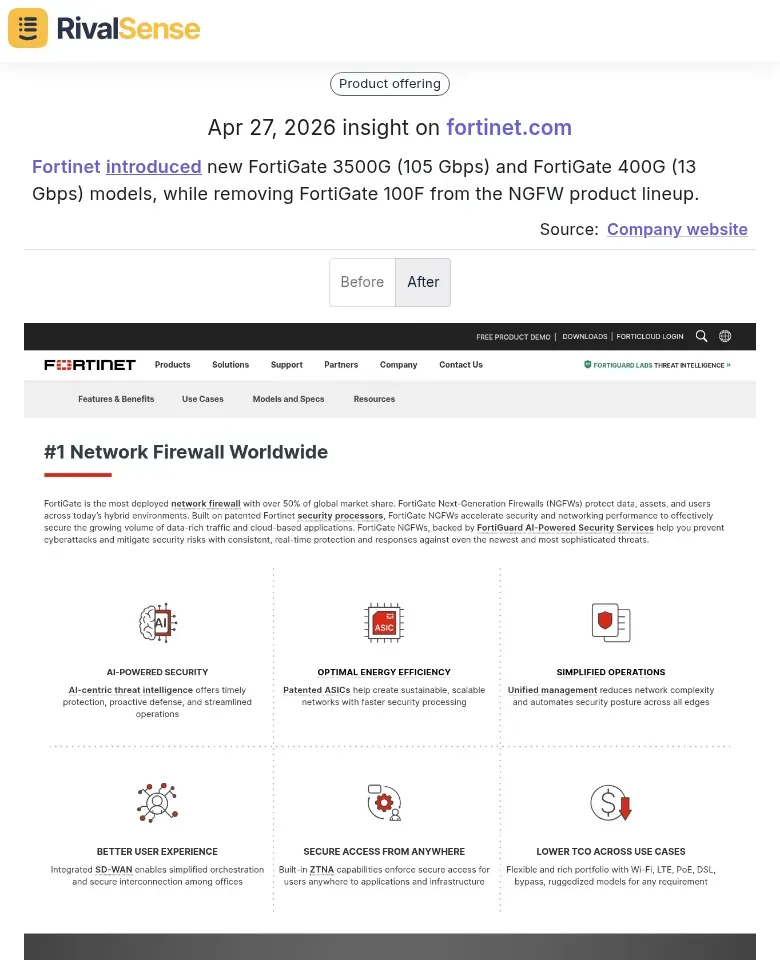
⚠️ Real insight in action: Tracking product line changes reveals strategic priorities. RivalSense noted that Fortinet introduced new FortiGate 3500G (105 Gbps) and FortiGate 400G (13 Gbps) models, while removing FortiGate 100F from the NGFW product lineup. Knowing which products a competitor launches (or sunsets) helps you anticipate where they’re investing R&D and where gaps may appear in their portfolio—giving you a window to differentiate or capture displaced customers.
Benefit 4: Improve Marketing and Sales Effectiveness
Competitor analysis sharpens your go-to-market engine. By auditing rival content—blogs, webinars, ads—you can pinpoint which channels drive their best engagement. Action step: Use a tool like RivalSense to track competitors’ top-performing posts; then test similar formats on your own channels.
Equip your sales team with battle cards. Create one-page comparison sheets that highlight your differentiators versus each key competitor. Include common objections and rebuttals. Tip: Update these quarterly—competitors pivot fast.
Monitor competitor messaging shifts. When a rival changes their value proposition or pricing page, it signals a strategic move. Checklist:
- Set alerts for competitor website changes.
- Review their new messaging for gaps you can exploit.
- Adjust your own positioning to emphasize strengths they ignore.
Pro tip: Run a monthly “competitive messaging audit” with marketing and sales to align on how to counter new claims. This keeps your campaigns relevant and your sales conversations winning.
Conclusion: Building a Sustainable Competitive Intelligence Practice
Building a sustainable competitive intelligence practice doesn't happen overnight—it requires consistent effort and cross-functional collaboration. Start by establishing a regular monitoring cadence. Use tools like RivalSense to automate tracking of competitor websites, product launches, pricing changes, and marketing moves. Set a weekly or bi-weekly rhythm to review updates and flag significant shifts.
Next, share insights cross-functionally. Create a simple dashboard or a monthly competitive brief that highlights key changes, threats, and opportunities. Distribute it to product, sales, marketing, and leadership teams. This alignment ensures everyone understands the competitive landscape and can adjust strategies accordingly.
Finally, continuously iterate your analysis framework. Markets evolve, and so should your approach. Every quarter, review your competitor set—are there new entrants or players that have pivoted? Update your tracking parameters and KPIs. Solicit feedback from teams on what insights are most valuable and refine your reporting.
Quick checklist for a sustainable practice:
- [ ] Automate competitor monitoring (e.g., RivalSense)
- [ ] Set a recurring review cadence (weekly/bi-weekly)
- [ ] Create a cross-functional distribution list
- [ ] Build a simple competitive dashboard or brief template
- [ ] Conduct quarterly framework audits
- [ ] Collect team feedback to improve relevance
By embedding competitive intelligence into your regular workflow, you transform ad-hoc research into a strategic advantage that drives growth.
Ready to make competitor tracking a constant growth lever? Try RivalSense for free at https://rivalsense.co/ and get your first competitor report today. Stop guessing—start knowing.
📚 Read more
👉 How One Price Shift Revealed a Competitor's Summer Strategy (and How You Can Do the Same)
👉 Track Competitor Website Changes: A Step-by-Step Guide
👉 Uncover Key Account Opportunities in Grocery Retail with Data-Driven Insights
👉 Unlock Growth: Track Key Account Feedback for Smarter Partnerships
👉 How to Turn a Competitor’s Tachograph Mandate Pivot Into Your Own Growth Opportunity