
How to Track Key Account Contracts: A Practical Guide for B2B Leaders
Tracking key account contracts isn't just about avoiding missed renewals—it's about protecting revenue, spotting risks early, and ensuring your most valuable relationships stay healthy. But for many B2B organizations, contracts are scattered across email threads, shared drives, and CRM notes. Without a system, you're flying blind.
Here’s a step-by-step guide to tracking key account contracts effectively, with actionable advice you can implement today.
1. Centralize Everything in One Place
You can't track what you can't find. According to an EY report, 9 out of 10 contract professionals struggle to locate specific contracts when needed. The first step is to create a single source of truth.
Actionable steps:
- Move all contracts (signed, draft, expired) into a centralized repository.
- Tag each contract with key metadata: account name, contract value, renewal date, key clauses, and owner.
- Use a tool that allows full-text search so you can find any clause in seconds.
Pro tip: If you're using spreadsheets, set up a master tracker with columns for contract ID, account name, start/end dates, auto-renewal terms, and next action date. But be warned—manual tracking gets brittle as you scale.
2. Define the KPIs That Matter for Key Accounts
Not all contracts are equal. For key accounts, focus on KPIs that directly impact revenue and relationship health.
Essential KPIs for key account contracts:
| KPI | What It Measures | Why It Matters for Key Accounts |
|---|---|---|
| Contract value | Total financial worth of the deal | Helps prioritize high-value accounts |
| Renewal rate | % of contracts renewed vs. expired | Directly indicates client satisfaction and revenue retention |
| Contract cycle time | Days from initiation to signed agreement | Long cycles signal friction in the sales process |
| Compliance rate | % of contracts meeting their set terms | Reduces legal exposure and audit risk |
| Turn frequency | Number of negotiation rounds before signing | High turns indicate unclear terms or misalignment |
| Review time | Hours from draft to final review | Measures legal team throughput |
| Obligation tracking | % of key milestones met on time | Prevents penalties and relationship strain |
Actionable steps:
- Pick 3–5 KPIs that align with your business goals. Don't try to track everything at once.
- Set a baseline by measuring your current performance manually for one quarter.
- Define SMART goals for each KPI (e.g., "Reduce contract cycle time for key accounts from 45 days to 30 days by Q3").
3. Monitor Renewals and Obligations Proactively
Missed renewals are the #1 cause of revenue leakage in key account contracts. And missed obligations (like service-level commitments) can damage trust.
Actionable steps:
- Set up automated reminders 90, 60, and 30 days before renewal dates.
- Create a checklist of key obligations for each contract (e.g., quarterly business reviews, SLA reporting, compliance filings).
- Assign ownership for each obligation and track completion in your system.
Checklist for proactive monitoring:
- [ ] Renewal dates logged and reminders active
- [ ] Key obligations documented per contract
- [ ] Owners assigned for each obligation
- [ ] Monthly review of upcoming expirations
- [ ] Quarterly health check on top 10 accounts by value
4. Automate Where Possible
Manual tracking works for 10 contracts. At 50 or 100, it breaks. Automation is the only way to scale.
What to automate:
- Renewal alerts – Get notified before contracts expire.
- KPI dashboards – See cycle times, compliance rates, and contract values update in real time.
- Obligation tracking – Automatically flag missed milestones or expiring clauses.
- Data collection – Pull contract data from CRM, ERP, and email without manual entry.
Pro tip: Look for tools that integrate with your existing stack (Salesforce, HubSpot, NetSuite) so you don't have to duplicate data entry.
5. Review and Act on the Data
Tracking is useless without action. Schedule regular reviews of your contract KPIs and use the insights to improve.
Monthly review cadence:
- Check renewal pipeline – Which key accounts are up for renewal in the next 90 days? Are there any risks?
- Analyze cycle times – Are any contracts stuck in negotiation? Why?
- Review compliance – Are both sides meeting their obligations? Any red flags?
- Identify trends – Are certain clause types causing delays? Are some accounts consistently late on payments?
Actionable steps:
- Create a simple dashboard (even in Google Sheets) that pulls your top KPIs together.
- Share a weekly or monthly report with stakeholders (sales, legal, finance).
- Use the data to renegotiate terms, improve templates, or adjust processes.
Why This Is Hard (And How to Fix It)
Most organizations struggle because contracts are scattered across systems and teams don't have visibility into the full lifecycle. KPMG research shows that 40% of contract value leakage is due to poor management practices. The fix is a combination of process discipline and the right tools.
Common pitfalls:
- Relying on spreadsheets for more than 20 contracts
- No single owner for contract tracking
- KPIs defined but not measured consistently
- No integration between contract data and CRM/ERP
How RivalSense Can Help
While you're tracking your own key account contracts, don't forget to keep an eye on your competitors' moves. RivalSense tracks competitor product launches, pricing changes, partnerships, and regulatory updates across 80+ sources—including company websites, social media, and public registries—and delivers a weekly email report so you never miss a signal that could affect your key accounts.
Here are real examples of the types of insights RivalSense captures and why each matters for your key account strategy:
-
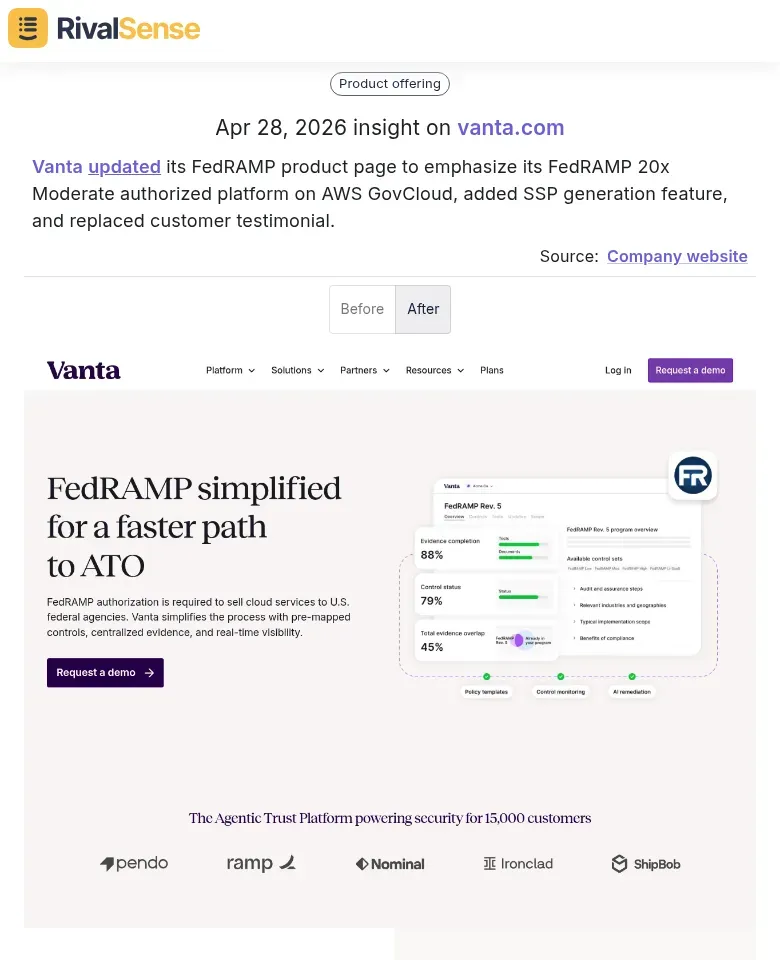
Product & Compliance Updates – Knowledge that a competitor has updated its compliance certifications can directly impact your value proposition in regulated industries. For instance, RivalSense spotted that Vanta updated its FedRAMP product page to emphasize its FedRAMP 20x Moderate authorized platform on AWS GovCloud, added an SSP generation feature, and replaced a customer testimonial. If one of your key accounts is in government or fintech, this signal could prompt you to highlight your own compliance strengths or renegotiate terms before they ask.
-
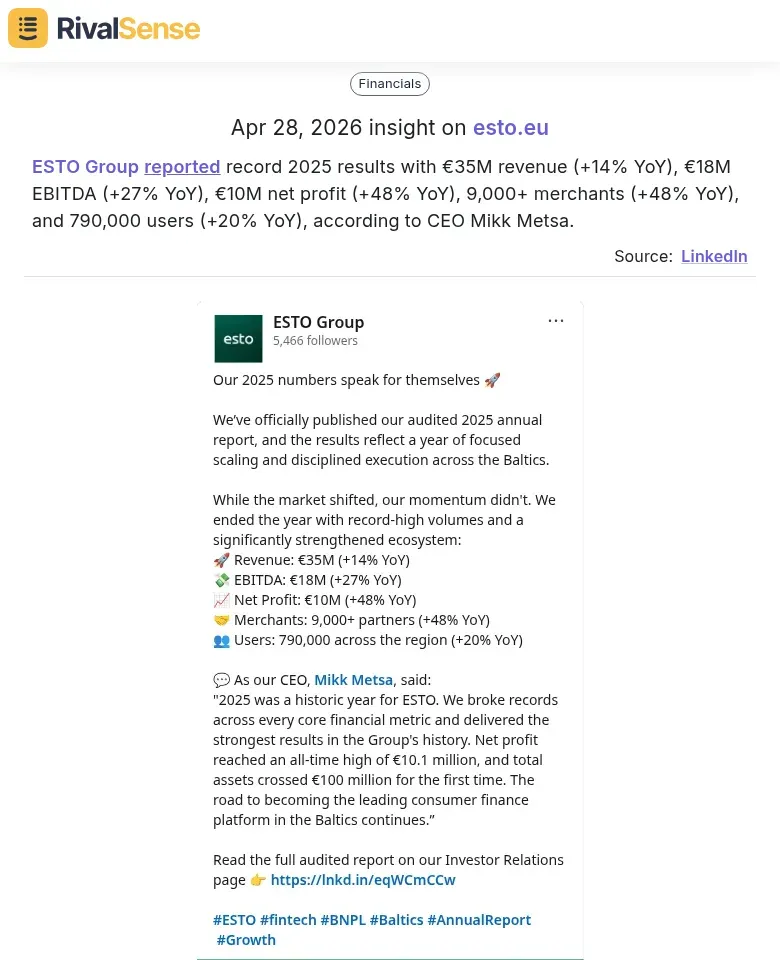
Financial Performance Signals – When a competitor reports record growth, it may indicate they are aggressively investing in sales or product—potentially targeting your key accounts. RivalSense detected that ESTO Group reported record 2025 results with €35M revenue (+14% YoY), €18M EBITDA (+27% YoY), €10M net profit (+48% YoY), 9,000+ merchants (+48% YoY), and 790,000 users (+20% YoY), according to CEO Mikk Metsa. This kind of financial health insight helps you anticipate competitive pricing moves or talent poaching risks.
-
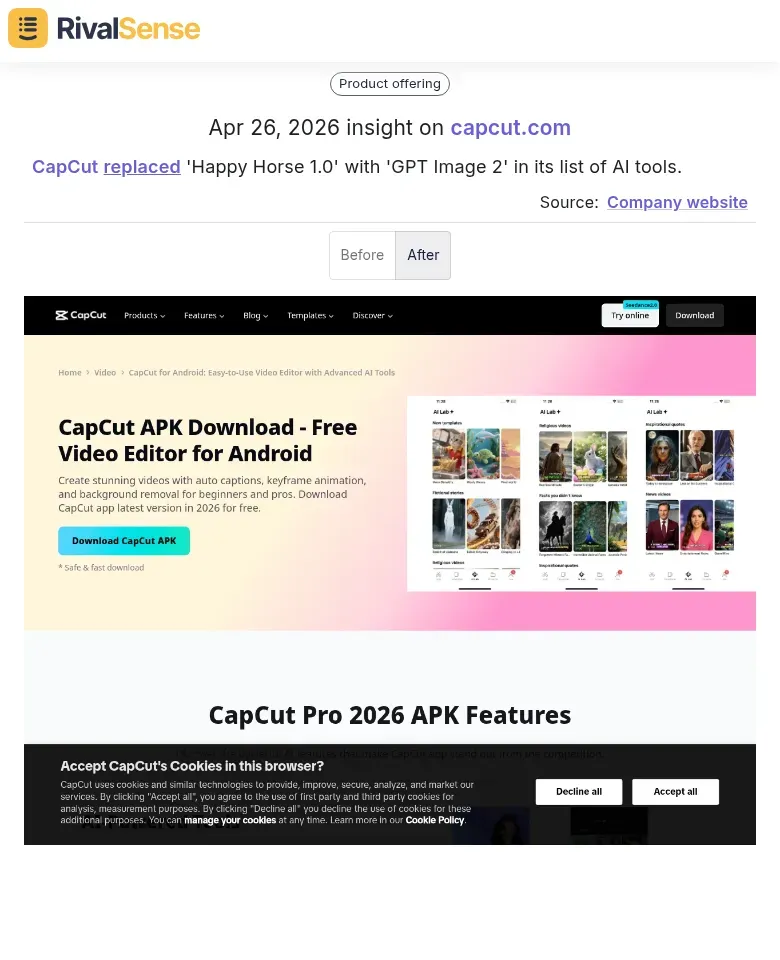
Product Feature Changes – A competitor tweaking their toolset can reveal strategic priorities or gaps. RivalSense noticed that CapCut replaced 'Happy Horse 1.0' with 'GPT Image 2' in its list of AI tools. While seemingly minor, such changes can indicate a shift in product focus that might affect your own feature roadmap or the way you position against them in key account conversations.
By integrating competitive intelligence into your contract tracking workflow, you can proactively address threats and seize opportunities—rather than reacting after a key account has already switched.
Try RivalSense free and see what your competitors are doing—while you get your own contract tracking in order. Get your first competitor report today: RivalSense.
Final Checklist for Tracking Key Account Contracts
- [ ] Centralized repository with full-text search
- [ ] 3–5 KPIs defined and measured monthly
- [ ] Automated renewal reminders (90/60/30 days)
- [ ] Obligation tracking with assigned owners
- [ ] Monthly review cadence with stakeholders
- [ ] Integration between contract data and CRM
- [ ] Competitive monitoring in place (via RivalSense)
Tracking key account contracts doesn't have to be overwhelming. Start with one or two steps from this guide, build momentum, and scale from there. Your revenue—and your key accounts—will thank you.
📚 Read more
👉 Unlock Growth: 5 Data-Driven Benefits of Competitor Analysis
👉 How One Price Shift Revealed a Competitor's Summer Strategy (and How You Can Do the Same)
👉 Track Competitor Website Changes: A Step-by-Step Guide
👉 Uncover Key Account Opportunities in Grocery Retail with Data-Driven Insights
👉 Unlock Growth: Track Key Account Feedback for Smarter Partnerships