
Track Competitor Financials & M&A to Boost Customer Satisfaction
Customer satisfaction isn’t just about your product—it’s shaped by your competitors’ stability and innovation. When a rival secures funding, acquires a key technology, or reports strong earnings, it signals strategic priorities that can directly impact product quality, support responsiveness, and long-term reliability. Conversely, financial distress or a failed merger often leads to service cuts, price hikes, or feature deprecation that affects your customers’ experience.
Tracking these signals helps you anticipate shifts before they hit the market. For example, if a competitor acquires a customer analytics startup, expect a surge in personalization features—prompting you to double down on your own UX improvements. If they report declining cash reserves, they may slash support staff, creating an opportunity for you to highlight your superior service.
Practical steps:
- ✅ Set up alerts for earnings calls, SEC filings, and M&A announcements of your top 3 competitors.
- ✅ Create a simple scorecard: track cash position, R&D spend, and recent acquisitions quarterly.
- ✅ Map each signal to a potential customer impact (e.g., new feature → need to update your roadmap; layoffs → opportunity to win disgruntled users).
- ✅ Share insights with your product and support teams weekly to align strategy.
By proactively monitoring financial and M&A moves, you turn competitor intelligence into a customer retention tool—keeping your experience one step ahead.
🔍 Decoding Funding Announcements: What a Series B Tells You About Product Evolution
When a competitor announces a Series B, it’s not just a financial milestone—it’s a signal of imminent product evolution. Here’s how to decode the announcement and use it to improve your own customer satisfaction.
1. Watch for positioning shifts. A new round often comes with refreshed messaging. Compare their homepage tagline, category descriptors, and case studies before and after the announcement. A shift from “project management for teams” to “AI-driven workflow automation” hints at a new target audience or feature focus.
2. Map capital to features. Series B funds typically fuel engineering hires and product expansion. Monitor their changelog, beta programs, and job postings for roles like “Senior Product Manager, AI” or “Integration Engineer.” If they’re building something you lack, prioritize similar capabilities.
3. Track value proposition reframes. Competitors may start emphasizing different benefits (e.g., speed over cost). This can reset market expectations. Survey your own customers to see if their priorities have shifted accordingly.
4. Create a funding tracker. Maintain a simple spreadsheet with columns: Company, Round, Amount, Date, Key Messaging Changes, New Features, and Customer Sentiment Impact. Review monthly to spot patterns.
✅ Real example from RivalSense:
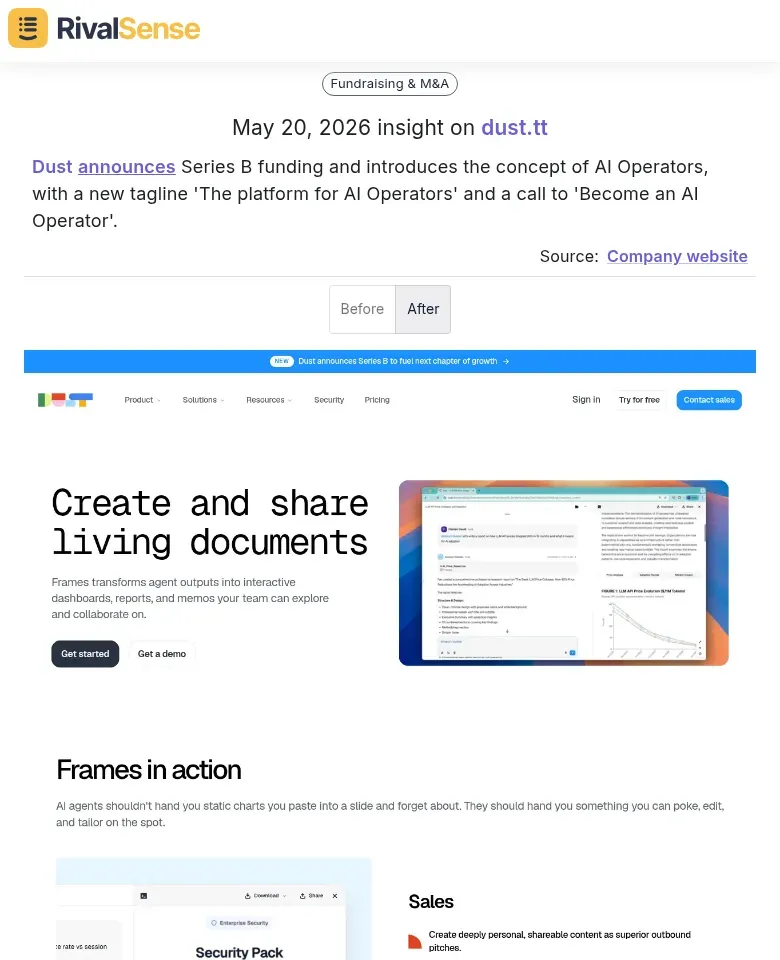
Dust announced a Series B funding and introduced the concept of "AI Operators," with a new tagline "The platform for AI Operators" and a call to "Become an AI Operator." This signals a major pivot—watch for new AI-powered features that could disrupt your market. By catching this early, you can adjust your own roadmap to stay ahead of customer expectations.
Practical tip: Set up Google Alerts for competitor names + “funding” or “Series [A/B/C].” When an alert fires, immediately archive their current website and marketing materials using a tool like Wayback Machine or a screenshot. This gives you a baseline to compare against future changes.
💰 Reading Financial Statements: Audited Results as a Trust Signal
Audited financial statements—especially those compliant with IFRS or GAAP—are a powerful trust signal. They indicate that a competitor is transparent, operationally mature, and subject to external scrutiny. For B2B buyers, this translates into confidence: a financially healthy vendor is more likely to invest in customer support, maintain long product roadmaps, and minimize churn risk.
How to use this insight:
- Benchmark stability. Compare your own financial metrics (revenue growth, EBITDA margins, cash reserves) against competitors’ audited reports. If you’re stronger, highlight this in sales conversations. If weaker, identify areas to improve.
- Reassure customers. Share relevant financial highlights (e.g., “We’ve grown 30% YoY and maintain a debt-free balance sheet”) in your marketing materials and pitch decks.
- Monitor red flags. Watch for declining revenues, rising debt, or going-concern warnings in competitors’ filings—these often precede service degradation or product cuts.
✅ Real example from RivalSense:
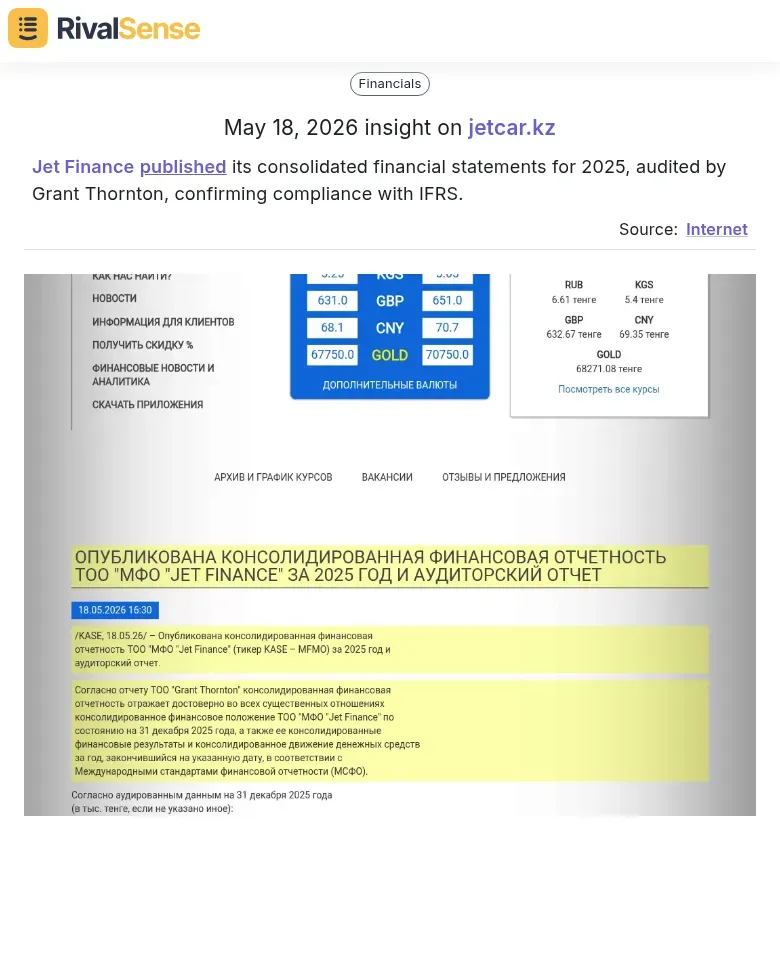
Jet Finance published its consolidated financial statements for 2025, audited by Grant Thornton, confirming compliance with IFRS. This transparency builds trust with enterprise buyers. Use it to benchmark your own financial practices and reassure your customers about your stability.
Practical steps:
- Set up alerts for competitors’ annual reports (SEC EDGAR, Companies House, or local registries).
- Create a simple dashboard tracking key ratios (current ratio, debt-to-equity, gross margin) over time.
- Use findings to adjust your own strategy: if a rival is cutting R&D spend, double down on innovation to capture disgruntled customers.
🚀 Leadership Moves and New Funds: Strategic Direction from Executive Changes
Leadership changes often reveal more than just internal restructuring—they signal where the market is heading. When a former executive from a competitor launches a new venture or fund, it’s a strong indicator of emerging technology trends and talent flows. For example, if a VP of Product from a leading SaaS company starts a fund focused on AI-driven analytics, expect that area to heat up. Similarly, when industry veterans take advisory roles at a competitor, it validates their strategic direction and can hint at upcoming pivots.
✅ Real example from RivalSense:

Former Cato Networks executive Yyovel leads Skinos Ventures' $26M debut fund for AI-driven cybersecurity startups, with Shlomo Kramer as strategic advisor and investor. This signals a surge of capital into AI cybersecurity—your customers may soon expect AI-powered security features. Track such moves to stay ahead of industry shifts.
Practical steps:
- Track where top talent goes using LinkedIn alerts and Crunchbase.
- Create a “leadership moves” tracker in your competitive intelligence tool, noting exits, new roles, and advisory positions.
- Map these moves to potential disruptions: a CTO leaving for a stealth startup might mean a new architecture is coming.
- Set up monthly reviews of these changes and discuss with your product team how they could affect your roadmap.
Pro tip: Use a simple spreadsheet to log each move, the executive’s expertise, and the likely impact on your market. This practice turns executive churn into actionable foresight, helping you anticipate next-generation solutions before they disrupt your customer satisfaction efforts.
🔗 Connecting the Dots: How to Turn Competitive Insights into Customer Delight
To turn competitive insights into customer delight, start by synthesizing financial, funding, and leadership signals. For example, if a competitor raises a large Series B, they’ll likely ramp up hiring and product launches. Use a simple signal tracker:
Signal Tracker Checklist
- [ ] Funding rounds (amount, lead investor, use of funds)
- [ ] Leadership hires (VP of Sales, CTO, etc.)
- [ ] Patent filings or new product announcements
- [ ] Pricing changes or trial offers
Next, proactively adjust your roadmap. If a competitor slashes prices, don’t just match—add a feature they lack. If they hire a support-heavy team, invest in self-service tools and proactive outreach.
Finally, communicate your stability. Send a brief email to customers: “While others pivot, we’re investing in [feature] to ensure you get [benefit].” Or share a quarterly “Competitive Landscape Update” that highlights your unique strengths. This turns intelligence into trust, showing customers you’re ahead of the curve—not reacting to it.
🏁 Conclusion: Building a Systematic Competitive Intelligence Practice
Building a systematic competitive intelligence (CI) practice doesn't require a massive budget—just the right process and tools. Start by setting up automated monitoring for competitor financials, funding announcements, and executive changes. Tools like RivalSense can track these signals daily, flagging material changes. Next, create a cross-functional CI process: designate a CI champion in product, support, and marketing to review and distribute insights weekly. For example, when a competitor raises a large round, your product team can prioritize features that address their likely expansion areas, while support prepares responses to customer concerns. Use a shared dashboard to log signals and action items. Finally, shift from reactive to proactive: instead of only responding to competitor moves, use insights to anticipate customer needs. If a competitor cuts a feature, proactively reach out to their dissatisfied customers with a better solution.
Simple checklist to get started:
- ✅ Set up automated alerts for financials and M&A.
- ✅ Schedule weekly 30-minute CI syncs across teams.
- ✅ Maintain a living “competitor playbook” with response templates.
- ✅ Review customer churn data alongside competitor news to spot patterns.
By making CI a habit, you'll turn every competitor signal into an opportunity to delight your customers. Ready to start tracking? Try RivalSense for free and get your first competitor report today.
📚 Read more
👉 The Hidden Benefits of Win-Loss Analysis Against Competitors (And How to Start Today)
👉 Predicting Competitor Pricing Shifts in Industrial Machinery Maintenance
👉 How RivalSense Revealed Smartpress's Label Expansion Before Competitors