
Key Account Tracking Framework for Travel Industry Growth
Introduction: Why Travel Companies Need a Key Account Tracking Framework
The travel industry moves fast—new routes, pricing changes, loyalty program updates, and shifting consumer preferences emerge daily. Reactive monitoring leaves you scrambling. A Key Account Tracking Framework turns competitive intelligence into a proactive advantage by systematically monitoring three signal types: product signals (new services, partnerships, tech investments), content signals (blog posts, social campaigns, SEO strategies), and behavioral signals (pricing patterns, booking flow changes, customer review responses).
✅ Practical first step: Identify 5–10 key competitors or travel brands you admire. For each, set up alerts for product launches, content updates, and behavioral shifts (e.g., price drops, new cancellation policies). Use a simple spreadsheet or a tool like RivalSense to log changes weekly. Within a month, you’ll spot trends before they become industry headlines—and pivot your strategy faster.
Tracking Product Innovations: From Price Alerts to Predictive Tools
To stay ahead in travel, track product innovations that solve core customer pain points like price volatility. Monitor competitor feature launches—e.g., price alerts, fare predictions, or flexible booking options. Use tools like RivalSense to get notified of new features and analyze their messaging.
Practical Steps:
- 🔔 Set up alerts for competitor product pages and changelogs.
- 📂 Categorize features by pain point (e.g., price uncertainty, cancellation fear).
- ⭐ Evaluate adoption via reviews or social media buzz.
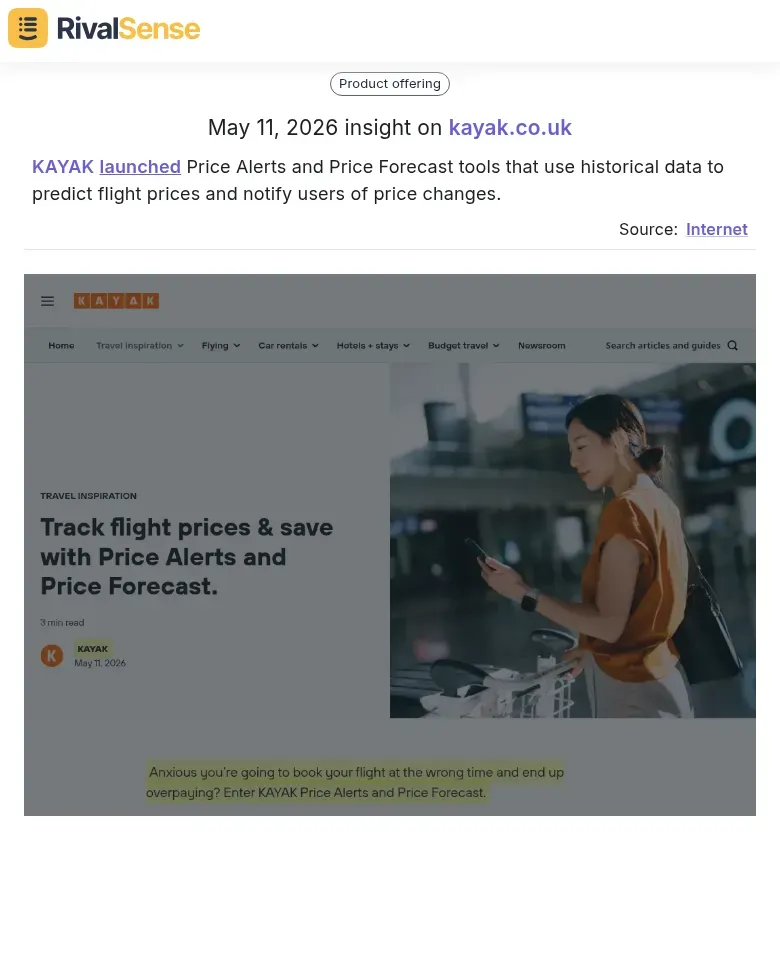
For example, RivalSense recently tracked that KAYAK launched Price Alerts and Price Forecast tools that use historical data to predict flight prices and notify users of price changes. This type of product insight is valuable because it reveals how competitors are building trust and reducing friction—giving you a blueprint to prioritize your own feature roadmap. If you can spot such launches early, you can react with targeted countermeasures or adopt similar capabilities faster.
Predictive tools use historical data to build trust and loyalty. Analyze how competitors communicate accuracy—do they show confidence scores or money-back guarantees? Identify gaps: Can you offer a novel twist, like combining price predictions with weather or event data?
Checklist for Differentiation:
- [ ] Map competitor features to your customer’s journey.
- [ ] Brainstorm 3 alternative solutions to the same problem.
- [ ] Test a minimal viable feature with a small user segment.
By systematically tracking innovations, you can spot opportunities to solve familiar problems in unexpected ways, driving differentiation and growth.
Mining Content for Strategic Signals: Reports, Research, and Thought Leadership
To extract strategic signals from travel industry content, start by systematically analyzing published reports, surveys, and thought leadership. Create a competitive intelligence grid that tracks key metrics like customer satisfaction scores, sustainability investments, and emerging destination preferences. For example, if multiple competitors highlight a shift from traditional tourism to natural wonders (e.g., ecotourism in Costa Rica or astrotourism in Chile), this signals a market pivot you can validate with your own data.
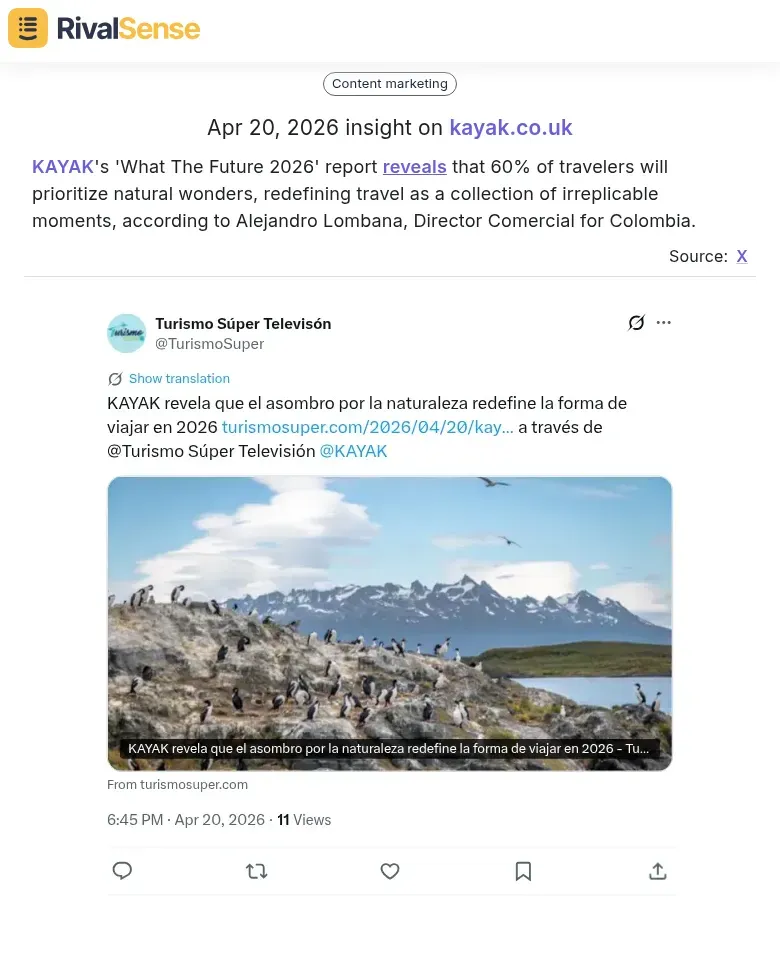
RivalSense spotted a powerful signal when KAYAK’s 'What The Future 2026' report revealed that 60% of travelers will prioritize natural wonders, redefining travel as a collection of irreplicable moments (according to Alejandro Lombana, Director Comercial for Colombia). Tracking report insights like this is valuable because they reveal where the entire industry is heading—not just one competitor. You can use such data to reposition your own brand, adjust content strategy, or develop partnerships around emerging preferences.
Practical Steps:
- 🔍 Set up alerts for competitor reports and industry surveys (e.g., Skift, Phocuswright).
- 🏷️ Categorize themes using a taxonomy: customer priorities, technology adoption, regulatory changes, sustainability.
- 📈 Identify shifts by comparing year-over-year mentions. If “experiential travel” rises 40% while “luxury resorts” drops, anticipate repositioning.
- 🧩 Map content to strategy: When a competitor publishes a white paper on “regenerative tourism,” they may be testing messaging for a new product line.
Checklist for Analysis:
- [ ] Track 3-5 key competitors’ published reports quarterly.
- [ ] Note changes in language (e.g., “sustainable” → “net-positive”).
- [ ] Cross-reference with customer reviews to validate priority shifts.
Use these signals to adjust your own messaging before competitors fully commit to a new direction.
Decoding Behavioral Trends: What Customer Data Reveals About Future Demand
To decode behavioral trends, start by segmenting customer data by demographics. Gen Z, for instance, prioritizes experiences over possessions—track their engagement with adventure packages, local immersion, and 'Instagrammable' moments. Use social media listening tools to monitor hashtags, shares, and comments as leading indicators of emerging demand. A spike in mentions of 'solo female travel' or 'digital nomad visas' signals a shift worth investigating.
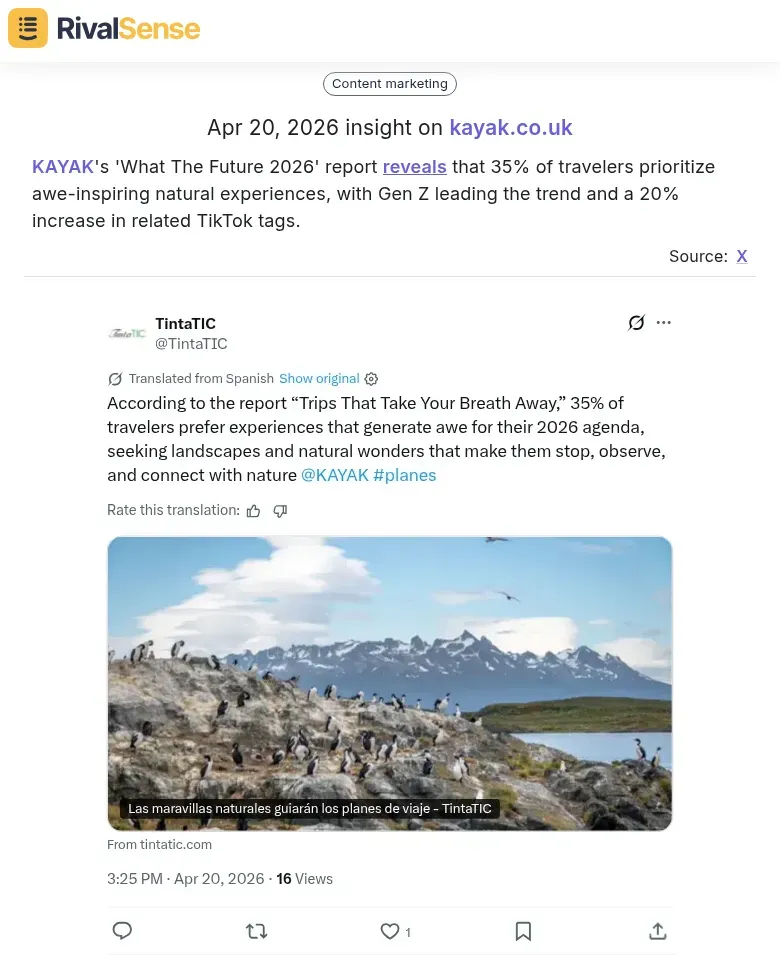
A concrete example from RivalSense: KAYAK's 'What The Future 2026' report reveals that 35% of travelers prioritize awe-inspiring natural experiences, with Gen Z leading the trend and a 20% increase in related TikTok tags. This type of behavioral insight helps you validate demand shifts early. If you see Gen Z driving a trend on social platforms, you can create targeted campaigns, curate experiences, or adjust your SEO to capture that audience before competitors saturate the space.
Next, correlate behavioral data with your own product and content signals. If site visits for 'eco-lodges' rise alongside positive sentiment on sustainability posts, you have a validated trend. Create a simple dashboard: track search queries, booking patterns, and content engagement side-by-side. For example, a 20% increase in searches for 'off-grid cabins' paired with a 15% click-through on related blog posts suggests a concrete opportunity.
Practical steps:
- Set up demographic filters in your analytics (age, location, device).
- Use social listening tools (e.g., Brandwatch, Sprout Social) to track relevant keywords.
- Build a correlation matrix comparing behavioral metrics (page views, time on site) with content performance (shares, comments).
- Review weekly to spot early signals before they become mainstream.
Checklist:
- [ ] Demographic segments defined
- [ ] Social media monitoring active
- [ ] Correlation dashboard live
- [ ] Weekly trend review scheduled
Building Your Own Framework: A Step-by-Step Guide
Step 1: Select Key Accounts & Define Signal Categories
- Choose 5–10 accounts that represent different travel segments (e.g., OTAs, airlines, hotel chains, travel tech).
- Define three signal categories:
- Product: new features, pricing changes, inventory expansions.
- Content: blog posts, social campaigns, SEO strategies.
- Behavior: hiring patterns, partnership announcements, funding news.
Step 2: Set Up Monitoring Tools & Cadence
- Use tools like RivalSense for automated tracking, Google Alerts for brand mentions, and BuiltWith for tech stack changes.
- Establish a weekly cadence: 30 min on Monday to review alerts, 15 min daily for quick scans.
- Create a shared dashboard (e.g., Notion, Airtable) to log signals with tags and priority levels.
Step 3: Analyze, Synthesize & Recommend
- Weekly: cluster signals into themes (e.g., “shift to direct bookings”).
- Monthly: write a 1-page synthesis with top 3 insights and their impact on your strategy.
- Actionable recommendation template: “Because [competitor] launched [feature], we should [action] by [deadline] to [goal].”
Pro Tips:
- Assign a signal owner for each account to ensure accountability.
- Review the framework quarterly: drop accounts that no longer provide insights, add emerging players.
- Always ask: “So what?” – turn every signal into a decision or experiment.
Conclusion: Turning Insights into Growth
In a fast-moving travel industry, reactive strategies leave you playing catch-up. The Key Account Tracking Framework transforms how you monitor competitors, partners, and market shifts—turning raw data into proactive decisions. By systematically tracking booking trends, pricing changes, loyalty program updates, and customer sentiment, you spot opportunities weeks before rivals do. Early detection of a competitor’s route expansion or a partner’s policy change gives you the lead to adjust offers, renegotiate terms, or launch counter-campaigns.
Your next steps:
- 🎯 Identify your top 5 key accounts (direct competitors, OTAs, hotel chains, airlines).
- 📡 Set up alerts for pricing, new routes, loyalty changes, and customer reviews.
- 🗓️ Schedule a weekly 30-minute review of insights with your team.
- 📝 Create a response playbook for common scenarios (e.g., price drop → bundle value-adds).
Start tracking today. Use tools like RivalSense to automate monitoring and get weekly digests. Try RivalSense free here and get your first competitor report today. The travel brands that win are those that act on intelligence—not just collect it. Turn insights into growth.
📚 Read more
👉 Track Competitor Financials & M&A to Boost Customer Satisfaction
👉 The Hidden Benefits of Win-Loss Analysis Against Competitors (And How to Start Today)
👉 Predicting Competitor Pricing Shifts in Industrial Machinery Maintenance
👉 How RivalSense Revealed Smartpress's Label Expansion Before Competitors