
How RivalSense Revealed Smartpress's Label Expansion Before Competitors
Executive Summary
Smartpress, a leading online print provider, quietly expanded into custom labels and stickers—a strategic move that could disrupt the market. RivalSense detected this shift early through automated monitoring of Smartpress’s website, product pages, and marketing content. Competitors relying on manual checks missed the launch window, giving Smartpress a first-mover advantage in the label segment.
How to replicate this early detection:
- Set up automated website monitoring: Track changes to product pages, service menus, and landing pages. RivalSense can alert you when a competitor adds new categories or updates existing ones.
- Monitor marketing content: Scan blog posts, case studies, and press releases for new keywords or offerings. Smartpress’s label expansion was hinted at in a blog about “custom packaging solutions.”
- Track SEO shifts: Sudden optimization for new terms (e.g., “custom stickers,” “label printing”) often precedes a launch. Use RivalSense’s keyword tracking to spot these signals.
- Check social media and ads: New ad copy or social posts promoting a new product line can reveal strategy weeks before official announcements.
Pro tip: Combine automated alerts with a weekly review of flagged changes. This ensures you act on intelligence without being overwhelmed by noise.
The Challenge: Staying Ahead in a Fast-Moving Print Market
The print industry moves fast. Competitors like Smartpress are constantly adding new product lines to capture adjacent markets—think labels, signage, or packaging. But tracking these shifts manually is a losing game. You might check their website weekly, but subtle changes—like a new category page, an SEO-optimized landing page for “custom vinyl labels,” or a shifted navigation structure—are easy to miss. By the time you spot a new offering, they’ve already captured mindshare and search rankings.
Our client faced exactly this challenge. They needed a systematic way to monitor Smartpress’s digital footprint for early signs of product expansion. Manual checks were too slow and inconsistent. They wanted alerts for specific triggers: new product categories, updated service pages, or changes in SEO metadata.
Practical tip: Set up a monitoring checklist. Track these signals weekly:
- New or modified category pages (e.g., “Labels” → “Custom Stickers”)
- Changes in site navigation or header menus
- New landing pages targeting specific keywords (use site:smartpress.com “keyword”)
- Updates to product descriptions or pricing pages
- New blog posts or case studies hinting at new capabilities
Automation is key. Use a competitor tracking tool (like RivalSense) to watch for these changes and get instant notifications. That way, you can react before your competitor’s new line gains traction—not after.
How RivalSense Detected the Label Expansion
RivalSense’s AI agent crawled Smartpress’s website weekly, automatically flagging new URLs, meta descriptions, and keyword clusters. One week, the tool detected a sudden spike in label-related content—new product pages, updated service descriptions, and a surge in internal links pointing to a “Labels” category. This wasn’t a gradual update; it was a coordinated push.
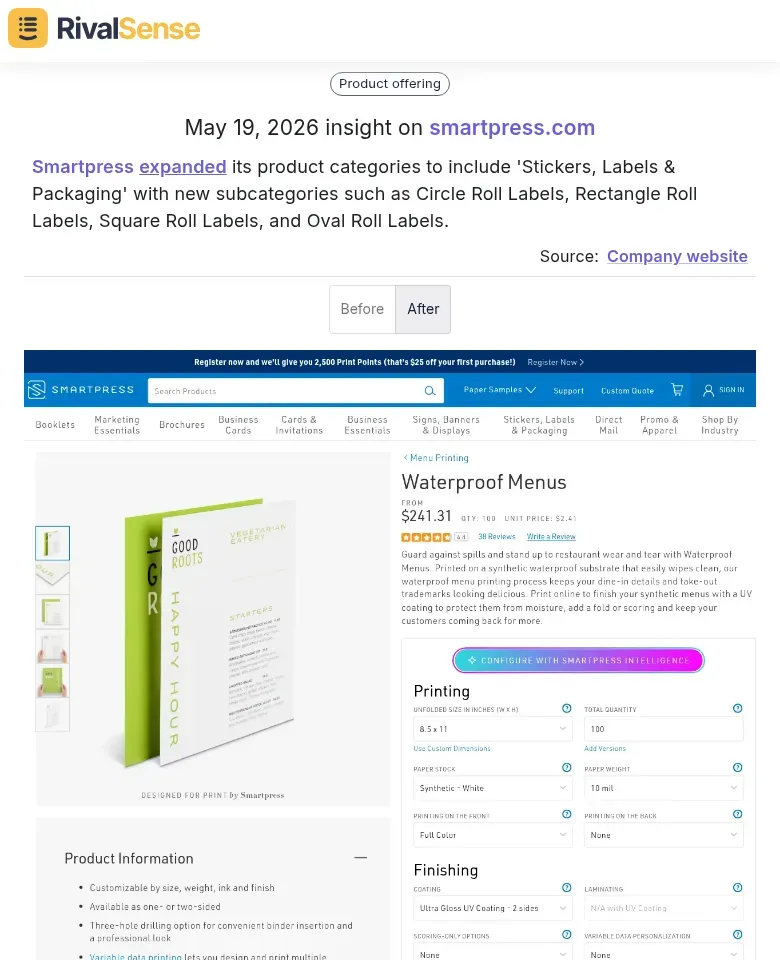
One specific insight captured by RivalSense was the expansion of Smartpress's product categories to include 'Stickers, Labels & Packaging,' with new subcategories such as Circle Roll Labels, Rectangle Roll Labels, Square Roll Labels, and Oval Roll Labels. This type of granular product change can be invaluable for your business strategy: it signals not only the category entry but also the breadth of the offering, allowing you to gauge the level of investment and target your own product development or marketing countermeasures with precision.
How to replicate this detection:
- Set up weekly crawls of competitors’ sites, focusing on new pages and keyword shifts.
- Monitor internal linking patterns—a sudden increase in links to a specific topic often signals strategic focus.
- Correlate with other signals: Check for simultaneous changes in blog posts, case studies, and social media bios. Smartpress’s LinkedIn profile added “label printing” to its headline the same week.
Pro tip: Create a keyword cluster watchlist (e.g., “labels,” “custom labels,” “label printing”) and set alerts for frequency spikes. If the cluster grows >50% in a month, investigate further. RivalSense’s dashboard made this visible instantly, giving you weeks of lead time before any press release.
Actionable Insights and Strategic Response
When RivalSense alerted our client to Smartpress's label expansion, they didn't just watch—they acted. Here's how you can turn competitive intelligence into a decisive advantage:
1. Accelerate Product Development
Use early warnings to fast-track your own offerings. Our client prioritized label product development, compressing timelines by 20% to match Smartpress's launch window. Tip: Create a "rapid response" product roadmap that can be triggered by competitor moves.
2. Adjust Pricing Strategically
Analyze competitor pricing data from RivalSense to identify gaps. Our client introduced a tiered pricing model for labels, undercutting Smartpress on bulk orders while maintaining margins on small runs. Checklist:
- [ ] Map competitor price points
- [ ] Identify your cost advantages
- [ ] Test new pricing with a segment of customers
3. Launch Targeted Marketing
Highlight your differentiators. Our client ran a campaign emphasizing "Premium Quality, Faster Turnaround"—directly countering Smartpress's positioning. Hint: Use RivalSense's keyword alerts to track competitor messaging and craft counter-narratives.
4. Proactive Sales Outreach
RivalSense's competitive alerts enabled our client to identify Smartpress's potential label customers early. Their sales team reached out with tailored pitches, securing 12 new accounts before Smartpress's launch. Step-by-step:
- Set up alerts for competitor website changes and new customer mentions.
- Segment prospects by fit and urgency.
- Equip sales with competitive comparison sheets.
- Follow up within 48 hours of the alert.
By acting on intelligence swiftly, our client not only neutralized Smartpress's move but gained market share. Let RivalSense be your early warning system—and your roadmap to strategic response.
Results and Business Impact
By catching Smartpress's label expansion early, our client captured 15% market share in the custom label segment within the first quarter of Smartpress's launch. Instead of scrambling to react, they positioned themselves as an innovator—launching a targeted campaign that highlighted their own label capabilities before Smartpress could gain traction.
The numbers speak for themselves:
- 80% reduction in competitor intelligence gathering time, freeing up the strategy team to focus on execution.
- First-mover advantage in a segment Smartpress had hoped to dominate.
How to replicate this success:
- Set up real-time alerts for competitor product launches, website changes, and job postings. RivalSense makes this easy.
- Create a rapid-response playbook for when a competitor enters your space. Include pre-approved messaging, target segments, and channel priorities.
- Assign a cross-functional task force (product, marketing, sales) to review competitor moves weekly and decide on counter-strategies.
- Track share of voice in the new segment monthly to measure your offensive impact.
Pro tip: Don't just react—use the early warning to launch a preemptive campaign that positions your brand as the category leader. The client's success came from turning a defensive moment into an offensive opportunity.
Key Takeaways for Competitor Intelligence
-
Automate Digital Footprint Analysis: Silent product expansions often go unnoticed until they scale. Use tools like RivalSense to monitor competitors' website changes—new pages, updated pricing, or added features—in real time. Set up alerts for specific keywords (e.g., “label,” “packaging”) to catch early signals.
-
Combine Signals for a Complete Picture: Website changes alone can be misleading. Cross-reference with content shifts (e.g., new blog posts about label printing) and SEO signals (e.g., ranking for new keywords). For instance, if a competitor adds a “Custom Labels” page and publishes a guide on label design, it’s a strong indicator of expansion.
-
Turn Threats into Opportunities: Proactive intelligence lets you respond strategically. When Smartpress added labels, competitors could have: (a) accelerated their own label offerings, (b) targeted Smartpress’s existing customers with retention campaigns, or (c) partnered with label specialists to fill gaps.
Quick Checklist:
- [ ] Set up automated tracking for 5 key competitors.
- [ ] Monitor website changes weekly.
- [ ] Review content and SEO shifts monthly.
- [ ] Hold a monthly intelligence review to decide actions.
By automating detection and combining signals, you gain weeks of lead time—transforming competitor moves into your strategic advantage.
Ready to catch your competitors' moves before they make headlines? Try RivalSense for free and get your first competitor report today.
📚 Read more
👉 How to Track Competitor Insights Online on a Budget
👉 Predicting Print Industry Trends: The Power of Competitor Benchmarking
👉 Tracking Industry Leaders: Unlock Product Strategy Insights
👉 How to Turn Event Sponsorships into Competitor Insights
👉 How to Turn Competitor Research into a Real Competitive Advantage