
Predicting Competitor Pricing Shifts in Industrial Machinery Maintenance
In industrial machinery maintenance, a sudden competitor price drop can erode margins by 15–20% overnight, while an unexpected hike might cause you to lose key contracts. Reactive pricing—scrambling to match cuts or justifying increases after the fact—leaves you perpetually behind. The financial impact is stark: missed revenue, strained customer relationships, and reactive discounting that devalues your services.
Predictive intelligence flips the script. Instead of reacting, you anticipate. By analyzing market signals—supply chain shifts, service bulletin frequency, or competitor hiring patterns—you can forecast pricing moves 4–6 weeks in advance.
Practical steps to start:
- Track leading indicators: Monitor competitor job postings (e.g., surge in maintenance tech hires often precedes service expansion).
- Analyze historical patterns: Map past price changes against events like trade shows or regulatory updates.
- Build a pricing response playbook: Define thresholds (e.g., if competitor drops >10%, trigger value-add bundling, not price matching).
Tip: Use a simple traffic-light system—green (no action), yellow (monitor), red (activate playbook)—to operationalize alerts without overreacting.
With predictive intelligence, you move from firefighting to strategic positioning, turning pricing surprises into opportunities for differentiation.
Key Drivers of Pricing Shifts in the Industrial Sector
Pricing in industrial machinery maintenance doesn't shift randomly—it's driven by three key forces. Understanding them helps you anticipate competitor moves before they happen.
1. Raw Material & Supply Chain Volatility
When steel, copper, or semiconductor prices spike, maintenance costs follow. Track commodity indices (e.g., LME copper) and supplier lead times. Tip: Set up Google Alerts for key raw materials and monitor your suppliers' public earnings calls for cost warnings.
2. Tech Advancements (IoT & Predictive Maintenance)
As IoT sensors and AI-driven diagnostics reduce emergency repairs, service providers may either lower prices (to win volume) or premium-price predictive contracts. Action: Audit your competitors' service offerings—do they now include remote monitoring? That signals a shift toward value-based pricing.
3. Regulatory Changes
New emissions standards or safety regulations force equipment upgrades, increasing maintenance complexity. Watch for EPA/OSHA updates and industry body announcements. Checklist: Review regulatory calendars quarterly; note compliance deadlines that could spike demand for specialized maintenance.
Proactive Step: Build a simple pricing signal dashboard with these three drivers. When two or more shift simultaneously, expect a competitor pricing move within 60–90 days.
Data Sources for Anticipating Competitor Moves
To anticipate competitor pricing shifts, leverage three key data sources. Public financial reports and earnings call transcripts reveal margin pressures or investment intentions—listen for mentions of 'cost optimization' or 'pricing power.' Patent filings and R&D investment patterns signal future capabilities; a spike in automation patents may precede service cost reductions. Customer reviews and job postings offer early signals: reviews complaining about high prices or job ads for pricing analysts suggest imminent changes.
Practical steps: Set up alerts for competitor earnings calls, monitor patent databases quarterly, and track review sentiment on G2 or Capterra. Checklist: ✅ Earnings transcripts scanned for pricing keywords. ✅ Patent filings reviewed for cost-reduction tech. ✅ Job postings analyzed for pricing roles. Tip: Combine signals—if a competitor files a cost-saving patent and posts pricing roles, a shift is likely within 6–12 months.
Real-World RivalSense Insights: What Competitor Intel Looks Like
Competitive intelligence isn't limited to industrial machinery. The same type of tracking can uncover moves in any B2B sector. Here are three examples from RivalSense that illustrate the breadth of data available:
1. Product updates: IPVanish VPN expands infrastructure
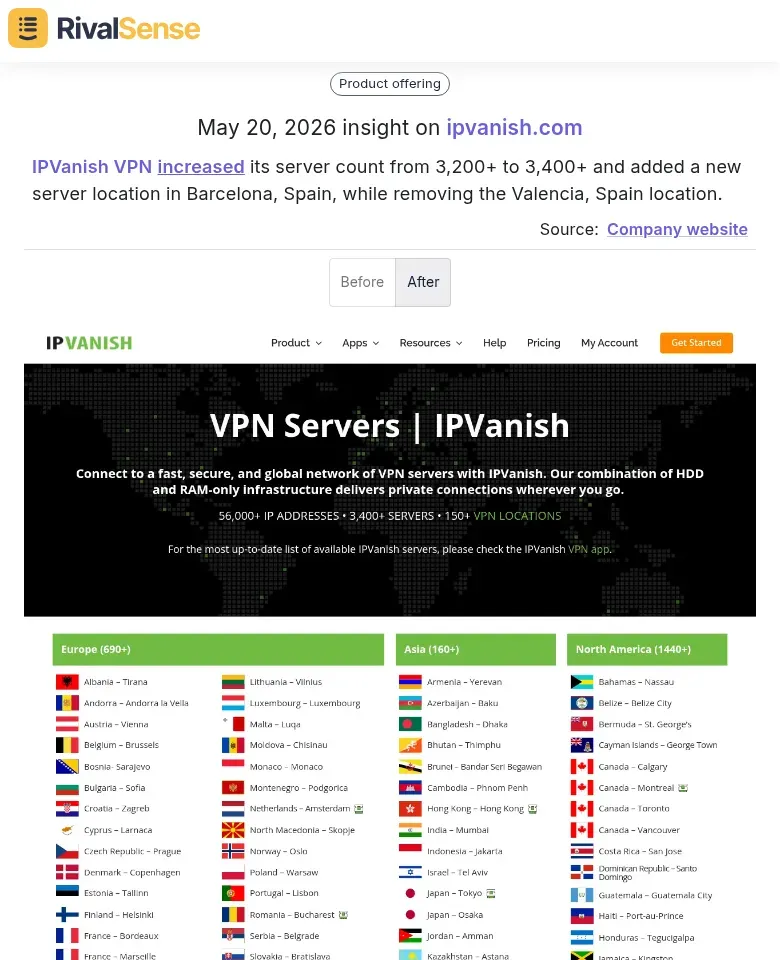
IPVanish VPN increased its server count from 3,200+ to 3,400+ and added a new server location in Barcelona, Spain, while removing the Valencia, Spain location. Why this matters: Tracking product updates like server counts and locations helps you gauge a competitor's capacity and geographic focus. In industrial maintenance, a competitor adding new service centers could signal expansion into your territory—often a prelude to price competition.
2. Partnerships: Gen's Norton LifeLock partners with DropQuote
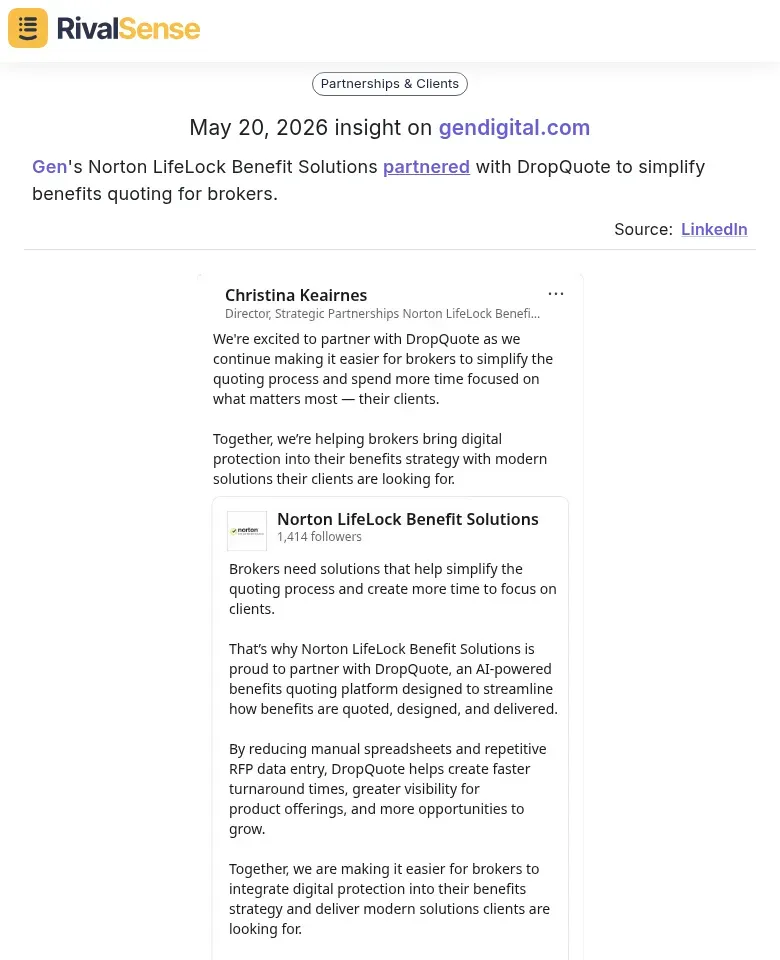
Gen's Norton LifeLock Benefit Solutions partnered with DropQuote to simplify benefits quoting for brokers. Why this matters: Partnerships reveal strategic priorities. A competitor teaming up with a quoting platform may be streamlining their sales process, hinting at a future price reduction to capture volume. For industrial firms, a partnership with a maintenance software provider could signal a shift toward bundled service offerings that undercut your standalone pricing.
3. Framework updates: Arcjet adds Python support
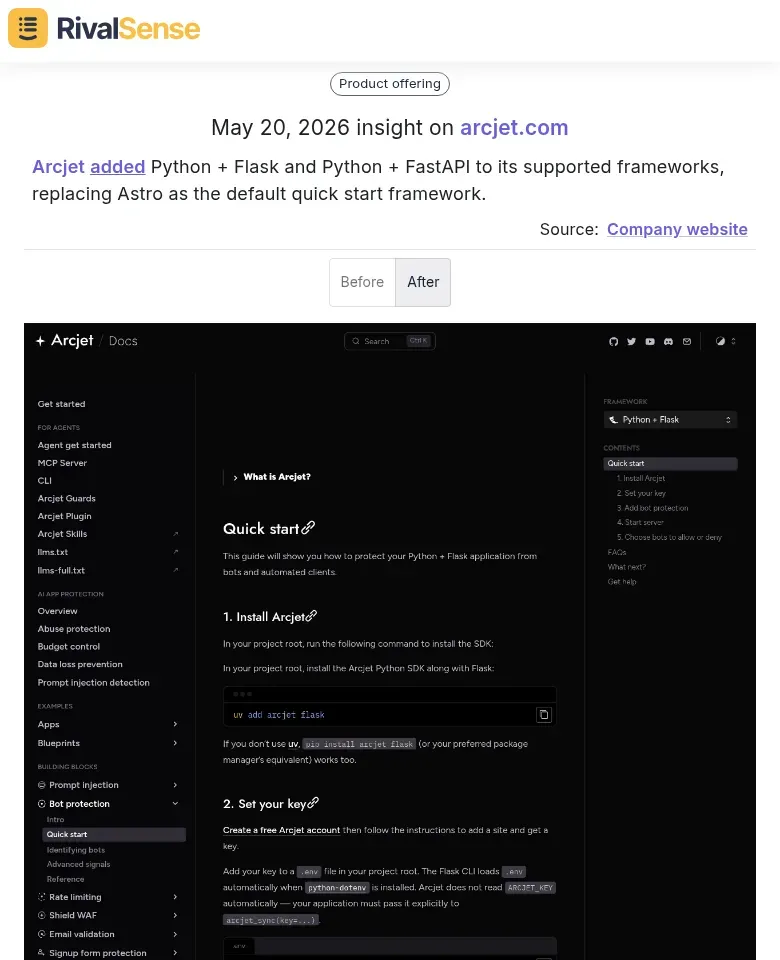
Arcjet added Python + Flask and Python + FastAPI to its supported frameworks, replacing Astro as the default quick start framework. Why this matters: Technology stack changes illustrate how competitors adapt to developer preferences. In industrial machinery, a competitor adding IoT integration support or predictive maintenance APIs could reduce their service costs, enabling them to lower prices while keeping margins.
These examples show that competitive intelligence captures a wide range of signals—product, partnership, and technology changes—all of which can foreshadow pricing moves. Using a tool like RivalSense automates this monitoring so you never miss a shift.
Analytical Frameworks to Predict Pricing Trends
To predict pricing shifts, combine three analytical frameworks. Price elasticity modeling quantifies how demand responds to price changes. Use historical data to calculate elasticity coefficients; if your product is elastic (coefficient >1), competitors are likelier to cut prices. Reverse-engineer competitor cost structures by analyzing public financials, supplier partnerships, and equipment specs. Estimate their raw material costs, labor, and R&D spend. For example, if a competitor recently invested in automation, their marginal costs dropped—signaling potential price cuts. Machine learning models (e.g., random forests or LSTMs) detect patterns in pricing behavior. Feed them historical prices, economic indicators, and competitor news. A practical step: start with a simple linear regression on your own pricing data to identify seasonality, then layer in competitor data. Checklist: 1) Collect 3+ years of pricing data. 2) Identify key cost drivers (steel, energy, labor). 3) Train a model on 80% of data, validate on 20%. Tip: monitor competitor job postings for clues about new cost-saving technologies.
Building an Early Warning System for Your Team
To stay ahead of competitor pricing shifts, build an early warning system that automates monitoring and integrates insights into your pricing workflows. Start by setting up automated alerts using tools like RivalSense or custom scrapers that track price changes on competitor websites, support pages, and marketplaces. Configure alerts for specific triggers—e.g., price drops of >5%, new discount codes, or changes in subscription tiers. Route these alerts to a shared Slack channel or email list so your team reacts in minutes, not days.
Next, embed competitive intelligence directly into your pricing strategy. Create a simple workflow: when an alert fires, a designated analyst validates the change (e.g., check if it's a permanent shift or a promotion), then updates a shared pricing dashboard. Use this data to run “what-if” scenarios—e.g., simulate the impact of matching a competitor's price on margin vs. volume. Document a decision tree: if competitor drops price by X%, consider offering a bundled service instead of a direct match.
Finally, align cross-functional teams. Hold a monthly “competitor pricing sync” with sales, marketing, and product. Sales shares frontline feedback (e.g., “lost deal to Competitor Y's lower annual plan”), marketing analyzes messaging shifts, and product assesses feature gaps. Use a shared CRM tag (e.g., “Competitor Price Alert”) to track opportunities influenced by pricing moves. This ensures everyone acts on the same intelligence, turning raw data into coordinated action.
Conclusion: Staying Ahead with Proactive Pricing Intelligence
Predicting competitor pricing shifts isn't just about reacting—it's about staying in control. By combining historical data analysis, market signals, and machine learning models, you can anticipate price changes before they happen. This proactive approach protects margins, strengthens customer retention, and positions your business as a market leader.
Actionable steps to implement a competitor pricing monitoring system:
- Identify key competitors – Focus on 5–10 direct rivals in industrial machinery maintenance.
- Set up automated tracking – Use tools like RivalSense to monitor pricing, promotions, and service bundles weekly.
- Define triggers – For example, a 5% price drop triggers a review of your own pricing strategy.
- Analyze patterns – Look for seasonal trends, product lifecycle stages, or competitor earnings announcements.
- Build a response playbook – Predefine actions: match, undercut, bundle, or add value.
Long-term benefits:
- Higher margins – Avoid unnecessary price wars.
- Faster decisions – Real-time alerts cut reaction time from weeks to hours.
- Stronger positioning – Use insights to differentiate on service, not just price.
Start small: pick one product line, track for 30 days, and refine. Continuous competitive pricing analysis turns uncertainty into a strategic advantage.
Ready to build your early warning system? Try RivalSense for free to get your first competitor report today and start anticipating pricing shifts before they impact your bottom line.
📚 Read more
👉 How RivalSense Revealed Smartpress's Label Expansion Before Competitors
👉 How to Track Competitor Insights Online on a Budget
👉 Predicting Print Industry Trends: The Power of Competitor Benchmarking
👉 Tracking Industry Leaders: Unlock Product Strategy Insights