
The Hidden Benefits of Win-Loss Analysis Against Competitors (And How to Start Today)
Your CRM says you lost on price. Your buyer says your rep never understood the problem. One of these is useful. The other is comfortable. Win-loss analysis—interviewing buyers after they make a purchase decision—is the single most underutilized competitive intelligence tool in B2B. It reveals not just who you lost to, but why the buyer chose them over you. And the gap between what your CRM tells you and what buyers actually say is where millions in revenue go to die.
Here’s how to use win-loss analysis to outmaneuver competitors—and how tools like RivalSense can fill the gaps when you can’t run a full interview program.
The Problem: Your CRM Is Lying to You
CRM disposition codes capture a single reason, reported by the seller, at the moment they are least motivated to be honest. Win-loss analysis captures 4–6 decision drivers per deal directly from the buyer. Research shows sellers and buyers disagree on loss reasons 50% to 70% of the time (Corporate Visions). In one study, the competitor tagged in CRM was wrong in roughly 70% of deals (Clozd).
Why reps get it wrong: After a six-month enterprise sales cycle ends in a loss, the rep has to diagnose their own defeat in a dropdown field. "Lost on price" is safe. "I never understood their actual requirements" is career suicide.
Why buyers lie: A procurement director who found your rep pushy and unprepared will not say that to your face. They offer "budget constraints" or "we went a different direction." Clozd calls this the breakup analogy: "You ask your ex why they don't want to date you anymore, and they respond: 'Oh, it's not you, it's me.'"
The Business Case: What ROI Should You Expect?
Small improvements in win rates produce outsized revenue impact. A company with $10M in quarterly bookings and a 20% win rate that improves to 22% generates an additional $800K in annual bookings. Here are the numbers from leading research firms:
- Gartner: Companies with formal win-loss programs achieve 15%–30% revenue increases and up to 50% win rate improvement.
- CSO Insights: Average 14.2% win rate increase among consistent practitioners.
- Clozd: 84% of programs running longer than two years report measurable gains.
Caveat: Companies spending less than $10K/year on win-loss report no ROI 94.4% of the time. There’s a minimum investment threshold.
The Hidden Pipeline Killer: 40%–60% of Deals End in "No Decision"
Your biggest competitor is not another vendor. It is the status quo. Research by Matthew Dixon and Ted McKenna analyzed over 2.5 million recorded sales conversations and found that 40%–60% of deals end in "no decision." These no-decisions break into two categories:
- 56% stem from buyer indecision (fear of messing up)
- 44% reflect genuine status quo preference
CRM data records these as "timing" or "budget." Win-loss interviews reveal the actual mechanics: stakeholder disagreements nobody raised, unquantified switching costs, implementation anxiety the demo failed to address.
The JOLT framework for rescuing stalled deals:
- Judge whether the buyer is struggling with the status quo or paralyzed by fear
- Offer a recommendation instead of asking what they want
- Limit their exploration to prevent analysis paralysis
- Take risk off the table with opt-out clauses and phased rollouts
Price vs. Value: Is Price Really Why You Lost?
Probably not. User Intuition analyzed 10,247 buyer conversations and found that 62.3% of buyers cite price initially, but only 18.1% were actually driven by price. What "too expensive" actually masks:
- Value-price misalignment – The rep never built a credible ROI case.
- Hidden switching costs – Retraining staff, migrating data, disrupting operations.
- Pricing model friction – Rigid multi-year contracts vs. cash-flow preferences.
- Career risk disguised as budget – The buyer couldn't defend a less-established vendor internally.
The "Five Whys" technique: When a buyer says "better integrations," ask what specifically about integrations mattered. The actual decision driver is buried 3.8 follow-up levels deep on average.
What Win-Loss Interviews Consistently Reveal
- 53% of buyers say a losing vendor could have won if not for a fixable misstep (Corporate Visions).
- Companies win roughly half the time as the more expensive option (Primary Intelligence).
- In 85% of successful purchases, buyers had direct prior experience with the winning vendor (6sense).
- Most buyers form a preference before they ever talk to a sales rep.
Top loss drivers (User Intuition):
- Product gaps & implementation risk: 23.8%
- Sales execution & champion confidence failures: 21.3%
- Timing & urgency misalignment: 16.9%
- Competitive positioning gaps: 11.4%
- Trust & credibility concerns: 8.5%
- Pricing: 12%
How to Build a Win-Loss Program from Scratch
1. Choose the Right Owner
Product marketing is the consensus pick. Sales should never conduct the interviews—reps are biased, prospects won't be candid, and the conversation devolves into a re-sell attempt.
2. Select Which Deals to Analyze
- Establish a deal-size floor
- Focus on competitive deals and strategic segments
- Include no-decision outcomes
- Gather roughly equal numbers of wins and losses
- Aim for at least 20 interviews balanced across outcomes
3. Interview Within 14 Days When Possible
At 14 days, buyers provide detailed, multi-factor accounts. By 30 days, narratives compress. By 60 days, most buyers have reconstructed simplified stories.
4. Code and Categorize Findings
Use a consistent framework:
- Product and features
- Pricing and commercial terms
- Sales execution quality
- Implementation and support expectations
- Competitive positioning
- Timing and internal process dynamics
Pattern recognition begins around interview 9 or 10. Meaningful statistical confidence requires 15–20 interviews per segment per quarter.
5. Close the Feedback Loop
- Share individual deal summaries immediately
- Run monthly Voice of the Buyer briefs with specific action items
- Conduct quarterly deep-dives with cross-functional stakeholders
- Prioritize using: frequency × revenue impact × addressability
Win-Loss Analysis and Competitive Intelligence: Two Halves of the Same System
Win-loss analysis tells you which competitive factors actually influenced buyer decisions. Competitive intelligence tells you what your competitors are doing—pricing changes, product launches, hiring patterns, messaging shifts. Without win-loss data, competitive intelligence is guesswork. Without competitive intelligence, win-loss analysis has no context for interpreting buyer feedback.
67% of win-loss programs are co-managed with competitive intelligence (Pragmatic Institute, Clozd). Teams with fully integrated CI and win-loss functions are 2x more likely to report measurable business impact.
Real-World Competitive Insights That Inform Win-Loss Analysis
Win-loss interviews often surface competitor moves that buyers mention—but you need external data to validate and contextualize them. Here are three examples of how competitive intelligence from RivalSense can turn buyer anecdotes into strategic action:
🏛️ Legal & Regulatory Wins: Agorapulse vs. X
Agorapulse won a court case against X on May 7, 2026, with the Paris court ruling the API price hike disproportionate, ordering X to revert to the $49,000 monthly fee for 15 months and pay €50,000 in legal fees, saving Agorapulse over €3 million.
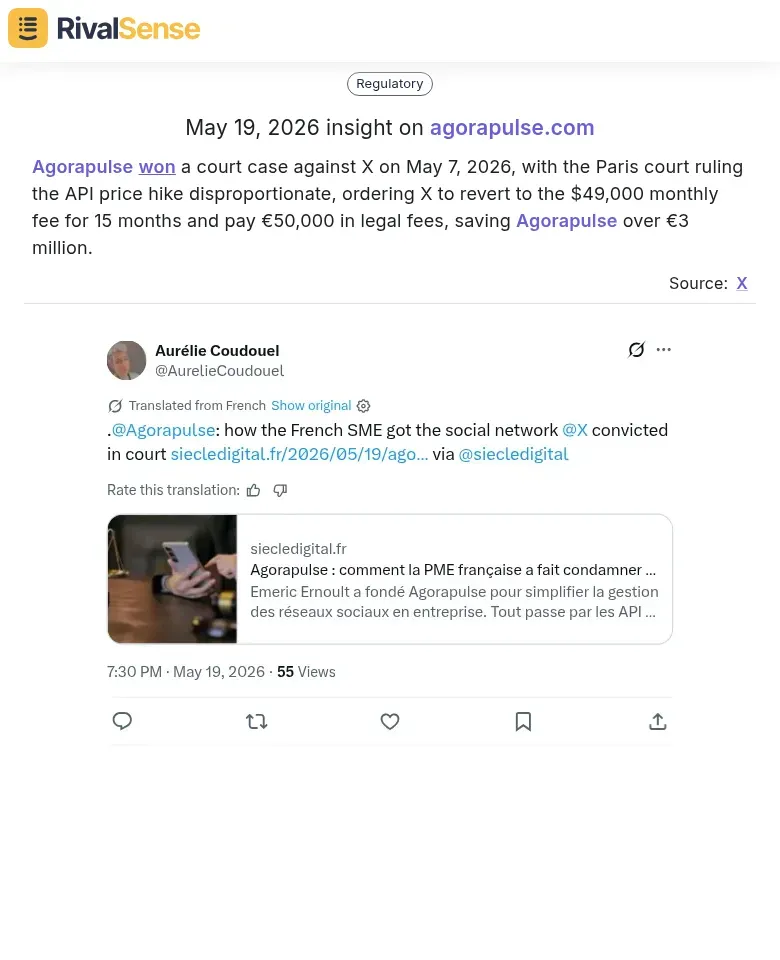
Why this matters for win-loss: If your buyers mention concerns about a competitor's pricing or legal risks, tracking court rulings and regulatory wins lets you arm your sales team with evidence that the competitor's business model is unstable. You can turn a vague "their API is expensive" into a concrete competitive advantage.
🎯 Product & Platform Pivots: Lasso
Lasso introduced expanded automated AI red teaming and renamed 'MCP Security' to 'MCP', while removing several platform capabilities and use cases including AI Model Risk Management, AI-SPM, AI Governance & Compliance, Data Loss Prevention, and Content Moderation.
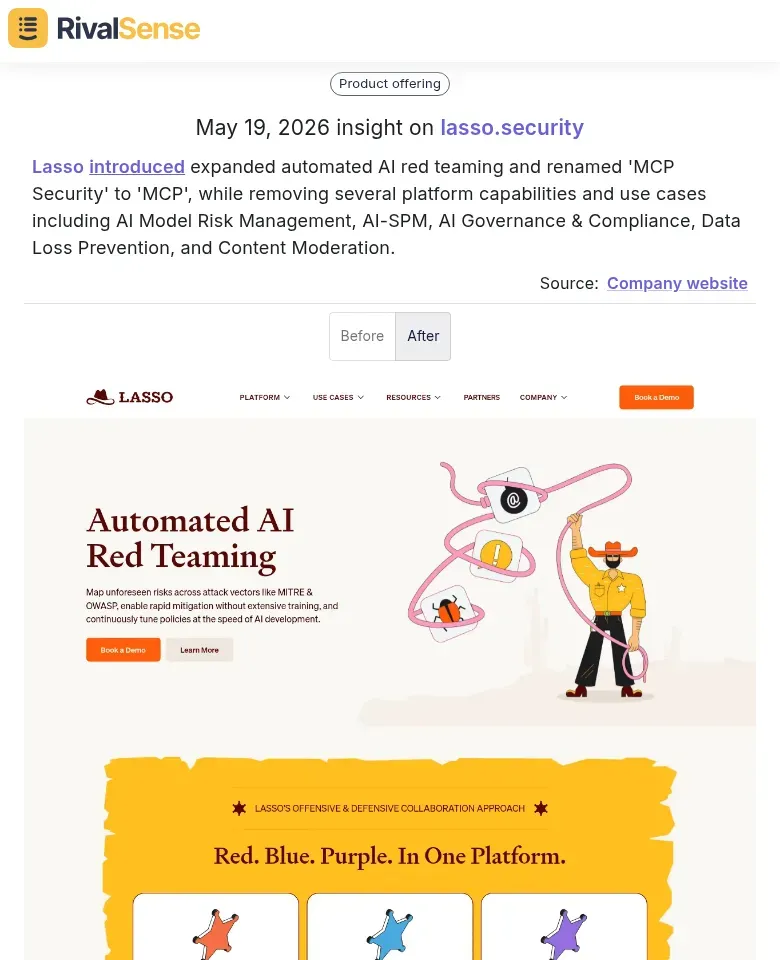
Why this matters for win-loss: When a competitor drops entire capabilities, it signals strategic retreat. Buyers who evaluated Lasso and chose you may now have second thoughts—or your win-loss interviews might reveal that Lasso's removed features were critical to their decision. Track product changes to adjust your positioning and re-engage lost prospects.
📋 Compliance & Framework Expansion: Vanta
Vanta expanded its framework mapping for the EU AI Act to support evidence reuse from ISO 42001, NIST AI RMF, CPS 234, and more.
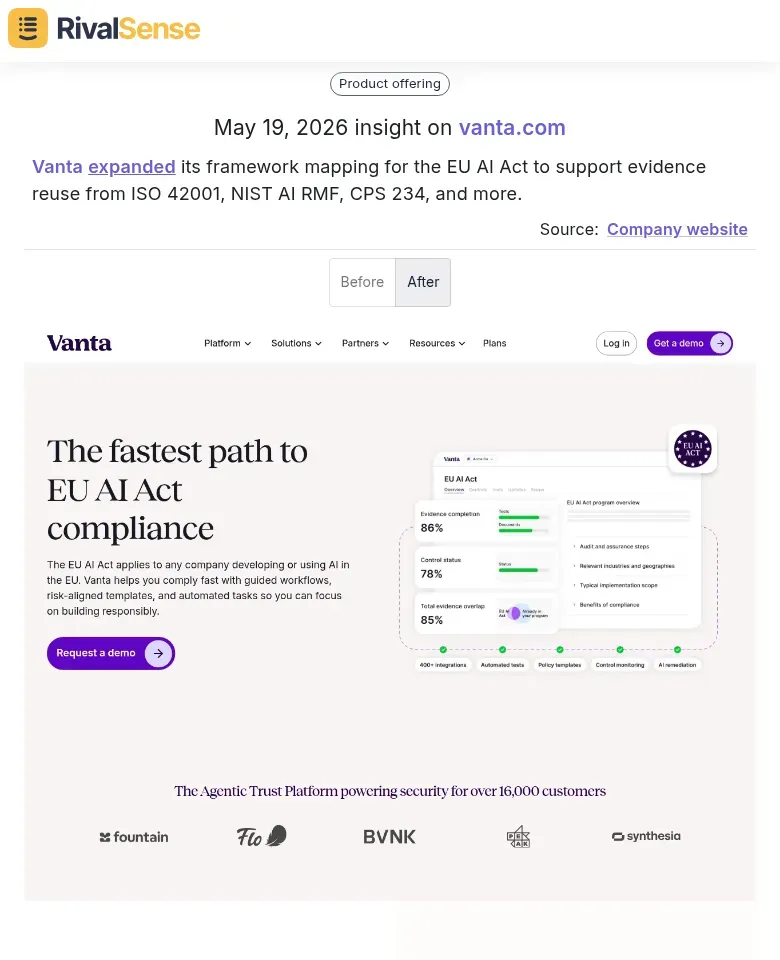
Why this matters for win-loss: If your win-loss data shows buyers chose Vanta because of compliance breadth, you now know exactly what feature gap to close. Real-time tracking of framework expansions helps you predict competitor roadmaps and prioritize your own compliance investments.
These insights come from RivalSense, which monitors 80+ sources—company websites, social media, registries—and delivers a weekly email report so you never miss a competitive move.
How RivalSense Fills the Gaps
Not every company can run a full win-loss interview program—especially at the $10K+ minimum investment that produces results. But you still need to know what your competitors are doing and how buyers perceive them. RivalSense tracks competitor product launches, pricing updates, event participations, partnerships, regulatory changes, management moves, and media mentions across 80+ sources—company websites, social media, internet, and registries. All delivered in a weekly email report.
This gives you the competitive intelligence half of the equation: real-time awareness of competitor moves. When you combine that with even a basic win-loss program (even 5–10 buyer calls per quarter), you get a complete picture:
- What competitors are doing (from RivalSense)
- Why it matters to buyers (from win-loss interviews)
For companies not ready for a full interview program, RivalSense surfaces buyer intelligence from public sources—review sites, social media discussions, forum threads—so you can start understanding buyer sentiment without a dedicated research budget.
Practical Checklist: Start Your Win-Loss Program This Week
| Step | Action | Time Estimate |
|---|---|---|
| 1 | Identify 5–10 lost deals from last quarter | 1 hour |
| 2 | Draft 8–12 interview questions (see below) | 2 hours |
| 3 | Assign a non-sales person to conduct interviews | 30 min |
| 4 | Schedule and conduct interviews (within 14 days of deal close) | 5–10 hours |
| 5 | Code findings into categories | 2 hours |
| 6 | Share insights with product, marketing, and sales teams | 1 hour |
| 7 | Set up RivalSense to track competitors mentioned in interviews | 15 min |
| 8 | Repeat monthly | Ongoing |
Sample Interview Questions:
- "What was happening in your organization that triggered this evaluation?"
- "At what point did you form a preference, and what shaped it?"
- "If you had to explain your final choice to a colleague not involved, what would you tell them?"
- "What would have needed to be different for the outcome to change?"
- "Was there anything that concerned you that you did NOT raise with any of the vendors?"
Common Questions
How many interviews do I need to see patterns?
Patterns begin around interview 9 or 10. For meaningful confidence, aim for 15–20 per quarter.
Should I do interviews in-house or outsource?
Outsourcing produces measurably better results—buyers share more honest feedback with neutral third parties. But DIY works below $15K annual budget or under 20 deals per quarter.
What's a good win rate?
Average B2B win rate is about 21% across all pipeline. Above 40% usually means under-qualification. Below 15% signals structural problems.
How does win-loss improve competitive intelligence?
It reveals which competitors buyers actually evaluated (CRM tags are wrong ~70% of the time), what capabilities tilted the decision, and where your positioning falls short.
Stop Guessing. Start Asking.
Your CRM data is a fiction. Your buyers know the truth. Win-loss analysis replaces that fiction with the buyer's actual experience. And when you pair it with real-time competitive tracking from RivalSense, you get a complete intelligence system: what competitors are doing, and why it matters to your buyers.
Try RivalSense for free today — get your first competitor report and start closing the intelligence gap.
📚 Read more
👉 Predicting Competitor Pricing Shifts in Industrial Machinery Maintenance
👉 How RivalSense Revealed Smartpress's Label Expansion Before Competitors
👉 How to Track Competitor Insights Online on a Budget
👉 Predicting Print Industry Trends: The Power of Competitor Benchmarking
👉 Tracking Industry Leaders: Unlock Product Strategy Insights