
The Ultimate Key Account Management Playbook: A 30-Day Plan to Retain & Grow Strategic Accounts
Key Account Management is a strategic approach to managing your most valuable customers. Unlike standard account management, KAM focuses on deep relationship building, long-term value creation, and proactive problem-solving. A Key Account Manager (KAM) acts as the bridge between the client and your organization, ensuring alignment, retention, and growth.
The Handoff: From Sales to Account Management
A clean handoff is the foundation of a successful relationship. Before Day 1, make sure you have:
- A handoff meeting with the sales rep to review the client’s history, pain points, and expectations.
- A complete client profile including decision-makers, budget, goals, and any red flags.
- An internal kickoff with your team (delivery, support, product) to align on roles and responsibilities.
Checklist for a Clean Handoff:
- [ ] Sales notes and call recordings shared
- [ ] Contract terms and deliverables clarified
- [ ] Stakeholder contact list with titles and influence level
- [ ] Any competitive intelligence gathered during the sales process
Week 1: Discovery & Relationship Building
Goal: Build trust and understand the client’s world.
| Day | Action |
|---|---|
| 1 | Send a welcome email with a clear onboarding timeline and agenda for your first meeting. |
| 2 | Conduct a discovery call with all key stakeholders. Ask open-ended questions about their goals, challenges, and what “success” looks like. |
| 3 | Map the client’s organizational structure and identify champions, influencers, and potential risks. |
| 4 | Review competitor activity that might affect the client’s market position. RivalSense can surface these shifts automatically. For example, a recent RivalSense alert revealed that UPrinting updated its product categories—adding Tabletop Banners, Plastic Signs, Magnets, Decals, A‑Frames, Displays, and Pole Flags, while removing Posters and some Signs subcategories. A change like this can directly impact a key account’s product mix and pricing strategy. |
| 5 | Summarize your findings and share a “Week 1 Recap” document highlighting key insights and next steps. |
Pro Tip: During discovery, ask: “What keeps you up at night?” and “If you could change one thing about your current provider, what would it be?”
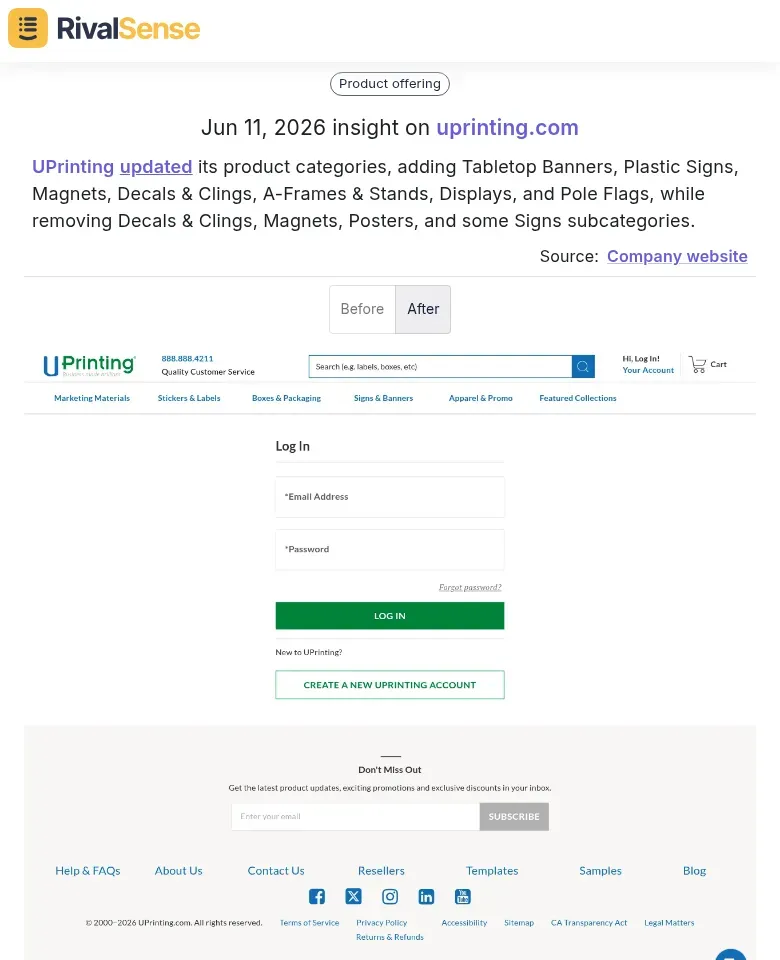
Why product‑category updates matter for KAM: A competitor reshaping its catalog can signal new revenue streams, supply‑chain adjustments, or a shift in target segments. Flagging this to your client early turns you from a vendor into a strategic advisor.
Week 2: Strategy & Alignment
Goal: Co-create a strategic plan that ties your services to their business outcomes.
- Run a joint strategy workshop (virtual or in-person) to align on quarterly goals and KPIs.
- Define success metrics that matter to the client (e.g., revenue growth, market share, customer satisfaction).
- Create a communication plan: How often will you meet? What’s the escalation path? Use which channels (email, Slack, quarterly reviews)?
- Share competitive insights that reveal opportunities or threats. A recent RivalSense alert showed that Charlotte AI AgentWorks is now available, and CrowdStrike reports a 3x faster time to respond with Charlotte AI. For a key account in cybersecurity, this is the kind of move that changes the competitive stakes overnight.
Sample Agenda for Strategy Workshop:
- 10 min: Review of Week 1 insights
- 20 min: Brainstorming on top 3 priorities
- 15 min: Define success metrics
- 10 min: Agree on communication cadence
- 5 min: Next steps and owners
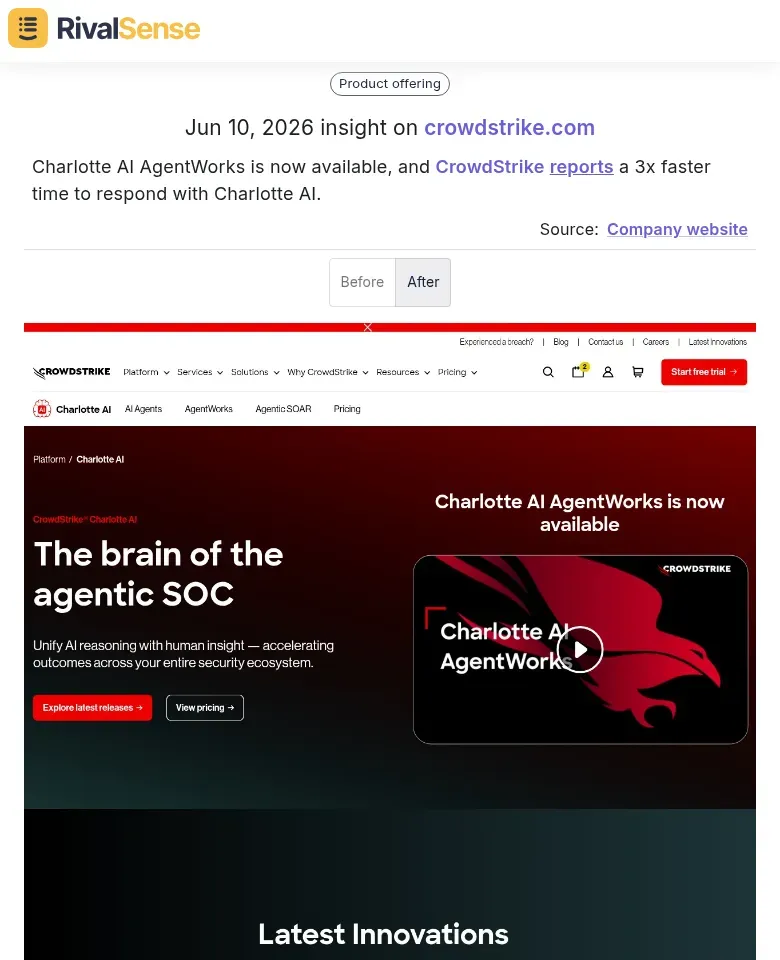
Why AI product launches matter for KAM: Speed‑to‑insight and automation are reshaping industries. An AI‑powered feature can redefine your client’s competitive advantage—or create a new threat. Having this intelligence in a weekly digest saves hours of manual research and helps you steer account strategy before the client asks.
Week 3: Execution & Early Wins
Goal: Deliver visible value quickly to build momentum.
- Identify low-hanging fruit – a quick process improvement, a report they’ve been missing, or an introduction to a valuable contact.
- Launch the first deliverable – even if it’s a small milestone, make sure it exceeds expectations.
- Monitor competitor activity – RivalSense recently flagged that Keplars, an email service, is now available as a verified integration on n8n, enabling users to automate email workflows, notifications, and campaigns. This kind of integration insight can spark a proactive conversation with a client about their own tool stack.
Early Win Ideas:
- Provide a market intelligence report (using RivalSense data) tailored to their industry.
- Fix a nagging operational issue within 48 hours.
- Introduce a cross-functional team member who can solve a specific pain point.
Checklist for Week 3:
- [ ] First deliverable completed and celebrated
- [ ] Regular status update sent to stakeholders
- [ ] Competitive landscape update shared (via RivalSense)
- [ ] Internal team alignment check
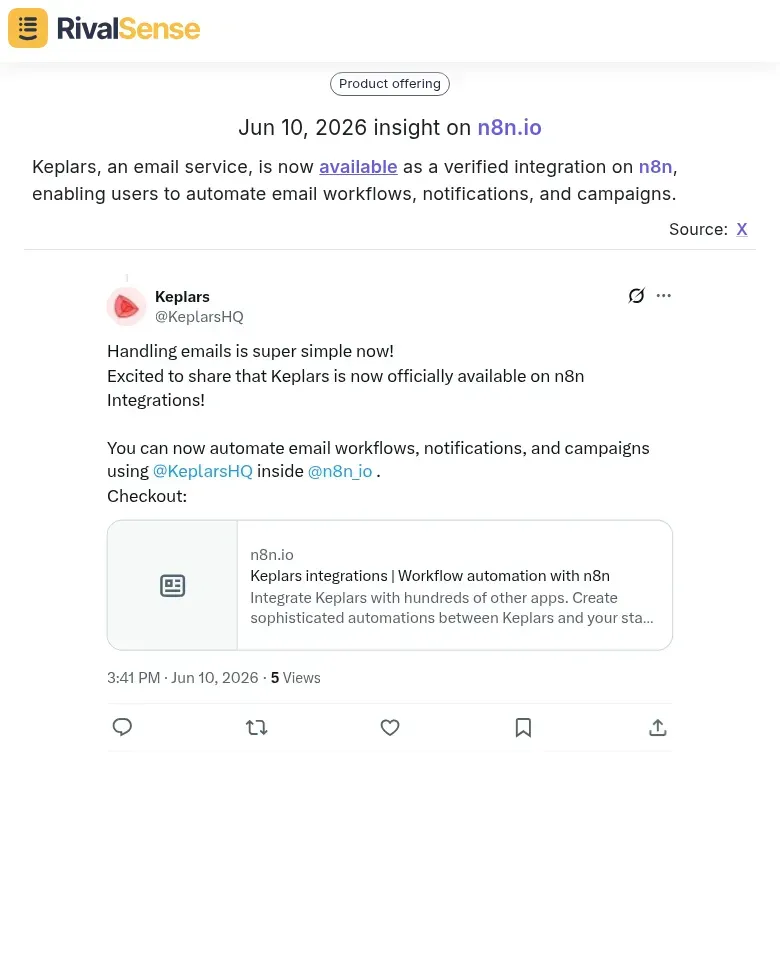
Why integration/partnership updates matter for KAM: A new integration can signal an ecosystem play that disrupts how your client’s customers work. Bringing this to the table shows you’re watching both direct competitors and the platforms that enable them.
Week 4: Review & Roadmap
Goal: Consolidate learnings and set the stage for long-term partnership.
- Conduct a 30-day business review with the client. Present:
- What was achieved (against the goals set in Week 2)
- Competitive insights gathered (e.g., “Your top competitor just hired a new CMO” – automatically tracked by RivalSense)
- Recommendations for the next 60 days
- Develop a 90-day roadmap with clear milestones, owners, and success criteria.
- Gather feedback – use a simple NPS survey or a candid conversation to ask: “What could we have done better?”
30-Day Review Template:
- Wins: List 3-5 key accomplishments
- Challenges: What didn’t go as planned and why
- Competitive Scan: 3 major moves from competitors and their implications (source: RivalSense)
- Next Steps: Top 3 priorities for the next month
Tools & Techniques for Long-Term KAM Success
- CRM Hygiene: Keep your account records up-to-date with contact changes, meeting notes, and next steps.
- Competitive Intelligence: Regularly scan the market for changes that could impact your client. RivalSense automates this by tracking company websites, social media, the internet, and various registries, delivering everything in a weekly email report. You’ll never miss a competitor’s product launch, pricing update, or partnership again.
- Executive Sponsorship: Ensure a senior leader from your company checks in with the client’s executive sponsor quarterly.
- Health Score: Develop a red/yellow/green score based on usage, satisfaction, and engagement to flag at-risk accounts early.
Why the First 30 Days Matter More Than Ever
In 2026, key account management is evolving. AI tools can automate reporting and monitoring, but the human skills—trust, empathy, strategic thinking—remain irreplaceable. The first 30 days set the tone for the entire relationship. A great KAM doesn’t just manage expectations; they proactively navigate the competitive landscape, anticipate client needs, and deliver value that goes beyond the contract.
Final Checklist: Your 30-Day KAM Playbook
- [ ] Clean handoff with sales
- [ ] Week 1: Discovery complete
- [ ] Week 2: Strategy aligned
- [ ] Week 3: Early wins delivered
- [ ] Week 4: Review done and roadmap set
- [ ] Competitive monitoring active (use RivalSense)
By following this playbook—and leveraging tools like RivalSense to stay ahead of market moves—you’ll turn key accounts into loyal advocates who grow with you for years to come.
Ready to get ahead of competitor moves? Try RivalSense for free at https://rivalsense.co/ and get your first competitor report today.
📚 Read more
👉 From Reactive to Predictive: A KAM Playbook for Med Equipment CEOs
👉 How Frank Dirksen’s CCO Appointment Revealed Helsing’s Global Expansion Playbook
👉 Website Changes: Decoding Competitor Moves for Key Account Playbooks
👉 Boost Key Account Productivity with Competitor and Compliance Tracking
👉 Spot Competitor Partnership Threats Before They Steal Your Key Accounts