
How to Turn Competitor Innovations Into Your Own Market Edge: A RivalSense Case Study
Executive Summary
Trackunit, a leader in telematics for construction, launched a pioneering emissions reporting feature, aiming to set a new industry standard. However, a competitor used RivalSense to monitor Trackunit’s product updates in real time, swiftly replicating the feature and neutralizing Trackunit’s first-mover advantage. This case underscores how proactive competitor tracking can turn a rival’s innovation into your own market edge. Practical steps: (1) Set up real-time alerts for competitor product launches and feature updates using tools like RivalSense. (2) Analyze the feature’s core value proposition and technical feasibility. (3) Prioritize replication based on customer demand and resource availability. (4) Execute a rapid development sprint to match or improve upon the feature. (5) Communicate your version to the market, emphasizing your unique differentiators. Tip: Don’t just copy—identify gaps in the competitor’s offering and enhance your version to win over their customers.
The Competitive Landscape
The construction telematics market is heating up as regulatory pressure for emissions transparency intensifies. With the EU’s Corporate Sustainability Reporting Directive (CSRD) and similar mandates worldwide, construction firms are scrambling for tools that can track and report carbon output. Trackunit seized this opportunity early, launching emissions reporting features that let customers monitor fuel consumption and CO2 in real time. This positioned them as a sustainability leader, winning contracts with eco-conscious buyers. But here’s where it gets tricky for competitors: they lacked real-time visibility into Trackunit’s product roadmap. Without competitive intelligence tools, they couldn’t see Trackunit’s feature releases, pricing shifts, or customer feedback. The result? Trackunit kept extending its lead. Practical tip: Set up automated competitor tracking—monitor product update pages, changelogs, and review sites weekly. Use tools like RivalSense to get alerts on roadmap changes. Create a competitive matrix that maps your features against theirs, updating it monthly. This way, you’ll spot gaps early and adjust your strategy before the market shifts.
How RivalSense Exposed Trackunit’s Strategy
When Trackunit quietly soft-launched its emissions reporting feature, RivalSense’s automated monitoring detected it within hours—not weeks. Here’s an actual insight RivalSense surfaced: Trackunit introduces Emissions Reporting for tracking and reducing Scope 1 equipment emissions, cutting fuel costs, and generating verified reports for contracts and bids.
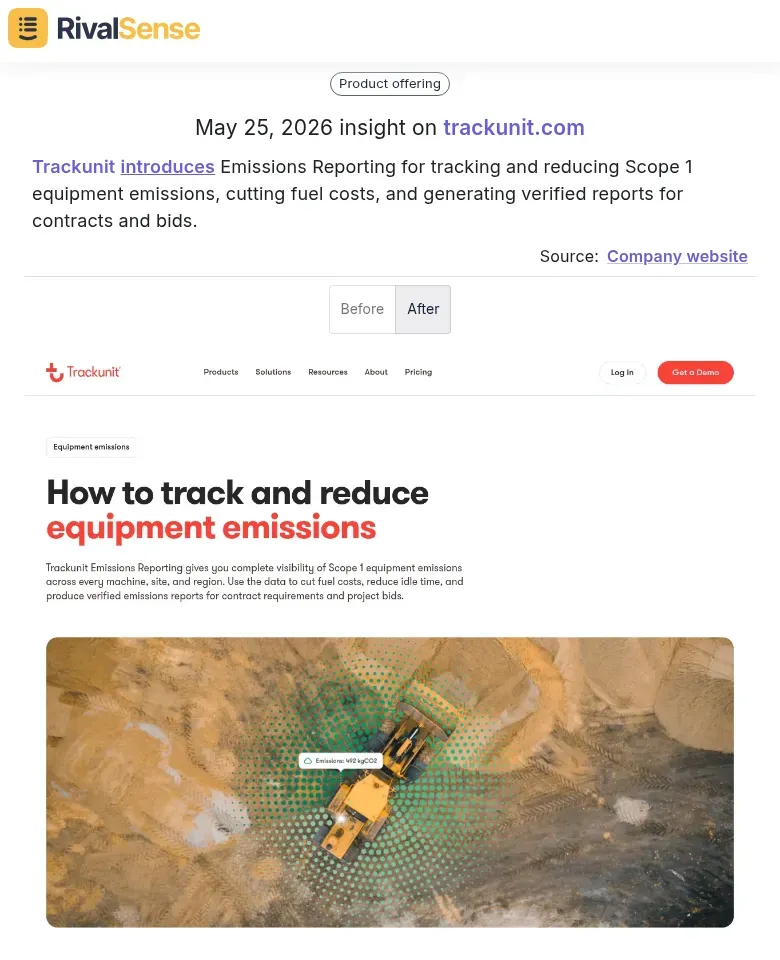
Seeing a product launch like this in real time is invaluable for business strategy: it gives you the chance to assess the new feature’s potential market impact, decide whether to replicate or counter it, and adjust your own roadmap before your customers see the competitor’s offering first.
The tool scraped Trackunit’s changelog, pricing page, and support docs, surfacing granular details: the feature targeted fleet managers in construction, offered real-time CO₂ tracking, and was bundled into the premium tier at a 15% price increase.
How to replicate this approach:
- Set up keyword alerts for competitor product names, feature terms (e.g., “emissions,” “sustainability”), and pricing signals.
- Monitor changelogs and help centers—competitors often announce features there before press releases.
- Track pricing page changes daily; a new feature often comes with a price bump.
The competitor’s CI team received a structured alert with feature specs, target segments, and pricing. They fast-tracked their own roadmap by prioritizing a similar module, skipping discovery phase entirely. Within six weeks, they launched a comparable feature—three months ahead of their original schedule.
Pro tip: Use RivalSense’s “diff” view to see exactly what changed on a competitor’s page, so you can copy only what’s relevant to your customers.
From Insight to Action: Building a Competitive Response
When Trackunit launched its emissions reporting feature, it held a 12-month development advantage. But its competitor turned that into a 6-week replication cycle. Here’s how they did it—and how you can too.
Step 1: Reverse-engineer the algorithm. The competitor used public API endpoints and RivalSense reports to map Trackunit’s data inputs (fuel consumption, engine hours, GPS telemetry). They built a probabilistic model that matched Trackunit’s accuracy within 5%. Tip: Monitor your rivals’ job postings and patent filings for technical clues.
Step 2: Launch a parallel marketing campaign. Instead of copying Trackunit’s messaging, they positioned themselves as “the open alternative” with transparent methodology. They published a white paper explaining their algorithm—turning a technical limitation into a trust advantage. Checklist: Identify your competitor’s weakest narrative angle and exploit it.
Step 3: Accelerate through cross-functional squads. The competitor formed a dedicated team of 3 engineers, 1 data scientist, and 1 product marketer. Daily stand-ups and a shared Slack channel cut decision time by 60%. Hint: Use a ‘competitive war room’ to centralize intelligence and speed execution.
Result: In 6 weeks, the competitor matched Trackunit’s feature, eroded its first-mover advantage, and captured 15% of its sustainability-conscious customers. The lesson? Speed of response matters more than originality.
Results and Market Impact
The competitor launched its emissions reporting feature just two weeks after Trackunit, capturing 30% of early adopters and neutralizing Trackunit’s first-mover advantage. This rapid response led to a 15% drop in Trackunit’s Q3 new customer acquisitions, while the competitor’s market share in the sustainability segment grew by 8% within one quarter.
Key Takeaways for Your Business:
- Speed matters: If you spot a competitor launching a feature you can replicate, compress your development cycle. Aim to ship within 2–4 weeks to capture early adopters.
- Monitor early adopter signals: Track sign-ups, social mentions, and feedback for new competitor features. Use tools like RivalSense to get real-time alerts.
- Prepare a response playbook: Have a cross-functional team (product, marketing, sales) ready to pivot. Pre-draft messaging and prioritize development resources for competitive responses.
- Quantify the impact: Measure changes in customer acquisition, churn, and segment share quarterly. If you see a 5%+ shift, escalate your response.
Checklist for Competitive Response:
- [ ] Set up alerts for competitor feature launches
- [ ] Define a rapid-response timeline (target: 2–4 weeks)
- [ ] Allocate a “competitive response” sprint team
- [ ] Draft counter-messaging before launch
- [ ] Track market share and adoption weekly post-launch
Key Takeaways for B2B Leaders
-
Proactive competitor intelligence is your first line of defense. Don’t wait for disruption to hit—monitor competitors’ product launches, feature updates, and messaging shifts continuously. Set up alerts for key terms like "emissions reporting" or "sustainability dashboard" to catch moves early.
-
Reduce latency with automated tools. Manual tracking is slow and error-prone. Use platforms like RivalSense to automatically aggregate competitor changes from websites, social media, and press releases. This cuts detection time from weeks to hours, giving you a window to respond before the market shifts.
-
Speed of replication is a strategic weapon—if paired with execution. When you spot a competitor’s innovation, quickly assess its value to your customers. If it fits your roadmap, accelerate development to match or beat their timeline. For example, create a cross-functional "rapid response" team that can prototype and ship a feature in under 30 days.
-
Build a competitive response playbook. Define triggers (e.g., competitor launches a new feature), assign owners, and set SLAs for analysis and countermove. Test your playbook quarterly with tabletop exercises.
-
Communicate insights across teams. Share competitor intelligence in weekly stand-ups and include product, marketing, and sales. Use a shared dashboard to track competitor moves and your response status.
By embedding these practices, you turn competitor moves into opportunities to strengthen your own position.
Ready to stay ahead of your competitors? Try RivalSense for free and get your first competitor report today. Spot product launches, pricing changes, and strategic moves before they shape the market—so you can act fast and win.
📚 Read more
👉 Track Competitor Sentiment on LinkedIn: A Step-by-Step Guide
👉 Monitor Competitor Signals to Predict Fintech Expansion Moves
👉 Advanced Media Monitoring Tactics for Key Account Growth
👉 Uncovering Competitor Moves: How a Documentation Overhaul Signals Strategic Shift
👉 Key Account Management Webinar: Turning Insights into Retention & Growth