
The Real-World Benefits of Competitive Intelligence Software (And How to Actually Use It)
Let’s be honest: the phrase “competitive intelligence software” sounds like something only enterprise strategy teams with six-figure budgets use. But the market—valued at $10.72 billion in 2025 and growing at nearly 10% CAGR—tells a different story. Companies of all sizes are realizing that staying ahead of competitors isn’t a nice-to-have; it’s survival.
But what does competitive intelligence (CI) software actually do for you? And how do you get real value from it without drowning in data? Let’s break down the tangible benefits and, more importantly, how to act on them.
1. Stop Reacting, Start Anticipating
The biggest shift CI software brings is moving from reactive to proactive strategy. Instead of learning about a competitor’s price drop from a customer who’s leaving, you see it coming.
Real-world example: A SaaS company using CI software noticed a competitor had filed a patent for a new feature. Six months before launch, they adjusted their roadmap and marketing messaging, neutralizing the competitor’s advantage before it existed.
Actionable tip: Set up alerts for specific triggers—pricing changes, new job postings (hiring for a role you don’t have yet?), or regulatory filings. Review these weekly, not daily. Information overload kills action.
2. Turn ‘Competitor Noise’ into Strategic Signals
Not every competitor move matters. The art of CI is filtering signal from noise. Good software does the heavy lifting of monitoring 80+ sources (company websites, social media, registries, news) so you don’t have to.
Checklist: What to actually track
- Product launches and feature updates
- Pricing and packaging changes
- Key hires and departures (especially in leadership, sales, product)
- Partnership announcements
- Event participation (which conferences are they sponsoring?)
- Media mentions and sentiment shifts
- Regulatory or compliance changes affecting your space
Pro tip: Create a simple scoring system: 1 = noise (ignore), 2 = interesting (monitor), 3 = actionable (discuss in next strategy meeting). Only escalate 3’s.
3. Sales Enablement That Actually Closes Deals
Your sales team is on the front lines. Give them ammunition that isn’t just “our product is better.”
How CI software helps sales:
- Win-back intel: A competitor’s product had a major outage? Your sales team can reach out with empathy and a comparison.
- Objection handling: Know exactly what competitors say about you—and prepare counter-narratives.
- Pricing leverage: If a competitor just raised prices, your team can frame your value as a better deal.
Template for sales enablement brief:
Competitor [X] just announced [specific change]. This impacts [customer pain point]. Our advantage is [your differentiator]. Suggested talking point: [one-liner].
Keep these briefs to 3 bullet points max. Sales won’t read essays.
Real Competitive Insights in Action
To show the real power of CI software, here are three examples of recent competitor moves tracked by RivalSense. Each demonstrates a different type of signal that can directly influence your strategy.
Example 1: Product Launch Signal (Anthropic)
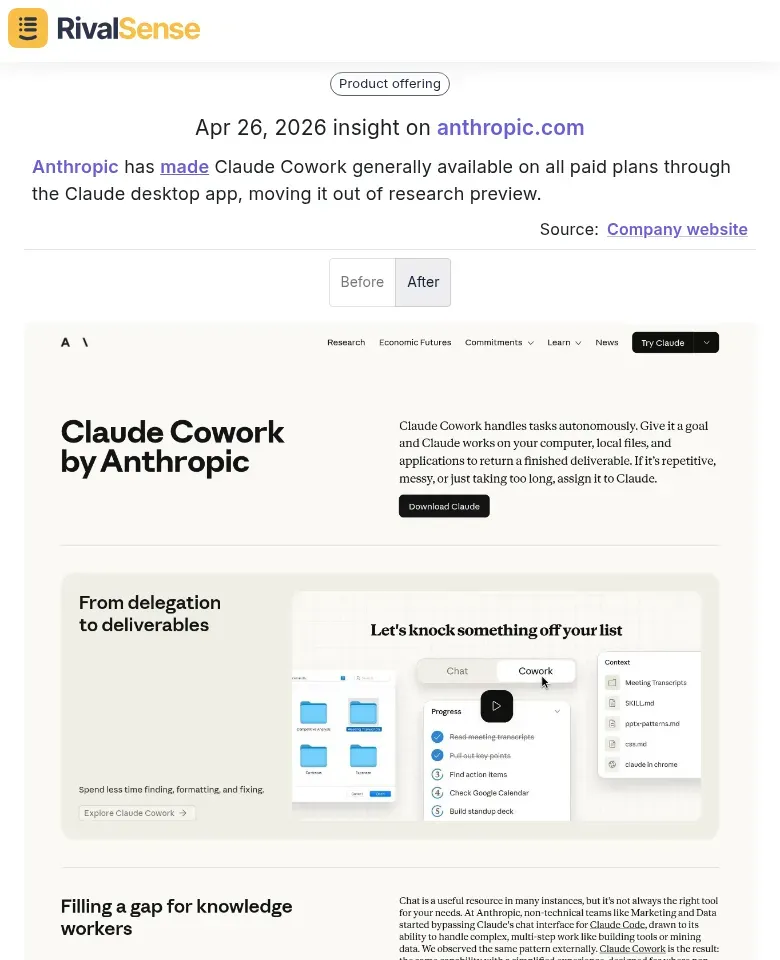
Insight: Anthropic has made Claude Cowork generally available on all paid plans through the Claude desktop app, moving it out of research preview.
Why this matters for your strategy: When a competitor launches a new feature or expands availability, it can shift customer expectations. If you’re in the AI assistant space, this signals a need to evaluate your own feature set and pricing. It also tells you that Anthropic is doubling down on enterprise use cases. Use this intel to plan your next product release or adjust your messaging to highlight your unique advantages.
Example 2: Technology Innovation Signal (NVIDIA)
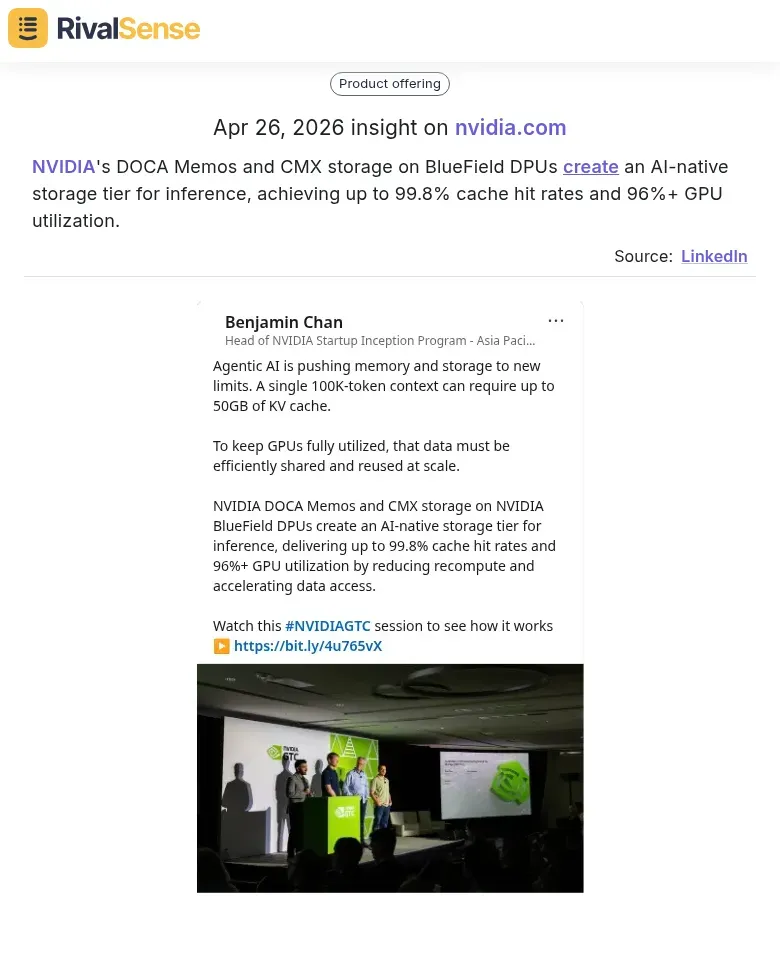
Insight: NVIDIA's DOCA Memos and CMX storage on BlueField DPUs create an AI-native storage tier for inference, achieving up to 99.8% cache hit rates and 96%+ GPU utilization.
Why this matters for your strategy: Technical breakthroughs from competitors can redefine performance benchmarks. If your product relies on AI infrastructure, this tells you where the bar is moving. You can use this information to inform your own R&D priorities, or to prepare counter-arguments for customers who might be tempted by NVIDIA’s offering. It’s also a signal of where they’re investing—you may want to partner with or avoid overlapping with that technology.
Example 3: Market Positioning Signal (Bitrix24)
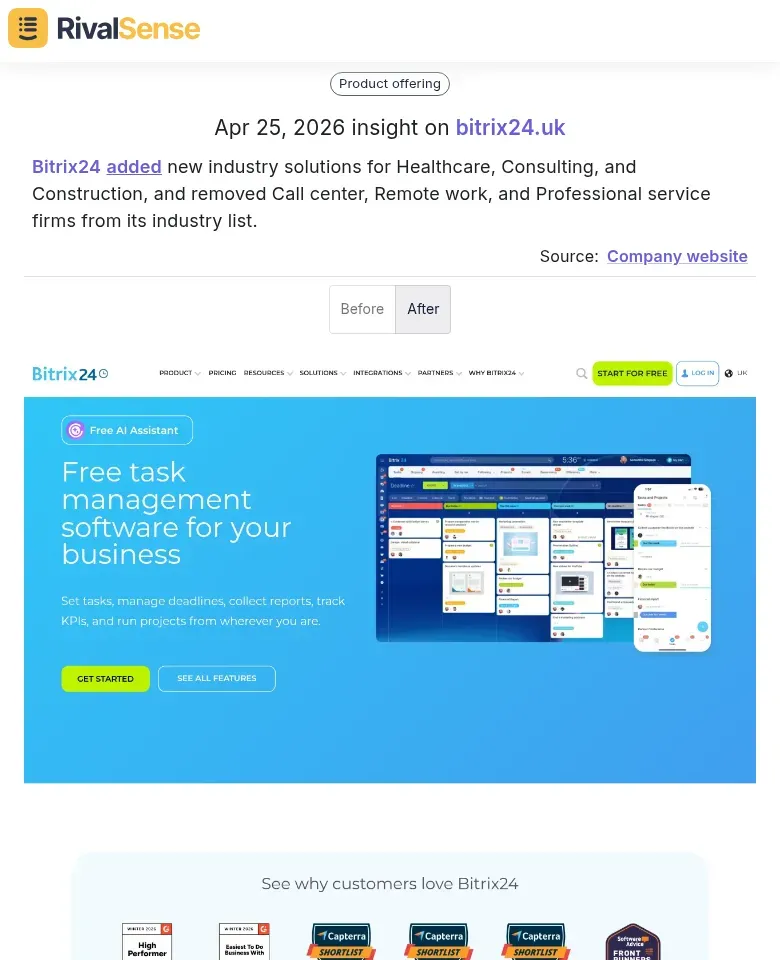
Insight: Bitrix24 added new industry solutions for Healthcare, Consulting, and Construction, and removed Call center, Remote work, and Professional service firms from its industry list.
Why this matters for your strategy: Changes in industry focus reveal where a competitor is pivoting. Bitrix24 is betting on verticalized solutions for Healthcare, Consulting, and Construction—and deprioritizing others. If you compete in those verticals, you now know where they’ll concentrate resources. If you serve the abandoned verticals, you may find an opportunity to capture disenfranchised customers. This insight can directly shape your sales targeting and content strategy.
These examples come from RivalSense’s weekly email reports, which track product updates, pricing, partnerships, events, management changes, and more across 80+ sources—so you never miss a strategic signal.
4. Product Development: Don’t Build What’s Already Being Built
How many features has your team built that a competitor already had? CI software helps you avoid “me-too” development and instead find gaps.
Practical steps:
- Weekly competitor product scan: What new features did they ship? What did they deprecate?
- Customer review analysis: What are their customers complaining about? That’s your opportunity.
- Patent monitoring: Early warning of where competitors are investing R&D.
Case in point: A B2B analytics firm noticed through CI that a competitor’s users consistently complained about a clunky export feature. They built a seamless export experience and won 12 enterprise accounts in 90 days.
5. Marketing That Positions You as the Smarter Choice
Marketing without competitive context is shouting into the void. CI software lets you position against competitors intelligently.
What to do with CI data in marketing:
- Content gaps: If competitors are writing about topic X but not Y, own Y.
- Comparison pages: Use real data (not vague claims) to show where you win.
- Win/loss analysis: Feed CI insights into why you lost deals—and adjust messaging.
Warning: Never badmouth competitors publicly. Instead, let the data speak: “Unlike [competitor], our solution [specific benefit]."
6. Risk Management: See the Black Swans Early
Competitive threats aren’t always direct. A new regulation, a partnership between two players, or a shift in investor sentiment can reshape your market overnight.
CI software helps you monitor:
- Regulatory changes (e.g., GDPR-like laws in your industry)
- Funding rounds (a well-funded competitor can outspend you)
- Patent lawsuits in your space
- Media narratives that could impact trust
Quick risk assessment framework:
| Threat Type | Impact (1-5) | Likelihood (1-5) | Action |
|---|---|---|---|
| New regulation | 4 | 3 | Start compliance prep |
| Competitor funding | 3 | 4 | Accelerate differentiation |
| Negative media | 2 | 2 | Monitor only |
7. The Weekly CI Report: Your Secret Weapon
Consistency beats intensity. Instead of a quarterly 50-page deck, get a weekly digest that’s actually read.
What an effective weekly CI report looks like:
- Top 3 signals (max 3 items that need attention)
- Competitor moves (new features, pricing, hires)
- Market shifts (regulatory, partnerships, funding)
- Action items (who does what by when)
Pro tip: Use a tool like RivalSense that delivers a curated weekly email—so you don’t have to build the report yourself. It tracks product updates, pricing, events, partnerships, management changes, and media mentions across 80+ sources, giving you the signal without the noise.
8. Avoid These Common CI Pitfalls
- ❌ Tracking too much. You don’t need to monitor every tweet. Focus on moves that affect your revenue.
- ❌ No owner. CI without a responsible person is just data. Assign someone (even part-time) to review and distribute insights.
- ❌ Not acting. The best CI report is useless if no one takes action. Tie insights to specific OKRs.
- ❌ Ignoring qualitative data. Numbers tell part of the story. Talk to customers, lost deals, and industry analysts.
Final Thought: CI Is a Muscle, Not a Project
The companies that win aren’t the ones with the most data—they’re the ones that turn insights into action consistently. Competitive intelligence software is the enabler, but the real benefit comes from building a habit of looking outward, questioning assumptions, and moving before you have to.
Start small. Pick one competitor. Set up tracking for three signals. Review weekly. Act on one insight per month. Within a quarter, you’ll wonder how you ever operated without it.
Want to see how easy competitive intelligence can be? Try RivalSense for free and get your first competitor report today. No credit card required.
📚 Read more
👉 Key Account Management Best Practices for Influencer Platforms
👉 How a Rival's Feature Shift Revealed a Market Opportunity
👉 5 Twitter Tactics for Key Account Intelligence
👉 Beginner's Guide to Tracking Key Account Interactions in Fintech
👉 Tracking Emerging Competitors: Unlocking Partnership & Client Insights