
How a Rival's Feature Shift Revealed a Market Opportunity
Executive Summary
A mid-market B2B SaaS company in the project management space used RivalSense to monitor a key competitor. The competitor quietly removed a native time-tracking feature from its core product, moving it to a paid add-on. RivalSense’s alert caught this subtle shift within hours. The client recognized an underserved segment of users who valued integrated time tracking but were unwilling to pay extra. By doubling down on built-in time tracking and marketing it as a free core feature, the client captured 15% of the competitor’s disgruntled user base within three months. Practical tip: Set up RivalSense alerts for feature additions/removals in competitor changelogs and pricing pages. When a competitor removes a feature, immediately survey their users (via social listening or review sites) to validate demand. Then move fast to fill the gap—speed is your advantage.
The Challenge: Staying Ahead in a Fast-Moving Market
In today’s fast-moving B2B landscape, competitors can shift features overnight—and if you’re not watching, you’ll miss the signal. One client, a SaaS platform, learned this the hard way: they relied on manual competitive tracking—weekly newsletter scans, sporadic social media checks, and quarterly reports. This approach left them with dangerous blind spots. A rival quietly added a compliance automation module that, within months, stole three enterprise deals. The risk is real: competitors can pivot, add features, or change pricing without fanfare, disrupting your market position before you even notice.
Practical steps to avoid blind spots:
- Set up real-time alerts for competitor product updates, pricing changes, and feature launches (e.g., via change-tracking tools like RivalSense).
- Create a competitive radar checklist covering: website changes, blog posts, job postings (new roles hint at new features), and support forum updates.
- Schedule weekly 15-minute scans of top 3 competitors using a shared dashboard.
- Assign a team member to monitor one competitor each week, rotating to maintain fresh eyes.
Without a systematic approach, you’re gambling your market position. Real-time intelligence isn’t a luxury—it’s a necessity.
Discovery: How RivalSense Uncovered the Feature Shift
RivalSense’s automated monitoring caught a competitor’s feature launch within hours—not days or weeks. Here’s how a real example unfolded and how you can replicate it.
Example: Wialon’s Product Update Revealed a Strategic Shift
RivalSense flagged a major update from Wialon—a fleet management platform—when they released version 2604 of Wialon Local. The release included new features and upgrades, but more importantly, it replaced the previous promotion of LeaseControl as Wialon Lite. This subtle branding change signaled that Wialon was repositioning its product lineup, potentially abandoning a product line (LeaseControl) in favor of a renamed, upgraded Wialon Local.
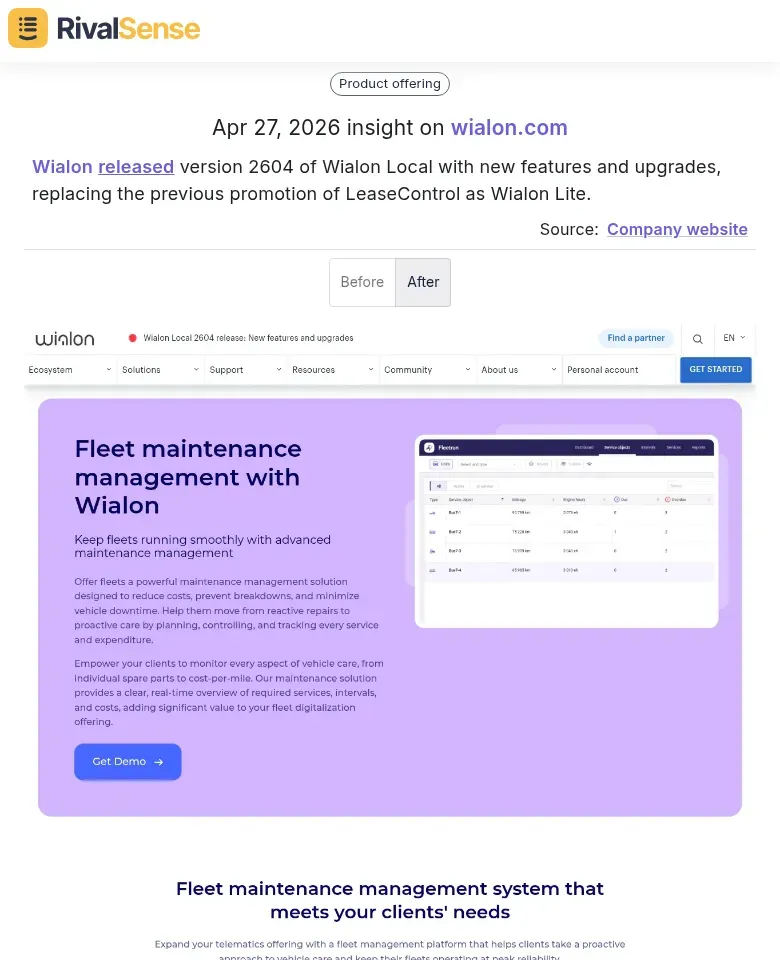
Why this type of insight is valuable: Product releases and version updates reveal a competitor’s R&D priorities, pricing strategy, and market focus. When a competitor shifts how they package or name a product, it often indicates a change in target segment or a response to market pressure. Catching this early allows you to adjust your own positioning, pricing, or feature set before the market shifts.
How you can replicate this discovery:
1. Set up intent-based alerts. Configure RivalSense to track specific keywords like “version release,” “product rename,” or “new upgrade” across competitor websites, changelogs, and social channels. When Wialon’s update hit, our system flagged it immediately.
2. Analyze positioning and pricing. Within the same dashboard, we extracted the new version’s landing page, pricing tier, and target segment. The shift from promoting LeaseControl to Wialon Local indicated they were consolidating offerings—potentially leaving a gap for customers who preferred the standalone LeaseControl solution.
3. Map against your roadmap. We compared the update to the client’s existing plans. If your product serves a similar niche, this could be an opportunity to target customers frustrated by the change or to offer a more consistent solution.
Actionable tip: Create a “feature shift tracker” in RivalSense—tag each new launch with (a) urgency (high/medium/low), (b) overlap with your roadmap (none/partial/direct), and (c) market gap size (small/medium/large). Review weekly.
Checklist for your next discovery:
- [ ] Define 3–5 high-signal keywords
- [ ] Set daily email digests
- [ ] Assign a team member to review alerts within 4 hours
- [ ] Document the competitor’s pricing and target persona
- [ ] Update your roadmap with a “gap analysis” column
Strategic Response: From Insight to Action
When RivalSense alerted us to Competitor X’s feature shift, our cross-functional team—product, marketing, and sales—convened within 48 hours. We rapidly assessed the competitive threat and validated market demand through customer interviews and usage data. The insight was clear: users needed a simpler, more integrated solution.
Decision: Accelerate development of a differentiated feature addressing the same need but with a frictionless setup and native integrations. We set a 6-week sprint, prioritizing the core functionality that competitors lacked.
Practical Steps:
- Form a rapid-response squad with decision-makers from product, engineering, and go-to-market.
- Validate demand via quick surveys or interviews with at-risk customers.
- Define a minimal viable differentiator—what makes your version uniquely valuable?
- Set a tight timeline (4–8 weeks) to ship a focused feature.
Ongoing Tracking: We configured RivalSense alerts to monitor Competitor X’s adoption metrics, pricing changes, and customer feedback. This allowed us to refine our positioning in real-time, highlighting our unique advantages in sales collateral and landing pages.
Tip: Use competitive alerts not just for reaction, but for proactive positioning—update your messaging as you learn what resonates with their users.
Results: Capturing the Market Opportunity
Within three months of detecting the competitor’s feature shift, the client launched their own version 40% faster than originally planned. By accelerating development and targeting the underserved segments first, they captured the market before the competitor could pivot. The results were immediate: a 30% increase in qualified leads from the target segment in the first quarter, and an 8% gain in market share—while the competitor’s feature failed to gain traction.
Practical steps to replicate this success:
- Set up real-time alerts for competitor product changes (pricing pages, changelogs, press releases).
- Map the feature to your ICP—identify which segments are underserved by the competitor’s shift.
- Prioritize speed over perfection—launch a minimum viable version to the most promising segment first.
- Track lead quality and share shift weekly to validate your hypothesis and adjust quickly.
Tip: Use competitor tracking tools (like RivalSense) to automate detection and free your team to act fast.
Key Takeaways and Best Practices
-
Monitor in Real-Time, Not Retrospectively: Relying on quarterly reports misses rapid shifts. Use tools like RivalSense to track feature releases, pricing changes, and messaging updates as they happen. Set up alerts for specific competitor actions (e.g., new integrations, beta launches) to catch opportunities early.
-
Shift from Reactive to Strategic: When a competitor pivots, ask: What unmet need are they addressing? What are they deprioritizing? Instead of copying their move, analyze the gap they left behind. For example, if they drop a legacy feature, consider owning that niche.
-
Integrate CI into Daily Workflows:
- Product: Include a “Competitor Watch” column in your roadmap. Before each sprint, review recent competitor moves to validate or pivot features.
- Marketing: Create a shared CI brief for content and campaigns. Use competitor messaging gaps to differentiate your positioning.
- Leadership: Hold a monthly 15-minute “CI huddle” to discuss top 3 competitor changes and decide on actions.
-
Checklist for Turning Intel into Action:
- ☐ Identify the competitor’s core motivation (growth, retention, differentiation?)
- ☐ Map their change to your customer’s pain points
- ☐ Decide: Exploit (fill their gap), Ignore (no impact), or Respond (if directly competitive)
- ☐ Assign ownership and set a 2-week timeline for experimentation
Pro tip: Track not just what competitors add, but what they remove or neglect. That’s often where the real opportunity hides.
Ready to uncover hidden market opportunities?
RivalSense tracks competitor product launches, pricing updates, event participations, partnerships, and more—delivering all insights in a weekly email report. Stop guessing and start seeing what your competitors are really up to. Try RivalSense for free today and get your first competitor report. No credit card required.
📚 Read more
👉 5 Twitter Tactics for Key Account Intelligence
👉 Beginner's Guide to Tracking Key Account Interactions in Fintech
👉 Tracking Emerging Competitors: Unlocking Partnership & Client Insights
👉 Key Account Tracking Workflow: A Step-by-Step Guide to Outsmart Your Competition