
Tracking Emerging Competitors: Unlocking Partnership & Client Insights
In today's fast-moving markets, established competitors aren't your only threat—emerging players and adjacent entrants often carry the seeds of disruption. By monitoring these newcomers early, you gain a strategic edge: they signal shifts in customer needs, highlight untapped market gaps, and reveal innovative business models before they become mainstream.
Why focus on emerging competitors? They operate without legacy constraints, experiment freely, and often target overlooked segments. Their moves—product launches, partnerships, funding rounds—can expose new revenue opportunities or warn of impending changes.
Practical steps to start:
- Set up alerts for keywords like "[industry] startup," "[competitor name] funding," or "[adjacent sector] partnership."
- Create a radar list of 10–15 emerging players (use Crunchbase, PitchBook, or industry news).
- Track their partnerships—they often reveal which clients or channels are being targeted.
- Analyze their customer reviews to spot unmet needs your product could address.
This blog will dive deeper into extracting partnership and client insights from competitor moves, turning early signals into actionable strategy.
Partnerships as Growth Accelerators: Learning from Platform Integrations
Partnerships with major platforms can be rocket fuel for emerging competitors, providing instant distribution and credibility. When a startup integrates deeply into an ecosystem like Google Workspace, Microsoft 365, or Salesforce, it gains access to a massive user base and signals reliability. For example, a new project management tool that offers a native Slack integration can ride on Slack's network effects, reducing customer acquisition costs significantly. The revenue impact is tangible: deep integrations often lead to higher retention rates and upsell opportunities, as users become dependent on the workflow synergy.
Key signals to watch:
- Partnership announcements: Monitor press releases and blogs of major platforms for new integrations.
- API integrations: Check developer portals or directories (e.g., Salesforce AppExchange, Slack App Directory) for new listings.
- Co-marketing activities: Look for joint webinars, case studies, or bundled offers.
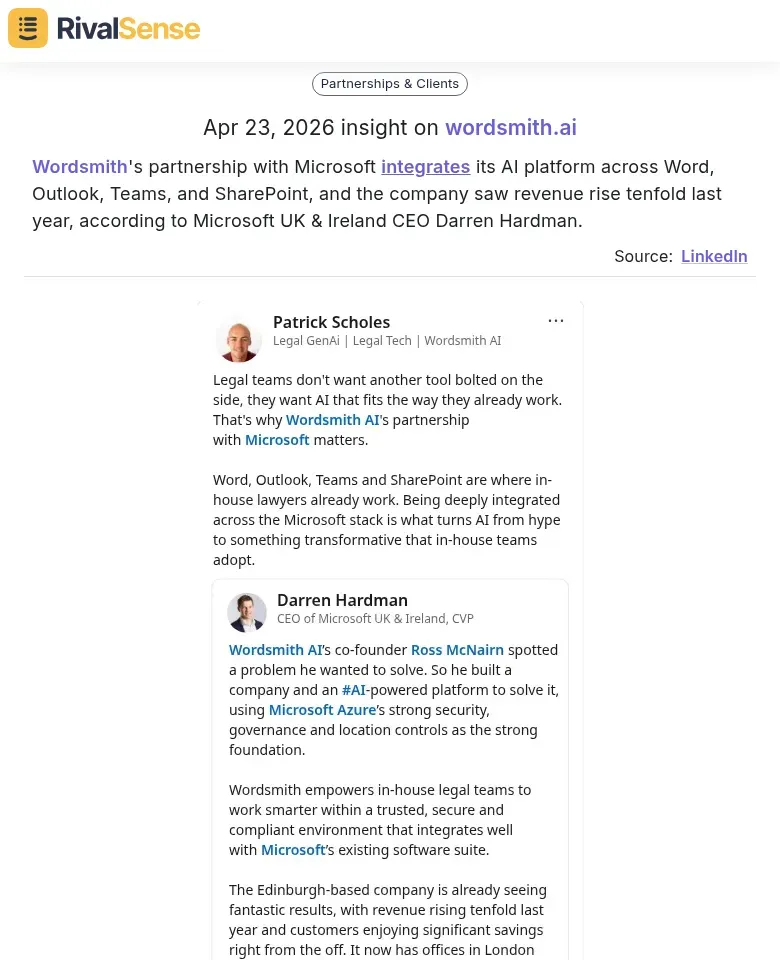
Why partnership insights matter strategically: They reveal how a competitor is leveraging ecosystem lock-in and scaling revenue. For instance, Wordsmith's partnership with Microsoft integrates its AI platform across Word, Outlook, Teams, and SharePoint—and the company saw revenue rise tenfold last year, according to Microsoft UK & Ireland CEO Darren Hardman. This type of insight signals not just a feature integration but a massive distribution win that can accelerate a competitor's market dominance.
Practical steps:
- Set up Google Alerts for "[Platform Name] + integration" or "[Platform Name] + partner."
- Use tools like RivalSense to track competitor partnership announcements automatically.
- Evaluate the integration depth: Is it a simple API connection or a deep embed with data sync? The latter indicates stronger strategic alignment.
- Assess the partnership's exclusivity – exclusive deals can create moats for the emerging competitor.
By systematically tracking these signals, you can anticipate competitive moves and adjust your own partnership strategy proactively.
Client Adoption Patterns: From Niche to Mainstream
To spot an emerging competitor before they become a threat, watch their client adoption patterns closely. Early adopters and flagship clients are powerful signals that a solution is gaining traction. Here's how to decode these signals:
1. Identify Early Adopters
Look for clients that are innovative or influential in your industry. A startup landing a well-known brand as a customer often indicates their product is solving a real pain point. Use tools like LinkedIn or Crunchbase to track new logos and check for press releases announcing partnerships.
2. Analyze Client Use Cases
Client use cases reveal the specific problems your competitor is solving. For example, if a competitor's case study highlights "integrated design-to-manufacturing workflows," it suggests their customers are struggling with siloed processes. This points to a market need you might be overlooking.
3. Monitor Testimonials & Case Studies
Track testimonials, case studies, and industry-specific deployments. Look for recurring themes: Are clients praising speed, cost savings, or ease of use? Are deployments concentrated in a particular vertical (e.g., healthcare or fintech)? These patterns can indicate where the market is heading.
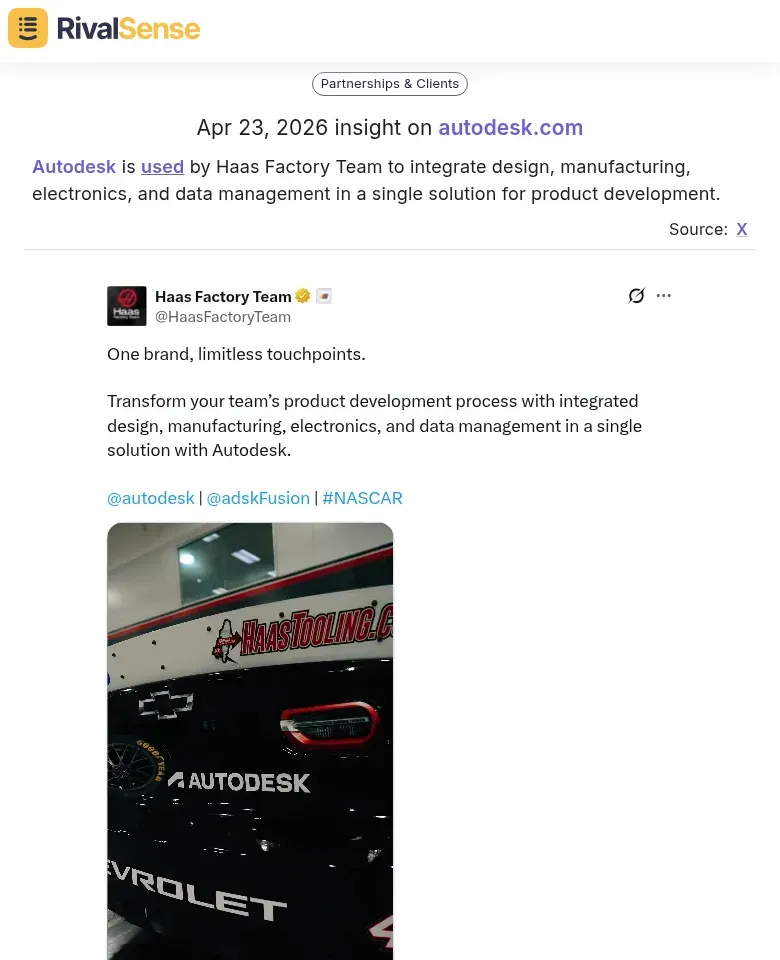
Why client adoption insights matter: They validate product-market fit and highlight vertical-specific traction. For instance, Autodesk is used by Haas Factory Team to integrate design, manufacturing, electronics, and data management in a single solution for product development. This adoption signal shows that even established players recognise an emerging competitor's value in solving complex industrial workflows.
Practical Checklist:
- [ ] Set up Google Alerts for competitor names + "case study" or "testimonial".
- [ ] Review their website's "Customers" page quarterly.
- [ ] Note the industries and company sizes of new clients.
- [ ] Look for repeat mentions of a specific feature or benefit in client quotes.
By systematically tracking adoption patterns, you can anticipate market shifts and adjust your strategy before the competitor becomes mainstream.
Vertical-Specific Solutions: Uncovering New Market Segments
When emerging competitors zero in on niche verticals, they often reveal underserved market segments ripe for exploration. For instance, a startup building AI-powered safety systems for mining operations solves a highly specific operational challenge—reducing accidents in hazardous environments. This vertical focus not only differentiates them from generalist players but also signals where demand is concentrated but unmet.
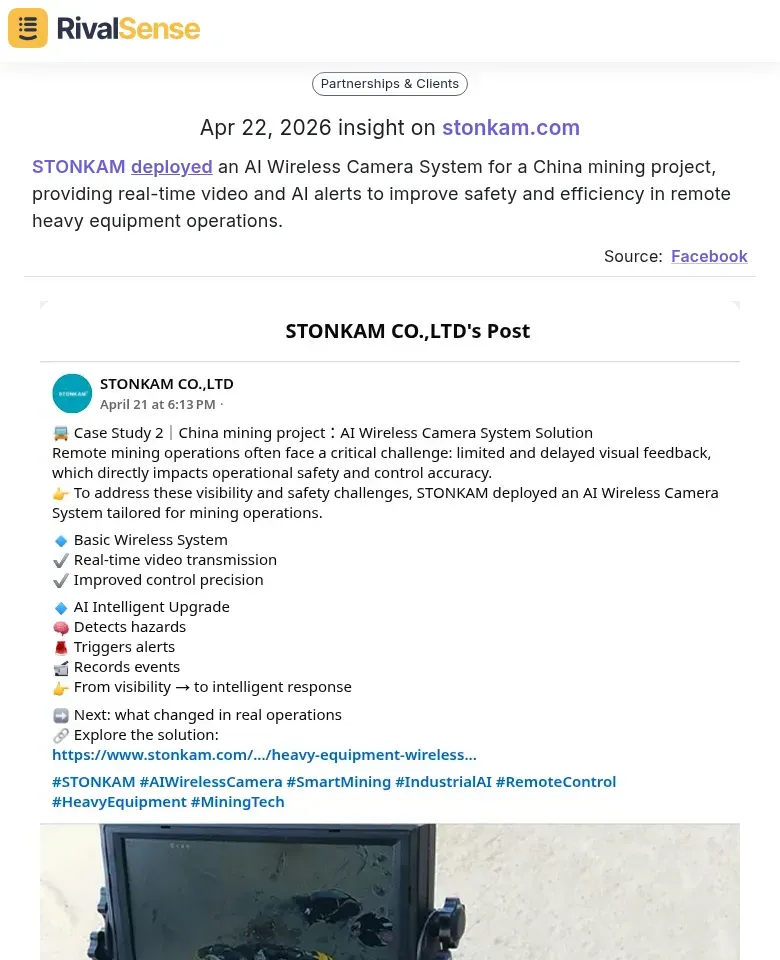
Why vertical-specific insights matter: They help you identify white spaces before they become crowded. Consider STONKAM, which deployed an AI Wireless Camera System for a China mining project, providing real-time video and AI alerts to improve safety and efficiency in remote heavy equipment operations. This deployment reveals a high-stakes market need that larger vendors may be ignoring—a classic early signal of a growing niche.
How to leverage this insight:
- Map competitor verticals. List the industries each emerging competitor targets. Tools like RivalSense can automate this tracking.
- Identify gaps. Look for verticals with high competitor activity but low solution maturity—these may be underserved.
- Assess partnership potential. Competitors solving adjacent problems (e.g., mining safety AI vs. equipment monitoring) could be complementary partners.
Practical tip: Create a matrix of verticals vs. competitor solutions. Highlight cells where only one or two players operate—those are your best bets for new market entry or collaboration. By monitoring where emerging competitors plant their flags, you can spot white spaces before they become crowded.
Technology Stack Analysis: Decoding Competitive Differentiation
To decode how emerging competitors differentiate, start by mapping their core technology stack. Use tools like BuiltWith or Wappalyzer to identify their AI, IoT, and cloud infrastructure. For example, a competitor leveraging real-time data processing (e.g., Apache Kafka) and automated workflows (e.g., Zapier) may offer faster, more responsive solutions than your legacy batch-processing system.
Practical Steps:
- Audit their public-facing tech – Check job postings for required skills (e.g., "TensorFlow," "AWS Lambda") and GitHub repos for open-source contributions.
- Analyze their integrations – If they integrate with Slack, Salesforce, or Shopify via APIs, they're building an ecosystem lock-in.
- Reverse-engineer pricing – Usage-based pricing often signals a cloud-native, serverless architecture.
Checklist for Your Roadmap:
- [ ] Identify 3 tech differentiators (e.g., real-time sync, no-code automation).
- [ ] Assess feasibility of adopting similar capabilities within 6 months.
- [ ] Prioritize features that close the gap in customer-perceived value.
Pro tip: Don't copy blindly—focus on the outcome their tech enables (e.g., "zero-touch onboarding") and innovate from there.
Actionable Framework: Building Your Emerging Competitor Radar
To build an emerging competitor radar, start by setting up systematic tracking of three signal types: partnership announcements, client wins, and technology deployments. Use tools like Google Alerts, Crunchbase, or RivalSense to monitor these in real time.
Key Metrics to Monitor:
- Revenue growth: Track funding rounds, hiring spikes, or public revenue disclosures.
- Customer concentration: Note if a competitor wins a single large client or diversifies across industries.
- Integration depth: Assess how deeply their product integrates with partners' systems (e.g., API depth, co-branded features).
Actionable Checklist:
- Create a shared dashboard with columns for competitor name, signal type, date, and strategic implication.
- Assign a team member to review signals weekly and flag high-priority items.
- Score each signal on a 1–5 scale for impact and urgency.
Translating Insights into Decisions:
- Partnerships: If a competitor partners with a key platform, explore counter-partnerships or alternative integrations.
- Product features: When they deploy a new feature, prioritize building a differentiated version or a complementary capability.
- Market entry: If they win clients in a new vertical, consider a targeted pilot or acquisition to block their expansion.
Pro Tip: Don't just track competitors—track their customers. A client win for them is a signal of unmet needs in your market. Use that insight to refine your own value proposition.
Ready to Build Your Radar? Try RivalSense Free
Tracking all these signals manually can be overwhelming. That's where RivalSense comes in: it monitors product launches, pricing updates, partnerships, regulatory changes, management moves, and media mentions across your competitors' websites, social media, and public registries—then delivers everything in a weekly email report.
Stop drowning in alerts and start acting on insights. Try RivalSense for free and get your first competitor report today.
📚 Read more
👉 Key Account Tracking Workflow: A Step-by-Step Guide to Outsmart Your Competition
👉 5 Real-World Competitor SWOT Examples for B2B Leaders
👉 How CrewAI's New Coding Skills Signal a Shift in Agentic AI Strategy
👉 5 Best Practices for Mining Competitor Insights from Twitter (with Real-World Examples)